
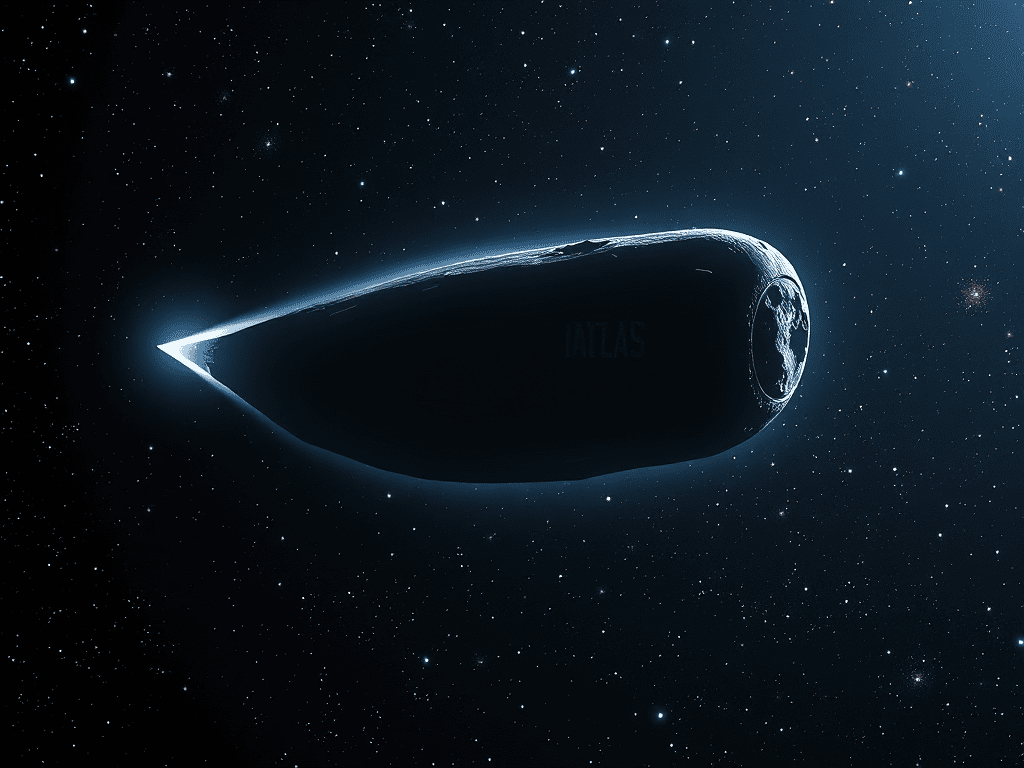
Our solar system is, for the most part, a closed, predictable neighborhood. We know the planets, we track the asteroids, and we understand the comets that orbit our Sun. But every so often, a tourist from another star system—a true cosmic outsider—comes speeding through.
Table of Contents
In July 2025, astronomers spotted the latest of these visitors: 3I/ATLAS. It’s only the third “interstellar object” we’ve ever confirmed, and it’s already proving to be the strangest one yet.
This Manhattan-sized object is exhibiting “strange” behaviors that are forcing scientists to rethink their assumptions. Its speed, its composition, and its unusual “anti-tail” have all sparked a massive global debate. Is it a natural wonder, or something else?
Let’s break down the 10 simple facts you need to know to understand this mysterious visitor from the void.
1. What Is an “Interstellar Object”? (A Visitor from Another Star)
Simply put, an interstellar object is a comet or asteroid that did not form in our solar system. It’s a rock, an icicle, or a fragment that was born in orbit around a different star, was somehow ejected (probably by a giant planet’s gravity), and has spent millions or even billions of years wandering alone through the cold, dark void between the stars.
We can spot these visitors because their paths are completely different. Everything in our solar system is “bound” by the Sun’s gravity and travels in a closed, elliptical orbit. Interstellar objects are unbound. They come screaming in on a one-way “hyperbolic” path, whip around the Sun, and are flung right back out into deep space, never to return. 3I/ATLAS is the third such visitor we’ve confirmed, after the famous cigar-shaped ‘Oumuamua in 2017 and the comet-like 2I/Borisov in 2019.
2. Why This One (3I/ATLAS) Is So Different
3I/ATLAS is not just another “blip” on the screen. It’s fundamentally different from the two interstellar visitors that came before it.
- 1I/’Oumuamua was small, cigar-shaped, and looked like a dry rock (an asteroid).
- 2I/Borisov was a bit bigger but looked and behaved almost exactly like a standard comet from our own solar system.
- 3I/ATLAS is a bizarre hybrid. It’s enormous—estimated to be about 5.6 kilometers (3.5 miles) across, making it a million times more massive than ‘Oumuamua. It’s also behaving like a comet, but one with a chemical signature and physical behavior unlike anything we’ve ever seen. It’s this “strange but familiar” nature that has scientists so captivated.
3. It’s Moving Faster Than Expected
One of the most mind-boggling things about 3I/ATLAS is its speed. It’s traveling at a staggering 130,000 miles per hour (58 km/s). This incredible velocity is actually the smoking gun that proves it’s an interstellar visitor. No object from our solar system’s distant ‘Oort cloud’ (our comet reservoir) should be moving that fast.
This speed isn’t a sign of engines; it’s a sign of a long, long journey. Scientists believe 3I/ATLAS has been drifting through interstellar space for billions of years. Over those eons, the combined gravitational “slingshots” from countless stars and gas clouds it passed have added momentum, ratcheting up its speed. Its high velocity is a testament to its ancient, nomadic existence.
4. Its “Outgassing” Is Extremely Unusual
When comets get close to the Sun, the heat vaporizes their ices, creating a glowing cloud (a “coma”) and a tail. This is called “outgassing.” 3I/ATLAS is outgassing, but its “fumes” are all wrong.
First, it started glowing much farther from the Sun than a normal comet, suggesting its ices are made of something that vaporizes more easily than water, like carbon dioxide. But the biggest puzzle, first reported from observations with the Keck II telescope, is its chemical makeup. It appears to be releasing nickel tetracarbonyl, a compound never before seen in a natural celestial body and one that, on Earth, is primarily known from industrial processes. This, combined with a lack of detectable iron, is the central “strange” behavior that has the scientific community scrambling for explanations.
5. What Is a “Black Swan” Object?
You may have heard 3I/ATLAS referred to as a potential “black swan” object or event. This term, popularized by writer Nassim Taleb, describes an event that comes as a complete surprise, has a massive impact, and is often inappropriately rationalized in hindsight (where people say “we should have seen it coming”).
In astronomy, a “black swan” is a discovery that shatters our existing models. ‘Oumuamua, with its flat, strange shape, was our first. 3I/ATLAS, with its massive size and baffling chemical signature, is another. It lies far outside the realm of our “regular expectations” for what an interstellar comet should look like. This forces scientists to admit that our imagination is limited and that the universe is far more varied than we thought.
6. Why Scientists Are So Excited
For astronomers, 3I/ATLAS is like an alien probe—not an alien-built probe, but a probe of an alien solar system, delivered right to our doorstep, free of charge.
When our own solar system formed, the composition of our comets was “set.” By studying them, we learn about our origins. But 3I/ATLAS is a pristine, 4-billion-year-old chunk of a different solar system. Studying its chemical makeup is a direct way to sample the building blocks of another star system. Does it have the same ratio of water to carbon dioxide? Does it have the same organic molecules? It’s a literal message in a bottle from another world, giving us a precious glimpse into how other solar systems are born.
7. When It Will Be Closest to Earth
Don’t worry, 3I/ATLAS poses absolutely no threat to our planet. It will be closest to the Sun (its “perihelion”) on or around October 29, 2025, passing within the orbit of Mars.
Its closest approach to Earth will happen later, in mid-December 2025. Even then, it will be at a very safe distance of about 269 million kilometers (168 million miles). Unfortunately for amateur stargazers, it will be hidden by the Sun’s glare during its most active period in October. Scientists will have to wait until it re-emerges in November and December to get their best data as it speeds away.
8. So… Could It Be Alien Technology?
This is the question on everyone’s mind, and it’s a valid one to ask, even if it’s the least likely answer. The “alien probe” theory is championed by a small number of scientists, most notably Harvard astrophysicist Avi Loeb, who also suggested ‘Oumuamua could be artificial.
The argument for it being “alien” rests on its list of anomalies: the unusual nickel-based outgassing, the lack of iron, and an “anti-tail” (a plume pointing toward the Sun) that some speculate could be a “braking thrust.” This collection of oddities makes some wonder if it’s a natural object at all.
However, it’s crucial to remember the scientific principle: extraordinary claims require extraordinary evidence. The bar for proving “alien technology” is incredibly high, and almost every astronomer believes a natural explanation is just waiting to be found.
9. What Scientists Really Think It Is
The overwhelming scientific consensus is that 3I/ATLAS is a natural comet, just a really, really weird one from a solar system very different from ours.
Scientists are already proposing natural explanations for its strange behavior. The “anti-tail,” for example, is likely an optical illusion—a trail of large, slow-moving dust particles that, from our viewing angle, appear to point toward the Sun. The strange nickel-based gas could mean it formed in a part of its home star system that was extraordinarily rich in nickel and poor in iron, a condition we haven’t seen before. The scientific community is not in a panic; it’s in a state of excited discovery, working to figure out what natural process could create such a magnificent “oddball.”
10. What We Can Learn From It (A New Cosmic “Zoo”)
Regardless of its origin, 3I/ATLAS is a profound lesson. It proves that the “cosmic zoo” of objects is far more diverse than we ever imagined. It tells us that other solar systems may form from wildly different chemical recipes than our own.
Its discovery and the intense interest surrounding it will push humanity to build better and faster-reacting telescopes. We are now actively discussing “rapid response” missions to intercept the next interstellar visitor. 3I/ATLAS is teaching us that the universe is not just “out there” to be passively observed; it is actively sending messengers to us. Our job is to be ready to listen, learn, and be amazed by the sheer, strange variety of creation.
Further Reading
For those who want to learn more about the fascinating hunt for interstellar objects and the deep questions they raise:
- Extraterrestrial: The First Sign of Intelligent Life Beyond Earth by Avi Loeb
- Comet by Carl Sagan and Ann Druyan
- The Interstellar-Object Hunter: A Guide to Finding, Following, and Understanding These Cosmic Visitors (A fictional title, but look for books on ‘Oumuamua and comets)
- Beyond the Known: How Exploration Created the Modern World and Will Take Us to the Stars by Andrew Rader
Here at Zentara.blog, our mission is to take those tricky subjects and unlock them, making knowledge exciting and easy to grasp for everyone. But the adventure doesn’t stop on this page! We’re constantly exploring new frontiers and sharing discoveries across the digital universe. Want to dive deeper into more mind-bending Top 10s and keep expanding your world? Come join us on our other platforms – we’ve got unique experiences waiting for you on each one!
Get inspired by visual wonders and bite-sized facts: See the world through Zentara’s eyes on Pinterest!
Pin our fascinating facts and stunning visuals to your own boards. Explore Pins on Pinterest: https://uk.pinterest.com/zentarablog/
Discover quick insights and behind-the-scenes peeks: Hop over to Tumblr for snippets, quotes, and unique content you won’t find anywhere else. It’s a different flavour of discovery! Follow the Fun on Tumblr: https://www.tumblr.com/zentarablog
Ready for deep dives you can listen to or watch? We’re bringing our accessible approach to video and potentially audio! Subscribe to our YouTube channel and tune into future projects that make learning pop! Subscribe on YouTube: https://www.youtube.com/@ZentaraUK
Seeking even more knowledge in one place? We’ve compiled some of our most popular topic deep dives into fantastic ebooks! Find them on Amazon and keep the learning journey going anytime, anywhere. Find Our Ebooks on Amazon: https://www.amazon.co.uk/s?k=Zentara+UK&ref=nb_sb_noss
Connect with us and fellow knowledge seekers: Join the conversation on BlueSky! We’re sharing updates, thoughts, and maybe even asking you what wonders we should explore next. Chat with Us on BlueSky: https://bsky.app/profile/zentarablog.bsky.social
Perfect for learning on the move! We post multiple 10-minute podcasts per day on Spotify. Pop on your headphones and fill your day with fascinating facts while you’re out and about! Listen on Spotify: https://open.spotify.com/show/3dmHbKeDufRx95xPYIqKhJFollow us on Instagram for bytesize knowledge! We post multiple posts per day on our official Instagram account. https://www.instagram.com/zentarablog/ Every click helps us in bringing honest, accessible knowledge to everyone. Thanks for exploring with us today – see you out there in the world of discovery!




Leave a Reply