
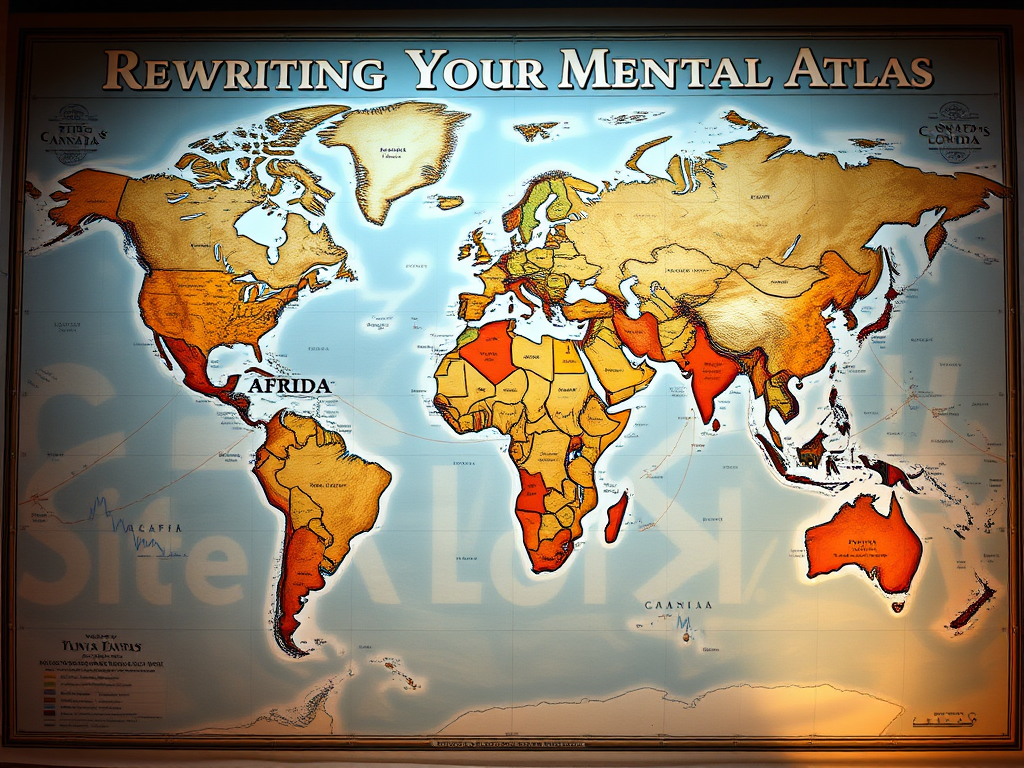
The Mercator projection, that familiar rectangle adorning classroom walls and online interfaces, has shaped our perception of the world for centuries. However, this ubiquitous map, while useful for navigation, significantly distorts the size and shape of landmasses, particularly those further from the equator. Stepping beyond this conventional representation reveals a world far more surprising and nuanced. Here are ten geography facts that will challenge your ingrained understanding of the world map and offer a fresh perspective on our planet.
1. Canada is Not Nearly as Large as It Appears on Most Maps.
The Mercator projection greatly exaggerates the size of landmasses in the higher latitudes. As a result, Canada, the second-largest country by land area, appears vastly larger than it is in reality when compared to countries closer to the equator. In truth, the entire continent of South America is significantly larger than Canada. Visualizing their true relative sizes can be a startling revelation, highlighting the distortion inherent in many standard world maps.
2. Africa is Immensely Larger Than You Probably Think.
Conversely, Africa, straddling the equator, suffers from the opposite distortion on Mercator projections, appearing smaller than it actually is. In reality, the African continent is vast, large enough to fit the United States, China, India, Japan, and almost all of Europe within its borders. This underestimation has historical roots in colonial-era cartography, which often visually diminished the size and perceived importance of non-European lands. Recognizing Africa’s true scale is crucial for understanding global demographics, resource distribution, and geopolitical dynamics.
3. The United States is Smaller Than Brazil.
Another casualty of the Mercator projection’s latitudinal distortion is the relative size of the United States and Brazil. On many world maps, the US appears larger or roughly the same size as Brazil. However, Brazil, the fifth-largest country in the world, is actually larger in land area than the contiguous United States. This fact underscores how our mental image of continental sizes can be skewed by common map projections.
4. London is Further North Than Parts of Canada.
The concept of latitude can often be counterintuitive when relying solely on visual representations. London, a major European capital, lies at a similar latitude to parts of Newfoundland and Labrador in Canada. This means London experiences comparable day lengths and solar angles to regions of eastern Canada. This fact challenges the common association of Canada with exclusively arctic or subarctic climates and highlights the influence of ocean currents like the Gulf Stream in moderating Europe’s climate.
5. The Pacific Ocean is Larger Than All the Earth’s Landmass Combined.
The sheer scale of the Pacific Ocean is often underestimated. It covers more than 30% of the Earth’s total surface area, making it larger than all the continents combined. This vast expanse underscores the dominance of water on our planet and the interconnectedness of seemingly distant landmasses through this massive body of water. Understanding the Pacific’s size is crucial for comprehending global climate patterns, marine ecosystems, and international trade routes.
6. The Geographic North Pole is Not Fixed.
While we often think of the North Pole as a static point at the top of the Earth, the actual magnetic and geographic poles are constantly shifting. The geographic North Pole is defined by the Earth’s axis of rotation, but this axis itself undergoes slight wobbles over time, a phenomenon known as polar wander. Furthermore, the magnetic North Pole, which compasses point to, is moving at a significantly faster rate due to changes in the Earth’s magnetic field. This dynamic nature of our planet’s poles challenges the notion of a fixed and unchanging global coordinate system.
7. There’s a Point in the Arctic Where All Time Zones Theoretically Meet.
At the precise geographic North Pole, all lines of longitude converge. Since time zones are defined by lines of longitude, theoretically, at the North Pole, you could step across all 24 time zones within a few paces. In practice, research stations in the Arctic typically adhere to a single time zone for logistical reasons, but the convergence of all meridians at this point is a fascinating geographical quirk.
8. The Dead Sea is the Lowest Point on Earth Not Covered by Ocean.
The Dead Sea, bordering Jordan, Israel, and Palestine, sits approximately 430.5 meters (1,412 feet) below sea level, making it the lowest land-based elevation on Earth. Its extreme salinity, far exceeding that of the ocean, creates its unique buoyancy. This remarkable geographical feature highlights the diverse topography of our planet and the existence of significant land depressions below global sea level.
9. Russia Spans Eleven Time Zones.
The sheer east-west expanse of Russia means that the country stretches across an astonishing eleven official time zones. When it’s morning in Kaliningrad on Russia’s western border, it’s already late afternoon or evening in parts of eastern Siberia. This vast temporal span within a single nation underscores its immense geographical size and the logistical complexities of managing a country that spans nearly half the globe longitudinally.
10. There’s a Landlocked Country Entirely Within Another Country.
Lesotho, a sovereign nation in Southern Africa, is a unique geographical anomaly: it is entirely surrounded by South Africa. This makes it an enclave, a country completely enclosed within the borders of another. This unusual situation has significant implications for Lesotho’s economy, politics, and its relationship with its larger neighbor, highlighting the complex and sometimes surprising political geography of our world.
Conclusion
Moving beyond the distorted lens of traditional world maps reveals a planet with surprising dimensions, shifting features, and fascinating geographical quirks. These ten facts challenge our ingrained perceptions and encourage a more nuanced and accurate understanding of the Earth’s physical and political landscape. By rethinking the world map, we gain a deeper appreciation for the true scale of continents and oceans, the dynamic nature of our planet, and the intriguing relationships between different regions and nations.
Further Reading
- Gall-Peters Projection maps (as an alternative to Mercator).
- WorldAtlas.com and other reputable geography websites.
- Books on cartography and the history of mapmaking.
- Academic journals focusing on geography and spatial studies.
- Educational resources from organizations like the National Geographic Society.




Leave a Reply