
Table of Contents
Before Luke Skywalker ignited a lightsaber, before Captain Kirk commanded the Enterprise, and before even Superman leaped over a tall building, there was Buck. Ask who is Buck Rogers, and you’ll uncover the story of the man who arguably invented the science-fiction hero. He was the original “man out of time,” a hero from our present flung into a dazzling, dangerous future. His adventures, which began nearly a century ago, laid the groundwork for almost every space opera and sci-fi epic we cherish today.
The name “Buck Rogers” became shorthand for “the future.” But how did this character come to be, and why does he still matter in a world that has surpassed many of his “futuristic” predictions? We’re diving deep into the 10 fundamental facts that trace the Buck Rogers origin story from a pulp magazine to a multimedia phenomenon. Prepare to set your blasters to “stunned” as we explore the enduring legacy of the grandfather of American sci-fi.
1. He Wasn’t “Buck” Rogers… At First (And He Started in a Magazine)
Long before the iconic comic strip or the 1970s TV show, the character we know as Buck Rogers made his debut under a different name. His story begins in the August 1928 issue of the pulp magazine Amazing Stories, a publication that was ground zero for the science-fiction genre. The story, a novella titled Armageddon 2419 A.D., was written by Philip Francis Nowlan.
The hero of this tale was not named “Buck” but Anthony Rogers. The Buck Rogers origin story is a classic “man out of time” narrative, a sci-fi twist on the Rip Van Winkle legend. Rogers, a World War I veteran (later updated to an American Air Force pilot), is working as a surveyor in Pennsylvania when he becomes trapped in a caved-in mine. Exposed to a mysterious radioactive gas, he falls into a state of suspended animation. He awakens nearly 500 years later, in 2419 A.D., to a world he doesn’t recognize—one where America has been conquered and fragmented by technologically advanced invaders, the “Han,” who rule from gleaming cities. This pulp-magazine origin provided the core template: a relatable man from our time acting as the audience’s guide to a complex, and often hostile, future.
2. He Blazed the Trail for Daily Sci-Fi Comics
While his Amazing Stories debut was popular, it was his jump to newspapers that made him a household name. John F. Dille, a newspaper syndicate boss, saw the potential in Nowlan’s story and convinced him to adapt it into a daily comic strip. On January 7, 1929, the Buck Rogers comic strip (now with his catchy new nickname) launched, illustrated by Dick Calkins.
This was a revolutionary move. While other strips had fantasy elements, Buck Rogers was the first major, mainstream daily comic strip dedicated purely to science fiction. It brought futuristic concepts to millions of “regular” people every single day over their morning coffee. The strip was an immediate sensation. It introduced readers to a visual lexicon of the future: rocket ships, rayguns (called “disintegrator pistols”), and strange new worlds. Calkins’s art, combined with Nowlan’s imaginative writing, created a tangible vision of the 25th century that captured the public’s imagination during the bleak beginnings of the Great Depression, offering a daily dose of high-tech escapism.
3. The ’70s TV Show Was a Post-Star Wars Sensation
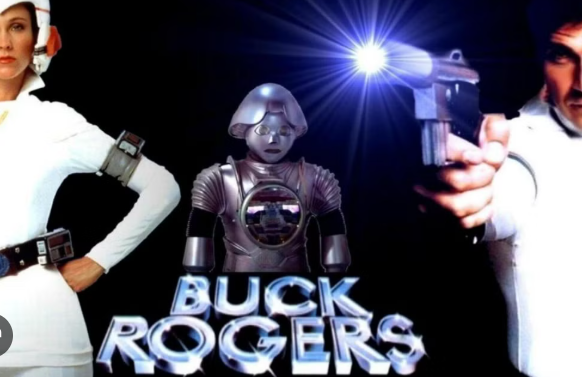
For many people born after 1970, the name “Buck Rogers” conjures one specific image: actor Gil Gerard in a tight white jumpsuit. The 1979 TV series Buck Rogers in the 25th Century was a direct-to-consumer product of the Star Wars craze. After George Lucas’s 1977 blockbuster proved that audiences were starved for space opera, television producer Glen A. Larson (the mind behind Battlestar Galactica) saw an opportunity.
He revived the long-dormant Buck Rogers property, launching it first as a successful theatrical movie (which was, in fact, the TV pilot) and then as a weekly series. This version updated the origin: Buck was now a NASA astronaut whose shuttle, Ranger 3, is knocked off course in 1987, freezing him for 504 years. He awakens to a post-apocalyptic Earth rebuilding itself, protected by the Earth Defense Directorate. The show was pure 1970s disco-era charm, complete with a sassy robot sidekick named Twiki (famously voiced by Mel Blanc with his “biddi-biddi-biddi” catchphrase), the formidable Colonel Wilma Deering (played by Erin Gray), and the villainous Princess Ardala. While its tone was far lighter and campier than the original comic, it cemented Buck Rogers in the minds of a whole new generation.
4. Wilma Deering: More Than Just a Damsel in Distress
In the world of 1920s and ’30s pulp adventure, female characters were often relegated to the role of the screaming “damsel in distress,” a prize to be won or a victim to be rescued. Wilma Deering was different. From her very first appearance in the 1928 novella, she was a central and capable figure.
When Anthony Rogers first awakens in the 25th century, Wilma is not a helpless civilian. She is a lieutenant (later Colonel) in the resistance, a skilled pilot, and a fierce soldier in her own right. In the original comics, she is the one who finds Rogers and introduces him to this new world. She is his partner in adventure, often fighting side-by-side with him against the “Han” invaders or the villainous Killer Kane. While she also served as a romantic interest, she was never just that. The 1979 TV series continued this tradition, with Erin Gray’s Colonel Deering commanding the entire planet’s fighter squadron. For decades, Wilma Deering was one of science fiction’s most prominent and competent heroines, paving the way for future female sci-fi leads like Princess Leia and Ellen Ripley.
5. The Great Sci-Fi Rivalry: Buck Rogers vs. Flash Gordon
If you ever get the two confused, you’re not alone—and there’s a good reason. Buck Rogers was the undisputed king of sci-fi comics in the early 1930s, and his success was not lost on rival newspaper syndicates. In 1934, King Features Syndicate decided they needed their own sci-fi hero to compete. They reportedly approached Tarzan creator Edgar Rice Burroughs, but when that failed, they tasked artist Alex Raymond with creating a hero to go head-to-head with Buck.
The result was Flash Gordon. The rivalry of Buck Rogers vs. Flash Gordon is a classic case of one-upmanship. To differentiate themselves, Flash Gordon leaned into pure fantasy and “space opera.” While Buck was a man from our time using his 20th-century wits in a futuristic Earth, Flash was an “everyman” polo player who was immediately whisked away to the alien planet Mongo to battle the flamboyant tyrant Ming the Merciless. Flash’s world was one of lavish, baroque kingdoms, shark-men, and hawk-men. Buck’s world, by contrast, was initially more focused on futuristic technology and guerrilla warfare on Earth. Together, these two characters defined the two major branches of pulp science fiction: Buck Rogers was the “sci-fi” and Flash Gordon was the “space fantasy.”
6. One Man Played Sci-Fi’s TWO Biggest Heroes
The rivalry between Buck and Flash became even more intertwined in the 1930s with the rise of the movie serial—weekly, short-episode films that left audiences on a cliffhanger. When it came time to cast these heroes for the silver screen, Hollywood found its man, and used him for both.
That man was Buster Crabbe, a handsome, blond-haired Olympic swimming champion. Crabbe first starred as Flash Gordon in the 1936 serial, which was a massive, budget-busting hit for Universal Pictures. Its success was so great that when Universal decided to make a Buck Rogers serial three years later in 1939, they simply cast Crabbe again. For an entire generation of film-goers, Buster Crabbe was science fiction. He played Flash Gordon in three separate serials and Buck Rogers in one 12-chapter epic. This casting cemented the public’s perception of the two heroes as interchangeable, but it also elevated Crabbe to the status of the first true sci-fi action star, decades before Harrison Ford or Keanu Reeves.
7. He Popularized the “Raygun” (And Sold Millions of Them)
Buck Rogers wasn’t just a story; he was a brand. And his most iconic piece of merchandise was the “raygun.” While the comic strips featured “disintegrator rays,” the merchandising minds at the John F. Dille Co. knew a good toy when they saw one. In 1934, they partnered with the Daisy Manufacturing Company—a company best known for its BB guns—to create the first-ever toy raygun: the “X-Z 31 Rocket Pistol.”
This wasn’t just a piece of plastic; it was a 9-inch, blued-steel pop gun that “zapped” with a loud pop and a flash of harmless sparks. It was an unprecedented smash hit. An estimated two million units were sold in the first year alone. The X-Z 31, and its many follow-ups, became the must-have toy for a generation of children. It was, in essence, the “lightsaber” of the 1930s. This toy did more than just make money; it physically placed the influence of Buck Rogers into the hands of children, allowing them to enact their own space-age adventures. It helped solidify the raygun as a permanent, non-negotiable part of the science-fiction visual language.
8. He Is the “Grandfather” of Modern Science Fiction
It is nearly impossible to overstate the influence of Buck Rogers on science fiction as a whole. Before him, sci-fi was largely the domain of authors like H.G. Wells and Jules Verne. Buck Rogers took these high-concept ideas and made them accessible, visual, and fun for a mass audience. He provided the blueprint for countless sci-fi tropes that we now take for granted:
- The Man Out of Time: The “frozen man” trope (see: Sleeper, Demolition Man, Futurama, Captain America).
- The Technology: He normalized “rocket ships” (a term his strip helped popularize), “rayguns,” “jetpacks” (which he called “flying belts”), and video-communication.
- The Team: He established the “heroic trio” (Buck the hero, Wilma the warrior/love-interest, and Dr. Huer the brilliant scientist mentor).
- The World: He presented a future with a complex (if simplistic) political structure, with Earth at the center of interplanetary conflicts.
Gene Roddenberry, the creator of Star Trek, cited Buck Rogers as a primary influence. George Lucas has spoken about the impact of both Buck Rogers and Flash Gordon serials on the creation of Star Wars. Every time a hero zips up a jetpack or a space pilot radios back to “Earth command,” they are echoing the adventures that Buck Rogers pioneered nearly 100 years ago.
9. His World Introduced “Sci-Fi Lingo” to the Public
Imagine trying to write a science-fiction story today without using words like “robot,” “spaceship,” or “laser.” Buck Rogers faced a similar problem in 1929—the vocabulary for the future didn’t exist. So, his creators invented it. The Buck Rogers comic strip and its accompanying radio show (which began in 1932) were responsible for either inventing or popularizing a huge swath of sci-fi lingo.
The strip used terms like “disintegrator,” “rocket-ship,” and “flying belt” with such regularity that they became part of the American vernacular. While “robot” was coined by Karel Čapek, Buck Rogers gave us popular robot sidekicks like the mechanical “Mekkano.” Even the slang of the 25th century caught on. Characters would exclaim “Great leaping rockets!” as a curse, or dismiss something as “old-fashioned” by calling it “Twentieth Century.” This “technobabble,” even in its simple form, was a brilliant world-building device. It made the 25th century feel like a real, distinct place with its own culture and way of speaking, further immersing the audience in the fantasy.
10. He’s More Than a Character; He’s an Idea
Buck Rogers has faded from the spotlight and returned many times over the last century. His original story is filled with dated concepts and unfortunate “Yellow Peril” stereotypes (the original “Han” invaders were unambiguously coded as Asian). And yet, the core concept remains undeniably powerful.
The reason who is Buck Rogers is still a relevant question is that he isn’t just a character; he’s a narrative device. He is the ultimate audience surrogate. The Buck Rogers origin story is a literary tool that allows a writer to explore a complex future through the fresh, relatable eyes of a contemporary. This allows for wonder, confusion, and exposition all at once. It’s a formula that Star Trek: The Next Generation used with its “thawed” 20th-century humans in “The Neutral Zone,” and it’s the entire premise of shows like Futurama. Buck Rogers represents the human capacity to adapt, to explore, and to hold onto one’s values even when the entire world changes around them. He is the enduring spirit of adventure, a 20th-century man forever leaping into the 25th.
Further Reading
Want to explore the 25th century for yourself? Here are a few essential books that dive deeper into the world of Buck Rogers and the era he helped create.
- Buck Rogers in the 25th Century: The Complete Dailies Vol. 1 by Philip Francis Nowlan and Dick Calkins
- Go straight to the source. This (and subsequent volumes) collects the original newspaper strips that started it all, letting you see the hero’s adventures exactly as readers did in 1929.
- The History of Science Fiction by Adam Roberts
- To understand Buck’s impact, it helps to see the bigger picture. Roberts provides an engaging and accessible history of the entire genre, placing pulp heroes like Buck and Flash in their proper context.
- Astounding: John W. Campbell, Isaac Asimov, Robert Heinlein, L. Ron Hubbard, and the Golden Age of Science Fiction by Alec Nevala-Lee
- This book focuses on the “Golden Age” of sci-fi that immediately followed Buck’s debut. It’s a fascinating look at the writers and editors who took the torch from the early pulp heroes and built the complex literary genre we know today.
Here at Zentara.blog, our mission is to take those tricky subjects and unlock them, making knowledge exciting and easy to grasp for everyone. But the adventure doesn’t stop on this page! We’re constantly exploring new frontiers and sharing discoveries across the digital universe. Want to dive deeper into more mind-bending Top 10s and keep expanding your world? Come join us on our other platforms – we’ve got unique experiences waiting for you on each one!
Get inspired by visual wonders and bite-sized facts: See the world through Zentara’s eyes on Pinterest!
Pin our fascinating facts and stunning visuals to your own boards. Explore Pins on Pinterest: https://uk.pinterest.com/zentarablog/
Discover quick insights and behind-the-scenes peeks: Hop over to Tumblr for snippets, quotes, and unique content you won’t find anywhere else. It’s a different flavour of discovery! Follow the Fun on Tumblr: https://www.tumblr.com/zentarablog
Ready for deep dives you can listen to or watch? We’re bringing our accessible approach to video and potentially audio! Subscribe to our YouTube channel and tune into future projects that make learning pop! Subscribe on YouTube: https://www.youtube.com/@ZentaraUK
Seeking even more knowledge in one place? We’ve compiled some of our most popular topic deep dives into fantastic ebooks! Find them on Amazon and keep the learning journey going anytime, anywhere. Find Our Ebooks on Amazon: https://www.amazon.co.uk/s?k=Zentara+UK&ref=nb_sb_noss
Connect with us and fellow knowledge seekers: Join the conversation on BlueSky! We’re sharing updates, thoughts, and maybe even asking you what wonders we should explore next. Chat with Us on BlueSky: https://bsky.app/profile/zentarablog.bsky.social
Perfect for learning on the move! We post multiple 10-minute podcasts per day on Spotify. Pop on your headphones and fill your day with fascinating facts while you’re out and about! Listen on Spotify: https://open.spotify.com/show/3dmHbKeDufRx95xPYIqKhJFollow us on Instagram for bytesize knowledge! We post multiple posts per day on our official Instagram account. https://www.instagram.com/zentarablog/ Every click helps us keep bringing honest, accessible knowledge to everyone. Thanks for exploring with us today – see you out there in the world of discovery!




Leave a Reply