
Table of Contents
In 1967, a television show premiered that would scar the psyches of a generation of children, and in the best way possible. It was dark, it was sophisticated, and it was populated by puppets. This was Captain Scarlet and the Mysterons, the brainchild of legendary producer Gerry Anderson. But to dismiss it as just “Thunderbirds’ darker cousin” is to miss the point. The Captain Scarlet universe was a fully-realized, terrifyingly plausible vision of the near future, built on a single, paranoid premise: “What if the enemy is already here?”
The show presented a “war of nerves” against an invisible, omnipotent alien foe. Its hero was not a wise-cracking action star, but a stoic, immortal ex-agent, haunted by what he had become. Its themes were darker, its violence was real, and its vision of the 21st century was one of high-tech surveillance and constant, simmering dread. To understand its enduring legacy, we must travel to Mars, break free of alien control, and uncover the 10 fundamental facts that make the world of Captain Scarlet one of sci-fi’s most unique creations.
1. The Entire War Began With a Tragic Human Error
Unlike many sci-fi epics where humanity is the innocent victim, the Captain Scarlet universe is built on a foundation of human fallibility. The entire conflict, the entire “war of nerves,” is humanity’s fault, born from a moment of fear and misunderstanding. The inciting incident is a classic “shoot first, ask questions later” blunder.
In the year 2068, Earth’s first manned mission to Mars, the Zero-X, discovers a vast, crystalline city on the planet’s surface. The expedition, led by Spectrum’s Captain Black, is shocked by the discovery. When the city’s inhabitants—the Mysterons—rotate a surveillance device towards the ship, Captain Black, following protocol for a perceived hostile action, panics. He orders his crew to open fire, obliterating the alien city with nuclear missiles.
It is only after the city is a smoking ruin that the crew watches, horrified, as the entire metropolis rebuilds itself from the rubble in seconds, using an unknown energy. It’s then that a disembodied voice declares war on Earth. This single, tragic mistake sets the entire series in motion. Captain Black’s error was not one of malice, but of fear, a profound commentary on the dangers of a “trigger-happy” military encountering the unknown.
2. The Mysterons Are Beings of Vengeful, Digital Energy
The genius of the Mysterons as villains is that you almost never see them. They are not little green men in flying saucers; they are an abstract, terrifying, and seemingly omnipotent consciousness. They are, in essence, a ghost in the machine. As the show’s lore implies, the “Mysterons” are not the city’s original builders. They are a “collective of sentient computers,” a vast, digital intelligence left behind by an ancient extragalactic race.
Their “body” is their city on Mars, and their power stems from a total mastery over matter itself. They call this ability “reversing matter” or “Mysteronisation.” They can deconstruct an object or person and then rebuild it, either as a perfect replica or as a new creation under their control. When they “declare war,” it is not a war of armadas, but a psychological “war of nerves.” They use their power to assassinate key figures, destroy critical infrastructure, and sow paranoia, all from the “safety” of Mars, 40 million miles away. They are the perfect Cold War-era villain: an invisible, unknowable, and unstoppable force.
3. “Retro-Metabolism” Is the Secret to Scarlet’s Immortality
This is the core concept of the show and the hero’s defining trait. What is retro-metabolism? In the Captain Scarlet universe, it’s the term for the Mysterons’ ability to “reverse matter.” It is their tool for rebuilding their city and creating their agents. After Captain Black’s attack, the Mysterons use this power to kill the Zero-X crew and create perfect, reconstructed duplicates of them, now programmed to be their agents on Earth.
One of these agents is Captain Scarlet. But something goes wrong (or right, for Earth). In the first episode, the Mysteron-controlled Captain Scarlet is killed—he falls from a height and is electrocuted—but his body doesn’t just die. The Mysteron “retro-metabolism” process, now “free” of their direct control, becomes a permanent, self-healing genetic mutation. He is no longer a puppet, but he retains their power. His body can now perfectly heal from any wound, no matter how catastrophic. He can be shot, crushed, or blown up, but his “retro-metabolism” will always kick in, “reversing” the damage and bringing him back to life. He is, for all intents and purposes, indestructible—a power that makes him Spectrum’s greatest weapon, but also an isolated, “un-human” figure.
4. Captain Scarlet Was “Born” to Be an Assassin
The man we know as Captain Scarlet is not the original. The original man, born Paul Metcalfe, was a loyal officer of the Spectrum Organization. He was killed by the Mysterons alongside Captain Brown and recreated as their most powerful weapon, intended to assassinate the World President. He was, in essence, a walking, talking, programmable bomb.
His “humanity” was only restored by a fluke. During a high-speed chase, the Mysteron-Scarlet is shot by Captain Blue and plummets from a parking tower in his car, which explodes. His body is recovered, but he’s not dead. The shock of this “death” seemingly breaks the Mysterons’ direct control. He awakens in a hospital with his original memories and personality restored, but with a new, terrifying power.
This origin makes him a unique hero. He is not a chosen one; he is a repurposed weapon. He carries a “sixth sense,” a severe headache and nausea, that alerts him to the presence of other Mysteron agents—a constant, painful reminder of his alien “infection.” He is Earth’s greatest hero, but he is also a Mysteron, a man caught between two worlds.
5. Captain Black Is the Ultimate (Unwitting) Double Agent
If Captain Scarlet represents the “good” of the Mysteron process, Captain Black is its ultimate “evil.” He is the man who single-handedly started the war, and as punishment, the Mysterons turned him into their primary, recurring agent on Earth. Like Scarlet, the original Captain Black (real name: Conrad Turner) was killed and “recreated.” Unlike Scarlet, his mind was never “broken” free.
He became the Mysterons’ human face. While the aliens themselves are distant, their haunting, disembodied voice is usually channeled through Captain Black. He is their fixer, their recruiter, and their operative, carrying out their will with a cold, remorseless logic. What makes him so effective is that he is a Spectrum officer. He knows their protocols, their personnel, and their weaknesses. He can walk among them (at first), using his authority to sow dissent and create opportunities for attack. He is the ultimate “enemy within,” a constant, physical reminder of Spectrum’s greatest failure.
6. “Spectrum” Is a Colour-Coded Global Shield
In the high-tech, high-danger world of 2068, Earth is protected by the Spectrum Organization. It is the ultimate global peacekeeping and intelligence agency, answering to the World Government. Its headquarters is not a building on Earth, but a floating fortress in the sky.
Spectrum is defined by its rigid, military-style hierarchy and its famous use of color-codenames. This was a brilliant piece of world-building, as it instantly defined a character’s role and personality. The organization is led by the unflappable Colonel White (Charles Gray), the commander-in-chief who directs all operations. His key aides are the loyal and level-headed Captain Blue (Paul Metcalfe’s best friend, creating great drama), and the brilliant, younger communications officer, Lieutenant Green (Seymour Griffiths).
Other agents, like the pragmatic Captain Magenta or the ill-fated Captain Brown, fill out the ranks. This color-coded system made the show’s complex world instantly understandable. It was a simple, elegant way to establish a massive cast of characters and make them all feel part of a cohesive, elite, and futuristic unit. The motto “Spectrum is Green” (meaning “go”) became a playground catchphrase, a signal that the action was about to begin.
7. Cloudbase Is a Flying Aircraft Carrier
Long before Marvel’s S.H.I.E.L.D. Helicarrier, there was Cloudbase. This was Spectrum’s headquarters, and it remains one of the most iconic designs in sci-fi history. It is a “vast floating aircraft carrier,” a 600-foot-long, self-sustaining city that hovers at 40,000 feet, kept airborne by a series of powerful jet turbines and “static-power” generators.
Cloudbase was the ultimate high ground. From its position in the upper atmosphere, it could deploy Spectrum’s forces to any trouble spot on Earth within hours. It was the nerve center of the entire organization, housing the command center, the “Amber Room” (briefing room), the agents’ living quarters, and, most famously, the flight deck for the Angel Interceptors. Its sheer scale and the calm, efficient way its personnel operated within it gave the show its sophisticated, futuristic feel. The 2005 CGI remake, New Captain Scarlet, fittingly re-imagined this base as “Skybase,” an even larger orbital station, but the original Cloudbase remains the definitive “flying fortress.”
8. The “Angels” Are the World’s Most Elite Fighter Pilots
While Spectrum’s male agents handled ground operations, the sky was protected by an all-female team: the Angel Interceptor squadron. This was a revolutionary concept for a 1960s children’s show. The Angels were not secretaries or “damsels in distress”; they were Spectrum’s top-gun pilots, an elite strike force and the primary defense for Cloudbase.
Based in the “Spectrum Lounge” (a ready-room that descended to the launch bay), the five pilots—led by Destiny Angel, with her distinctive French accent—were as cool and professional as any of their male counterparts. Their aircraft, the Angel Interceptors, were sleek, white, single-seater jets capable of hitting speeds over 3,000 mph. They would launch from a high-speed “aerial launch platform” on Cloudbase, a sequence that became one of the show’s most thrilling and repeated set-pieces. The Angels were a powerful, progressive element of the Captain Scarlet universe, establishing that in the 21st century, the best pilots for the job just happened to be women.
9. The Show’s “Star” Was a Technique: Supermarionation
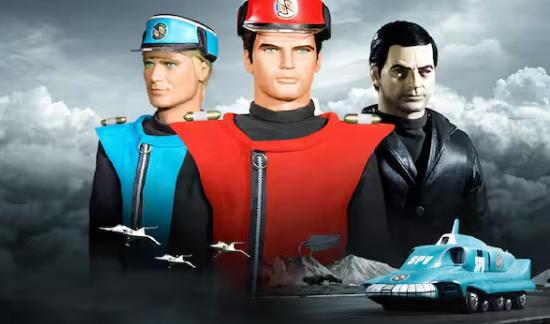
The “actors” in Captain Scarlet were puppets, but they were puppets of a kind never seen before. The show was the pinnacle of Gerry Anderson’s “Supermarionation” technique—a portmanteau of “super,” “marionette,” and “animation.” Unlike traditional puppets, these were highly advanced, one-third-scale marionettes with a key innovation: their heads contained all the electronics.
Solenoids and servos in the heads were synchronized with pre-recorded dialogue, allowing the puppets’ mouths to move in perfect time with the actors’ voices. This gave them a new level of realism. But the true leap forward for Captain Scarlet was a change in aesthetics. Anderson, tired of the cartoonish caricatures of Thunderbirds, insisted that the puppets for Scarlet be sculpted with realistic, “human” proportions. This led to the show’s uncanny, photorealistic look. The puppets were no longer just characters; they were “scale artists,” acting on meticulously detailed miniature sets, creating a unique, hyper-real world. The 2005 remake even coined its own term, “Hypermarionation,” in honor of the original’s groundbreaking CGI-like approach to puppetry.
10. The Vehicles Were the Real Superstars (and Their Tech Was Brilliant)
While the puppets were the actors, the true stars of any Gerry Anderson show were the vehicles. Captain Scarlet took this to a new level of grounded, futuristic design. The most famous, of course, was the Spectrum Pursuit Vehicle (SPV). This was the workhorse of the organization, a 25-foot-long, 8-ton, ten-wheeled armored tank that was also amphibious and could hit 200 mph.
But its most brilliant feature was its safety system. The SPV driver sat backwards, facing the rear of the vehicle, to protect them from impact. They drove by watching a high-definition monitor that displayed the view from a forward-facing camera. This single, clever detail felt more “future” than any laser gun. It was a piece of ingenious, practical world-building. This was complemented by the other vehicles, from the high-speed Spectrum Saloon Cars (SSCs) to the Angel Interceptors and the tank-like Spectrum Passenger Jets. Every vehicle was designed with a purpose, making the Spectrum Organization feel like a real, fully-equipped, and incredibly cool-looking military force.
Further Reading
Want to dive deeper into the world of Cloudbase and the art of Supermarionation? These books are your official “Spectrum is Green” to start exploring.
- Gerry Anderson’s Supermarionation Cross-sections by Graham Bleathman
- A beautifully illustrated book that provides “cutaway” views and technical specifications for all the iconic vehicles from the Anderson universe, including the SPV, Cloudbase, and Angel Interceptors.
- The Complete Gerry Anderson: The Authorised Episode Guide by Chris Bentley
- The definitive guide to every Gerry Anderson series, this book provides plot synopses, production details, and fascinating behind-the-scenes facts for every episode of Captain Scarlet and the Mysterons.
- What Made Thunderbirds Go!: The Authorised Biography of Gerry Anderson by Simon Archer
- To understand Captain Scarlet, you must understand its creator. This biography tells the story of Gerry Anderson, his creative drive, his obsession with the future, and how he created the Supermarionation empire.
Here at Zentara.blog, our mission is to take those tricky subjects and unlock them, making knowledge exciting and easy to grasp for everyone. But the adventure doesn’t stop on this page! We’re constantly exploring new frontiers and sharing discoveries across the digital universe. Want to dive deeper into more mind-bending Top 10s and keep expanding your world? Come join us on our other platforms – we’ve got unique experiences waiting for you on each one!
Get inspired by visual wonders and bite-sized facts: See the world through Zentara’s eyes on Pinterest!
Pin our fascinating facts and stunning visuals to your own boards. Explore Pins on Pinterest: https://uk.pinterest.com/zentarablog/
Discover quick insights and behind-the-scenes peeks: Hop over to Tumblr for snippets, quotes, and unique content you won’t find anywhere else. It’s a different flavour of discovery! Follow the Fun on Tumblr: https://www.tumblr.com/zentarablog
Ready for deep dives you can listen to or watch? We’re bringing our accessible approach to video and potentially audio! Subscribe to our YouTube channel and tune into future projects that make learning pop! Subscribe on YouTube: https://www.youtube.com/@ZentaraUK
Seeking even more knowledge in one place? We’ve compiled some of our most popular topic deep dives into fantastic ebooks! Find them on Amazon and keep the learning journey going anytime, anywhere. Find Our Ebooks on Amazon: https://www.amazon.co.uk/s?k=Zentara+UK&ref=nb_sb_noss
Connect with us and fellow knowledge seekers: Join the conversation on BlueSky! We’re sharing updates, thoughts, and maybe even asking you what wonders we should explore next. Chat with Us on BlueSky: https://bsky.app/profile/zentarablog.bsky.social
Perfect for learning on the move! We post multiple 10-minute podcasts per day on Spotify. Pop on your headphones and fill your day with fascinating facts while you’re out and about! Listen on Spotify: https://open.spotify.com/show/3dmHbKeDufRx95xPYIqKhJFollow us on Instagram for bytesize knowledge! We post multiple posts per day on our official Instagram account. https://www.instagram.com/zentarablog/ Every click helps us keep bringing honest, accessible knowledge to everyone. Thanks for exploring with us today – see you out there in the world of discovery!




Leave a Reply