
Table of Contents
Beyond the Iron Curtain: The Ideology That Shaped a Century
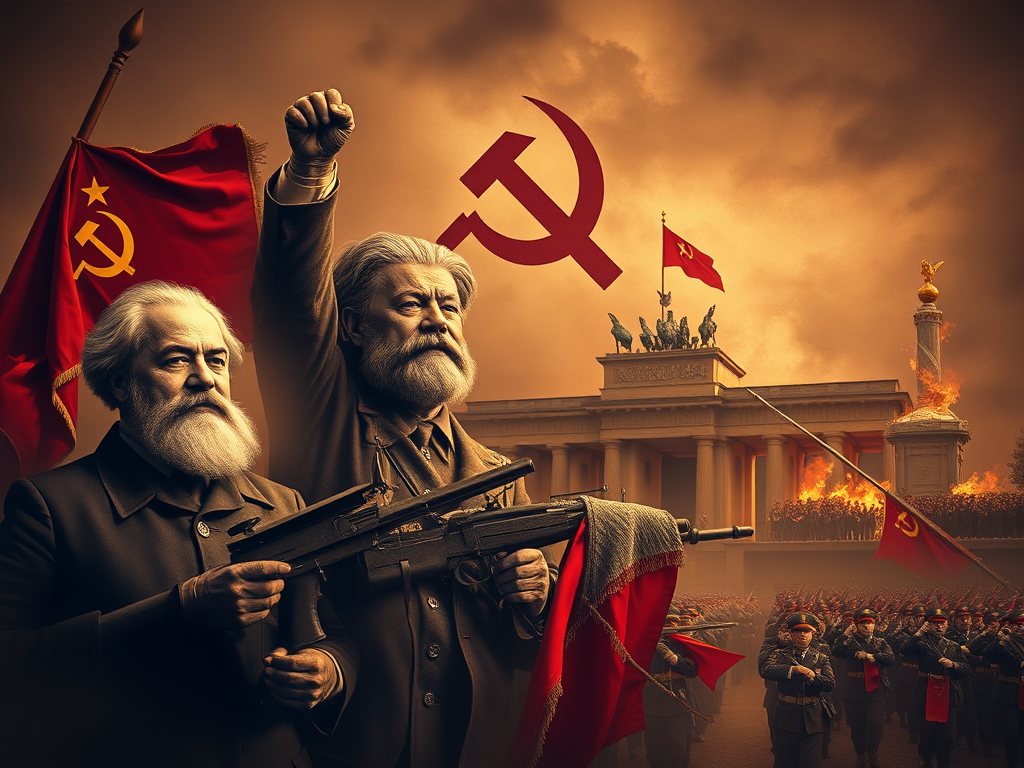
For much of the 20th century, the world was divided into two camps: the Capitalist West and the Communist East. To the average observer, Communism evokes images of military parades in Red Square, the Berlin Wall, and the stoic faces of leaders like Lenin and Stalin. It is often remembered simply as the “enemy” of the Cold War—a monolithic gray block of history that collapsed when the Wall came down.
But the history of Communism is far stranger, more ancient, and more contradictory than the standard textbook narrative suggests. It is a story that involves ancient Greek philosophers, American utopian experiments, wars against birds, and leaders who worked as pastry chefs in Boston. It is an ideology that promised a stateless paradise but built the most powerful police states in history.
Whether you view it as a failed experiment or a misunderstood philosophy, understanding Communism is essential to understanding the modern world. From its surprising origins to its bizarre implementation, here are 10 facts about Communism that go beyond the Hammer and Sickle.
1. Communism Did Not Start with Karl Marx
While Karl Marx is the father of modern Communism (specifically “Marxism”), the concept of a society where property is shared communally is thousands of years old. Long before the Communist Manifesto was published in 1848, ancient thinkers and religious groups were practicing their own versions of communal living.
In the 4th century BC, the Greek philosopher Plato wrote The Republic, in which he described an ideal ruling class (the Guardians) who would share all property, spouses, and children in common to prevent corruption. Early Christian communities described in the Book of Acts also practiced a form of “primitive communism,” selling their possessions and distributing the proceeds to anyone in need.
Even in the 6th century AD, the Persian reformer Mazdak advocated for the communal ownership of property and social welfare programs to help the poor, predating Marx by over a millennium. Marx didn’t invent the idea of sharing wealth; he just tried to turn it into a scientific economic theory based on class struggle and industrialization.
2. The First “Communist” Government Lasted Only 72 Days
The first time the working class actually seized power and tried to run a major city according to socialist principles wasn’t in Russia in 1917, but in France in 1871. Following France’s defeat in the Franco-Prussian War, radical Parisians rose up and formed the “Paris Commune.”
For two brief, chaotic months, the Commune governed Paris. They passed radical reforms that were decades ahead of their time: they separated church and state, abolished child labor, cancelled rent payments during the siege, and allowed employees to take over businesses abandoned by their owners.
It ended in a bloodbath known as “The Bloody Week,” where the French army retook the city, slaughtering approximately 20,000 Communards in the streets. Despite its short life, the Paris Commune became a legendary obsession for later revolutionaries. Lenin was so fixated on it that he is said to have danced in the snow on the day his Soviet government survived longer than 73 days, proving they had beaten the Commune’s record.
3. Marx Never Expected the Revolution to Happen in Russia
If you could travel back in time and tell Karl Marx that the first great Communist revolution would happen in Russia, he would likely have laughed at you. Marx’s theory of history was very specific: he believed that Communism could only emerge from a fully developed Capitalist society.
In Marx’s view, a country first needed to industrialize, build factories, and create a massive class of urban factory workers (the proletariat). These workers would then naturally rise up and seize the means of production. Therefore, he expected the revolution to start in advanced industrial nations like Great Britain, Germany, or the United States.
Russia, by contrast, was an agrarian feudal monarchy. It had very few factories and was populated mostly by illiterate peasant farmers, not urban workers. When the Bolsheviks seized power in 1917, they were effectively trying to “skip” the capitalist phase of history that Marx deemed necessary. This forced them to ruthlessly industrialize the country at breakneck speed, leading to the brutal policies of the Soviet era.
4. Ho Chi Minh Was a Pastry Chef in Boston and London
Ho Chi Minh is remembered as the revolutionary leader of North Vietnam who fought against the French and the Americans. But before he was a guerrilla commander wearing simple sandals, he was a world traveler working in the service industry of the West.
In his youth, Ho traveled the world as a cook’s helper on ships. During the 1910s, he lived in London, where he reportedly worked as a snow sweeper and later as a kitchen hand at the Drayton Court Hotel. Even more surprisingly, he spent time in the United States, living in Boston and New York.
While in Boston, he worked as a baker and pastry chef at the Omni Parker House hotel—the same hotel where Malcolm X would later work as a busboy. It is a surreal historical footnote that the man who would later defeat the U.S. military spent his early years baking Parker House rolls for wealthy American patrons, studying the American Declaration of Independence, which he would later quote in his own declaration of freedom from France.
5. A “War on Birds” Caused the Deadliest Famine in History
One of the most tragic examples of the failure of central planning occurred in China during the “Great Leap Forward.” In 1958, Mao Zedong launched the “Four Pests Campaign,” ordering the eradication of rats, flies, mosquitoes, and sparrows.
Mao believed that sparrows were eating too much grain and robbing the people of their hard work. He mobilized the entire population to bang pots and pans, destroy nests, and shoot birds until the sparrow population was nearly extinct. The campaign was a “success” in that the birds died, but the ecological consequences were catastrophic.
Mao had forgotten that sparrows don’t just eat grain; they also eat insects. Without the sparrows to keep them in check, locust populations exploded. The locusts swarmed across the country, devouring crops and stripping the land bare. This ecological disaster, combined with other failed policies, led to the Great Chinese Famine, which killed an estimated 15 to 45 million people. In a desperate irony, the Chinese government eventually had to import sparrows from the Soviet Union to restock the population.
6. The “Red Terror” Was Official Policy, Not an Accident
There is a common misconception that the violence of Communist regimes was just a result of chaotic circumstances or “bad apples” like Stalin. However, the use of terror was a feature, not a bug, of the system from the very beginning.
Vladimir Lenin, often romanticized as the “good” revolutionary compared to Stalin, explicitly authorized the use of mass executions to secure power. In 1918, following an assassination attempt, the Bolsheviks officially launched the “Red Terror.” Lenin sent telegrams ordering the public hanging of “kulaks” (wealthy peasants) to set an example.
He established the Cheka, the first secret police force, which would later evolve into the KGB. The Cheka was given the authority to execute “class enemies” without trial. The logic was that the ends (a perfect utopia) justified the means (eliminating anyone who stood in the way). This institutionalized violence laid the groundwork for the Great Purges that would follow decades later.
7. Pol Pot Targeted People Who Wore Glasses
The Khmer Rouge regime in Cambodia (1975–1979) represents perhaps the most extreme and terrifying implementation of Communist ideology in history. Led by Pol Pot (born Saloth Sar), the regime wanted to return Cambodia to “Year Zero,” creating a purely agrarian society by completely erasing modern civilization.
The regime didn’t just target political opponents; they targeted the very concept of intellect. In their fanaticism to wipe out “bourgeois” influence, they began killing anyone they suspected of being an intellectual. This included doctors, teachers, engineers, and monks.
The criteria for being an “intellectual” became absurdly broad. People were executed simply for having soft hands (implying they didn’t do manual labor), speaking a foreign language, or, most notoriously, wearing glasses. To the Khmer Rouge, spectacles were a symbol of reading and academic elitism. It remains one of the only times in history where needing corrective lenses was a death sentence.
8. There Were “Communist” Utopias in 19th-Century America
Long before the Cold War, the United States was a hotbed for communal experiments. In the 19th century, dozens of “utopian socialist” communities sprang up across America, fueled by religious fervor or secular idealism.
One of the most famous was Brook Farm in Massachusetts (1841), which attracted famous writers like Nathaniel Hawthorne. Members agreed to share labor and profits equally, hoping to balance intellectual freedom with manual work. Another was the Oneida Community in New York, which practiced “Bible Communism,” sharing not only property but also practicing “complex marriage” where all men and women were married to each other.
While these communities didn’t call themselves “Marxist” (Marx was writing at the same time), they were built on the same fundamental principle: that private property was the root of social evil and that communal living would perfect human nature. Most of these experiments collapsed due to financial ruin or internal bickering, proving that small-scale communism is just as difficult to maintain as the nation-state version.
9. Daily Life Was Defined by the Motto: “We Pretend to Work, They Pretend to Pay Us”
While history books focus on the gulags and secret police, the reality for the average citizen in the Soviet bloc was often defined by boredom and economic stagnation. Because the state guaranteed everyone a job (unemployment was technically illegal), there was no incentive to work hard.
Wages were low, and there was little to buy in the shops anyway. This led to a pervasive culture of laziness and inefficiency, famously summed up by the Soviet joke: “We pretend to work, and they pretend to pay us.”
Factories would produce heavy quotas of useless goods just to meet targets. For example, if a shoe factory was evaluated on the number of shoes produced, they would make thousands of tiny baby shoes to save materials. If they were evaluated on weight, they would make a few enormous, heavy shoes. This “command economy” resulted in a superpower that could send a man into space but couldn’t reliably stock toilet paper or blue jeans for its citizens.
10. Modern China Has More Billionaires Than Almost Anywhere Else
The final and perhaps most confusing fact about Communism is its modern survival strategy. Today, the People’s Republic of China is ruled by the Chinese Communist Party (CCP). Its constitution still enshrines Marxism-Leninism, and its leaders still study Mao.
Yet, China is home to the second-largest number of billionaires in the world, trailing only the United States. Following the death of Mao, leader Deng Xiaoping initiated reforms in 1978 with the famous pragmatism: “It doesn’t matter if a cat is black or white, so long as it catches mice.”
China adopted “Socialism with Chinese characteristics,” which is effectively a state-run capitalist economy. The state retains tight political control, but the economy runs on profit, private ownership, and global trade. It is a paradox that would likely baffle Karl Marx: a “Communist” country that serves as the manufacturing engine for global Capitalism.
Further Reading
To understand the human cost and the historical sweep of this ideology, these books are highly recommended:
- “Animal Farm” by George Orwell – A short, brilliant allegorical novella that explains the corruption of revolutionary ideals better than any textbook.
- “Nothing to Envy: Ordinary Lives in North Korea” by Barbara Demick – A deeply moving and accessible book that weaves together the true stories of defectors, showing what daily life is really like under a totalitarian regime.
- “Mao’s Great Famine” by Frank Dikötter – A groundbreaking history book that documents the devastating reality of the Great Leap Forward, perfect for those who want to understand the cost of the “Sparrow Campaign.”
- “The Gulag Archipelago” (Abridged) by Aleksandr Solzhenitsyn – A monumental work that exposed the Soviet forced labor camp system to the world. The abridged version is an essential read for understanding the “Red Terror.”
Keep the Discovery Going!
Here at Zentara, our mission is to take tricky subjects and unlock them, making knowledge exciting and easy to grasp. But the adventure doesn’t stop at the bottom of this page. We are constantly creating new ways for you to learn, watch, and listen every single day.
📺 Watch & Learn on YouTube
Visual learner? We publish 4 new videos every day, plus breaking news shorts to keep you smarter than the headlines. From deep dives to quick facts, our channel is your daily visual dose of wonder.
Click here to Subscribe to Zentara on YouTube
🎧 Listen on the Go on Spotify
Prefer to learn while you move? Tune into the Zentara Podcast! We drop a new episode daily, perfect for your commute, workout, or coffee break. Pop on your headphones and fill your day with fascinating facts.
Click here to Listen on Spotify
Every click, view, and listen helps us keep bringing honest knowledge to everyone. Thanks for exploring with us today—see you out there in the world of discovery!




Leave a Reply