
Table of Contents
The Dream Demon That Saved a Studio and Changed Horror Forever
In the landscape of 1980s horror, slasher villains were typically silent, hulking brutes behind masks. They were unknowable forces of nature—like Michael Myers or Jason Voorhees—who decimated teenagers with mechanical efficiency. Then came Freddy Krueger. He wasn’t silent; he was chatty. He didn’t wear a mask; his face was a scarred map of his own sins. And most terrifying of all, you couldn’t run away from him, because he lived in the one place you had to go eventually: your sleep.
A Nightmare on Elm Street (1984) didn’t just launch a franchise; it saved a movie studio, launched the career of one of the world’s biggest movie stars, and introduced a villain who became a pop culture phenomenon. Wes Craven’s creation blurred the lines between reality and dreams so effectively that it left an entire generation afraid to close their eyes.
But beyond the jump scares and the iconic striped sweater, the history of the franchise is filled with bizarre coincidences, production miracles, and dark inspirations. From the true medical mystery that sparked the idea to the “happy ending” that was ruined by studio interference, here are 10 facts about the Nightmare on Elm Street franchise that will keep you up at night.
1. The Movie Was Inspired by a Terrifying True Medical Mystery
It is comforting to believe that a concept as surreal as a dream-killing demon is purely fiction. However, Wes Craven’s inspiration for the central plot—dying in your sleep—came from a very real and tragic medical phenomenon known as “Asian Death Syndrome” or Sudden Unexpected Nocturnal Death Syndrome (SUNDS).
In the late 1970s and early 1980s, the L.A. Times ran a series of articles about healthy young men from Southeast Asian refugee families (specifically Hmong refugees fleeing the aftermath of war in Cambodia and Laos) who were dying mysteriously in their sleep. These men had no underlying heart conditions.
Craven was particularly haunted by one specific account: a young man who was terrified to sleep, telling his parents that “something” was chasing him in his nightmares. He stayed awake for days, fueled by coffee and fear. When he finally succumbed to exhaustion, his parents heard screaming from his room. By the time they reached him, he was dead. An autopsy revealed no physical cause of death. Craven took this terrifying reality—the idea that the mind could effectively kill the body during a nightmare—and gave it a face.
2. Johnny Depp’s Casting Was Pure Luck (And Thanks to a Teenager)
Before he was Captain Jack Sparrow or the face of Tim Burton’s gothic fantasies, Johnny Depp was just a kid accompanying his friend to an audition. The role of Glen Lantz, the boyfriend of the protagonist Nancy, was originally intended to be a “jock” type—a muscular, traditional football player.
Depp was the opposite: a skinny, cigarette-smoking musician with greased-back hair and earrings. He wasn’t there to audition; he was just tagging along with his friend, actor Jackie Earle Haley (who, in a strange twist of fate, would go on to play Freddy Krueger in the 2010 remake). When the casting director spotted Depp, they asked him to read for the part.
Wes Craven remained skeptical that this “weird” kid could play the heartthrob. To break the tie, he showed headshots of the potential actors to his teenage daughter and her friends. They pointed to Depp and said, “He’s beautiful.” Craven trusted the teenage girl demographic, cast Depp on the spot, and accidentally launched the career of a Hollywood icon.
3. Freddy’s Glove Was Made from Steak Knives to Exploit Primal Fears
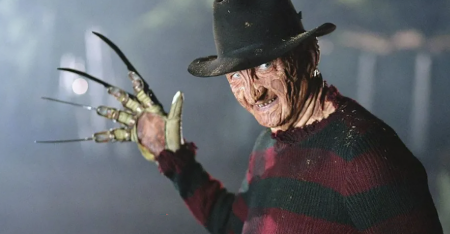
While Jason has his machete and Leatherface has his chainsaw, Freddy Krueger’s weapon is far more intimate and personalized: a tattered leather glove with razor-sharp blades attached to the fingers. Wes Craven designed this weapon not just to be scary, but to tap into the deepest, most primitive parts of the human brain.
Craven reasoned that the earliest fear mankind ever experienced was the fear of predators—specifically, the claws of wild animals like cave bears. He wanted a weapon that mimicked a biological claw, something that was an extension of the killer’s hand rather than a tool he picked up.
To bring this vision to life on a shoestring budget, special effects artist Jim Doyle constructed the original glove using cheap steak knives found at a local store. He attached them to a modified boiler glove using copper piping. The result was a weapon that looked menacingly homemade, implying that Freddy had built it himself in his boiler room workshop. It remains one of the most recognizable props in film history.
4. The “Red and Green” Sweater Is Scientifically Designed to Be Painful
Costume design in horror movies is rarely accidental, and Freddy’s sweater is a masterclass in psychological discomfort. Wes Craven didn’t just pick red and green because they looked festive or grungy; he picked them because of optical science.
Craven read an article in Scientific American (some sources say it was a generic science journal) stating that red and green are the two most clashing colors for the human retina. Placed side-by-side, they are difficult for the eye to process together, causing a subtle, unconscious strain and vibration.
He wanted Freddy to be a visual sore, something that literally hurt to look at. This subtle unease contributes to the character’s shifting, unstable presence on screen. Interestingly, the sweater was originally hand-knitted by a costume designer, and if you look closely at the first film, it has no stripes on the sleeves—a detail that was changed in later sequels as the “official” look was standardized.
5. Robert Englund Was Not the First Choice for Freddy
It is impossible to imagine anyone other than Robert Englund donning the fedora and scars, but he was not the first actor cast in the role. Wes Craven originally wanted a more physically imposing, silent figure—essentially a “dream stuntman.”
The studio initially hired British character actor David Warner (famous for roles in The Omen and Titanic). Makeup tests were even done with Warner. However, due to scheduling conflicts, Warner had to drop out just before production began.
Craven then shifted his approach. He realized he needed an actor who could project malevolence through heavy prosthetics, not just a stuntman in a mask. Robert Englund, who was known at the time for playing a friendly alien on the TV series V, auditioned with a unique energy. He played Freddy with a wide-legged stance and a “rat-like” scurrying motion, rather than a lumbering monster walk. This performance choice gave Freddy his distinctive, energetic personality, saving the character from becoming just another silent slasher.
6. The Original Script Made Freddy a Child Molester, Not Just a Murderer
The Freddy Krueger we know is a “child murderer” who killed the children of Elm Street. However, in Wes Craven’s original script, the character’s backstory was even darker. Freddy was explicitly written as a child molester.
Just as production was starting, a series of high-profile child abuse cases broke out in California. The studio executives at New Line Cinema were terrified that the public would revolt against a movie that featured a molester as the central villain, fearing it would be seen as exploitative of current tragedies.
Craven was forced to change the backstory. In the finished film, the dialogue carefully dances around the specific nature of his crimes, referring to him killing the children. However, the subtext remains heavily embedded in the film—Freddy’s behavior, his invasion of the bedroom (a private, safe space), and the “dirty old man” energy are remnants of that darker, original concept. The 2010 remake controversially attempted to return to this original idea, much to the discomfort of audiences.
7. The “Happy Ending” Was Sabotaged by the Studio
A Nightmare on Elm Street is famous for its twist ending: just when Nancy thinks she has defeated Freddy and stripped him of his power, she gets into a convertible with her friends, the roof slams up (revealing Freddy’s sweater pattern), and her mother is pulled through a tiny window in the front door.
Wes Craven hated this ending. His original vision was a definitive, spiritual victory for Nancy. She would strip Freddy of his power by turning her back on him, walk out into the sunlight, and the movie would end with her realizing it was all a dream, leaving her empowered and alive.
Robert Shaye, the head of New Line Cinema, insisted on a shock ending that would leave the door open for a sequel. He wanted Freddy to “win” or at least survive. They compromised on the ending we see today, but the effect is jarring. If you watch closely, the scene where the car roof comes up happens so fast because they had almost no budget left to shoot it properly. The “dummy” of Nancy’s mom being pulled through the window is also famously stiff and unrealistic—a blemish Craven always regretted.
8. The “Rotating Room” Effect Was a Dangerous Engineering Marvel
Two of the most iconic deaths in the film—Tina being dragged across the ceiling and Johnny Depp being sucked into his bed followed by a geyser of blood—were achieved using a massive rotating room set.
The production built a full-scale bedroom set inside a giant gimbal that could spin 360 degrees. For Tina’s death, the room was slowly rotated so that the actress (and the camera, which was bolted to the floor) moved with it, while the furniture was nailed down. This allowed her to appear to be rolling up the wall and onto the ceiling.
For Johnny Depp’s death, the room was turned upside down. The crew poured 500 gallons of fake blood (water and red dye) through a hole in the “floor” (which was actually the ceiling). Gravity did the work, creating the effect of a blood geyser shooting “up” from the bed. The issue was that the sheer volume of liquid caused the room to spin unexpectedly, and the fake blood short-circuited the electrical wiring, shocking crew members and leaving the set spinning out of control while covered in red dye. It was a chaotic, dangerous shoot that resulted in one of the best practical effects in horror history.
9. Wes Craven Was Inspired by a Bully and a Homeless Man
The name “Freddy Krueger” wasn’t chosen at random. It was the name of a real-life bully who tormented Wes Craven in elementary school. By naming his ultimate villain after him, Craven exacted the ultimate creative revenge.
The visual look of Freddy, however, came from a much more traumatic childhood memory. Craven recalled being a young boy and looking out his apartment window to see a disfigured, shambling homeless man walking down the alley. The man stopped, looked up, and stared directly into the young Craven’s eyes.
He didn’t scream or wave; he just stared with a terrifying, knowing intensity. Craven was so scared he hid away from the window, but when he peeked back out minutes later, the man was still there, staring. That sensation of an adult invading the safety of a child’s world—and the specific fedora the man wore—became the blueprint for the Springwood Slasher.
10. The Franchise Saved New Line Cinema from Bankruptcy
Today, New Line Cinema is a giant studio known for The Lord of the Rings and It. But in 1984, it was a tiny distribution company on the verge of bankruptcy. They had no money to produce films, only to distribute small art-house or exploitation movies.
Robert Shaye, the founder, bet literally everything on A Nightmare on Elm Street. During production, they frequently ran out of money. Checks to the crew would bounce, and Shaye would have to scramble to find new investors or max out credit cards just to buy film stock for the next day’s shoot.
When the film was released, it became a massive sleeper hit, earning $25 million on a $1.8 million budget. The profits single-handedly saved the company. This is why New Line Cinema is affectionately (and literally) known in the industry as “The House That Freddy Built.” Without Freddy Krueger, there would be no Peter Jackson Lord of the Rings trilogy distributed by New Line decades later.
Further Reading
If you are ready to wake up and read more about the man in the fedora, these books offer an incredible look into the craft and chaos of the franchise:
- “Never Sleep Again: The Elm Street Legacy” by Thommy Hutson – This is widely considered the bible of the franchise. It is an exhaustive, definitive account of the making of the original film, featuring hundreds of interviews and rare photos.
- “Welcome to Elm Street: Inside the Film and Television Nightmares of Wes Craven” by Wayne Byrne – A fantastic deep dive that analyzes the themes, production history, and the broader cultural impact of Wes Craven’s work on the series.
- “Hollywood Monster: A Walk Down Elm Street with the Man of Your Dreams” by Robert Englund – A witty and engaging memoir from Freddy himself, offering a behind-the-scenes look at what it was like to play the villain for decades.
- “Slash of the Titans: The Road to Freddy vs Jason” by Dustin McNeill – For fans interested in the business side of horror, this book details the ten-year “development hell” struggle to get the two biggest icons of horror on screen together.
Keep the Discovery Going!
Here at Zentara, our mission is to take tricky subjects and unlock them, making knowledge exciting and easy to grasp. But the adventure doesn’t stop at the bottom of this page. We are constantly creating new ways for you to learn, watch, and listen every single day.
📺 Watch & Learn on YouTube
Visual learner? We publish 4 new videos every day, plus breaking news shorts to keep you smarter than the headlines. From deep dives to quick facts, our channel is your daily visual dose of wonder.
Click here to Subscribe to Zentara on YouTube
🎧 Listen on the Go on Spotify
Prefer to learn while you move? Tune into the Zentara Podcast! We drop a new episode daily, perfect for your commute, workout, or coffee break. Pop on your headphones and fill your day with fascinating facts.
Click here to Listen on Spotify
Every click, view, and listen helps us keep bringing honest knowledge to everyone. Thanks for exploring with us today—see you out there in the world of discovery!




Leave a Reply