
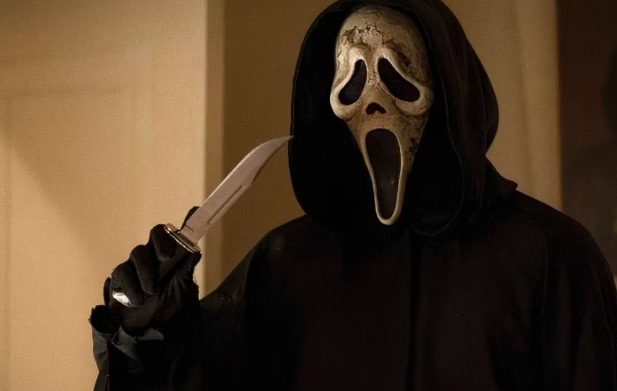
10 Bone-Chilling Secrets Behind Scream: How Ghostface Rewrote the Rules of Horror Forever
At the dawn of a new era for cinema, the horror genre was on life support. The lumbering giants of the 1980s—the silent slashers and supernatural dream-stalkers—had become parodies of themselves, relegated to predictable sequels and straight-to-video releases. Then came a ringing telephone, a voice asking about “scary movies,” and a script that didn’t just follow the rules—it recited them back to the audience before shattering them. Directed by the legendary Wes Craven and written by the sharp-witted Kevin Williamson, this film didn’t just scare people; it made them part of the joke.
The genius of this production lies in its self-awareness. It was the first major “meta-horror” film, acknowledging that the characters within the movie had seen movies just like the one they were in. This layer of irony, combined with genuine tension and a mystery that kept audiences guessing until the final frame, breathed new life into a dying medium. Whether you are a “Final Girl” enthusiast or a casual viewer who hides behind a popcorn bucket, these ten facts reveal how a single film transformed the landscape of terror into something smarter, faster, and much more dangerous.
1. The Shocking Bait-and-Switch of the Opening Scene
In the history of cinema, few moments are as jarring as the first ten minutes of this film. At the time of its release, Drew Barrymore was arguably the biggest star in the cast. The marketing materials, posters, and trailers all prominently featured her face, leading every theater-goer to believe she was the central protagonist of the story. By killing her off in the opening sequence, the filmmakers sent a violent, clear message to the audience: “No one is safe.”
This was a deliberate homage to Alfred Hitchcock’s Psycho, which famously dispatched its lead actress early in the runtime. However, in the context of the slasher genre, it was a revolutionary move. It stripped the audience of their comfort and predictability. If the biggest name in the credits could be gutted and hung from a tree before the title card even appeared, then the traditional safety nets of Hollywood storytelling were gone. This subversion of celebrity expectation created an atmosphere of genuine dread that permeated the rest of the film, ensuring that the stakes felt high for every remaining character.
2. The Accidental Discovery of the Iconic Ghostface Mask
The mask that launched a thousand nightmares was almost never used. While scouting locations, the production team found the “Peanut-Eyed Ghost” mask inside an abandoned house. It was a mass-produced, store-bought item from a costume company called Fun World. Wes Craven immediately fell in love with its expressive yet vacant look—a face that seemed to be melting in a silent scream. However, the studio originally wanted a more “monstrous” and unique design, fearing that a store-bought mask looked “cheap” or “unimaginative.”
Craven stood his ground, insisting that the simplicity of the mask made it scarier. It represented an “everyman” terror; anyone could go to a local shop, buy this mask, and become a monster. Eventually, after various custom designs failed to capture the same eerie energy, the studio struck a deal with Fun World to use the design. This decision turned a piece of inexpensive plastic into the most recognizable horror icon of its generation. It proved that in horror, the most effective tools are often those that feel familiar, grounded, and disturbingly accessible.
3. The “Rules” That Defined a Genre’s Self-Awareness
Before this film, horror characters were often criticized for their “stupidity”—running upstairs when they should go out the front door or investigating strange noises in the dark. This script changed that by introducing the character of Randy Meeks, a video store clerk who literally vocalized the “rules” of the slasher genre. By having the characters acknowledge the tropes of horror movies while living through one, the film bridged the gap between the screen and the audience.
The “Rules” (don’t have sex, don’t drink or do drugs, and never say “I’ll be right back”) became a cultural touchstone. This meta-commentary didn’t just provide comic relief; it raised the intellectual bar for the genre. It challenged the audience to stay one step ahead of the killer, turning the viewing experience into a game of wits. This self-reflexive approach forced future horror filmmakers to be more creative, as they could no longer rely on cliches that the audience—and the characters—were now fully aware of. It transformed horror from a passive experience into an interactive one.
4. The Dark Real-Life Inspiration Behind the Script
While the film is famous for its wit and pop-culture references, its origin is surprisingly dark. Screenwriter Kevin Williamson was inspired to write the story after watching a news special about a real-life serial killer known as the “Gainesville Ripper.” The real-world terror involved a series of brutal crimes in a college town that left the community paralyzed with fear. Williamson, who was house-sitting at the time, found himself checking the locks on his doors and windows, imagining a killer lurking in the shadows.
This sense of “suburban invasion” is what gives the film its staying power. It moved the horror away from haunted castles and dreamscapes and placed it in the pristine, brightly lit living rooms of middle-class America. The idea that a phone call could turn your safe haven into a kill zone tapped into a primal, modern anxiety. By grounding the “slasher” in a reality that felt uncomfortably close to home, the film reminded audiences that the most terrifying monsters aren’t from outer space or hell—they are the people living in your neighborhood.
5. The Psychological Warfare of the Ghostface Voice
One of the most effective tools in the film’s arsenal is the voice of the killer. Rather than having an actor on set provide the voice, Wes Craven hired Roger L. Jackson to speak through a telephone. Crucially, Craven forbade Jackson from meeting the other actors during the production. When the actors were filming their scenes and talking to “Ghostface” on the phone, they were actually talking to a stranger they had never seen, whose location on set was kept hidden from them.
This created a genuine sense of unease and spontaneity in the performances. The fear in the actors’ voices was real because they were reacting to a live, unpredictable human being rather than a pre-recorded track or a familiar co-worker. Jackson’s ability to shift from a flirtatious, charming conversationalist to a raspy, murderous predator became a hallmark of the series. This separation of the “voice” from the “body” allowed the killer to feel omnipresent, a ghost in the machine that could reach out and touch the characters anywhere there was a telephone line.
6. Redefining the “Final Girl” for a New Generation
Sidney Prescott, portrayed by Neve Campbell, broke the mold of the traditional “Final Girl.” In many 1970s and 80s slashers, the female survivor was often a passive figure whose survival was a matter of luck or pure innocence. Sidney, however, was a character defined by her resilience and her refusal to be a victim. Having already suffered the trauma of her mother’s death before the movie begins, Sidney is a battle-hardened protagonist who fights back with intelligence and ferocity.
She doesn’t just run; she strategizes. She uses her knowledge of the killer’s tactics to turn the tables. Furthermore, the film allowed Sidney to have a complex personal life, including a boyfriend and a realistic struggle with intimacy, without “punishing” her for it—a direct subversion of the old-school horror trope that sexually active characters must die. Sidney Prescott became a symbol of agency, proving that a horror heroine could be vulnerable and terrified, yet ultimately the most capable person in the room. This shift paved the way for more nuanced and empowered female leads across all of cinema.
7. The Intense Battle with the Censorship Boards
The film’s visceral violence and intense tone led to a legendary struggle with the MPAA (Motion Picture Association of America). The board originally wanted to give the film an NC-17 rating, which would have been a death sentence for its commercial prospects. They were particularly concerned with the opening sequence and the final “reveal” scene, which they found to be excessively gory and mean-spirited. Wes Craven, a veteran of horror who had faced these boards many times before, had to engage in a delicate dance of editing and negotiation.
To save the film’s R-rating, Craven used a classic directorial trick: he claimed that he didn’t have any more “alt-takes” or milder footage to use. He also argued that the film was a satire, and that the violence was a necessary part of its commentary on media and society. Eventually, the board relented, but only after some minor trims were made to the most graphic moments. This struggle highlighted the “transgressive” nature of the film; it was pushing the boundaries of what was acceptable in mainstream entertainment, forcing the industry to reconsider how it classified horror and suspense.
8. Casting Against Type: The Fight for Gale Weathers
Courteney Cox was at the height of her television fame when she lobbied for the role of the ambitious, cutthroat reporter Gale Weathers. At the time, she was primarily known for playing a “sweet” and “approachable” character on a hit sitcom. The producers were initially hesitant to cast her, fearing she wouldn’t be believable as a cynical, fame-hungry journalist who didn’t care whose toes she stepped on to get a story.
Cox, however, was determined to break out of her “nice girl” image. She famously wrote to the director, explaining that she could be a “bitch” and that she understood the drive of the character perfectly. Her performance became one of the highlights of the film, providing a sharp, comedic edge to the horror. Gale Weathers evolved into one of the most beloved characters in the franchise—a woman whose morality was often flexible but whose courage was undeniable. This casting choice proved that “typecasting” is a barrier meant to be broken and that the best horror characters are those who are flawed, ambitious, and deeply human.
9. The Game-Changing Twist of the Dual Killers
Perhaps the most significant “rule-breaking” moment in the film occurs during the climax. For decades, the slasher genre followed a singular monster: one Jason, one Michael, one Freddy. This film upended that expectation by revealing that there were actually two killers working in tandem. This revelation explained how the killer seemed to be in two places at once and how “Ghostface” could be outmaneuvered by the characters only to reappear instantly.
This twist was a narrative masterstroke because it played on the audience’s ingrained assumptions about horror movies. By having two killers, the film moved away from the “unstoppable supernatural force” trope and toward a more terrifying “human conspiracy.” It suggested that evil isn’t always a lone wolf; it can be a shared madness, a pact between friends. This ending left the audience wondering who they could truly trust, as the “monster” could be anyone—or multiple people—hiding in plain sight. It added a layer of psychological complexity that changed the “whodunnit” aspect of horror forever.
10. The Legacy of the “WB Aesthetic” and the Horror Revival
The success of this film created a seismic shift in the industry, launching what many call the “teen horror boom.” It introduced a specific aesthetic—high-production values, attractive young casts, and snappy, pop-culture-heavy dialogue—that dominated the late 90s and early 2000s. Studios suddenly realized that horror wasn’t just for a niche “gore-hound” audience; it could be a mainstream blockbuster event that appealed to teenagers and adults alike.
This film single-handedly revitalized the slasher sub-genre, leading to a wave of similar films that attempted to capture its “meta” magic. More importantly, it proved that horror could be “smart.” It didn’t have to sacrifice character development or sharp writing for the sake of a jump-scare. The legacy of this film can be seen in every modern horror movie that acknowledges its own existence or plays with audience expectations. It turned a “dying” genre into a cultural powerhouse, ensuring that as long as there are phones to ring and rules to break, horror will always find a way to reinvent itself.
Further Reading
- The Wes Craven Horror Encyclopedia by Various Authors
- It’s a Scream: The Making of the Scream Movies by Various Authors (Check for production journals and interviews)
- Men, Women, and Chain Saws: Gender in the Modern Horror Film by Carol J. Clover (Essential for understanding the “Final Girl” theory)
- Scream: The Inside Story (Behind-the-scenes documentation of the script and casting)
- 10 The Exorcist III (1990) Movie Facts You Didn’t Know
- 10 Scream (1996) Movie Facts That Changed Horror
- 10 Hostel (2005) Movie Facts That Shocked Viewers
- 10 Hellraiser (1987) Movie Facts That Built Its Legacy
- 10 Candyman (1992) Movie Facts That Still Give Chills
- 10 Essential Facts About The Texas Chainsaw Massacre (1974)
- 10 Essential Facts That Explain the World of The Walking Dead TV Show
- From – Season 1 Full Recap and Spoilers Explained
- 10 Things You Should Know About The Thing (1982) – Movie Facts and Hidden Details
- 10 Fascinating Supernatural Facts You Probably Missed – TV Show Lore



