
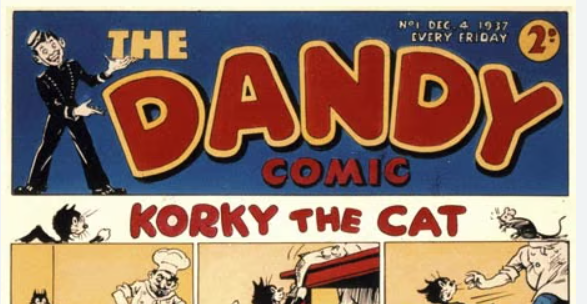
For nearly eight decades, The Dandy was the undisputed king of the British newsstand. With its vibrant covers, slapstick violence, and a cast of characters that became household names, it defined the childhood of millions across the United Kingdom and beyond. While its “younger brother,” The Beano, eventually took the spotlight in the 21st century, it was The Dandy that first broke the mold, transforming the way children’s stories were told.
The story of The Dandy is one of innovation, cultural shifts, and a surprisingly resilient spirit. From its birth in Dundee, Scotland, to its eventual transition into a digital pioneer, the comic acted as a weekly mirror for British society. Whether it was mocking dictators during World War II or adapting to the rise of television and the internet, The Dandy remained a bastion of “anarchy in a waistcoat.” Here are ten facts that reveal the hidden layers of this legendary British comic.
1. It Was the First Modern British Comic Strip
Before December 4, 1937, most “comics” in the UK were actually “story papers”—dense pages of text with a few small illustrations. The Dandy Comic changed everything by being the first weekly publication in Britain to use speech bubbles (also known as speech balloons) instead of captions beneath the pictures.
This was a revolutionary shift in the history of comics. By letting the characters “speak” directly to the reader, the pacing became faster and the humor more immediate. This American-style format made the comic an instant hit, selling over 500,000 copies of its first issue. It moved the medium away from Victorian-era “moral instruction” and toward the loud, kinetic, and irreverent style that would define the Golden Age of British comics.
2. Desperate Dan Was Originally a Cowboy “Hard Man”
The face of The Dandy was undoubtedly Desperate Dan, the world’s strongest man who could shave with a blowtorch and eat whole “cow pies” (complete with horns sticking out of the crust). When he first appeared in issue #1, he was portrayed as a more rugged, slightly more dangerous outlaw in the Wild West.
However, as the years went by, his character underwent a fascinating transformation. He became a “gentle giant,” a domestic hero who lived with his Aunt Aggie and often found himself in trouble for accidentally destroying buildings while trying to do a good deed. This blend of superhuman strength and suburban mundane life made him incredibly relatable. Dan wasn’t just a superhero; he was a parody of the American “tough guy,” localized for a British audience that loved the idea of a man who could lift a horse but was still terrified of his aunt’s scolding.
3. It Held the Title of World’s Third-Longest-Running Comic
Until its final print issue in 2012, The Dandy was one of the oldest continually published comics in existence. It outlasted thousands of competitors, including many of its stablemates at D.C. Thomson. For decades, it sat just behind the American Detective Comics and Action Comics in terms of longevity.
Its survival was a testament to the “House of Anarchy” philosophy. While other comics tried to be educational or overly polite, The Dandy stayed true to the “fun-first” mantra. It was the “rebel” of the nursery, providing a safe space for children to laugh at authority figures, from strict teachers to bumbling policemen. This longevity created a multi-generational legacy where grandfathers and grandsons could share the same jokes about Korky the Cat or Bananaman.
4. Korky the Cat Was the Original Front-Page Star
While Desperate Dan is the character everyone remembers today, he wasn’t always the cover star. For the first 47 years of the comic’s life, that honor belonged to Korky the Cat. Korky was a sophisticated, anthropomorphic cat who lived like a human, often outsmarting his rivals and getting into surreal scrapes.
Korky’s dominance on the cover (from 1937 to 1984) showed the comic’s early reliance on “animal funny-business,” a staple of the era. It wasn’t until the mid-80s that the editorial team realized Desperate Dan’s massive popularity had eclipsed the cat. When Dan finally moved to the front page, it signaled a shift in the Dandy characters hierarchy, focusing more on the exaggerated human “strongmen” and “menaces” that the audience craved.
5. It Mocked Adolf Hitler During the Height of WWII
During World War II, The Dandy did its bit for the war effort by using humor as a weapon. At a time when the UK was facing the Blitz and severe rationing, the comic featured strips that openly mocked the Axis powers. Desperate Dan, in particular, was shown crossing the Atlantic to literally “kick” the Nazis back to Berlin.
Because paper was rationed, the comic was forced to go “fortnightly” (every two weeks), alternating with its sister title The Beano. Despite the thin paper and limited ink, these wartime issues are among the most valuable collectible comics today. They provided a vital morale boost for children, proving that even the most terrifying global threats were no match for a British sense of the ridiculous and a well-placed cow pie.
6. Bananaman Jumped Ship from Another Comic
Many fans associate Bananaman—the schoolboy Eric Twinge who transforms into a superhero after eating a banana—primarily with The Dandy. However, he wasn’t an original Dandy creation. Bananaman originally debuted in Nutty in 1980.
When Nutty folded, Bananaman was “rescued” and moved to The Dandy, where he became a cornerstone of the brand. His inclusion brought a more modern, “parody of DC/Marvel” energy to the comic. With his exaggerated chin and bumbling heroics, he bridged the gap between the classic slapstick of the 1930s and the more media-savvy humor of the 1980s and 90s. He eventually became so popular that he starred in his own BBC animated series, voiced by the comedy trio The Goodies.
7. It Experimented with a “TV-Style” Format in the 2000s
In an attempt to combat falling sales and the rise of digital entertainment, The Dandy underwent a radical redesign in 2010. It was rebranded as The Dandy Xtreme and later just The Dandy, with a focus on “celebrity” content and a format that mimicked the fast-paced style of a television show or a website.
The comic began featuring parodies of real-life celebrities like Simon Cowell, Cheryl Cole, and Jeremy Clarkson. This was a controversial move for traditionalists, but it was a bold attempt to keep the Dandy comic history relevant to a generation of kids who spent more time on YouTube than at the newsagent. While the “celebrity” era was short-lived, it showed the publisher’s willingness to “adapt or die” in a rapidly changing media landscape.
8. The Final Print Issue Featured a Secret Cameo
On December 4, 2012—exactly 75 years to the day after its first issue—The Dandy published its final print edition. It was a bittersweet moment for the industry. To mark the occasion, the editors included a massive 100-page “souvenir” issue that brought back almost every character from its long history.
Hidden in the pages were numerous “easter eggs” and cameos. Even Sir Paul McCartney, a lifelong fan who once said his greatest ambition was to appear in the comic, finally got his wish. He was drawn into a strip alongside Desperate Dan. The final issue sold out almost instantly, proving that while the “weekly habit” had faded, the public’s affection for the brand was still incredibly strong.
9. It Relaunched as a Digital-Only Comic
When the print version ended, D.C. Thomson didn’t give up on the brand. They launched The Dandy Digital, making it one of the first major comic titles in the world to attempt a “digital-first” strategy. The digital version included interactive games, animations, and “voice-over” strips.
While the digital-only experiment only lasted about six months before being integrated into broader Beano/Dandy digital hubs, it was a pioneering move. It recognized that the future of comics lay in the palm of a child’s hand via a tablet or smartphone. Today, the spirit of The Dandy lives on through the Beano website and annuals, where Desperate Dan and his friends continue to appear in a “best of” format.
10. Dandy Annuals Remain a British Christmas Tradition
Even though the weekly comic is no longer on the shelves, The Dandy Annual is still published every year. For many families in the UK, the “Bumper Book” of Dandy fun is a staple Christmas morning gift. These annuals often feature “reprints” of classic stories alongside new adventures.
The continued success of the annuals proves that the legacy of The Dandy is about nostalgia as much as it is about humor. Adults who grew up with the comic in the 50s, 70s, or 90s now buy the annuals for their children and grandchildren, ensuring that the legend of the cow pie and the “strongest man in the world” stays alive for the next century. It remains a cornerstone of the British cultural identity, representing a time when the world was a little more colorful and a lot more mischievous.
Further Reading
- The Legend of Desperate Dan by Christopher Riches
- The Dandy: 75 Years of Fun by D.C. Thomson
- The Art and History of The Dandy by Morris Heggie
- British Comics: A Cultural History by James Chapman
- The History of the Beano and Dandy by D.C. Thomson (Collection)
Keep the Discovery Going!
Here at Zentara, our mission is to take tricky subjects and unlock them, making knowledge exciting and easy to grasp. But the adventure doesn’t stop at the bottom of this page. We are constantly creating new ways for you to learn, watch, and listen every single day.
Watch & Learn on YouTube
Visual learner? We publish 4 new videos every day, plus breaking news shorts to keep you smarter than the headlines. From deep dives to quick facts, our channel is your daily visual dose of wonder.
Click here to Subscribe to Zentara on YouTube
Listen on the Go on Spotify
Prefer to learn while you move? Tune into the Zentara Podcast! We drop a new episode daily, perfect for your commute, workout, or coffee break. Pop on your headphones and fill your day with fascinating facts.
Click here to Listen on Spotify
Every click, view, and listen helps us keep bringing honest knowledge to everyone. Thanks for exploring with us today—see you out there in the world of discovery!




Leave a Reply