
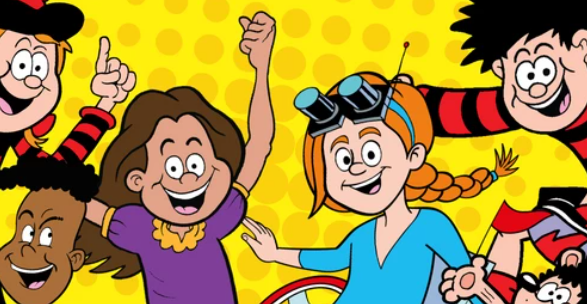
For generations of British children, the arrival of The Beano at the local newsagent was the highlight of the week. With its iconic red-and-yellow logo and a cast of rebellious, spiky-haired mischief-makers, it has been the definitive manual for “menaces” since 1938. While the rest of the world was obsessed with caped crusaders and cosmic battles, The Beano stayed grounded in the world of school dinners, “slippers” (of the disciplinary kind), and the eternal struggle between kids and “softies.”
As the world’s longest-running weekly comic, The Beano is a British cultural institution on par with Doctor Who or the BBC. However, behind the slapstick humor and the smell of ink lies a history filled with wartime defiance, surprising celebrity fans, and a constant evolution to stay relevant in a digital age. Whether you grew up reading about Dennis the Menace or are just discovering the chaos of Bash Street, these ten facts reveal the surprising story behind the “World’s Number One Comic.”
1. It Was Born as a “B-Movie” for Children’s Reading
In the 1930s, the publishing giant D.C. Thomson based in Dundee, Scotland, wanted to expand its reach. At the time, they already had a successful comic called The Dandy. To capitalize on its success, they launched a companion magazine on July 30, 1938, called The Beano Comic.
The name “Beano” is actually a shortened version of “bean-feast,” a British slang term for a rowdy celebration or a banquet. Originally, the comic didn’t look much like the one we see today; it featured many more text stories and adventure strips. The goal was to provide a “beano” for the mind—a weekly feast of fun that was affordable for every child during the tail end of the Great Depression. It was designed to be fast, loud, and irreverent, a stark contrast to the stuffy, educational children’s literature of the era.
2. Dennis the Menace Wasn’t the Original “Big Star”
It’s hard to imagine The Beano without its spiky-haired mascot, but Dennis the Menace didn’t actually appear until 1951—thirteen years after the comic started. In the early days, the “cover star” was a character called Eggo the Ostrich. Eggo was a surreal, slapstick bird who appeared on the front page for over a decade.
Other early favorites included Pansy Potter (the Strongman’s Daughter) and Lord Snooty, a posh boy who hung out with a gang of street kids. It wasn’t until the post-war era that the “menacing” energy we associate with the comic today truly took over. When Dennis finally made his debut in issue #452, he wasn’t even on the cover; he was a half-page strip tucked away inside. It took years of being “the world’s naughtiest boy” for him to claim the throne and the iconic red-and-black striped jumper.
3. Two Different “Dennis the Menaces” Were Born in the Same Month
In one of the strangest coincidences in the history of comics, two completely different characters named “Dennis the Menace” debuted in March 1951. In the UK, David Law’s version appeared in The Beano, while in the United States, Hank Ketcham’s version appeared in daily newspapers.
The two creators had never met and were working on opposite sides of the Atlantic. The characters were also vastly different: the British Dennis was a genuinely rebellious “bad lad” with a dog named Gnasher, while the American Dennis was a younger, more “accidental” troublemaker in overalls. To avoid legal battles, the two publishers reached an informal agreement: the British Dennis would stay in the UK, and the American one would keep the US. This is why the American Dennis is often referred to as “Dennis” or “Dennis the Menace” in the UK only through his cartoon and movie adaptations.
4. The Comic Was a Symbol of Wartime Defiance
During World War II, paper shortages in the UK were severe. Many magazines and newspapers were forced to shut down, but The Beano and The Dandy were considered so important for national morale that the government allowed them to continue publishing—albeit on a reduced schedule of every other week.
The comic didn’t just provide escapism; it joined the fight. Characters like Addie and Hermy (parodies of Adolf Hitler and Hermann Göring) were used to mock the Nazi leadership, showing children that even the most frightening villains could be laughed at. Because of the paper rationing, the comics from this era are incredibly rare and sought after by collectors. The Beano’s survival through the Blitz helped solidify its place as a “national treasure” that could withstand any crisis.
5. The “Bash Street Kids” Were Inspired by Real Dundee Schoolchildren
One of the most beloved strips in the comic is The Bash Street Kids, a chaotic classroom of kids including Danny, Fatty, and Smiffy. The artist, Leo Baxendale, didn’t have to look far for inspiration. In the 1950s, he would watch the children playing in the playground of the high school across the street from the D.C. Thomson offices in Dundee.
He noticed the sheer energy, the messiness, and the constant movement of the children. He wanted to capture that “organized chaos” on the page. Originally titled When the Bell Rings, the strip eventually became The Bash Street Kids. The school, known as Beanotown High, became a staple of the Beano universe, representing every child’s dream of a school where the kids—not the teachers—were the ones in charge.
6. Gnasher Once Went Missing and Sparked a National Search
In 1986, The Beano pulled off one of the biggest publicity stunts in British comic history. Dennis’s loyal hound, Gnasher, went missing from the comic strip. For six weeks, Dennis walked the streets of Beanotown alone, looking for his dog.
The story wasn’t just in the comic; it became a genuine news event. Local newspapers carried “Missing Dog” notices, and the BBC even ran “appeals” for information on Gnasher’s whereabouts. It turned out Gnasher had run off to start a family, and he eventually returned with a litter of puppies (including Gnipper). The event proved just how much these characters were part of the national consciousness; people weren’t just reading a comic—they were following the lives of “friends.”
7. It Features “Easter Eggs” for Adult Readers
While The Beano is written for children (aged roughly 6 to 12), the writers and artists often hide jokes for the parents who are reading along. This is particularly true in the artwork, where background posters or street signs often reference pop culture or political events.
For example, a character might be seen reading a book by “A. Menace” or walking past a shop called “Law & Order” (a nod to Dennis creator David Law). In more recent years, the comic has featured parodies of celebrities like David Beckham, Harry Hill, and even politicians, making sure that the “slightly above average” reading level is met with sharp, satirical wit that keeps the humor layered.
8. It Officially Replaced the “Slipper” with “Timeouts” in the 90s
For decades, the standard ending to a Dennis the Menace strip was Dennis being given a “thrashing” with a slipper or a cane by his father. This was a reflection of the British parenting standards of the mid-20th century. However, as social norms changed, so did the comic.
In the 1990s, the editors made a conscious decision to stop depicting corporal punishment. Instead of the slipper, Dennis was “punished” with things like being grounded, losing his computer privileges, or the dreaded “timeout” chair. This shift sparked a national debate at the time, with some traditionalists mourning the loss of the old ways, but it allowed The Beano to remain a relatable, modern reflection of life for contemporary kids. It proved that you don’t need a slipper to have a “menace.”
9. Famous Fans Include David Bowie and Queen Elizabeth II
The appeal of The Beano transcends social classes and industries. David Bowie was a lifelong fan and famously included a copy of the comic in his 1960s publicity photos. Even the late Queen Elizabeth II was said to have a fondness for the comic, as it represented a “timeless” version of British childhood.
In 2012, to celebrate the Queen’s Diamond Jubilee, the comic featured a special strip where the Queen visited Beanotown. Other fans like musician Paul McCartney and actor Mark Hamill have expressed their love for the comic’s unique brand of chaos. It is one of the few pieces of media that a grandfather and a grandson can bond over, both having read the exact same comic during their respective childhoods.
10. It is a Digital Pioneer and a World Record Holder
The Beano isn’t just a “relic” of the past; it is currently the longest-running weekly comic in the world, as certified by Guinness World Records. It has published over 4,200 issues without ever missing a single week (even during the war).
Today, the comic has expanded into Beano.com, a massive digital hub featuring games, quizzes, and videos that reach millions of children every month. They use data science to understand what kids are laughing at today, ensuring that characters like Minnie the Minx and Roger the Dodger are just as popular on a tablet screen as they were on newsprint. The “House of Anarchy” has successfully navigated the shift from the 20th to the 21st century, proving that mischief is an evergreen business.
Further Reading
- The History of The Beano: The Story So Far by Christopher Riches
- Beano: 80 Years of Fun by D.C. Thomson
- The Art of Dennis the Menace by David Law (Collection)
- British Comics: A Cultural History by James Chapman
- Masters of British Comic Art by David Roach
Keep the Discovery Going!
Here at Zentara, our mission is to take tricky subjects and unlock them, making knowledge exciting and easy to grasp. But the adventure doesn’t stop at the bottom of this page. We are constantly creating new ways for you to learn, watch, and listen every single day.
Watch & Learn on YouTube
Visual learner? We publish 4 new videos every day, plus breaking news shorts to keep you smarter than the headlines. From deep dives to quick facts, our channel is your daily visual dose of wonder.
Click here to Subscribe to Zentara on YouTube
Listen on the Go on Spotify
Prefer to learn while you move? Tune into the Zentara Podcast! We drop a new episode daily, perfect for your commute, workout, or coffee break. Pop on your headphones and fill your day with fascinating facts.
Click here to Listen on Spotify
Every click, view, and listen helps us keep bringing honest knowledge to everyone. Thanks for exploring with us today—see you out there in the world of discovery!




Leave a Reply