
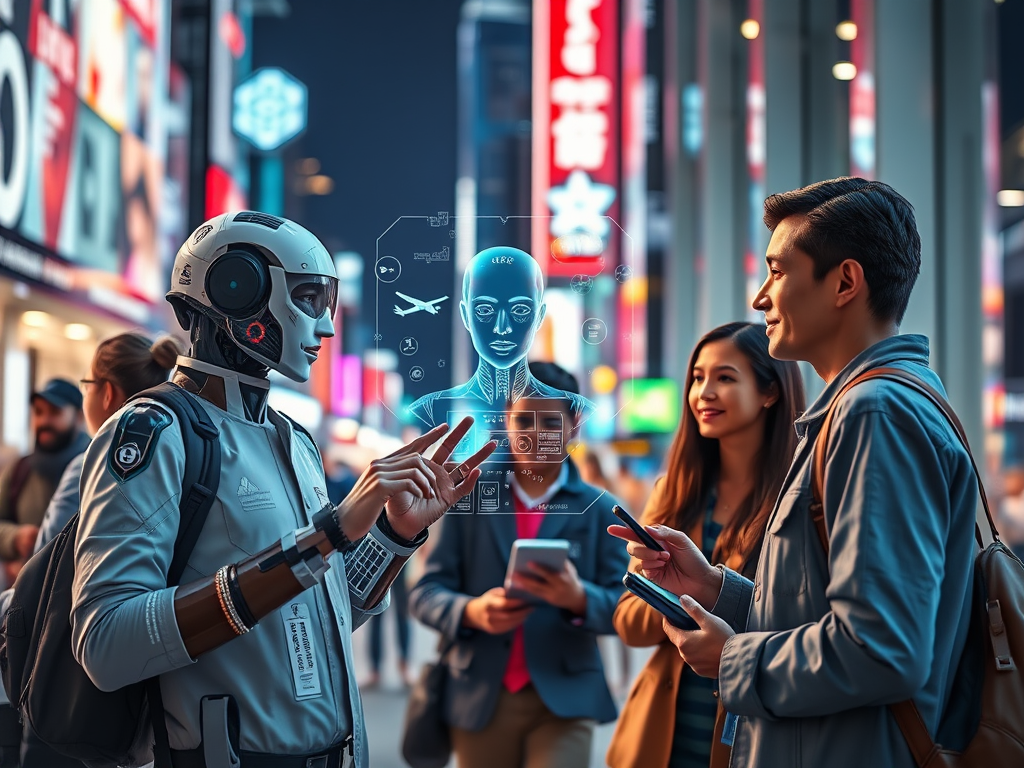
The transition from technology being a tool we use to a utility that works for us has officially arrived. With the release of Gemini 3 Flash and the rise of agentic AI, the digital landscape has undergone a seismic shift. This isn’t just about a smarter chatbot; it’s about a fundamental change in how we interact with the world around us. In this article, we explore the top ten ways this revolution is reshaping our daily existence, from the way we work to the way we heal.
1. The Rise of the Autonomous AI Agent
For years, we have treated artificial intelligence like a high-tech encyclopedia—you ask a question, and it gives you an answer. However, the Gemini 3 revolution has introduced us to the era of the AI agent. An agent is different from a simple chatbot because it doesn’t just talk; it acts. Imagine having a personal assistant who doesn’t just tell you which flights are available but actually goes into your calendar, checks your preferences, finds the best deal, and presents you with a “ready-to-click” booking.
This shift toward agentic workflows means AI can now plan and execute multi-step tasks across different applications. If you tell a personal AI assistant to “organize a birthday dinner,” it can look up restaurants, message your friends on WhatsApp to check their availability, and set a calendar invite once everyone agrees. This moves the technology from a “query-and-response” model to a “goal-and-execution” model. It’s like moving from a manual screwdriver to a robotic assembly line; the human provides the vision, and the autonomous agents handle the repetitive, complex logistics. This foundational change is the bedrock of the modern digital assistant experience, making our daily schedules feel significantly lighter.
2. Real-Time Thought Streaming and Deeper Reasoning
One of the most mind-blowing features of the new Gemini 3 Pro and Deep Think modes is real-time thought streaming. In the past, AI felt like a black box—you put a prompt in, and an answer came out. Now, we can actually see the “internal reasoning” of the machine as it works through a problem. This is a breakthrough in model transparency and interpretability. When you ask a complex question about physics or law, the AI shows its work, outlining the different paths of logic it is considering before settling on the best one.
This parallel reasoning allows the model to tackle problems that used to be too “thorny” for computers. It uses long-context understanding to read through thousands of pages of information in seconds, connecting dots that a human might miss. Think of it like a master detective who doesn’t just give you the name of the culprit but walks you through every clue, every fingerprint, and every motive in real-time. This level of frontier intelligence ensures that the answers we receive aren’t just fast; they are deeply considered and verified against a massive web of data, reducing the risk of “hallucinations” or errors that plagued earlier generations of tech.
3. Your New Personal Coding Partner: Vibe Coding
In the past, writing software was a skill reserved for those who spent years learning complex languages like C++ or Python. The introduction of agentic development platforms like Google Antigravity has turned this on its head with a concept called vibe coding. Essentially, if you can describe it, the AI can build it. You don’t need to know where the semicolons go; you just need to explain the “vibe” or the function of the app you want to create.
By using multimodal reasoning, Gemini 3 can listen to your voice, look at a rough sketch you drew on a napkin, and transform those unstructured thoughts into a fully functioning piece of software. It’s like having a world-class engineer sitting next to you who can read your mind. Whether you want to build a custom budget tracker or a simple game for your kids, the barrier to entry has vanished. This low-code and no-code movement, powered by AI-assisted software development, is democratizing technology, allowing anyone with an idea to become a creator. It turns the computer from a static machine into a dynamic canvas that responds to human creativity in real-time.
4. The Final End of the Language Barrier
We have had translation apps for a long time, but they often felt clunky, losing the “soul” of the conversation or failing to understand local slang. The Gemini 3 era has brought about native multimodality in translation, meaning the AI understands the intonation, emotion, and cultural context of speech. It doesn’t just translate words; it translates meaning. This is “universal translation” in its truest form, operating with Flash-level latency so there is no awkward pause between sentences.
Imagine wearing a pair of smart glasses or using your phone during a trip to a foreign country. As someone speaks to you in a different language, you hear their voice in your own language, with their original tone and emotion preserved. This real-time speech-to-speech interaction is changing how we travel, do business, and connect with people from different backgrounds. By removing the friction of communication, Gemini 3 Flash is effectively shrinking the world, making global collaboration as easy as talking to a neighbor. It’s not just about words anymore; it’s about the seamless flow of human connection across every border.
5. Finding New Medicines at Warp Speed
While many of us use AI for daily tasks, some of the most profound changes are happening in the laboratory. The Gemini 3 revolution is a massive win for the natural sciences. Because these models can process multimodal datasets—including genomic data, chemical structures, and thousands of medical journals—they are helping scientists discover new medicines and treatments in a fraction of the time it used to take.
Using scientific reasoning, the AI can simulate how different drug compounds will interact with the human body, spotting potential side effects before a single physical test is even conducted. This is particularly vital in fields like precision medicine, where treatments are tailored to an individual’s specific genetic makeup. The AI acts as a “subject librarian” and a “research partner,” synthesizing decades of research to suggest new avenues for curing diseases like cancer or Alzheimer’s. By automating the “data crunching” part of science, we are freeing up human researchers to focus on the big breakthroughs, potentially adding years to the average human lifespan through AI-powered healthcare innovations.
6. Automating the Boring Daily Chores
We all have those “invisible” tasks that eat up our time: filing emails, paying bills, scheduling appointments, and organizing digital photos. The agentic capabilities of the latest AI models are designed to take these chores off our plates entirely. By integrating with your most-used apps—like Gmail, Calendar, and Drive—Gemini 3 can act as a proactive manager for your digital life.
You might ask your assistant to “find all the receipts from my last business trip and put them in a spreadsheet,” and it will go through your inbox, extract the data from PDFs, and organize it perfectly. It can even handle scheduled actions, such as sending you a morning summary of your top priorities or checking your favorite news sites for specific updates while you sleep. This isn’t just a time-saver; it’s a stress-reducer. By handling the “cognitive load” of modern life, these autonomous workflows allow us to spend more time on things that actually matter, like family, hobbies, or creative work. The AI has “grown up and got a job,” and that job is making your life run more smoothly.
7. AI in the Physical World: The Robotics Leap
For a long time, AI lived inside our screens, but Gemini Robotics 1.5 has brought that intelligence into the physical world. By treating video and sensory data as a “temporal stream,” Gemini 3 allows robots to understand the world much more like humans do. This is a leap in general-purpose robotics, where machines are no longer programmed for just one task but can learn to navigate complex, changing environments.
In the home, this might look like a robot that can not only vacuum but also pick up toys, sort laundry, or even help with basic cooking tasks by following a video recipe. In a warehouse or hospital, these physical AI agents can move supplies and assist humans with heavy lifting or delicate procedures. The multimodal perception allows these machines to “see” a problem and “reason” through a physical solution, such as how to grip a fragile glass without breaking it. As AI merges with advanced hardware, the line between “digital assistant” and “physical helper” is blurring, promising a future where robots are as common as kitchen appliances.
8. Creating Art and Video from a Single Word
The creative world has been transformed by generative capabilities that allow anyone to turn a spark of an idea into a cinematic reality. With models like Veo 3.1 and Gemini 3, the quality of AI-generated art and video has reached a point where it is indistinguishable from professional work. This is more than just a filter; it’s a new form of multimodal fluency where the AI understands the principles of lighting, physics, and storytelling.
A filmmaker can now describe a scene—”a neon-lit city in the rain with a 1940s noir vibe”—and the AI can generate a high-definition video clip that follows those exact instructions. For artists, it means being able to iterate on ideas at lightning speed, using the AI to expand a single sketch into a full gallery of concepts. While this raises important questions about the nature of art, it also acts as a massive “imagination multiplier.” It allows people who might not have the technical skills of a painter or a cinematographer to share their unique visions with the world, making the creative workflow more inclusive and expansive than ever before.
9. The Energy Cost of Smart Tech: Efficiency Matters
As we use more AI, a major concern has emerged: how much energy does all this “thinking” take? The Gemini 3 revolution has placed a massive emphasis on model efficiency. The launch of Gemini 3 Flash was specifically designed to provide high-level reasoning while using 30% fewer tokens and significantly less power than previous versions.
This push for efficiency is crucial for making AI sustainable. By using a Mixture-of-Experts (MoE) architecture, the model only activates the parts of its “brain” that are necessary for a specific task, much like how your brain doesn’t use the same regions to walk as it does to solve a math problem. This makes the technology faster and cheaper to run, which is why it can now be integrated into everything from your smartwatch to your car’s dashboard without draining the battery instantly. This focus on the “Pareto frontier” of quality versus cost ensures that the benefits of AI don’t come at an unsustainable environmental price, making green AI a central pillar of the 2025 tech landscape.
10. Staying Safe in a World of Smart Machines
With great power comes the need for great responsibility. As AI becomes more agentic and autonomous, AI safety and ethics have moved to the forefront of the conversation. The latest models are built with a “most rigorous safety profile,” including automated evaluation systems that act as a judge to catch errors or biased responses before they reach the user.
Staying safe means ensuring that AI agents always ask for confirmation before doing something big, like making a purchase or sending a sensitive email. It also involves data sovereignty, where you have total control over what the AI remembers and how your information is used. Developers are focusing on sovereign AI and privacy-preserving techniques, like running some tasks locally on your device rather than in the cloud. By building a “closed-loop system” for safety, where the AI constantly monitors its own behavior and adjusts, we are creating a digital environment where we can enjoy the benefits of automation without losing control. Trust is the final frontier of the AI revolution, and it’s being built through transparency, reliability, and human-centric design.
Further Reading
- The Age of AI: And Our Human Future by Henry A. Kissinger, Eric Schmidt, and Daniel Huttenlocher
- Co-Intelligence: Living and Working with AI by Ethan Mollick
- Scary Smart: The Future of Artificial Intelligence and How You Can Save Our World by Mo Gawdat
- Human Compatible: Artificial Intelligence and the Problem of Control by Stuart Russell
Keep the Discovery Going!
Here at Zentara, our mission is to take tricky subjects and unlock them, making knowledge exciting and easy to grasp. But the adventure doesn’t stop at the bottom of this page. We are constantly creating new ways for you to learn, watch, and listen every single day.
Watch & Learn on YouTube
Visual learner? We publish 4 new videos every day, plus breaking news shorts to keep you smarter than the headlines. From deep dives to quick facts, our channel is your daily visual dose of wonder.
Click here to Subscribe to Zentara on YouTube
Listen on the Go on Spotify
Prefer to learn while you move? Tune into the Zentara Podcast! We drop a new episode daily, perfect for your commute, workout, or coffee break. Pop on your headphones and fill your day with fascinating facts.
Click here to Listen on Spotify
Every click, view, and listen helps us keep bringing honest knowledge to everyone. Thanks for exploring with us today—see you out there in the world of discovery!




Leave a Reply