
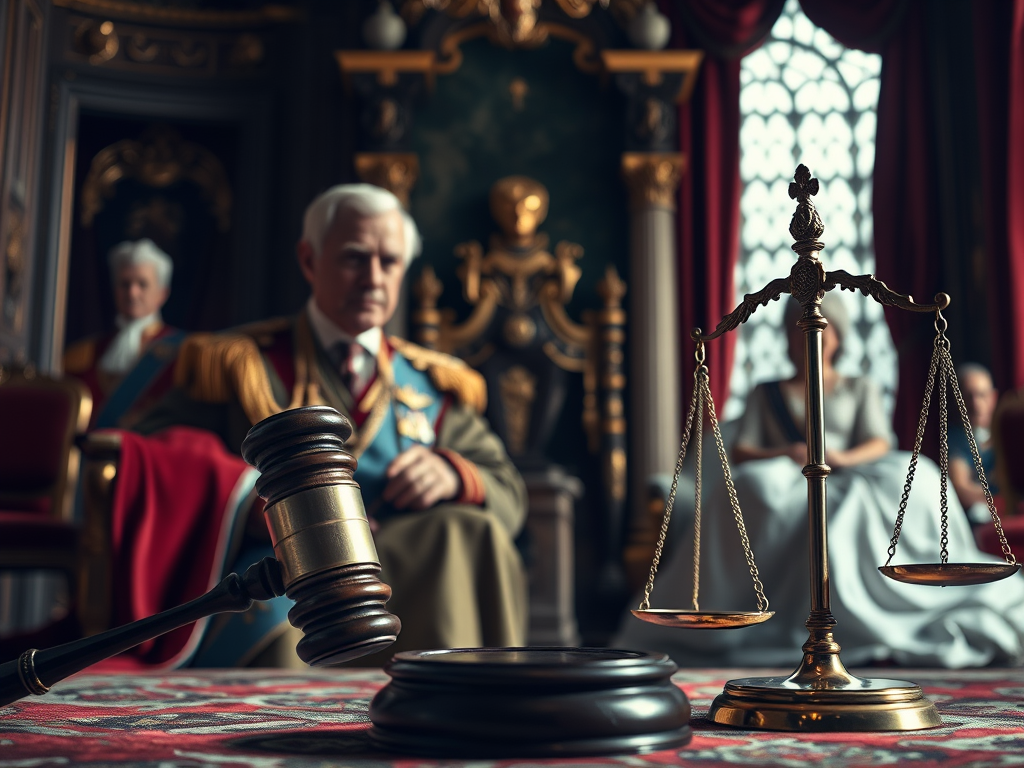
The arrest of Andrew Mountbatten-Windsor on February 19, 2026—his 66th birthday—sent shockwaves through the global community. Following allegations surfaced in the “Epstein Files” regarding his time as a UK trade envoy, the former prince was detained by Thames Valley Police on suspicion of misconduct in public office. This unprecedented event has forced the public to confront a question that was once unthinkable: How does the law actually apply to the British Royal Family?
While King Charles III has stated that “the law must take its course,” the intersection of royal tradition and modern justice is a complex web of ancient statutes and 21st-century accountability. Here are the top 10 historic and legal facts you need to know to understand this turning point in the British Monarchy.
1. Decoding the “Line of Succession”
The Line of Succession is essentially the “waiting list” for the throne. It is governed by both common law and the Act of Settlement 1701. Currently, Andrew Mountbatten-Windsor remains eighth in line to the throne, despite no longer being a working royal or holding the title of “His Royal Highness.”
Being in the line of succession does not grant a person legal immunity; rather, it is a statement of hereditary right. However, if a person in the line of succession were to be convicted of a serious crime, it would create a constitutional crisis. While the Succession to the Crown Act 2013 modernized the rules (such as allowing the eldest child to inherit regardless of gender), it does not automatically remove someone from the line due to criminal investigation. Only an Act of Parliament can legally strike a person from the succession list, a move that is historically rare but now being discussed by constitutional experts.
2. Can a Royal Actually Be Arrested?
The short answer is yes—but with a major caveat. There is a distinction between the Sovereign (the King) and “Members of the Royal Family.” Under the principle of Sovereign Immunity, the King cannot be arrested or be the subject of civil or criminal proceedings in his own courts. This is because the legal system operates in the King’s name; essentially, the King cannot sue himself.
However, this protection does not extend to his relatives. While senior royals were historically shielded by “Royal Prerogative” and a culture of deference, that shield has vanished in the modern era. As seen with the arrest of Andrew Mountbatten-Windsor at the Sandringham estate, police do not need the King’s permission to detain a member of the family for a suspected crime. The 2026 arrest proves that while the King is the “fount of justice,” his family members are subject to the same police procedures as any other citizen.
3. The 400-Year-Old Ghost of King Charles I
To find the last time a high-ranking royal faced such severe legal peril, we have to look back to 1647. During the English Civil War, King Charles I was taken into custody by Parliamentary forces. His subsequent trial for “high treason” was a landmark moment in world history, leading to his execution in 1649.
Charles I’s trial established the revolutionary legal principle that the monarch is not an absolute power but is bound by the laws of the land. While the 2026 arrest of Andrew is for misconduct in public office rather than treason, the historical parallel is striking. Commentators have noted that not since the 17th century has the “integrity of the crown” been so directly challenged by the legal system. This historic precedent reminds us that the British legal system has spent centuries slowly dismantling the idea that royal blood provides a “get out of jail free” card.
4. What “Misconduct in Public Office” Means
The specific charge against Andrew Mountbatten-Windsor is misconduct in public office (MiPO). This is a “common law” offense, meaning it isn’t defined by a single written act but by centuries of court rulings. It applies when a public official willfully neglects their duty or abuses their power to such a degree that it amounts to an abuse of the public’s trust.
In this case, the investigation centers on Andrew’s role as the UK’s Special Representative for International Trade and Investment between 2001 and 2011. Allegations from the Epstein Files suggest he may have shared sensitive or confidential government documents with the late Jeffrey Epstein. Because the role of trade envoy is considered a “public office,” the law treats any abuse of that position with extreme severity. If convicted, MiPO carries a maximum sentence of life imprisonment, highlighting that the law views the betrayal of public trust as one of the most serious crimes a person can commit.
5. How Titles are Stripped (The Letters Patent)
Many wonder why Andrew is now referred to as “Mr. Mountbatten-Windsor” or “the former prince” in news reports. This is the result of Letters Patent—legal documents issued by the Sovereign. In early 2022, the late Queen Elizabeth II stripped Andrew of his military affiliations and “Royal Highness” (HRH) status, though he technically remained a prince by birth.
Removing the title of “Prince” or “Duke” entirely is more difficult. Under the Titles Deprivation Act 1917, the monarch has the power to remove peerages, but it usually requires a formal process involving the Privy Council. In the wake of the February 2026 arrest, there is growing pressure for the King to issue a new Letters Patent to formally and permanently remove all remaining titles. This would be a symbolic “legal divorce” between the individual and the institution of the Monarchy.
6. The Role of the King vs. The Law
One of the most significant moments of the 2026 crisis was King Charles III’s public statement: “The law must take its course.” This was not just a personal sentiment; it was a profound constitutional statement. In a Constitutional Monarchy, the King reigns but does not rule. He must remain politically neutral and respect the independence of the judiciary.
If the King had attempted to block the Thames Valley Police or influence the investigation, it would have likely triggered a “constitutional meltdown” and calls for the abolition of the monarchy. By standing aside, Charles is reinforcing the Rule of Law. This highlights a fundamental fact: the modern British Monarchy survives only as long as it respects the democratic and legal institutions of the United Kingdom. The King is the “Head of State,” but the Law is the “Head of the Land.”
7. What Happens to the “Eighth in Line”?
As the eighth in line to the throne, Andrew’s legal status creates a logistical headache for the government. Usually, those high in the succession list receive state-funded security (Royalty and Specialist Protection). However, since being “stepped back” from duties, Andrew’s security has been a point of contention.
His arrest and “release under investigation” mean that he is currently a private citizen under police scrutiny, yet he still holds a place in the line of succession. If he were to be charged and convicted, it would mark the first time in modern history that a person in the direct line of succession served a prison sentence. Legal experts are currently debating whether a prisoner can technically remain a “Counsellor of State”—one of the senior royals who can stand in for the King if he is ill or abroad. Most agree that Parliament would move to change the law to prevent such a scenario.
8. How Parliament Can Change Royal Rules
While the Monarchy feels like an ancient, unchanging entity, it is actually subject to the will of Parliament. This is known as Parliamentary Sovereignty. If the King and the legal system find themselves at an impasse regarding a member of the Royal Family, Parliament can simply pass a new law to fix it.
For example, the Succession to the Crown Act 2013 was passed to ensure that Princess Charlotte wouldn’t be “bumped down” the line by her younger brother. Similarly, if Andrew’s legal troubles continue to damage the institution, Parliament could pass an “Andrew Mountbatten-Windsor Bill” to formally remove him from the line of succession and strip his remaining titles. This power ensures that the people, through their elected representatives, always have the final say over how the Royal Family is structured and governed.
9. Famous Royal Legal Battles of the Past
While the 2026 arrest is unprecedented, the Royal Family has had “brushes” with the law before. In 2002, Princess Anne became the first senior royal in modern times to be convicted of a criminal offense. She pleaded guilty to a charge under the Dangerous Dogs Act after her bull terrier bit two children in Windsor Great Park. She was fined £500 but was not arrested.
Other instances include Prince Philip, who was investigated (but not charged) following a car crash in 2019, and the various speeding fines accumulated by younger royals over the years. However, these were all “summary offenses”—minor legal matters. The 2026 investigation into misconduct in public office is an “indictable offense,” the most serious category in English law. It moves the conversation from “unfortunate accidents” to “alleged criminal corruption,” marking a dark new chapter in royal legal history.
10. Why This Changes the Monarchy Forever
The arrest of Andrew Mountbatten-Windsor is widely seen as the “death of royal deference.” For centuries, the Royal Family was protected by a “veil of secrecy” and a public unwilling to “poke about” the institution. As historian Anna Whitelock noted in early 2026, the public now expects transparency and accountability above all else.
This event has shattered the “aura” of the Monarchy. It proves that the “firm” is no longer a protected class but a group of individuals who must answer to the public and the police. Moving forward, the Monarchy will likely become smaller, more transparent, and more legally defined. The “Geneva of the Royals”—the idea that they are a neutral, untouchable space—is gone. In its place is a modern institution that must prove its value and its integrity every single day under the watchful eye of the law.
Further Reading
- “The Diamond Queen” by Andrew Marr: A detailed look at how the late Queen navigated the intersection of family and the law.
- “The Gilded Cage” by Robert Jobson: An exploration of the modern challenges facing the House of Windsor and King Charles III.
- “Battle of Brothers” by Robert Lacey: A deep dive into the internal family dynamics that have led to the current institutional crisis.
“On Monarchy” by Vernon Bogdanor: The definitive academic text on the constitutional and legal rules that govern the British Crown.




Leave a Reply