
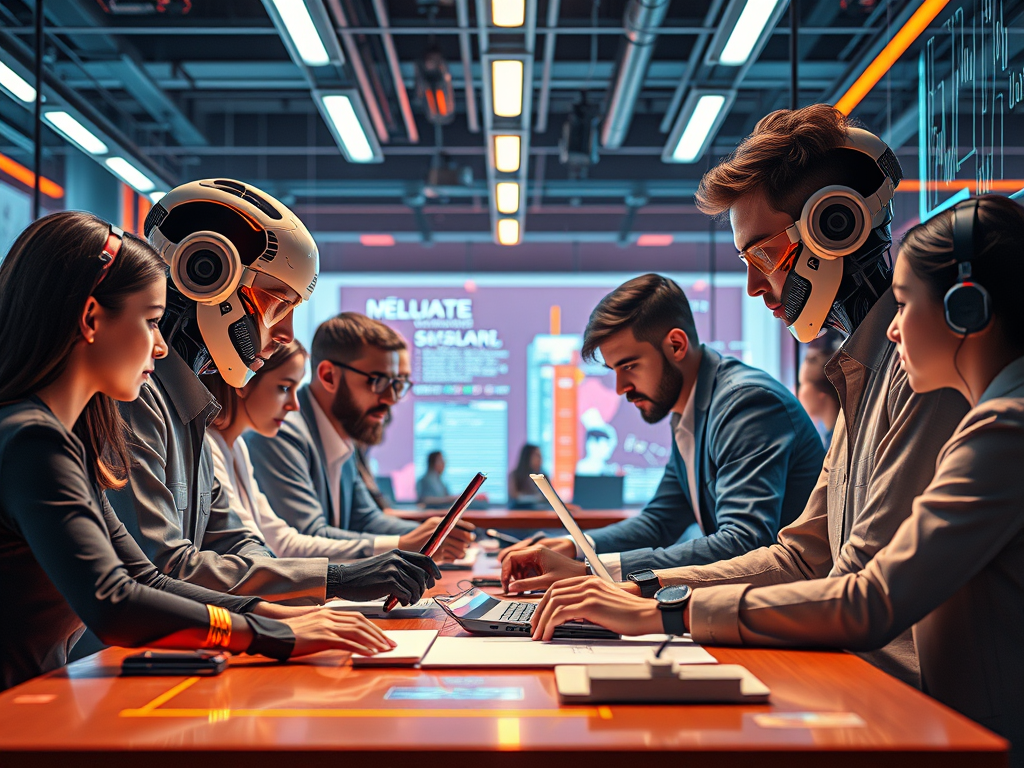
The workplace of 2026 has officially moved past the “AI hype” phase and into the era of the Silicon Workforce. This is not a world of metallic robots sitting at desks, but rather a sophisticated ecosystem of autonomous AI agents that work alongside human professionals. As of June 2025 and into early 2026, the primary conversation in enterprise leadership has shifted from “Will AI replace me?” to “How do I manage my digital labor?”
Understanding the silicon workforce is essential for any professional navigating the modern economy. It represents a fundamental redesign of productivity, where human judgment is the “control center” and silicon intelligence is the “engine.” Below are the top 10 foundational strategies and concepts that define this new era of human-AI synergy.
1. The Great Transition: From Passive Chatbots to Autonomous Agents
The most significant shift in the silicon workforce is the move from “Copilots” to “Agents.” In the early 2020s, we “chatted” with AI. We gave it a prompt, and it gave us a response. Today, however, the silicon workforce is composed of agentic AI—systems designed not just to talk, but to do.
An autonomous agent doesn’t wait for a human to click “run” at every step. Instead, it is given a goal—for example, “Optimize our shipping logistics for a 15% cost reduction by Friday”—and it proceeds to research data, contact vendors, and simulate outcomes independently. It acts as a digital worker that continues to progress toward a goal until it is achieved. Think of it like the difference between a voice-controlled light switch (Copilot) and a smart thermostat (Agent); one requires an instruction for every action, while the other understands the desired outcome and manages the complexity in the background. This transition is the cornerstone of digital labor today.
2. The Human Shift: Becoming the Orchestrator, Not the Operative
In a world where silicon can handle repeatable cognitive tasks, the human role has undergone a dramatic transformation. We are moving from being “operatives”—the people who do the work—to being orchestrators. Orchestration is the art of defining intent, setting ethical boundaries, and providing the final approval for an agent’s actions.
Imagine a conductor of an orchestra. The conductor doesn’t play every instrument; instead, they ensure that every musician (or in this case, every AI agent) is in sync, following the correct tempo, and contributing to the overall harmony of the piece. As a human worker in the silicon workforce, your value is no longer in how many spreadsheets you can fill, but in your ability to manage a team of agents to produce a strategic result. This shift requires a high level of decision intelligence, as you must be able to spot subtle errors in an agent’s logic before they compound into major business risks.
3. Job Unbundling: Why Roles are Dissolving into Dynamic Task Clusters
The silicon workforce is forcing us to rethink what a “job” actually is. We are seeing a phenomenon known as job unbundling, where traditional job descriptions are being broken down into individual tasks. Some of these tasks are perfectly suited for silicon (data analysis, scheduling, routine drafting), while others remain firmly in the human domain (empathy, complex negotiation, ethical reasoning).
For example, a marketing manager’s role is no longer a monolith. The AI might handle the “unbundled” tasks of real-time ad spend optimization and A/B testing across 50 channels, while the human manager focuses on the creative storytelling and brand strategy that build a soul for the company. By viewing work as a collection of tasks rather than a static role, organizations can more effectively deploy their hybrid workforce to maximize both speed and creativity.
4. Building for Agency: Why Your Current Business Architecture is Broken
One of the harshest lessons of 2025 was that you cannot simply “bolt on” AI agents to a business process designed for humans. Most organizations are built around “human-compatible” workflows—meaning they involve manual sign-offs, legacy software interfaces, and physical breaks. To leverage the silicon workforce, companies must redesign for agentic orchestration.
This involves building agent-compatible architectures, which typically use microservices and “knowledge graphs” that allow AI to navigate enterprise data without needing a human to explain where the files are located. If an agent has to wait three days for a human to approve a $10 purchase, the speed advantage of the silicon workforce is lost. Leading organizations are now creating “fast-track” protocols for agents, allowing them to operate at the speed of light within predefined guardrails, fundamentally changing the future of work.
5. The Digital Onboarding: Training Silicon Workers for Enterprise Context
We used to think of “training” as something only humans needed. In 2026, digital onboarding is a critical operational discipline. An AI agent might be “intelligent” out of the box, but it doesn’t know your company’s specific culture, its “unwritten rules,” or its unique relationship with a long-term client.
Just as you wouldn’t expect a new human hire to know the filing system on day one, an AI agent must be “onboarded” by connecting it to the company’s internal data and fine-tuning it on historical success metrics. This process ensures that the silicon workforce doesn’t just produce generic results, but results that are deeply contextualized to your business. The “Human in the Loop” (HITL) strategy is essential here: humans monitor the agent’s early outputs, providing feedback that “refines” the agent’s model until it reaches a level of trust equivalent to a senior employee.
6. Accountability 2.0: Managing Performance with Cryptographic Receipts
One of the biggest hurdles for the silicon workforce is the “black box” problem—how do we know why an AI made a certain decision? To solve this, the industry has moved toward Accountability 2.0, which uses immutable logs and “cryptographic receipts” to track every action an agent takes.
In this new framework, transparency is not an afterthought; it is a requirement. Performance management for agents involves auditing these logs to ensure the agent hasn’t developed “bias” or “drift.” This is particularly vital in regulated industries like finance or healthcare. If an agent at an insurance company denies a claim, there must be a clear, traceable path showing the data points it used. This level of traceability ensures that humans can remain legally and ethically accountable for the work performed by their silicon counterparts.
7. Guarding Against “Agentic Enshittification” in the Rot Economy
As we deploy agents at scale, there is a risk of what digital historian Cory Doctorow calls “enshittification”—a process where digital systems eventually sacrifice user value for efficiency or profit. In the silicon workforce, this takes the form of the Rot Economy, where AI agents interact primarily with other agents, creating a closed-loop system that loses its connection to real human needs.
Imagine an AI-led marketing agent creating content specifically to be “liked” by an AI-led social media scraper, which then informs an AI-led strategy bot. Without human intervention, the system can quickly spiral into a cycle of mediocre, soulless output that “looks” productive on a chart but provides zero value to actual customers. To combat this, the silicon workforce must be anchored by human-centered design. We must constantly ask: Is this agent solving a real human problem, or is it just lowering the cost of being mediocre?
8. The Democratization of Expertise: Leveling the Professional Playing Field
Perhaps the most positive aspect of the silicon workforce is the democratization of expertise. In the past, specialized knowledge—like complex tax law, coding, or high-end data science—was gatekept by those with expensive degrees or years of niche experience. Today, AI agents can act as “expertise multipliers.”
A junior analyst with a well-orchestrated team of agents can now perform the work that previously required a team of five senior consultants. This doesn’t make the senior consultants obsolete; it raises the “floor” of what a single professional can achieve. For small businesses, this is a revolutionary equalizer. It allows a three-person startup to leverage the same level of technical fluency and operational power as a Fortune 500 company, provided they understand how to manage their silicon assets effectively.
9. Decision Intelligence: The New High-Stakes Skill for 2026
In 2026, the most valuable skill on a resume isn’t “coding” or “Excel”—it’s Decision Intelligence. This is the ability to evaluate AI-generated recommendations and decide when to trust them and when to override them. As AI handles the “heavy lifting” of data analysis, the human “final say” becomes the most critical point in the value chain.
Think of it as the “pilot’s dilemma.” Modern airplanes can fly themselves most of the time, but when a “Black Swan” event occurs—an unpredictable, high-impact storm or a mechanical failure—the human pilot’s judgment is what saves the day. In the silicon workforce, your job is to handle the “edge cases”—the moments where the data is ambiguous, the ethics are murky, or the human stakes are high. Developing this hybrid skillset of technical literacy and moral reasoning is the key to long-term career security.
10. The 24/7 Global Synthetic Supply Chain: Productivity Beyond Human Hours
The final thing to know is that the silicon workforce has created the first truly synthetic supply chain. Because AI agents do not need sleep, weekends, or health insurance, productivity is no longer tied to human biological limits. This allows for a “follow-the-sun” model of work that is truly 24/7.
While a human team in London sleeps, their silicon agents are processing data, drafting reports, and preparing the “desk” for the next day. This creates a relentless pace of fintech innovation and operational speed. However, this also presents a challenge for human well-being. If the “silicon half” of the team is working 168 hours a week, the human half must be careful not to feel pressured to match that pace. The goal of the silicon workforce is to “Free the Human Spirit”—automating the grind so that people can focus on what truly matters: creativity, connection, and purpose.
Further Reading
- The Age of AI by Henry A. Kissinger, Eric Schmidt, and Daniel Huttenlocher
- Work Disrupted: Opportunity, Resilience, and Growth in the Accelerated Future of Work by Jeff Schwartz
- Human + Machine: Reimagining Work in the Age of AI by Paul R. Daugherty and H. James Wilson
- The Coming Wave: Technology, Power, and the Twenty-first Century’s Greatest Dilemma by Mustafa Suleyman
The Wealth of Humans: Work and Its Absence in the Twenty-first Century by Ryan Avent




Leave a Reply