
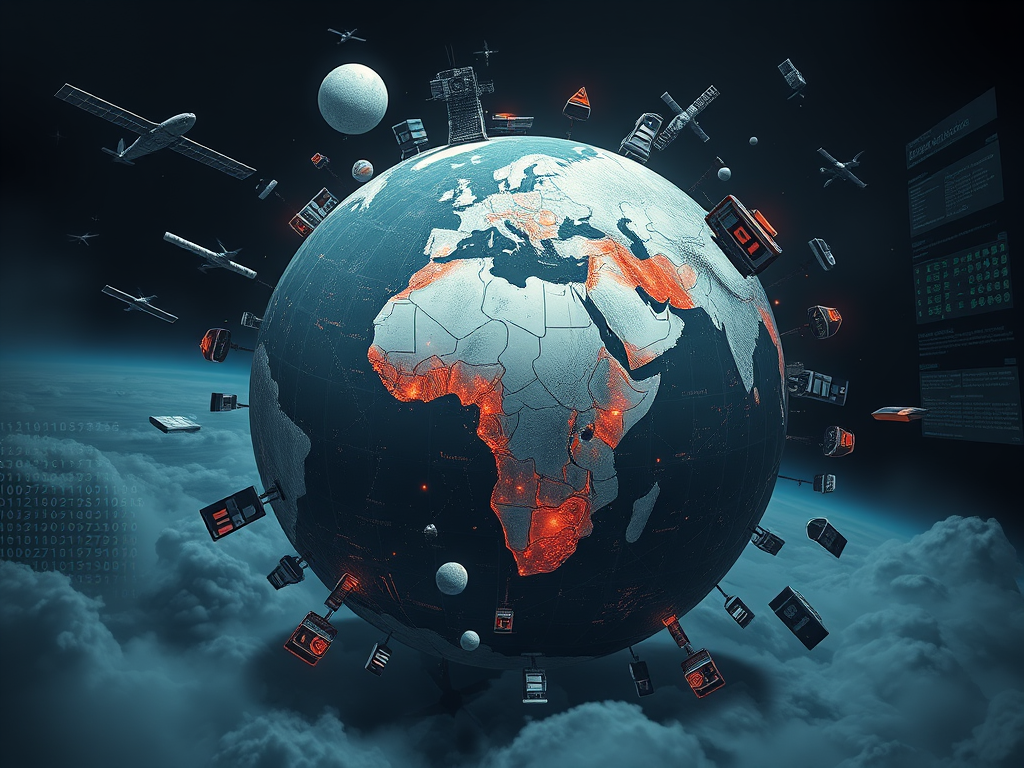
As we move deeper into the second half of this decade, the world feels increasingly like a high-stakes game of Jenga. We often focus on the obvious “blocks” being pulled—inflation, election cycles, or the latest social media trend—but beneath the surface, several structural risks are vibrating with tension. The World Economic Forum recently labeled 2026 the beginning of the “Age of Competition,” a period where cooperation is a luxury and strategic friction is the norm.
Understanding the global risks 2026 landscape requires looking past the loud headlines and examining the silent, compounding threats that could reshape our lives. These aren’t just “what-if” scenarios; they are active trends in geopolitical instability and economic volatility that are currently flying under the radar. From the bottom of the ocean to the edge of the atmosphere, here are the top 10 risks we need to start discussing today.
1. Geoeconomic Confrontation: The Weaponization of Everyday Trade
For decades, we viewed global trade as a “win-win” peace project. In 2026, that era has officially ended, replaced by geoeconomic confrontation. This isn’t just a simple trade war over steel or grain; it is the strategic weaponization of essential supply chains. Imagine a world where your access to high-end electronics or affordable medicine depends entirely on whether your government is “in sync” with the country that mines the necessary rare earth minerals.
This risk focuses on the use of economic policy tools—such as export controls and investment restrictions—to achieve political leverage. It’s like a game of chess where the board itself is the global economy. When nations use “economic weapons,” they create a fragmented market where efficiency is sacrificed for security. This leads to supply chain disruption that drives up prices and slows down innovation. For the average consumer, this means “just-in-time” delivery might become “if-and-when” delivery, making the global marketplace far more unpredictable and expensive.
2. The Third Nuclear Era: AI and the Automation of Armageddon
We often think of nuclear risk through the lens of the Cold War—two superpowers with their fingers on the “red button.” However, we have entered a Third Nuclear Era that is much more complex. This new era is defined by the integration of artificial intelligence and space-based assets into command-and-control systems. The danger here isn’t necessarily a calculated, intentional strike, but a high-speed accident caused by automated decision-making.
In this landscape, AI-driven surveillance might misinterpret a routine satellite move or a test flight as an incoming attack. Because AI processes data faster than human reflection, the window for diplomacy closes in seconds. This is a profound shift in geopolitical conflict dynamics. We are moving away from the “balance of terror” toward a “fragility of speed.” If the algorithms managing our defense systems lack transparency or “hallucinate” threats, the risk of accidental escalation becomes a terrifyingly real possibility that few are discussing in public forums.
3. Space Debris and Orbital Congestion: The Closing of the Sky
Our modern lives—GPS, banking, weather forecasting, and internet connectivity—rely on a thin shell of satellites orbiting Earth. Yet, we are currently facing a crisis of orbital congestion. With thousands of new satellites launched annually, the probability of a “Kessler Syndrome” event—a chain reaction where one collision creates thousands of pieces of shrapnel that destroy other satellites—is at an all-time high.
Think of it like a highway where everyone is driving at 17,000 miles per hour, but there are no lanes and the road is littered with invisible bricks. If a major collision occurs, it could render specific orbits unusable for decades, essentially “blinding” our modern civilization. This technological risk is often ignored because space feels vast and empty, but the reality is that our “digital sky” is becoming a junkyard. Losing satellite infrastructure would trigger an immediate economic downturn and disrupt everything from global shipping to emergency services.
4. Quantum Decryption: The “Y2Q” Moment for Cybersecurity
You’ve likely heard of quantum computing as a tool for miracle drugs or new materials, but its darker side is a looming cybersecurity threat 2026 experts call “Y2Q.” Most of our current encryption—the digital “locks” on our bank accounts, private messages, and state secrets—is based on math problems that classical computers find impossible to solve. A sufficiently powerful quantum computer, however, could “pick” these locks in seconds.
The risk is that bad actors are already practicing “store now, decrypt later.” They are stealing encrypted data today, waiting for the day they can unlock it with quantum power. This creates a massive cyber insecurity gap. If we don’t transition to “quantum-resistant” encryption fast enough, the entire foundation of digital trust could evaporate. It’s like discovering that every vault in the world can suddenly be opened with a universal key that has just been handed out to the highest bidder.
5. Maritime Cyber-Logistics: The Fragile Linchpin of Trade
While we worry about our laptops being hacked, a more significant risk lies in maritime logistics. Over 80% of global trade travels by sea, managed by a complex web of aging operational technology and modern digital systems. Ports and shipping vessels are becoming prime targets for state-based cyberattacks aimed at causing maximum economic pain.
If a hacker shuts down a major port’s automated crane system or messes with the GPS coordinates of a container ship, it creates a ripple effect throughout the entire global economy. This isn’t a hypothetical fear; we’ve seen small-scale “previews” where port outages led to weeks of delays. In 2026, as geopolitical tensions rise, the ocean’s “digital highways” are a massive, unprotected flank. This supply chain risk could lead to sudden shortages of food and fuel, proving that the most effective way to hurt a country isn’t a bomb, but a well-placed line of code in a shipping manifesto.
6. AI Environmental Drain: The Hidden Cost of the “Cloud”
We often speak of artificial intelligence as a weightless, digital entity, but its physical footprint is massive and growing. The data centers required to train and run advanced AI models consume staggering amounts of electricity and, more importantly, water for cooling. In 2026, this is emerging as a critical environmental risk that could trigger local water wars.
A single conversation with a generative AI can consume as much water as a bottle of soda, and the cumulative effect of millions of these interactions is putting immense strain on local utilities. This creates a conflict between technological progress and resource scarcity. In regions already suffering from climate-driven droughts, the presence of a massive data center becomes a lightning rod for social unrest. We are essentially trading our natural resources for digital “intelligence,” a trade-off that is becoming increasingly unsustainable as extreme weather events become the new normal.
7. Undersea Cable Vulnerability: The Physical Fragility of the Internet
If you picture the internet, you likely imagine satellites or “the cloud.” In reality, 99% of all international data traffic travels through a network of fiber-optic cables on the ocean floor. These cables are the “nervous system” of our global society, and they are surprisingly vulnerable. Whether through accidental ship anchors or intentional sabotage, a cut cable can disconnect entire continents.
In 2026, this has become a significant geopolitical risk. Nations are increasingly aware that cutting these cables is a way to “blind” an adversary without firing a single shot. Because these cables often bunch together in narrow “chokepoints,” a single event can have a catastrophic impact on financial stability and communication. We are living in a digital world built on a very fragile, physical foundation that we are currently doing very little to protect or diversify.
8. Social Fragmentation and the “Gen Z Rebellion”
Across the globe, a sense of “broken promises” is fueling social polarization. Many in the younger generations feel that the “ladders to the good life”—affordable housing, stable careers, and a healthy planet—have been pulled up. This is leading to what sociologists are calling a “Gen Z Rebellion,” characterized by a total retreat from traditional institutions and a loss of faith in the “social contract.”
This risk manifests as political volatility and widespread misinformation and disinformation. When people feel the system no longer works for them, they become susceptible to “populist” narratives that offer simple, often destructive, solutions to complex problems. This fragmentation makes it impossible for societies to agree on basic facts, let alone solve massive issues like climate change impacts. It is the “rot” within the foundation of democracy that makes every other global risk much harder to manage.
9. The Economic Debt Reckoning: A Sovereign Bubble Ready to Burst
Since the pandemic, global debt has reached levels that were previously unimaginable. In 2026, as interest rates remain volatile and growth slows, we are approaching an “economic reckoning.” Many nations, particularly in the developing world, are spending more on interest payments than on health or education. This creates a massive risk of sovereign debt defaults.
Think of it like a household that has been living on credit cards for years. Eventually, the bank stops increasing the limit. If a major economy or a cluster of smaller ones defaults, it could trigger a global asset bubble burst similar to 2008, but with far fewer tools for governments to fix it. This economic instability would wipe out trillions in wealth and lead to a decade of stagnation. We are currently “kicking the can down the road,” but in 2026, the road is quickly running out.
10. Ecological Tipping Points: Biodiversity and the Food Chain
While we talk a lot about “carbon footprints,” we don’t talk enough about biodiversity loss and ecosystem collapse. Our global food system depends on a very narrow range of species and stable environmental conditions. As we push ecosystems past their “tipping points,” we risk a sudden, systemic failure in the food chain.
This isn’t just about losing a few rare species; it’s about the collapse of the insects that pollinate our crops or the health of the oceans that provide protein for billions. When an ecosystem “breaks,” it doesn’t happen slowly—it happens all at once. This ecological collapse is a “multiplier” of all other risks, driving mass migration, fueling geopolitical conflict over fertile land, and creating a world where “food security” is a relic of the past. It is the ultimate “sleeper risk” that underpins every other aspect of human civilization.
Further Reading
- The Uninhabitable Earth: Life After Warming by David Wallace-Wells
- Life 3.0: Being Human in the Age of Artificial Intelligence by Max Tegmark
- Principles for Dealing with the Changing World Order by Ray Dalio
- Deadliest Enemy: Our War Against Killer Germs by Michael T. Osterholm & Mark Olshaker
Keep the Discovery Going!
Here at Zentara, our mission is to take tricky subjects and unlock them, making knowledge exciting and easy to grasp. But the adventure doesn’t stop at the bottom of this page. We are constantly creating new ways for you to learn, watch, and listen every single day.
📺 Watch & Learn on YouTube
Visual learner? We publish 4 new videos every day, plus breaking news shorts to keep you smarter than the headlines. From deep dives to quick facts, our channel is your daily visual dose of wonder.
Click here to Subscribe to Zentara on YouTube
🎧 Listen on the Go on Spotify
Prefer to learn while you move? Tune into the Zentara Podcast! We drop a new episode daily, perfect for your commute, workout, or coffee break. Pop on your headphones and fill your day with fascinating facts.
Click here to Listen on Spotify
Every click, view, and listen helps us keep bringing honest knowledge to everyone. Thanks for exploring with us today—see you out there in the world of discovery!




Leave a Reply