
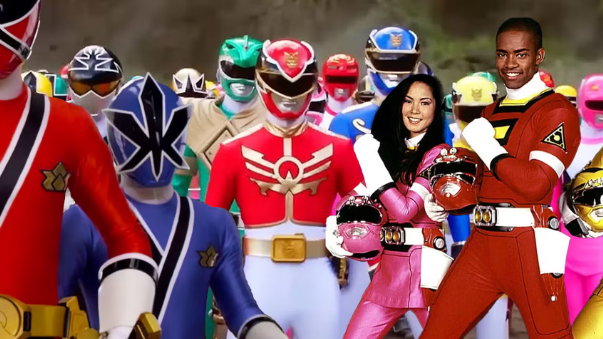
The year was 1993, and television was about to be hit by a technicolor tidal wave that no one—not even the network executives—saw coming. Five teenagers with “attitude,” garbed in spandex and piloting prehistoric mechanical beasts, didn’t just capture the Saturday morning market; they became a global phenomenon. But behind the sparks, the karate chops, and the giant monster battles lies a history as complex and colorful as the Rangers themselves.
To understand Mighty Morphin Power Rangers (MMPR), you have to look past the nostalgia. It was a masterclass in guerrilla filmmaking and a gamble on a “franken-show” format that had never been tried in the West. It bridged the gap between Japanese pop culture and American marketing, creating a blueprint for the “toyetic” television era. Whether you were a child of the 90s or a newcomer curious about the roots of this multi-billion-dollar franchise, these ten facts reveal the grit, the luck, and the creative chaos that powered the Grid.
1. The “Frankenstein” Method: Why the Action Looked So Different
If you ever noticed that the Rangers looked slightly shorter, grainier, or more “Japanese” once they put on their helmets, your eyes weren’t playing tricks on you. Mighty Morphin Power Rangers was built using footage from the Japanese Super Sentai series, specifically the 16th season titled Kyoryu Sentai Zyuranger.
The production team at Saban Entertainment used a “Frankenstein” approach: they filmed American actors for the “civilian” scenes in Angel Grove and then spliced in action footage from Japan for the morphed battles and Megazord fights. This was a revolutionary cost-cutting measure that allowed for high-octane pyrotechnics and complex stunt work on a shoe-string budget. However, it created a surreal disconnect; the Rangers would go from a sunny park in California to a rocky, overcast quarry in Japan in the blink of an eye. This 90s superhero TV show succeeded because it leaned into this campy aesthetic rather than fighting it.
2. The Yellow Ranger’s Secret: Thuy Trang and the Male Stunt Double
One of the most glaring (yet often overlooked) results of using Japanese footage involved the Yellow Ranger, Trini. In the original Japanese Zyuranger series, the character under the yellow helmet (Boi) was a man. This is why, if you look closely at the suits, the Pink Ranger has a skirt, but the Yellow Ranger does not.
When the show was localized for America, the producers cast the talented Thuy Trang as Trini. However, whenever Trini morphed, the footage switched to a male Japanese stunt performer. This led to some funny visual inconsistencies where the Yellow Ranger suddenly appeared more muscular or lacked the feminine physique of Kimberly. This quirk is a staple of Power Rangers trivia, highlighting how the show’s creators prioritized the “Rule of Cool” over perfect visual continuity, effectively teaching a generation of kids that heroics aren’t defined by a silhouette.
3. The Green Ranger Was Originally a Short-Term Guest
It is impossible to imagine the franchise without Tommy Oliver, played by the late Jason David Frank. The Green Ranger is arguably the most iconic character in the show’s history, but he was never meant to stay. Originally, the “Green with Evil” arc was intended to be a one-off mini-series to boost ratings, after which the character would be written out permanently.
However, the “Tommy Mania” that followed was unprecedented. Saban was flooded with fan mail from children begging for the Green Ranger’s return. The producers listened, but they faced a major hurdle: they had run out of Japanese footage of the Green Ranger. To keep him on the team, they had to commission entirely new footage from Japan and eventually “reincarnate” Tommy as the White Ranger using footage from a different Sentai series, Gosei Sentai Dairanger. This pivot solidified Tommy’s legacy and proved that fan-favorite characters could literally change the course of a show’s production.
4. A Multi-Year Battle to Get the Show on Air
Haim Saban, the media mogul behind the series, didn’t just wake up one day and find success. He spent nearly eight years trying to sell the concept of Power Rangers to various networks. Most executives laughed him out of the room, calling the concept of “teens in spandex fighting rubber monsters” too weird, too cheap, or too foreign for American audiences.
It wasn’t until Margaret Loesch, then-head of Fox Kids, saw the potential that the show found a home. Even then, the internal feedback was dismal; after the pilot screened, many at Fox believed it would be a disaster. They aired it during a “death slot” in the summer, expecting it to fade away. Instead, it became the highest-rated children’s show in history within weeks. This origin story of Power Rangers serves as a classic example of “the underdog winning,” mirroring the very themes of the show itself.
5. The “Attitude” of Angel Grove: Diversity as a Foundation
The casting call famously asked for “teenagers with attitude,” but what the creators actually built was one of the most diverse casts on television at the time. While the show has faced retroactive criticism for its accidental color-coding (the Black and Yellow Rangers’ ethnicities), the intent was to create a team that looked like the audience watching.
The five original Rangers represented a mix of backgrounds, interests, and personalities—from the “nerdy” Billy to the “valley girl” Kimberly. For many kids in the 90s, seeing a diverse group of friends working together toward a common goal without internal prejudice was a powerful, if subtle, message. The cultural impact of Power Rangers went beyond toys; it normalized the idea of a multicultural superhero team long before it was a standard industry practice.
6. The “Power” of Low Budgets and Non-Union Work
Despite the show making hundreds of millions of dollars in merchandise, the actual production of the first season was notoriously low-budget. The actors were hired on non-union contracts and worked grueling 12-to-15-hour days, often performing many of their own stunts without the protections modern actors enjoy.
This financial friction eventually led to the first major cast shake-up. In the middle of the second season, Austin St. John (Jason), Walter Jones (Zack), and Thuy Trang (Trini) attempted to negotiate for better pay and union representation. The producers refused, leading to their departure and the introduction of the “Stone Canyon” trio: Rocky, Adam, and Aisha. This behind-the-scenes drama is why the original Red, Black, and Yellow Rangers are suddenly replaced by doubles in heavy disguises for several episodes before the “Power Transfer”—a moment of Power Rangers history that taught fans early on about the realities of the TV business.
7. Lord Zedd Was “Too Scary” for Parents
When the show transitioned into its second season, the producers wanted a villain more menacing than the bumbling Rita Repulsa. Enter Lord Zedd, an original American creation with exposed muscle, a chrome exoskeleton, and a glowing red visor. Unlike Rita, who mostly shouted from her moon base, Zedd was genuinely intimidating.
The backlash was almost immediate. Parents across the country complained that Zedd was “too dark” and “too frightening” for a children’s show. In response, Saban had to “soften” the character. This led to the iconic storyline where Rita Repulsa returns and uses a love potion on Zedd, turning the terrifying warlord into a more comedic, bickering husband. This shift in villain dynamics shows how sensitive the production was to the “moral panic” surrounding children’s media in the 90s.
8. The Show Was Banned in Several Countries
While the US was obsessed with “Morphin Time,” other countries were less than thrilled. Mighty Morphin Power Rangers was actually banned or heavily censored in several regions, including Canada, New Zealand, and parts of Scandinavia. The primary concern? Violence.
Critics argued that the show’s focus on hand-to-hand combat encouraged children to kick and punch each other on the playground. In Malaysia, the show faced a unique hurdle: the word “Morphin” was considered too close to “morphine,” and the government feared it would inadvertently promote drug use. They eventually had to censor the word or change the title. Despite these controversies in children’s television, the show’s popularity only grew, proving that “forbidden fruit” is often the most appealing to a young audience.
9. Bryan Cranston’s Secret Connection to the Blue Ranger
Long before he was Walter White in Breaking Bad, Bryan Cranston was a struggling actor doing voiceover work for Saban. If you listen closely to some of the early monsters, such as “Twin Man” or “Snizard,” you might hear a familiar rasp. Cranston was a regular in the voice-acting booth for the show’s “Monster of the Week” segments.
The show’s creators were so fond of him that they actually named the Blue Ranger, Billy Cranston, after him. While Cranston has joked about the meager paychecks he received back then, the connection remains a beloved piece of MMPR fun facts. It serves as a reminder that even the biggest stars often have humble, “morphin” beginnings in the trenches of genre television.
10. The Legacy of the “Sentai” Suits: Reusing and Recycling
Because the show relied on Japanese footage, the American production often had to get creative when they ran out of “official” suits. Fans might notice that in some scenes, the Ranger suits look slightly baggy or the helmets look different. This was often because the production was using “stunt suits” or domestic replicas that didn’t quite match the high-quality Japanese originals.
Furthermore, many of the monsters seen in the background of Lord Zedd’s palace or in the “Dark Dimension” were actually costumes recycled from other Japanese series like Metal Der or Masked Rider. This culture of creative recycling in TV allowed MMPR to feel like a vast, populated universe on a shoestring budget. It taught the production team how to build an empire out of spare parts, a skill that has kept the franchise running for over 30 continuous seasons.
Further Reading
- “The Power Rangers Ultimate Visual History” by Ramin Zahed and Jody Revenson
- “Lighting the Way” (Biography) by Jason David Frank (Posthumous accounts/articles)
- “A History of Tokusatsu” by various scholars (For context on the Japanese origins)
- “The Fifty-Year Mission: The Next 25 Years” by Edward Gross (Includes insights into the 90s TV landscape)

Leave a Reply