
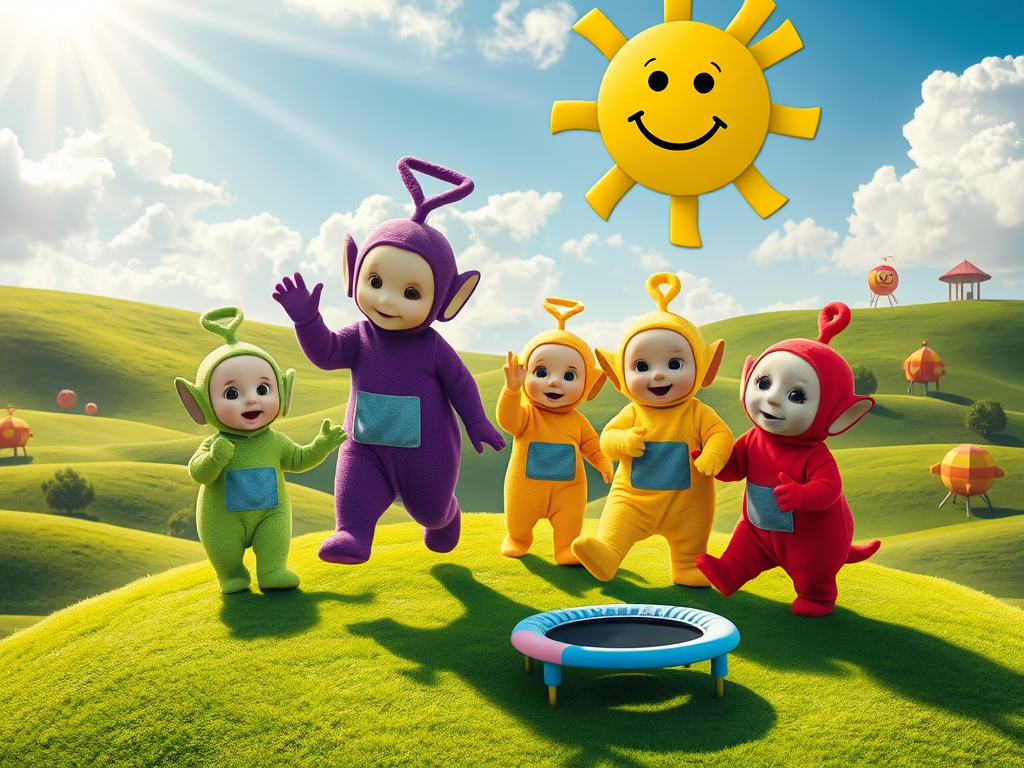
In the late 1990s, a surreal, neon-colored phenomenon swept across the globe, captivating toddlers and confusing adults in equal measure. The Teletubbies was not just a television show; it was a cultural shift in how we approached early childhood development and media consumption. With their television stomachs, antennae-adorned heads, and a penchant for “Tubby Custard,” Tinky Winky, Dipsy, Laa-Laa, and Po became the faces of a new generation of early years education.
Created by Anne Wood and Andrew Davenport of Ragdoll Productions, the series was designed to appeal to the “emergent” child—those between the ages of one and four who were just beginning to grasp the nuances of language and social interaction. However, as the show grew into a multi-billion dollar empire, the behind-the-scenes reality of Teletubbyland became the stuff of legend. From the staggering size of the actors to the secret history of their grassy habitat, there is far more to these “technological babies” than meets the eye.
As of late 2025, the Teletubbies remain a powerhouse in the digital economy, enjoying a massive resurgence on streaming platforms and social media. Here are the top 10 facts you didn’t know about the Teletubbies that will change the way you look at the “Eh-oh!” forever.
1. The Gargantuan Reality: The Secret of the 10-Foot Giants
One of the most mind-bending facts for many adults to grasp is that the Teletubbies were not the size of toddlers—they were actually larger than many professional basketball players. Because the set was designed with a specific forced perspective to make them look small and “baby-like,” the actual height of the costumes was hidden from the audience. In reality, Tinky Winky (the purple Teletubby) stood nearly 10 feet tall, while Po (the red one) was the “shortest” at approximately 6 feet 6 inches.
Imagine standing next to a creature the size of a small elephant that is trying to give you a “Big Hug.” The costumes themselves were incredibly heavy, with Tinky Winky’s suit weighing around 60 pounds. To maintain the illusion, everything in Teletubbyland had to be scaled up. The flowers were oversized, and even the “Noo-Noo” vacuum cleaner was a massive piece of machinery. This theatrical scale was necessary so that the young children watching would perceive the characters as being their own size. When you see a Teletubby on a standard television screen, you are actually looking at a biological giant moving through a world of massive proportions.
2. The Moonwalk Inspiration: Astronauts in the Garden
When Anne Wood and Andrew Davenport were conceptualizing the characters, they didn’t look to other cartoons for inspiration; they looked to the stars. The way the Teletubbies move—their heavy, rhythmic, and slightly bouncy gait—was directly inspired by the movements of Apollo 11 astronauts on the moon. The creators felt that a toddler’s first steps were remarkably similar to the low-gravity leaps of Neil Armstrong and Buzz Aldrin.
This visual production choice was intended to reflect the “unexplored frontier” of a child’s early life. Just as astronauts were exploring a brand-new world with curiosity and a bit of physical clumsiness, toddlers are exploring the physics of their own environment. The antennae on the Teletubbies’ heads also served as a nod to this “technological baby” theme, acting as receptors for the world around them. By mimicking the deliberate and joyful movements of space travelers, the show captured the sense of wonder and physical discovery that defines the toddler development phase.
3. The Rabbit Problem: Flemish Giants and the Facts of Life
To maintain the illusion of scale, the production team couldn’t use regular-sized bunnies in the background of Teletubbyland. Instead, they “cast” a specific breed known as Flemish Giant rabbits. these animals are roughly the size of a medium-sized dog and were the only “real” animals allowed on the set. However, working with animals always brings unexpected challenges, and the Teletubby rabbits became notorious for a very specific reason: they wouldn’t stop mating on camera.
Because the show required long, tranquil shots of the meadow to create a “soothing” environment for children, the amorous activities of the giant rabbits frequently forced the crew to stop filming and do a reshoot. It became a running joke among the production crew that the rabbits were providing an unintentional “facts of life” tutorial in the background of an educational show. Despite their extracurricular activities, the rabbits remained a core part of the show’s aesthetic, helping to ground the surreal, neon world of the Tubbytronic Superdome in a sense of natural—if somewhat oversized—reality.
4. The Original Sun Baby: A Secret Kept for 19 Years
The giggling “Sun Baby” that rose over the horizon at the start of every episode is one of the most iconic images in 90s children’s TV. For nearly two decades, the identity of the baby remained a mystery. It wasn’t until 2014 that Jess Smith, then a college student, revealed she was the one whose face had been superimposed onto the sun. She had been cast as a nine-month-old when a health visitor at a hospital was asked by the production team to look out for “smiley babies.”
To get her to laugh for the camera, her father sat behind the lens and played with a teddy bear while she watched. For her performance, which would eventually reach over a billion children, she was paid just £250 and given a box of toys. As of 2025, Jess Smith is a mother herself, and her story remains a favorite bit of pop culture trivia. The “Sun Baby” role has since been passed to a new generation in the Netflix reboot, but the original giggles of Jess Smith continue to define the nostalgic “Eh-oh!” for millions of adults.
5. The “Gay” Controversy: Tinky Winky’s Magic Bag
In 1999, an unexpected cultural firestorm erupted when American TV evangelist Jerry Falwell denounced Tinky Winky as a “gay role model.” His argument centered on Tinky Winky being purple (the color of pride), having a triangle antenna (a symbol of the gay rights movement), and—most controversially—carrying a handbag. The “Tinky Winky handbag” became a national talking point, leading the BBC to issue an official statement clarifying that the bag was simply a “magic bag” and that the character was a “sweet, technological baby.”
The controversy highlighted a massive generational gap in the understanding of childhood play. For the show’s creators, the bag was a prop used to teach children about volume and “putting things inside other things.” To a two-year-old, a bag is just a container; it has no gendered or political connotations. While the media frenzy was intense, it ultimately had little effect on the show’s popularity. In fact, it solidified the Teletubbies’ status as a cultural icon, as the characters were defended by everyone from parents to academics who praised the show for its inclusive and non-judgmental approach to play.
6. The Dark Side of the Hill: Why the Set Was Flooded
The original Teletubbyland was filmed on a real farm in Wimpstone, Warwickshire. For years, the rolling green hills and the buried Tubbytronic Superdome were a place of magic for the crew. However, after the show ended in 2001, the site became a nightmare for the landowner, Rosemary Harding. Fans of the show would constantly trespass on her property, jumping fences and crossing cattle fields just to see where Tinky Winky and Po had lived.
Tired of the constant “Teletubby tourism,” the owner eventually made the drastic decision to flood the hill, turning the iconic site into a permanent pond. Today, the spot where the Teletubbies once shared “big hugs” is a quiet body of water used for local aquatics. The demolition of Teletubbyland served as a symbolic end to the original era of the show, but it also birthed a variety of internet “creepypastas” and dark theories. In reality, the flooding was simply a practical—if somewhat somber—solution to a very modern problem of fan culture and private property.
7. The “Adult” Following: Teletubbies and Stoner Culture
While the show was meticulously designed for toddlers, it found a massive, unintended audience among teenagers and young adults in the late 90s. The bright colors, slow-paced repetition, and surreal landscape made it a cult favorite in the rave culture and “stoner” communities of the time. The New York Times even reported in 1998 that young adults were watching the show after long nights of clubbing, drawn to its “trippy” and comforting aesthetic.
This demographic shift led to a bizarre period where Teletubby merchandise wasn’t just in toy stores, but also in university dorm rooms. The “Teletubbies Say Eh-Oh!” single even reached number one on the UK charts, fueled by both children and a cynical, ironic adult audience. The creators were always a bit bemused by this, maintaining that while they appreciated the support, the show’s primary goal was always educational development. Nonetheless, the Teletubbies’ status as a “psychedelic” masterpiece remains a fascinating footnote in the history of millennial nostalgia.
8. The Original Po’s Double Life: From Teletubby to Mature Drama
Pui Fan Lee, the actress who played Po in the original series, is a highly respected performer who took her role as the “red Teletubby” very seriously. She even learned how to speak basic Cantonese for the role, as Po was intended to be multiracial (Dipsy was intended to be black, played by John Simmit). However, Pui Fan Lee made headlines in 2001 when she appeared in a very different kind of show: the Channel 4 drama Metrosexuality.
In the show, she played a lesbian character and performed a sex act on another woman, which caused a tabloid scandal at the time. Critics and shocked parents asked how “Po” could do such a thing. Her response was simple and professional: “Yes, I was Po. But I am an actress, too.” This moment highlighted the often-overlooked fact that behind the heavy costumes, there were classically trained actors, dancers, and performers who viewed the Teletubbies as a job in physical theater. Today, many of the original actors have gone on to successful careers in children’s television production and choreography.
9. The Secret Recipe of Tubby Custard
To any child watching in the 90s, “Tubby Custard” looked like the most delicious substance on Earth. It was pink, bubbly, and seemed to have a consistency somewhere between pudding and a thick milkshake. However, the reality of the prop design was much less appetizing. The original Tubby Custard was actually made from a mixture of mashed potatoes dyed with red and yellow acrylic paint.
Because the actors had to interact with the “custard” all day under hot studio lights, using real food like yogurt or actual custard was impossible; it would have spoiled and smelled terrible within hours. The mashed potato mixture provided the perfect weight and texture for the “Tubby Custard Machine” to pump out, but it was strictly “look but don’t eat.” For the actors, the “bloopers” involving the custard machine were some of the messiest parts of the job, often requiring them to spend hours cleaning the thick, painted potato paste off their 10-foot tall suits.
10. The 2025 Evolution: The Teletubbies in the Digital Age
As of December 2025, the Teletubbies have completed a massive digital pivot. While the original 365 episodes remain a staple of nostalgia TV, the brand has expanded through a high-profile Netflix reboot and a booming YouTube presence. The introduction of the “Tiddlytubbies”—eight smaller, younger Teletubbies—has allowed the brand to target an even younger “infant” demographic while keeping the original characters as “big brothers and sisters.”
The modern Teletubbies also participate in high-end fashion collaborations and digital collectibles (NFTs and blind-box toys like Pop Mart), proving that their appeal spans both the playpen and the runway. Their “official” social media accounts utilize memes and viral trends to engage with the adults who grew up watching them, effectively bridging the gap between early childhood education and modern internet culture. The Teletubbies aren’t just a relic of the 90s; they are a living, evolving entity in the global media landscape.
Further Reading
- The Teletubbies: The Official Companion by Ragdoll Productions – A visual guide to the creation and philosophy behind the original show.
- Anne Wood: The Woman Who Made the Teletubbies by various authors (biography) – A look at the life and business savvy of the creator of Ragdoll Productions.
- Childhood and Memory: The Impact of 90s Television by Dr. Sarah Hughes – A scholarly but accessible look at how shows like Teletubbies shaped the cognitive development of millennials.
- The Business of Children’s Television by Steemers, J. – A great resource for understanding how the Teletubbies became a global financial empire.
Keep the Discovery Going!
Here at Zentara, our mission is to take tricky subjects and unlock them, making knowledge exciting and easy to grasp. But the adventure doesn’t stop at the bottom of this page. We are constantly creating new ways for you to learn, watch, and listen every single day.
📺 Watch & Learn on YouTube
Visual learner? We publish 4 new videos every day, plus breaking news shorts to keep you smarter than the headlines. From deep dives to quick facts, our channel is your daily visual dose of wonder.
Click here to Subscribe to Zentara on YouTube
🎧 Listen on the Go on Spotify
Prefer to learn while you move? Tune into the Zentara Podcast! We drop a new episode daily, perfect for your commute, workout, or coffee break. Pop on your headphones and fill your day with fascinating facts.
Click here to Listen on Spotify
Every click, view, and listen helps us keep bringing honest knowledge to everyone. Thanks for exploring with us today—see you out there in the world of discovery!




Leave a Reply