
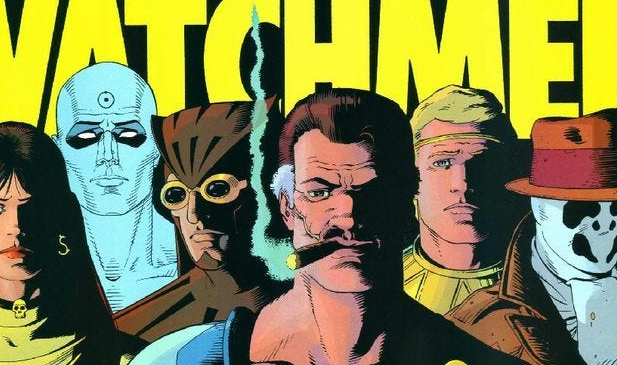
In the mid-1980s, the landscape of visual storytelling changed forever. While the world was accustomed to primary-colored heroes saving the day with a smile, a writer named Alan Moore and an artist named Dave Gibbons released a twelve-issue limited series that would dismantle the very idea of the superhero. Watchmen wasn’t just a comic book; it was a literary earthquake. It didn’t just ask “What if superheroes were real?”—it asked, “What kind of person would want to be one?”
Set against a backdrop of Cold War tension and existential dread, the story follows a group of retired “costumed adventurers” as they investigate the murder of one of their own. From its intricate structure to its chillingly realistic portrayal of power, Watchmen remains the only graphic novel to appear on Time magazine’s list of the 100 best English-language novels. Whether you are a first-time reader or a long-time scholar of the “Smiley Face,” these ten revelations explore the mechanical precision and hidden history behind this monumental work.
1. The Charlton Connection: The Heroes Who Almost Were
When Alan Moore first conceived the story, he didn’t intend to create brand-new characters. DC Comics had recently acquired a stable of heroes from the defunct Charlton Comics, including Blue Beetle, The Question, and Captain Atom. Moore’s original pitch, titled “Who Killed the Peacemaker?”, utilized these established figures. However, DC executives realized that Moore’s dark, deconstructive narrative would leave many of these characters dead or unusable for future traditional stories.
To preserve the Charlton IP, Moore and Gibbons were instructed to create original characters. This pivot proved to be a stroke of creative genius. By creating archetypes like Nite Owl (based on Blue Beetle), Rorschach (based on The Question), and Dr. Manhattan (based on Captain Atom), they were able to comment on the entire history of the medium without being bogged down by decades of existing continuity. This independence allowed the creators to take the characters to psychological extremes that would have been impossible with corporate-owned icons.
2. The Architecture of Art: The Rigid Nine-Panel Grid
One of the most striking aspects of Watchmen is its visual discipline. Unlike many modern comics that use splash pages and jagged, irregular layouts, Dave Gibbons illustrated almost the entire book using a strict nine-panel grid. This “3×3” layout serves a very specific narrative purpose: it controls the pacing of the story with metronomic precision. It forces the reader to focus on the passage of time and the minute details of the environment.
This layout also allowed for incredible visual “Easter eggs” and symmetry. In Chapter V, titled “Fearful Symmetry,” the entire issue is a visual mirror; the layout of the first page is reflected exactly on the last page, the second on the penultimate, and so on, meeting at a center spread. This level of technical complexity is rarely seen in the medium. The grid acts as a cage for the characters, reflecting the fatalistic theme of the book: that every moment is already written, and we are simply moving through the frames.
3. A Story Within a Story: The Purpose of the Pirate Comic
New readers are often confused by the inclusion of Tales of the Black Freighter, a gruesome pirate comic being read by a teenager at a newsstand throughout the novel. This isn’t just filler; it is a sophisticated “meta-narrative” that mirrors the psychological journey of Adrian Veidt (Ozymandias). In the world of Watchmen, because real-life “superheroes” existed and were often controversial, the public lost interest in superhero comics, leading the industry to pivot toward pirate tales.
The pirate story tells of a man who, in a desperate attempt to save his home from an impending invasion, becomes a monster himself, eventually realizing that the “evil” he was fighting was a projection of his own paranoia. This perfectly parallels Veidt’s plan to “save” the world through a horrific act of violence. By the time the two narratives converge at the end of the book, the Black Freighter serves as a grim warning about the cost of utilitarianism and the danger of the “savior” complex.
4. Rorschach’s Mask: The Moving Inkblot Mystery
Rorschach, the gritty, uncompromising vigilante, is arguably the most famous character in the novel. His mask, which he refers to as his “true face,” consists of two layers of latex with a heat-sensitive black fluid between them. This fluid shifts in response to his body heat and pressure, creating ever-changing, symmetrical inkblots. While the book is grounded in “realism,” this is one of the few pieces of “super-science” outside of Dr. Manhattan.
The inkblots are a literal representation of the Rorschach test used in psychology, where a patient’s interpretation of an ambiguous shape reveals their inner state of mind. For the character Walter Kovacs, the mask is a way to project his black-and-white morality onto a “gray” world. Interestingly, Dave Gibbons never drew the mask with a “smile” or a “frown”; the patterns are always abstract, leaving the reader to project their own emotions onto Rorschach’s faceless void, just as the characters in the book do.
5. The Radical Color Palette of John Higgins
The mood of Watchmen is defined by its unique color scheme, which was revolutionary for the 1980s. Most superhero comics of the era relied on the “primary” colors—red, blue, and yellow—to make the heroes pop off the page. Colorist John Higgins took the opposite approach, utilizing a palette of “secondary” colors: purples, oranges, and sickly greens. This choice gives the world of Sunnydale—no, sorry, the world of alternate-history New York—a sense of decay and unease.
These colors heighten the feeling of a world on the brink of nuclear winter. When Dr. Manhattan appears, his glowing blue form stands out even more drastically against these muted, secondary tones, emphasizing his alienation from humanity. The colors also change to reflect the shifting timelines; the “past” often has a warmer, more nostalgic glow, while the “present” feels cold and clinical. Higgins’ work proved that coloring was not just about “filling in the lines,” but was a vital tool for psychological storytelling.
6. World-Building Through “Under the Hood”
One of the most innovative features of the Watchmen graphic novel is the inclusion of supplemental text at the end of each chapter (except the last). These sections include excerpts from Hollis Mason’s autobiography Under the Hood, police reports, psychiatric files, and corporate memos from Veidt Enterprises. Moore included these because he felt that traditional “thought bubbles” were an outdated way to convey a character’s inner life.
These documents provide a staggering amount of world-building that the main narrative doesn’t have time for. They explain the history of the Minutemen (the 1940s heroes), the sociological impact of Dr. Manhattan on the global economy (such as the death of the internal combustion engine), and the legal process that led to the banning of masked vigiliantes. This “found footage” style of storytelling makes the world of Watchmen feel incredibly dense and authentic, rewarding readers who take the time to pore over every word.
7. The Squid vs. The Bomb: The Original Ending
The climax of the graphic novel involves a giant, genetically engineered “alien” squid appearing in the heart of New York City. The psychic shockwave emitted by the creature kills millions, convincing the United States and the Soviet Union to end their nuclear standoff to face a “common enemy.” This ending is often contrasted with the 2009 film adaptation, which replaced the squid with an explosion framed on Dr. Manhattan.
The “squid” ending is crucial to the book’s themes for several reasons. First, it highlights Adrian Veidt’s background as a fan of “pulp” fiction and “B-movies”—the squid is a literal manifestation of a “monster from outer space” trope. Second, the sheer absurdity of the plan makes Veidt’s cold, calculating genius feel even more terrifying. The creature was grown in a secret laboratory by kidnapped artists and scientists, emphasizing how Veidt “authored” a fake reality to manipulate the entire planet.
8. The Doomsday Clock and the 11:54 Motif
Throughout the series, the image of a clock ticking toward midnight appears repeatedly. This is a reference to the real-world Bulletin of the Atomic Scientists’ Doomsday Clock, which represents how close humanity is to global catastrophe. In Watchmen, the clock starts at several minutes to midnight and inches closer with each passing chapter.
The motif is integrated into the art in subtle ways. Blood spatters across the iconic yellow smiley face at the same angle as a clock hand pointing to 11:54. Dr. Manhattan, whose father was a watchmaker, sees time as a simultaneous whole, yet the world around him is obsessed with the “ticking” of the countdown. This creates a sense of unavoidable fate. The “watch” in Watchmen is not just a verb—meaning to observe—but a noun, representing the mechanical, heartless march of time that no hero can truly stop.
9. Ozymandias and the Alexander the Great Connection
Adrian Veidt, the “smartest man on the cinder,” styles himself after Ozymandias, the Greek name for the Egyptian Pharaoh Ramesses II. However, his true obsession is Alexander the Great. Veidt views himself as the modern successor to Alexander’s vision of a unified world. He even keeps a pet lynx-like creature named Bubastis, named after an Egyptian city, symbolizing his desire to bridge the gap between ancient wisdom and future technology.
The title “Ozymandias” also refers to a famous poem by Percy Bysshe Shelley about the inevitable decline of empires. The poem describes a ruined statue in the desert with the inscription: “Look on my Works, ye Mighty, and despair!” By choosing this name, Moore is foreshadowing the ultimate futility of Veidt’s plan. Even if he saves the world today, the “statue” of his utopia will eventually crumble into the sand. This adds a layer of tragic irony to Veidt’s “victory” at the end of the story.
10. The Creator’s Exile: Alan Moore’s Legal Stand
Perhaps the most famous “behind-the-scenes” fact is the deep rift between writer Alan Moore and DC Comics. The original contract stated that the rights to Watchmen would revert to Moore and Gibbons once the book went out of print. However, because the graphic novel became a perennial bestseller and stayed in print for decades, the rights never reverted.
Moore felt that the “spirit” of the contract had been violated, leading him to sever ties with DC and refuse to have his name associated with any sequels, prequels, or films. He has famously declined all royalty payments from the adaptations, requesting that the money be sent to his collaborators instead. This real-world conflict over “who owns the heroes” mirrors the book’s own themes of power, exploitation, and the loss of innocence in the comic book industry.
Further Reading
- Watchmen: The Annotated Edition by Leslie S. Klinger and Dave Gibbons
- Watching the Watchmen by Dave Gibbons, Chip Kidd, and Mike Aston
- Alan Moore: Personification of Power by Gary Spencer Millidge
- The Extraordinary Works of Alan Moore by Eric Hoffman

Leave a Reply