
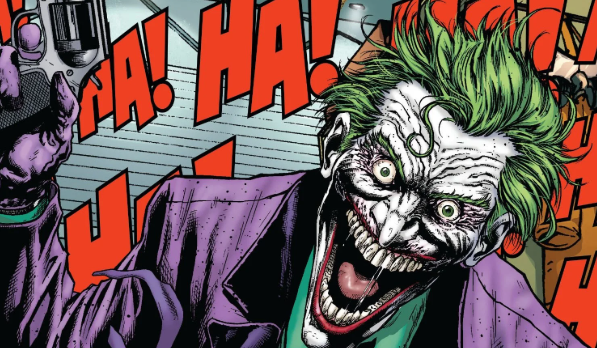
In the shadow-drenched streets of Gotham City, where shadows stretch long and hope often feels like a flickering candle in a hurricane, one laugh rings out louder and more terrifying than any siren. He is the Ace of Knaves, the Harlequin of Hate, and the most enduring enigma in comic book history. He is the Joker.
Since his debut, the Joker has transcended the role of a mere “bank robber in a costume.” He has become a cultural icon representing the pure, unadulterated concept of chaos. While Batman stands for rigid order, discipline, and the belief that the world can be fixed, the Joker is the living embodiment of the void. He is the punchline to a joke that no one else finds funny, a force of nature that cannot be reasoned with, bought, or intimidated. To understand the Joker is to look into the abyss and see it smiling back.
For beginners and seasoned enthusiasts alike, the Joker’s history is a labyrinth of lies, shifting identities, and calculated cruelty. To truly grasp why this character remains the ultimate antagonist, one must peel back the layers of his greasepaint and explore the dark logic that fuels his madness.
1. The Mystery of the “Multiple Choice” Origin
The most fascinating aspect of the Joker’s history is that he has no definitive origin story. While most superheroes and villains have a clear “inciting incident”—a radioactive spider bite or an exploding planet—the Joker’s past is a shifting kaleidoscope of possibilities. In the legendary story The Killing Joke, the character famously remarks, “If I’m going to have a past, I prefer it to be multiple choice!”
This lack of a concrete backstory is a deliberate narrative choice. It makes the Joker less of a man and more of a terrifying idea. One popular version depicts him as a failed stand-up comedian who turned to crime to support his pregnant wife, only to lose everything in a single day. Another version suggests he was a ruthless mob enforcer from the start. By refusing to settle on one truth, DC Comics ensures that the Joker remains unpredictable. He isn’t a victim of a specific circumstance; he is the result of the world breaking in just the right way. This ambiguity allows every new generation of writers to reinvent his terror while keeping the core of his mystery intact.
2. The Transformation of the Red Hood
While his name remains a mystery, the physical transformation of the Joker is almost always tied to a character known as the Red Hood. In his early criminal days (or perhaps his first and only day), a man wearing a domed red helmet led a group of thieves into the ACE Chemical Processing Plant. During a confrontation with Batman, the man in the red hood fell into a vat of volatile chemicals.
The results were catastrophic and iconic. The chemicals bleached his skin a ghostly white, dyed his hair a permanent shock of emerald green, and twisted his facial muscles into a perpetual, grotesque grin. This wasn’t just a change in appearance; it was a total psychic break. The man who crawled out of the chemical waste was no longer human in the traditional sense. The “Red Hood” identity has since become a recurring motif in Gotham, eventually being adopted by the resurrected Jason Todd, but its most significant role was serving as the cocoon from which the Joker was born. This transformation serves as a dark mirror to Batman’s own origin; where Bruce Wayne was forged in the fire of loss, the Joker was brewed in the acid of absurdity.
3. The Philosophy of “One Bad Day”
The Joker isn’t motivated by money, power, or even revenge in the traditional sense. His true mission is philosophical. He believes that the only thing separating the “sanest” person alive from a raving lunatic is “one bad day.” He views civilization as a fragile mask that people wear to hide their inner darkness, and his goal is to force everyone—especially Batman—to take that mask off.
This philosophy makes him infinitely more dangerous than a common criminal. The Joker doesn’t want to rule Gotham; he wants to prove that Gotham is just as ugly as he is. He frequently orchestrates elaborate, cruel social experiments to test the morality of his victims. He wants to show the world that when things get “bad enough,” even the most heroic people will turn on each other. This ideological warfare is why Batman finds him so difficult to defeat. You can’t punch an idea, and as long as the Joker can find a way to make a good person snap, he feels he has won the ultimate argument.
4. The Lethal Chemistry of Joker Venom
While the Joker is a master of psychological warfare, he is also an incredibly gifted, albeit deranged, chemist. His signature weapon is Joker Venom (often called “Laughing Gas”). This toxin is one of the most feared substances in the DC Universe. Upon exposure, the victim is seized by uncontrollable fits of laughter, followed by paralysis and, eventually, death. The most horrifying aspect is the “Rictus Grin”—the venom leaves the victim’s corpse with a terrifying, frozen smile identical to the Joker’s own.
Over the years, the Joker has developed countless variations of this toxin. Some versions act instantly, while others are “time-released” to create maximum suspense. He has delivered the venom through gas clouds, poisoned water supplies, and even tainted makeup. The venom serves as his “brand,” a way to mark his work and ensure that his victims’ final moments are an agonizing parody of joy. It reflects his belief that life is a cruel joke, and his “mercy” is simply helping others see the humor in their own demise.
5. The Brutal Legacy of “A Death in the Family”
One of the most defining moments in the Joker’s long history of violence is his murder of Jason Todd, the second Robin. In the storyline A Death in the Family, the Joker kidnapped the young hero, brutally beat him with a crowbar, and left him in a warehouse rigged with explosives. This wasn’t just a victory for the Joker; it was a permanent scar on Batman’s soul.
This event changed the stakes of their rivalry forever. Before this, there was a sense that the “dynamic duo” would always win and the villains would always go back to Arkham. By killing a member of the Bat-family, the Joker proved that he could inflict lasting, irreparable damage. It shifted the tone of Batman comics toward a darker, more consequence-heavy reality. For the Joker, the murder was the ultimate punchline—he took away Batman’s ward and partner, leaving the Dark Knight to carry the weight of that failure for the rest of his life. It remains a testament to the Joker’s capacity for calculated, personal cruelty.
6. The Long Shadow of The Killing Joke
If A Death in the Family was about physical loss, the events of The Killing Joke were about psychological trauma. In this story, the Joker targets Commissioner James Gordon by shooting and paralyzing his daughter, Barbara Gordon (who was Batgirl at the time). The Joker then kidnaps the Commissioner and subjects him to a “funhouse” of horrors, attempting to drive the city’s most honest cop insane.
The Joker’s goal was to prove that even a man as righteous as Jim Gordon could be broken by “one bad day.” However, the Joker failed. Gordon remained sane and insisted that the Joker be brought in “by the book,” proving that the human spirit could resist the Joker’s brand of chaos. Despite the Joker’s “moral” defeat, the impact on the DC Universe was massive. Barbara Gordon’s paralysis led to her transition into Oracle, the world’s greatest information broker, proving that while the Joker can break bodies, he cannot always break the will to fight back.
7. The Toxic Dynamics with Harley Quinn
For a significant portion of his history, the Joker was accompanied by Harley Quinn, a character who began as his psychiatrist at Arkham Asylum. Dr. Harleen Quinzel fell victim to the Joker’s manipulation, believing she was the only one who truly understood his “pain.” She eventually helped him escape and became his devoted sidekick and lover.
Their relationship is the ultimate example of a toxic, abusive dynamic. The Joker never truly loved Harley; he viewed her as a tool, a punchline, or a distraction. He would alternate between “affection” and horrific physical and emotional abuse to keep her under his thumb. In recent decades, Harley Quinn has broken away from the Joker, evolving into an anti-hero and finding her own identity. This separation has allowed the Joker to return to being a “lone wolf,” while also highlighting how his brand of madness can infect and destroy even the most brilliant minds. It serves as a cautionary tale about the seductive nature of chaos.
8. The “Pale Man” and the Theory of Immortality
In some of the most chilling modern interpretations of the character, writers have toyed with the idea that the Joker might be more than just a man. During the Endgame arc, evidence was presented suggesting that the Joker might be an immortal entity known as the “Pale Man,” who has haunted Gotham City for centuries. This theory posits that he has used a mysterious substance called “Dionesium” to heal from fatal wounds and reset his identity over generations.
While this was eventually revealed to be another elaborate ruse by the Joker to torment Batman’s sense of history, the idea stuck in the minds of readers. It plays into the “Evergreen” nature of the character—the sense that as long as there is a Gotham, there will be a Joker. Whether he is a man who fell in a vat or a cosmic force of entropy, the Joker occupies a space in the narrative where he feels inevitable. He represents the darkness that humanity can never quite outrun, making him a timeless threat that feels as old as civilization itself.
9. The Enigma of the “Three Jokers”
A recent and mind-bending revelation in DC lore suggested that there isn’t just one Joker, but actually three. This concept was introduced to explain the character’s shifting personality over the decades. The three archetypes are:
- The Criminal: A cold, calculating, and serious version reminiscent of his earliest appearances.
- The Clown: The colorful, prank-obsessed trickster of the middle years.
- The Comedian: The nihilistic, sadistic philosopher who emerged in the modern era.
This “Three Jokers” mystery explored the idea that the Joker is a legacy or a collective, rather than a single individual. It suggests that the Joker is so fundamental to the universe that he has “backups” or “successors” waiting in the wings. While the Bat-family eventually confronted this trio, the core takeaway remains the same: the Joker is too big for one man to contain. This narrative device allowed DC to pay homage to every era of the character while adding a new layer of existential dread to his mythos.
10. The Inseparable Bond with the Batman
The most fundamental truth about the Joker is that he cannot exist without Batman. He often describes their relationship as an “unstoppable force meeting an immovable object.” The Joker is obsessed with the Dark Knight, not because he wants to kill him, but because he wants to complete him. In his eyes, Batman is just as “crazy” as he is—he just wears a different mask.
The Joker refuses to kill Batman because, without his “straight man,” the joke is over. Conversely, Batman refuses to kill the Joker because of his strict moral code against taking a life. This creates a tragic, endless cycle of violence. The Joker is the shadow that Batman casts; the more the Caped Crusader fights for order, the more the Joker pushes back with chaos. They are two sides of the same coin, destined to dance until the end of time. This bond is the heart of their rivalry and the reason why the Joker remains the most compelling villain in all of fiction.
Further Reading
To witness the Clown Prince of Crime at his most terrifying and brilliant, these graphic novels are the definitive resources:
- Batman: The Killing Joke by Alan Moore and Brian Bolland
- Batman: A Death in the Family by Jim Starlin and Jim Aparo
- Batman: The Man Who Laughs by Ed Brubaker and Doug Mahnke
- Joker by Brian Azzarello and Lee Bermejo
- Batman: Arkham Asylum (A Serious House on Serious Earth) by Grant Morrison and Dave McKean




Leave a Reply