
In the history of cinema and literature, few stories capture the cold, indifferent nature of the universe as effectively as No Country for Old Men. Born from the desolate, sparse prose of Cormac McCarthy and brought to life through the meticulous, unflinching lens of the Coen Brothers, this narrative is a modern masterpiece of the neo-Western genre. It is a story that refuses to provide the easy comforts of traditional storytelling; there are no clean victories, no soaring musical crescendos, and no clear-cut justice.
Instead, we are presented with a landscape—both physical and moral—that is as barren as the Texas desert. At its heart, it is a meditation on the transition of time, the inevitability of change, and the terrifying realization that the “good old days” were perhaps never as good as we remember. Whether you are a fan of the Academy Award-winning film or the haunting novel, the following facts dive into the bones of this story, revealing the craft and philosophy that make it an evergreen staple of psychological tension.
1. The Haunting Symphony of Total Silence
One of the most striking elements of the film adaptation is something the audience often doesn’t notice until the credits roll: the almost complete absence of a musical score. While most thrillers use violins or percussion to tell the audience when to feel scared, the Coen Brothers opted for a nearly silent experience. Out of the entire runtime, there are only a few minutes of actual music, mostly comprised of low-frequency ambient drones that are often mistaken for the wind.
This was a calculated risk that pays off immensely. By removing the “safety net” of a score, every sound in the environment becomes amplified and heavy with meaning. The crunch of gravel under a boot, the jingle of keys, and—most famously—the rhythmic “whoosh” of a captive bolt pistol become the soundtrack of the film. This silence forces the viewer into the same headspace as Llewelyn Moss; you are hyper-aware of your surroundings, listening for the slightest hint of a predator. It reinforces the theme that in this world, there is no divine orchestration—only the cold, physical reality of the desert.
2. Anton Chigurh’s Haircut Was a Psychological Weapon
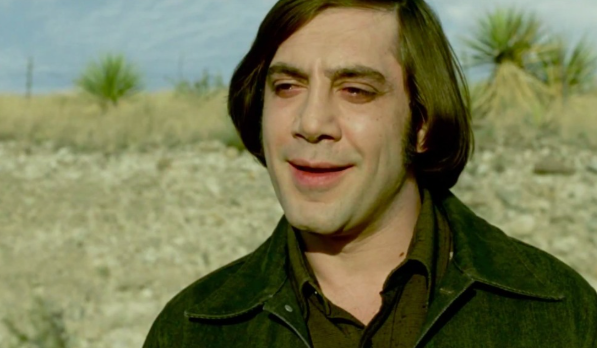
When Javier Bardem first saw the hairpiece designed for his character, Anton Chigurh, he reportedly looked in the mirror and said, “I’m not going to get laid for two months.” While it might seem like a trivial aesthetic choice, the “pageboy” bob was a stroke of genius. The Coen Brothers wanted a look that was timeless but unsettling—something that didn’t belong to any specific era or fashion trend. They drew inspiration from a photo of a man in a brothel in 1979, aiming for a look that was both “creepy” and strangely “monastic.”
The haircut serves a deeper purpose: it makes Chigurh look “off.” He doesn’t look like a standard movie hitman or a gritty criminal. He looks like an outsider, a “pure ghost” who exists outside the normal social order. This visual dissonance contributes to his terrifying presence. Because he looks so peculiar, yet acts with such clinical, detached efficiency, he becomes an almost supernatural force. The haircut strips away his humanity, leaving behind a silhouette that feels like an omen of death rather than a man you could pass on the street.
3. The Symbolism of the Captive Bolt Pistol
The choice of weapon for the story’s antagonist is perhaps one of the most brilliant symbolic flourishes in modern fiction. Anton Chigurh carries a pneumatic captive bolt pistol—a tool traditionally used in slaughterhouses to stun cattle before they are processed. On a practical level, it is a terrifying weapon: it’s silent, it doesn’t leave behind ballistic evidence like a bullet, and it can blow a door lock right out of its frame.
However, the “hard-hitting” fact here is the metaphor it creates. By using a tool designed for livestock on human beings, Chigurh is making a statement about the nature of his victims. To him, the people he encounters are not complex individuals with dreams and rights; they are merely cattle waiting for their time to come. It highlights his view of the world as a giant, indifferent processing plant where death is a mechanical certainty. The bolt pistol removes the “glamour” of a gunfight and replaces it with the cold, industrial efficiency of a slaughterhouse, reinforcing the idea that for Chigurh, killing is simply a function of his existence.
4. The “Multiple Choice” Casting of Llewelyn Moss
Josh Brolin’s performance as Llewelyn Moss is widely considered his breakout role, but he almost didn’t get the part. At the time, Brolin was not the “A-list” star he is now, and the Coen Brothers were initially hesitant. In a move that fits the “independent” spirit of the film, Brolin actually recorded his audition tape while on the set of another project, with the help of famous directors Robert Rodriguez and Quentin Tarantino. They used a high-end digital camera and professional lighting to make his audition look like a finished movie.
Despite the high production value of the tape, the Coens’ first reaction was reportedly unimpressed. It took further persistence and a screen test for them to realize that Brolin possessed the exact “laconic Texan” energy needed for Moss. Moss is a character who says very little but thinks a lot. He represents the common man who finds a fortune and thinks he is smart enough to outrun fate. Brolin’s ability to convey Moss’s grit, overconfidence, and eventual desperation is what makes the character’s trajectory so painful to watch. He is the “everyman” hero we want to win, making his eventual fate a bitter pill to swallow.
5. The Subversive Death of the Protagonist
One of the most controversial and “hard-hitting” aspects of the story is the way Llewelyn Moss dies. In a typical Hollywood thriller, the protagonist and the antagonist would have a final, climactic showdown—a battle of wits and bullets where the hero either wins or goes out in a blaze of glory. No Country for Old Men subverts this entirely. Moss is killed off-screen by a group of minor characters (the Mexican cartel members) that we barely know.
When Sheriff Bell arrives at the motel, the deed is already done. We see the aftermath: a body on the floor and a missing briefcase. This choice is intentionally frustrating. It robs the audience of the “catharsis” they expect from a movie. However, this is the central point of the narrative. Death in the real world is often sudden, unceremonious, and occurs when you are least prepared for it. By denying us the “big fight,” the story reinforces its theme that the universe doesn’t care about your character arc. Fate doesn’t wait for the third act to conclude; it strikes whenever the coin lands on the wrong side.
6. The Philosophy of the Coin Toss
The coin toss is the most iconic sequence in the story, but its meaning is often misunderstood as simple randomness. For Anton Chigurh, the coin is a way to absolve himself of responsibility. He views himself as an agent of fate. When he tells the gas station clerk, “I didn’t put it up [the coin], fate did,” he is expressing a deterministic worldview. He believes that the entire history of the universe—every star that burned out and every war that was fought—has led to this specific moment where a coin lands on a counter.
This “hits hard” because it challenges the idea of free will. Chigurh offers his victims a 50/50 chance, but in his mind, the outcome is already written. It is only the human participant who is “blind” to the result. This philosophy makes him a terrifying villain because he cannot be bargained with. You cannot appeal to his mercy because he doesn’t believe he has any. He is merely the hand that flips the coin. This scene remains a masterclass in tension because it forces the audience to confront the terrifying reality of how much of our lives are determined by sheer, cold chance.
7. Sheriff Bell and the Meaning of the Title
The title No Country for Old Men is taken from the opening line of W.B. Yeats’s poem, “Sailing to Byzantium.” The poem begins, “That is no country for old men. The young in one another’s arms, birds in the trees…” In the context of the story, the “old man” is Sheriff Ed Tom Bell, played with a weary brilliance by Tommy Lee Jones. Bell is the true protagonist of the story, even if Moss gets more screen time.
The title refers to Bell’s realization that the world has become more violent and senseless than he can understand. He looks back at the “old-timers” who didn’t even carry guns and wonders if he ever really measured up. The “hard-hitting” truth at the end of the story is that Bell isn’t just an old man complaining about the “youth today.” He is a man facing the reality of his own obsolescence. The world has always been violent—as his uncle Ellis points out—but Bell is only just now realizing that he is powerless to stop it. The story ends not with a gunfight, but with a man describing a dream, signifying a retreat into the internal world because the external world has become too much to bear.
8. Roger Deakins and the Visual Language of Barrenness
The cinematography of the film, handled by the legendary Roger Deakins, is a masterclass in “minimalist” storytelling. Deakins and the Coens decided to avoid the lush, sweeping vistas common in Westerns. Instead, they focused on a “flat” and “stark” look. The colors are muted—tans, browns, and grays—reflecting the parched landscape and the moral vacuum of the story.
Deakins used light to create a sense of isolation. Many scenes are lit by a single source, like a lamp in a motel room or the headlights of a truck, leaving the rest of the frame in pitch-black shadow. This visual style mirrors the narrative: we only see a small part of the “truth” at any given time, while the “darkness” (represented by Chigurh) is always lurking just out of sight. The landscape is beautiful in its own harsh way, but it is a beauty that is indifferent to human life. The vastness of the desert makes the characters look like ants, emphasizing their insignificance in the grand scheme of the cosmos.
9. The Uncanny Accuracy to the Source Material
It is rare for a film adaptation to be so faithful to its source novel that entire pages of dialogue are lifted verbatim. The Coen Brothers reportedly had the novel open on their laps while writing the script. Cormac McCarthy’s writing style—characterized by a lack of punctuation and a focus on physical action—translated perfectly to the Coens’ visual style.
One of the few major changes they made was to actually remove dialogue. In the novel, Chigurh is slightly more talkative, explaining his philosophy in more detail. The Coens realized that the character was more effective if he was more of a mystery. However, the themes remain identical. Both the book and the film are obsessed with the idea of “the ledger”—the idea that every action has a cost and that the “bill” eventually comes due. This faithfulness ensured that the movie retained the “soul” of McCarthy’s bleak vision, making it one of the rare instances where the film is considered as much of a masterpiece as the book.
10. The Final Monologue: The Dreams of a Father
The story concludes with Sheriff Bell, now retired, recounting two dreams to his wife. In the first dream, he loses some money his father gave him. In the second, he and his father are riding horses through a snowy mountain pass. His father rides past him, carrying fire in a horn, “fixing to make a fire somewhere out there in all that dark and all that cold.”
This ending “hits hard” because it provides no traditional closure. It is a quiet, contemplative moment that leaves the audience questioning everything they just saw. The “fire in the dark” represents hope, or perhaps the “spark” of civilization and decency that men like Bell’s father tried to carry through a cold world. Bell realizes that his father is waiting for him in that “dark and cold” afterlife. The final line of the story—“And then I woke up”—is a jarring return to reality. It suggests that the “hope” of the fire is just a dream, and the reality is the silent, cold morning of an old man who has outlived his era. It is one of the most poignant endings in history, leaving the viewer in a state of quiet, existential reflection.
Further Reading
If you are captivated by the gritty, philosophical world of No Country for Old Men, these books are essential additions to your library:
- No Country for Old Men by Cormac McCarthy (The original masterpiece)
- Blood Meridian, or the Evening Redness in the West by Cormac McCarthy (A more brutal, historical look at the West)
- The Coen Brothers: The Iconic Filmmakers and Their Work by Ian Nathan
- Cormac McCarthy’s Western Novels by Barcley Owens




Leave a Reply