
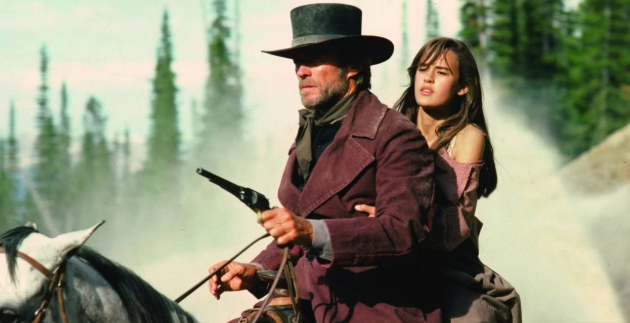
In the vast, sun-scorched landscape of the Western genre, few figures cast a shadow as long and as imposing as Clint Eastwood. By 1985, he was already a legend, the Man with No Name who had redefined the cowboy for a generation. Then, a figure cloaked in shadow and righteousness rode into view. Pale Rider, the highest-grossing Western of the 1980s, was a cinematic event. It felt both classic and thrillingly new, a ghost story wrapped in a tale of frontier justice. It was Eastwood’s first time back in the saddle in nearly a decade, and he returned with a film that was mythic, spiritual, and packed with the silent, deadly cool that only he could deliver. The story of a mysterious Preacher who comes to the aid of down-trodden gold miners against a ruthless mining baron resonated with audiences, becoming a critical and commercial success. It stands as a powerful entry in Eastwood’s incredible directorial career and a landmark of the modern Western. So, holster your six-shooter and settle in, because we’re about to unearth 10 surprising and fascinating facts about Pale Rider that will give you a new appreciation for this iconic film.
1. A Deliberate Homage to a Western Classic
If you watched Pale Rider and felt a sense of familiar narrative echoes, you weren’t imagining it. The film’s plot, centered on a mysterious stranger who defends a community of settlers against a powerful cattle baron (or in this case, a mining baron), is a deliberate and direct homage to the 1953 classic, Shane. Clint Eastwood has never been shy about his admiration for the works of director George Stevens, and Shane is one of the most revered Westerns of all time. Both films feature a young protagonist (Megan in Pale Rider, Joey in Shane) who idolizes the enigmatic hero. Both heroes try to avoid violence before ultimately strapping on their guns to defend the innocent. Even specific scenes carry thematic weight across both films. The sequence where the Preacher faces down Club, the brutish enforcer, in the general store mirrors the famous saloon confrontation between Shane and the antagonistic Chris Calloway. Eastwood wasn’t simply copying an old story; he was engaging in a cinematic conversation, taking the foundational myth of Shane and infusing it with his own unique style, darker tone, and the supernatural ambiguity that makes Pale Rider so distinct.
2. The Title is a Direct Biblical Reference
The film’s evocative title, Pale Rider, isn’t just a cool-sounding name for a Western hero. It’s drawn directly from the Bible, specifically from the Book of Revelation, Chapter 6, Verse 8. The line reads: “And I looked, and behold a pale horse: and his name that sat on him was Death, and Hell followed with him.” This single, powerful verse provides the central mystery and mythic underpinning of the entire film. From the moment the Preacher appears, framed against the snowy mountains, there is a question of his true nature. Is he just a man of the cloth who is good with a gun, or is he something more? An avenging angel? A ghost? The physical manifestation of Death itself, sent to deliver judgment upon the wicked? The film never gives a definitive answer, and that’s its greatest strength. The title itself is the biggest clue, inviting the audience to see the Preacher not just as a man, but as a supernatural force of cosmic justice, making his sudden appearance and disappearance all the more haunting and powerful.
3. Clint Eastwood’s Return to the Saddle After a Long Break
By the mid-1980s, Clint Eastwood had broadened his cinematic horizons significantly. He had directed and starred in comedies like Every Which Way but Loose, prison dramas like Escape from Alcatraz, and action thrillers like Firefox and Sudden Impact, where he reprised his role as Dirty Harry. The Western, the very genre that had made him an international superstar, had been absent from his filmography for nearly a decade. His last Western prior to Pale Rider was 1976’s The Outlaw Josey Wales. The genre was considered by many in Hollywood to be a thing of the past, a relic of a bygone era. Eastwood’s decision to not only star in but also direct a large-scale Western was a bold statement. He proved that the genre was far from dead, and that audiences were still hungry for classic tales of good versus evil on the American frontier. The massive success of Pale Rider single-handedly revitalized the Western for the 1980s and paved the way for a resurgence of the genre in the years to come, including Eastwood’s own Oscar-winning masterpiece, Unforgiven.
4. The “Preacher” Has No Name
In a classic Eastwood tradition, the protagonist of Pale Rider is a man of mystery. While other characters refer to him simply as “Preacher,” his actual name is never spoken or revealed at any point in the film. This was a deliberate choice, echoing the iconic “Man with No Name” persona from his “Dollars Trilogy” with director Sergio Leone. By withholding a name, Eastwood elevates the character from a simple man to a mythic archetype. He is not a person with a past that can be easily defined; he is a symbol. He represents hope for the miners and retribution for Coy LaHood and his men. This anonymity adds to the supernatural undercurrent of the film. Is he nameless because he is a ghost, a spirit who no longer has a worldly identity? This ambiguity forces the audience to engage with the character on a more symbolic level, making him one of the most memorable and enigmatic heroes in modern Western cinema.
5. Filmed in the Real Sawtooth Mountains of Idaho
To capture the rugged and majestic beauty of the film’s setting, Clint Eastwood chose to shoot on location in the Sawtooth National Recreation Area and the Boulder Mountains near Sun Valley, Idaho. This decision was crucial in giving the film its authentic, epic scope. The towering, snow-capped peaks and pristine wilderness provided a stunning and often imposing backdrop for the drama, dwarfing the human conflict and emphasizing the harsh realities of frontier life. The production team built the entire mining camp town from scratch on location, creating a lived-in, functional set that added to the film’s realism. Filming at high altitudes in a remote location presented numerous logistical challenges, from unpredictable weather to the difficulty of transporting heavy equipment. However, the result is a film that feels grounded in a real place, with a tangible sense of atmosphere that simply could not have been replicated on a studio backlot. The landscape of Pale Rider is as much a character as the Preacher himself.
6. The Bullet Scars Tell a Hidden Story
One of the most subtle yet powerful clues to the Preacher’s true nature is revealed when he removes his shirt to bathe. On his back are six healed bullet wounds, arranged in a pattern that is eerily similar to the wounds sustained by Marshal Stockburn’s previous victim, a man he describes killing years earlier. This is the film’s most direct hint that the Preacher is, in fact, the ghost of that very man, returned from the grave to exact his revenge. The scars are never explicitly explained or pointed out by another character. Eastwood, as a director, trusts his audience to see them and connect the dots themselves. It’s a masterful piece of visual storytelling, a quiet moment that re-contextualizes the entire narrative. It confirms the supernatural theories and transforms the story from a simple tale of a helpful stranger into a chilling ghost story of vengeance from beyond the grave.
7. A Future “James Bond” Played a Minor Role
Long before he would order a martini “shaken, not stirred” as the suave superspy James Bond, a young Timothy Dalton was considered for a role in Pale Rider. While he didn’t end up in the final film, his future 007 co-star did. The actor John Russell, who would later play the villainous Brad Whitaker in The Living Daylights (1987) opposite Dalton, portrays the main antagonist, Marshal Stockburn, in Pale Rider. Russell brings a cold, reptilian menace to the role of the “gunfighter for hire” who, along with his seven deputies, rides in to terrorize the miners. His calm, professional demeanor makes him a chilling and effective foil to Eastwood’s righteous Preacher. It’s a fascinating piece of trivia for film fans, connecting the rugged world of the Western to the sophisticated espionage of the James Bond franchise through this talented character actor.
8. The Unique Sound of the Gunshots
Clint Eastwood has always paid meticulous attention to the sound design in his films, and Pale Rider is no exception. He wanted the gunshots to have a unique and impactful sound, something beyond the standard “bang” used in most movies at the time. To achieve this, the sound effects team layered the traditional gunshot sound with the deep, booming crack of a cannon. This combination created a sound that was not only louder and more powerful but also had a distinct, almost thunderous echo. This auditory choice enhances the mythic quality of the film. When the Preacher fires his weapon, it doesn’t just sound like a pistol; it sounds like a clap of divine judgment, a sonic manifestation of his righteous fury. It’s a subtle but incredibly effective technique that adds to the film’s larger-than-life atmosphere.
9. The Famous “Six-Shooter” Monologue was Eastwood’s Idea
One of the film’s most quoted and memorable scenes features the Preacher calmly disassembling and cleaning his Remington 1858 revolver while delivering a chilling monologue to one of LaHood’s thugs. He speaks about the nature of his weapon and the inevitability of the coming conflict. This scene was not in the original script. It was an idea that Clint Eastwood developed during production. He felt there needed to be a moment where the Preacher, in a quiet and controlled manner, laid out the stakes and established his absolute confidence and deadly purpose. The monologue is a masterclass in understated intimidation. Eastwood’s calm delivery, combined with the methodical way he handles the gun, is far more menacing than any loud threat could ever be. It’s a perfect encapsulation of his screen persona: a man of few words, but when he speaks, you listen.
10. A Family Affair On and Off the Set
Clint Eastwood is known for frequently collaborating with a trusted team of filmmakers and, occasionally, his own family. Pale Rider was no exception. While his children didn’t have acting roles in this particular film, his then-partner, Sondra Locke, was originally slated to play the role of Sarah Wheeler. However, the part eventually went to actress Carrie Snodgress. More significantly, Eastwood’s son, Kyle Eastwood, who is now a renowned jazz musician, had a hand in the film’s music. Although the main score was composed by Lennie Niehaus, Kyle Eastwood contributed a piece to the soundtrack. This continues a long tradition of Eastwood involving his family in his creative projects, adding a personal touch to the behind-the-scenes story of this classic Western.
Conclusion
Pale Rider stands as a monumental achievement in the Western genre and in Clint Eastwood’s legendary career. It is a film that respects the traditions of the past while forging a new, darker, and more mystical path. By blending the classic Shane narrative with supernatural undertones and his own signature brand of stoic heroism, Eastwood created a film that is both a thrilling piece of entertainment and a profound meditation on justice, faith, and retribution. From its biblical title to the ghostly scars on its hero’s back, every element is carefully crafted to build a powerful and enduring myth. Pale Rider proved that the Western was not only alive but could still be a vehicle for complex, compelling storytelling. What does the Preacher’s mysterious nature mean to you – is he a man, a ghost, or something else entirely?
Dive Deeper
For those who want to explore the world of the Western and Clint Eastwood’s incredible contribution to it, here are a few recommended books for your reading list:
- Clint Eastwood: A Biography by Richard Schickel: An in-depth and authorized biography that covers Eastwood’s entire life and career, offering unparalleled insight into his filmmaking process and his thoughts on iconic films like Pale Rider.
- Shane by Jack Schaefer: Read the classic 1949 novel that inspired both the 1953 film and, in turn, Pale Rider. Discover the original story of the mysterious gunslinger who becomes a legend.
Ride, Boldly Ride: The Evolution of the American Westernby Mary Lea Bandy and Kevin Stoehr: This book offers a comprehensive look at the history of the Western genre, from its silent-era origins to its modern interpretations, placing films like Pale Rider in their broader cinematic context.




Leave a Reply