
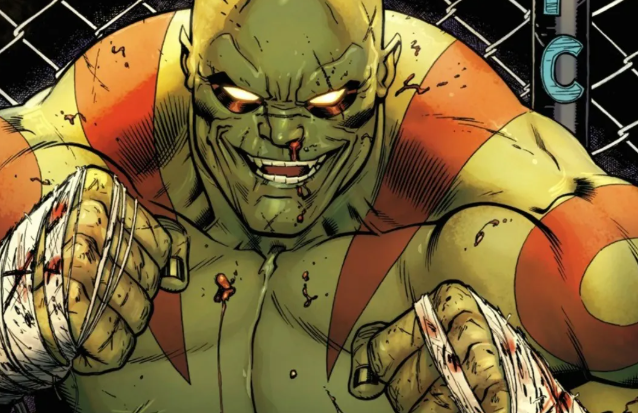
In the neon-soaked, chaotic expanse of the Marvel Cosmic landscape, few names command as much immediate respect—and sheer terror—as Drax the Destroyer. To many modern fans, he is the dry-witted, literal-minded powerhouse of the Guardians of the Galaxy. However, the comic book history of Drax is far darker, weirder, and more tragic than his cinematic counterpart suggests. He is not just a warrior; he is a biological weapon, a soul reborn in a crucible of vengeance, and a being whose entire existence was originally hard-coded with a single directive: the total annihilation of the Mad Titan, Thanos.
Understanding Drax requires peeling back layers of cosmic reincarnation and shifting power levels. He has been a cape-wearing powerhouse capable of shattering planets, a simple-minded brute with the heart of a child, and a scarred, knife-wielding assassin. He represents the ultimate “homing missile” of the Marvel Universe—a man whose grief was so profound that cosmic entities saw fit to weaponize it. This guide explores the essential truths behind the man once known as Arthur Douglas, tracing his flight path from a quiet life on Earth to the farthest reaches of the galaxy.
1. The Tragic Human Origin of Arthur Douglas
Before he was a green-skinned engine of destruction, Drax was a regular human man named Arthur Douglas. A resident of Burbank, California, Arthur was a saxophone player and a devoted family man. His life changed forever during a mundane drive through the desert with his wife, Yvette, and daughter, Heather. Above them, the Mad Titan Thanos was scouting Earth in secret. Believing the family had seen his ship, Thanos destroyed their car to ensure his presence remained a secret. Arthur and his wife perished in the attack, leaving their souls to drift into the cosmic void.
However, the cosmic entity known as Kronos—the grandfather of Thanos—was looking for a way to stop his grandson’s nihilistic rampage. Kronos intercepted Arthur’s soul and placed it into a powerful, humanoid body fashioned from the earth of the planet itself. This new being was stripped of Arthur’s memories and filled with an instinctive, burning hatred for Thanos. Thus, Drax the Destroyer was born, not from a desire for heroism, but from a desperate need for cosmic balance. This origin grounds the character in a deep, albeit forgotten, sense of loss that fuels his relentless pursuit of the Titan.
2. A Living Weapon Created by Cosmic Gods
Drax is unique among Marvel heroes because he was literally engineered to be an “Anti-Thanos.” When Kronos and Mentor (Thanos’s father) realized the threat the Mad Titan posed to the universe, they didn’t just train a soldier; they designed a predator. His original body was physically superior to almost any other biological life form, intended to match Thanos in raw strength and durability. He wasn’t meant to have a life, a hobby, or friends; he was a biological construct with a singular psychic tether to his target.
This “built-in” purpose is what defines Drax’s early adventures. He could sense Thanos’s presence across the galaxy, acting as a sentient tracking device. While other heroes might stumble upon a villain’s plot, Drax was always moving toward Thanos with the inevitability of a tidal wave. This creates a fascinating dynamic: Drax is a hero by circumstance, but a weapon by design. His existence is a constant battle between the remnants of his human soul and the cosmic programming that demands blood, making him one of the most focused and dangerous entities in the stars.
3. The Dramatic Evolution of His Power Levels
Drax’s power levels have fluctuated more than almost any other character in Marvel history. In his original “Classic” form, he was a heavyweight on par with the Silver Surfer or Thor. He possessed the power of flight, could fire devastating cosmic energy blasts from his hands, and was virtually indestructible. During this era, he wore a signature purple cape and cowl, looking every bit the traditional superhero. He was capable of trading blows with the Hulk and survived battles that would have vaporized entire fleets.
However, after a series of deaths and rebirths, his power set shifted dramatically. In his more modern incarnation, Drax lost his ability to fly and his energy projection. Instead, he became a master of close-quarters combat, favoring two large knives and relying on extreme physical agility and a refined “hunter’s instinct.” While he is technically “weaker” in terms of raw output, he is often portrayed as more dangerous in this form due to his tactical precision and undying tenacity. This evolution reflects the character’s journey from a blunt cosmic instrument to a sharpened, personal blade of vengeance.
4. The “Simple-Minded” Era and the Hulk Connection
For a significant portion of his history, Drax was not the grim assassin or the literal-minded warrior fans know today. Following a psychic battle that damaged his brain, Drax was resurrected with a child-like intellect. This “dumb” Drax was physically more powerful than ever but possessed the personality of a confused, gentle giant who just wanted to watch cartoons and eat snacks. During this time, he often found himself in the company of the Infinity Watch, serving as the team’s muscle while being treated almost like a mascot.
This era of Drax is frequently compared to the “Savage Hulk” persona. He was prone to tantrums and could be easily manipulated, yet his inherent goodness often shone through. This period highlighted the tragedy of Arthur Douglas—even when his mind was broken and his memories were gone, the “Destroyer” was still just a man-child looking for a place to belong. It provided a much-needed emotional depth to the character, proving that even without his genius or his memories, he was a hero at heart.
5. The Surprising Survival of His Daughter, Moondragon
One of the most poignant elements of Drax’s lore is that he isn’t actually the last of his line. While Arthur Douglas believed his entire family died in the desert, his daughter Heather was actually rescued by Mentor. She was taken to Titan, where she was raised by the Priests of Pama and developed immense telepathic and martial arts abilities, eventually taking the name Moondragon. For years, Drax and Moondragon operated in the same cosmic circles without realizing their biological connection.
When the truth was finally revealed, it didn’t lead to a happy family reunion. Moondragon is often arrogant and morally ambiguous, while Drax was, at the time, either a mindless brute or a focused killer. Their relationship has been fraught with tension, brainwashing, and even death. However, Heather remains the only tether Drax has to his former life as a human. Every time they stand on the same battlefield, it serves as a reminder of the life Thanos stole from them—one man turned into a weapon, and one girl turned into a cold, powerful telepath.
6. Drax Once Wielded the Power Gem
As a member of the Infinity Watch—a group assembled by Adam Warlock to guard the Infinity Gems (now called Infinity Stones)—Drax was entrusted with the Power Gem. This was an appropriate choice, as Drax’s physical strength was already off the charts, and the Gem amplified his might to infinite levels. Because of his simplified mental state at the time, Drax didn’t use the Gem for complex cosmic manipulation; he mostly used it to hit things harder.
In one of the most famous and bizarre moments in cosmic Marvel history, Drax actually swallowed the Power Gem, thinking it was a piece of candy. Because of his incredible durability, the Gem remained safely in his stomach, providing him with a constant surge of energy without him ever having to “activate” it. This period solidified Drax as a fundamental pillar of the cosmic hierarchy. He wasn’t just a guy with a grudge; he was a literal guardian of the building blocks of reality, entrusted with the most dangerous weapon in existence because his heart was too simple to be corrupted by its power.
7. The Annihilation Transformation
The modern version of Drax—the one with the red tattoos and the twin daggers—debuted shortly before the “Annihilation” event. During a prison transport crash, the “simple” Drax was killed by a fellow inmate, only to emerge from a biological husk in a new, leaner, and more lethal form. This Drax was no longer a bumbling giant; he was a silent, calculating hunter with a vastly improved intellect and a renewed sense of purpose.
This transformation was a turning point for the character. He shed the cape and the cosmic blasts in favor of a more “grounded” approach to killing. He also received his iconic tattoos, which represent the history of his life and his many battles. This version of Drax was the one who finally managed to do the impossible: during the Annihilation Wave, he punched through Thanos’s chest and ripped out the Titan’s heart. It was the culmination of decades of storytelling, proving that even a “de-powered” Drax was more than capable of fulfilling his primary directive if he was focused enough.
8. His “Literal” Nature vs. Comic Book Focus
While the films popularized the idea that Drax belongs to a race of people who don’t understand metaphors, the comic book version is slightly different. In the comics, Drax is a unique being, not a member of an alien species. His occasional social awkwardness or “literalism” stems from two places: his damaged psyche from his various resurrections and his singular, obsessive focus on his mission. When you are a biological weapon designed to kill a god, small talk and linguistic nuances don’t really matter.
In the comics, his humor is often much darker and drier. He isn’t necessarily confused by metaphors; he simply doesn’t care for them. He views the world through the lens of a hunter. If a teammate makes a joke, Drax might ignore it because it doesn’t help him track his prey. This makes him a “straight man” in the comedic sense, but his detachment is born from cosmic trauma rather than cultural misunderstanding. He is a man who has lost his humanity so many times that he has forgotten how to participate in the “normal” world.
9. A History of Infinite Resurrections
Death is rarely permanent in comics, but for Drax, it is practically a revolving door. Because his soul is tied to a cosmic purpose, he has been brought back to life multiple times, often changing his physical appearance and mental state with each rebirth. This makes Drax a “living memory” of the universe’s needs. If the universe needs a powerhouse, Kronos brings back the cape-wearing titan. If the universe needs a scalpel, he returns as the tattooed assassin.
This cycle of rebirth adds a layer of existential dread to the character. Drax can never truly rest. Even when he achieves his goal and kills Thanos, the cosmic gears of the Marvel Universe eventually turn, Thanos returns, and Drax is pulled back from the afterlife to begin the hunt once more. He is a “Destroyer” in perpetuity, a soul trapped in a cycle of violence that he never asked for. This immortality is his greatest strength, but also his most profound curse, as it prevents Arthur Douglas from ever finding the peace he lost in that California desert.
10. Finding a New Family in the Guardians
Despite his history as a solo hunter and a weapon of the gods, Drax eventually found a semblance of peace as a member of the Guardians of the Galaxy. Joining the team alongside Star-Lord, Rocket Raccoon, and Gamora gave Drax something he hadn’t had since his life as Arthur Douglas: a family. While he often acts as the team’s stoic muscle, his loyalty to his teammates is absolute. He has evolved from a man who only cares about “The Destroyer” into a hero who cares about protecting the galaxy at large.
His role in the Guardians allows for a more nuanced exploration of his character. He is no longer just “the guy who wants to kill Thanos.” He is a mentor to younger heroes, a protector of the innocent, and a friend to outcasts. In the modern era, Drax has learned that while he was created for destruction, he can choose to use that power for preservation. This transition from a weapon to a person is the true heart of his story, showing that even the most broken soul in the cosmos can find a reason to keep living beyond revenge.
Further Reading
- Annihilation: Drax the Destroyer by Keith Giffen
- Warlock and the Infinity Watch by Jim Starlin
- Guardians of the Galaxy (2008 Series) by Dan Abnett and Andy Lanning
- Drax: Guardians of the Galaxy by CM Punk and Bunn



