
Out of the Bottle: 10 Untold Secrets Behind the Magic of I Dream of Jeannie
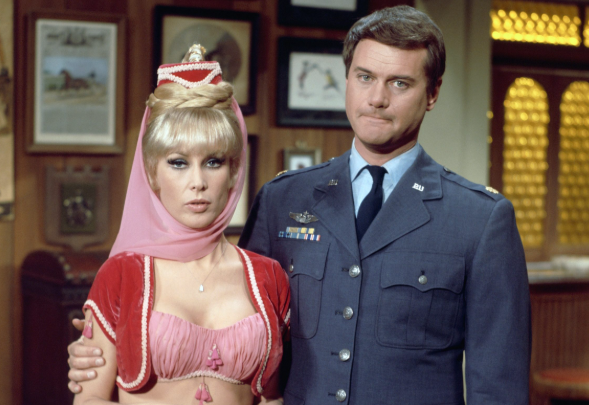
When the smoke cleared and a beautiful genie emerged from a decorative bottle on a deserted beach, television audiences were whisked away into one of the most vibrant fantasies of the 1960s. I Dream of Jeannie was more than just a sitcom; it was a colorful, high-energy escape that blended the high-stakes world of the American Space Race with the ancient whimsy of Middle Eastern folklore. While Samantha Stephens on Bewitched was trying to fit into the mortal world, Jeannie was unapologetically magical, constantly turning the life of her “Master,” Captain (later Major) Anthony Nelson, into a whirlwind of chaos and comedy.
The show’s premise was simple yet effective: an astronaut finds a bottled genie after a crash landing, and she proceeds to fall in love with him, using her powers to “help” him in ways that usually result in disaster. Yet, the production of this beloved series was anything but simple. From strict television censors to the physical hazards of the special effects, the journey of bringing Jeannie to life was filled with hurdles that required as much ingenuity as a magic spell.
To truly appreciate the legacy of this classic, one must look beneath the pink chiffon and the “Major Nelson” cries. The show serves as a time capsule of an era obsessed with the moon, suburban perfection, and the evolving boundaries of what could be shown on screen. Here are ten surprising facts that reveal the real magic—and occasional mayhem—behind the making of I Dream of Jeannie.
1. The Scandal of the Forbidden Belly Button
Perhaps the most famous piece of trivia in television history involves the strict “no-navel” policy enforced by NBC’s Standards and Practices. While Jeannie’s harem costume was undeniably revealing for the mid-sixties, the censors had a specific, bizarre obsession with her belly button. They decreed that while her midriff could be exposed, her navel must remain covered at all times to maintain “decency.”
This led to the creation of high-waisted silk pants and a waistband that was frequently adjusted or even taped to Barbara Eden’s skin to ensure no skin-slip occurred during her energetic dancing or bowing. Producers were so terrified of a “navel sighting” that they kept a close watch on every frame of film. There is a legendary story that a censor once walked onto the set during a rehearsal to check the height of the waistband personally. This strange preoccupation with a small part of the human anatomy remains a hilarious example of the rigid and often illogical moral codes of early broadcast television.
2. Why Barbara Eden Almost Didn’t Get the Part
When legendary writer and producer Sidney Sheldon began developing the show, he had one very specific rule: “No blondes.” Because Bewitched was already a massive hit featuring the blonde Elizabeth Montgomery, Sheldon was determined to find a brunette or a redhead to avoid accusations of being a “copycat” series. He auditioned dozens of actresses, but none of them captured the specific blend of innocence, mischief, and comedic timing he envisioned for Jeannie.
Eventually, his casting director urged him to see Barbara Eden. Sheldon was initially hesitant due to her hair color, but the moment she began her screen test, he knew his “no blonde” rule had to be broken. Eden brought a “human” quality to the supernatural character; she didn’t play Jeannie as a goddess, but as a woman deeply and somewhat naively in love. Her chemistry with the rest of the cast was so undeniable that Sheldon realized the audience wouldn’t care about the hair color—they would only care about the charm.
3. The High-End Liquor Bottle That Became a TV Icon
One might expect that Jeannie’s ornate, magical home would have been a custom-designed prop built by a master artisan. In reality, the most famous bottle in television history started its life as a 1964 Christmas decanter for Jim Beam bourbon. Specifically, it was a “Beam’s Choice” bottle designed to hold whiskey. A member of the production team spotted the bottle in a liquor store window and realized its shapely silhouette was perfect for a genie’s lamp.
The prop department took the glass decanter and spent hundreds of dollars (a significant sum at the time) transforming it. They used gold leaf, purple paint, and intricate glasswork to hide its humble origins. Over the course of the series, several versions of the bottle were used—some were painted with darker hues for the early black-and-white episodes to provide better contrast, while the later color seasons featured the vibrant pink and gold design fans recognize today. The original bottle used in the pilot is now a priceless piece of television memorabilia.
4. Larry Hagman’s Behind-the-Scenes Turbulence
While Major Nelson was the “straight man” to Jeannie’s antics, the actor playing him, Larry Hagman, was often anything but calm behind the scenes. Hagman was a classically trained actor who frequently felt frustrated by the show’s often absurd scripts and the repetitive nature of the “genie-out-of-the-bottle” gags. His frustration sometimes manifested as difficult behavior on set, leading to tensions with the crew and even his co-stars.
Hagman was known to voice his displeasure loudly and, at several points, was reportedly close to being replaced. However, Barbara Eden remained his staunchest defender, recognizing that his brilliance as a physical comedian and his ability to play “frustrated” was what made the show work. Despite his personal struggles with the material, Hagman’s performance was essential; without his grounded, often exasperated energy, Jeannie’s magic would have lacked a necessary foil. It is a testament to his professionalism that none of this internal friction ever made it onto the screen.
5. The Forbidden Wedding That Ended an Era
In the world of sitcoms, the “will they or won’t they” dynamic is often the engine that keeps the story moving. For years, the tension between Jeannie’s desire to marry her “Master” and Tony’s insistence on maintaining his bachelor status fueled the plot. However, in the fifth season, NBC executives made the fateful decision to force a marriage between the two lead characters, believing it would provide a ratings boost.
Both Barbara Eden and Larry Hagman were vocally opposed to the move, arguing that the “chase” was the heart of the show. They were right. Once Tony and Jeannie were married, the inherent conflict of the series vanished. Jeannie became more of a traditional “housewife” who happened to have magic, and Tony lost the frantic energy of a man trying to hide a secret. The ratings plummeted shortly after the wedding episode, and the show was canceled soon after. To this day, the I Dream of Jeannie wedding is cited by television historians as one of the earliest examples of a show “jumping the shark.”
6. Zuma Beach: The Freezing “Desert Island”
The pilot episode begins with Tony Nelson stranded on a deserted island in the South Pacific, where he first discovers the bottle. While the scenery on screen looks like a tropical paradise, the reality was quite the opposite. The scenes were filmed at Zuma Beach in Malibu, California, during a particularly cold winter stretch.
The “tropical” water was actually bone-chillingly cold, and the wind off the Pacific was brutal. Barbara Eden, dressed in only her thin silk harem costume, had to pretend she was basking in the heat of the tropics while her teeth were practically chattering between takes. To make matters even more difficult, the “smoke” used for Jeannie’s entrance from the bottle was a chemical concoction that was often difficult to breathe in the ocean breeze. Despite the freezing conditions, the actors maintained their sunny dispositions, creating one of the most iconic “meet-cute” scenes in television history through sheer physical endurance.
7. The Double Life of Jeannie’s Evil Sister
In a recurring gag that allowed Barbara Eden to showcase her range, the show introduced Jeannie’s sister, also named Jeannie (referred to in scripts as Jeannie II). Unlike the sweet and loyal blonde Jeannie, Jeannie II was a brunette who wore a green costume and was constantly trying to steal Tony Nelson for herself or ruin Jeannie’s reputation.
Playing both roles required a significant amount of technical trickery. Split-screen photography was used, requiring Eden to film her scenes twice—once as the hero and once as the villain—acting against a “stand-in” or a mark on a wall. Because the two characters had such different personalities, Eden had to meticulously track her movements and timing to ensure the “interaction” between the sisters looked seamless. These episodes were fan favorites because they allowed Jeannie to be the “straight man” for once, reacting to the outrageous and often cruel behavior of her magical sibling.
8. NASA’s Real-Life Influence on the Script
Because Tony Nelson and his best friend Roger Healey were Air Force officers assigned to NASA, the show had a unique relationship with the actual American space program. At the height of the Space Race, anything involving astronauts was considered “cool” and patriotic. The show actually filmed several segments at the real Kennedy Space Center and used stock footage of rocket launches provided by NASA.
The producers hired technical consultants to ensure that the “NASA talk” sounded somewhat authentic, even if the plots involved genies and ancient curses. Interestingly, NASA was reportedly happy with the show’s portrayal of astronauts as heroic, disciplined, and (mostly) level-headed men. The show’s setting in Cocoa Beach, Florida, turned the sleepy town into a landmark for tourists, and the connection to the space program gave the fantasy show a “modern” edge that set it apart from the more traditional domestic settings of other sitcoms of the era.
9. The Dangerous Chemistry of Jeannie’s Magic Smoke
In the 1960s, special effects were achieved through practical means rather than computers. The “smoke” that accompanied Jeannie’s departures and arrivals was often created using a chemical called titanium tetrachloride. When this chemical is exposed to air, it creates a thick, white smoke. However, it is also highly corrosive and can be irritating to the eyes and lungs.
The actors had to be incredibly careful not to inhale the “magic” directly. There were instances where the wind would shift, blowing the chemical smoke directly into the actors’ faces, leading to stinging eyes and coughing fits. Later in the series, the production switched to safer methods, including pressurized CO2 and localized fog machines, but the early days of the show required the cast to be quite brave. Every time you see Jeannie “blink” away in a puff of smoke, you are witnessing a carefully timed physical stunt that carried a real risk of chemical irritation.
10. The Enduring Legacy of the Pink Harem Costume
The costume designed for Jeannie by Gwen Wakeling has become one of the most recognizable outfits in the history of the world. Interestingly, the color was chosen specifically to pop on the new color television sets that were becoming standard in American homes in the mid-sixties. The “Jeannie Pink” was actually a very specific shade of fuchsia silk, accented with dark red velvet and gold trim.
Because the show was so physical—involving dancing, running, and stunts—the costume had to be incredibly durable. Barbara Eden actually had several identical outfits, as the silk would often snag or stain during filming. After the show ended, the costume became a staple of the Smithsonian Institution’s collection, cemented as a piece of American history. It represents a specific moment in pop culture where the exotic and the suburban collided, creating an image of femininity that was powerful, magical, and eternally playful.
Further Reading
- Jeannie Out of the Bottle by Barbara Eden and Wendy Leigh
- The I Dream of Jeannie Handbook by Stephen Cox and Howard Frank
- Dreaming of Jeannie: A Guide to the 1960s Classic by Various Authors
- Sidney Sheldon: The Other Side of Me by Sidney Sheldon (Includes his experiences creating the show)
- 10 Things You Should Know About Foghorn Leghorn – Looney Tunes
- 10 Futurama TV SHOW Facts That Still Hold Up
- 10 Things You Should Know About Speedy Gonzales – Looney Tunes
- 10 Things You Should Know About Yosemite Sam – Looney Tunes
- 10 Things You Should Know About The Looney Tunes
- 10 Things You Should Know About Road Runner – Looney Tunes
- 10 Things You Should Know About Wile E. Coyote – Looney Tunes
- 10 Things You Should Know About Tweety Pie – Looney Tunes
- 10 Things You Should Know About Sylvester The Cat – Looney Tunes
- 10 Things You Should Know About Porky Pig – Looney Tunes



