
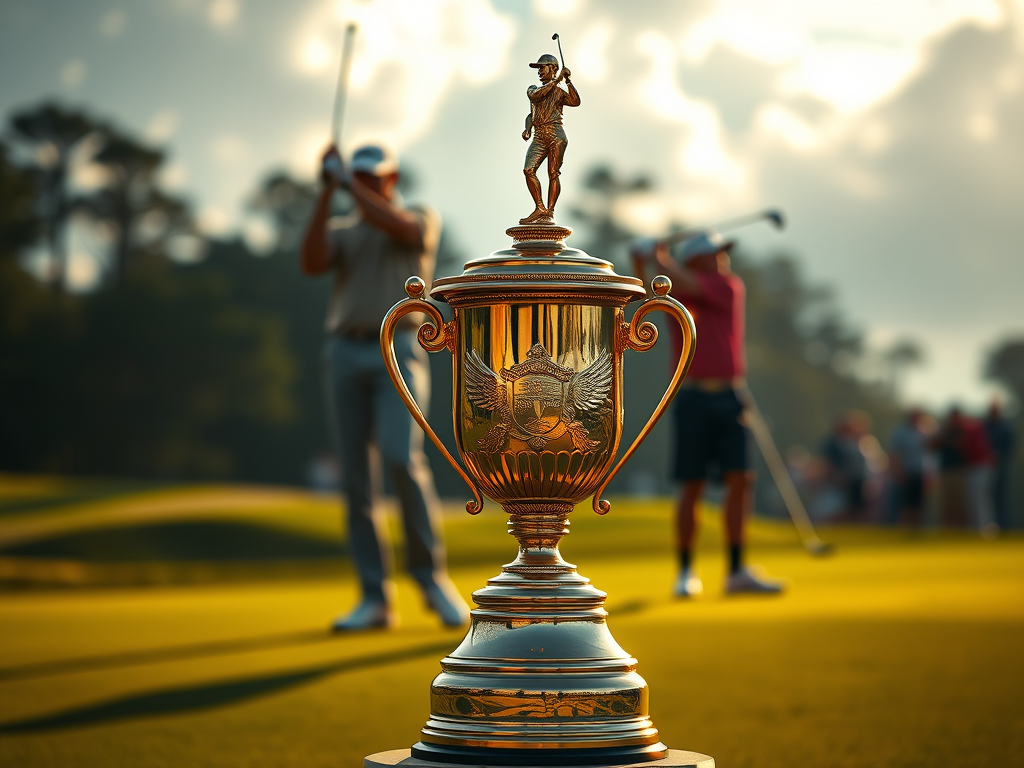
The Ryder Cup stands as one of the most compelling and dramatic events in the world of sport, transcending individual achievement to become a fierce biennial team competition. Pitting the best male professional golfers from the United States against those from Europe, it is a spectacle of national pride, intense camaraderie, and unforgettable moments of triumph and heartbreak. Unlike any other golf tournament, players compete not for prize money, but for the honor of lifting the coveted trophy and etching their names into sporting folklore.
What began as a friendly transatlantic encounter between golf professionals has evolved into a global phenomenon, captivating millions with its unique match-play format and the raw emotion it ignites. The history of the Ryder Cup is rich with iconic performances, legendary rivalries, and pivotal moments that have shaped its enduring legacy. It’s a story of shifting dominance, dramatic comebacks, and the spirit of sportsmanship that, despite the fierce competition, often prevails. This article delves into 10 key facts that illuminate the fascinating evolution of the Ryder Cup, offering insight into its origins, its growth, and the defining characteristics that make it golf’s greatest rivalry.
1. The Visionary Founder: Samuel Ryder and the Genesis of the Cup
The Ryder Cup owes its existence to the vision and generosity of one man: Samuel Ryder. Born in Preston, Lancashire, in 1858, Ryder was a prosperous English seed merchant who later moved to St Albans. He developed a keen interest in golf relatively late in life, at the age of 50, and became a passionate advocate for the professional game. Frustrated by the lack of opportunities for British professionals, Ryder began sponsoring exhibition matches.
The idea for an international team competition gained traction after an unofficial match between British and American professionals at Wentworth in 1926. Ryder, impressed by the camaraderie and competitive spirit, remarked, “We must do this again.” Seizing on this sentiment, he commissioned a gold trophy, standing 17 inches tall and weighing four pounds, to be presented for the biennial contest. The gilded figure of a golfer atop the trophy is believed to be Abe Mitchell, Ryder’s personal golf instructor at the time. Ryder’s philanthropic gesture laid the foundation for an event that would grow far beyond his initial expectations, becoming a symbol of international sporting rivalry and camaraderie. The first official Ryder Cup match was contested in June 1927.
2. The Inaugural Contest: USA Dominance Begins
The very first official Ryder Cup match took place in June 1927 at the Worcester Country Club in Worcester, Massachusetts, USA. The competition pitted a team from Great Britain, captained by Ted Ray, against a United States team, led by the legendary Walter Hagen. At this nascent stage, the format consisted of four 36-hole foursomes matches on the first day and eight 36-hole singles matches on the second day, totaling 12 points available.
The American team emerged victorious, winning by a convincing margin of 9½ to 2½ points. British captain Ted Ray famously attributed their defeat to the Americans’ “superior putting,” a theme that would often re-emerge in future contests. This inaugural win set an early precedent for what would become a significant period of American dominance in the Ryder Cup. For decades, particularly after World War II, the United States consistently outperformed their British and Irish counterparts, often by wide margins, leading some to question the long-term competitiveness of the event. This early American superiority underscored the need for future format changes to foster a more balanced and intense rivalry.
3. Evolution of the Teams: From Great Britain to Europe
For the first five decades of its existence, the Ryder Cup was contested exclusively between the United States and a team representing Great Britain. In 1953, golfers from the Republic of Ireland were added to the British team, though the team name was only officially changed to “Great Britain and Ireland” for the 1973 Ryder Cup. Despite this inclusion, American dominance continued almost unabated. From 1935 to 1985 (excluding World War II years), Great Britain and Ireland only managed to win once, in 1957, with one tie in 1969.
The turning point for the competition’s competitiveness came in 1979. Recognizing the waning interest due to the one-sided nature of the matches, Jack Nicklaus, arguably the greatest golfer of all time, proposed a crucial change to the PGA of Great Britain. He suggested that players from continental Europe be included in the non-U.S. team. This revolutionary expansion transformed the event, allowing stars like Spain’s Seve Ballesteros and Germany’s Bernhard Langer to participate. The newly formed “Team Europe” brought a fresh dynamic, a broader talent pool, and a fiercely competitive spirit that rapidly revitalized the rivalry, turning it into the epic contest we know today.
4. The Match Play Format: Fueling Intense Rivalry
Unlike most professional golf tournaments that use stroke play (counting every shot), the Ryder Cup employs a match play format. This means that golfers compete head-to-head for individual holes, with the player or team who wins more holes winning the match. If the scores are tied after 18 holes, the match is “halved,” and each side receives half a point. The winner of a match scores one point for their team.
The Ryder Cup format, as currently structured since 1979, consists of 28 matches played over three days:
- Day 1 & 2: Four foursomes matches (alternate shot, two players per team using one ball) and four fourball matches (each player plays their own ball, the lower score of the two players on a team counts) are played each day.
- Day 3: Twelve singles matches (one-on-one) are played. This format creates immense drama. Every putt, every shot, can directly win or lose a hole, building intense pressure and immediate consequences. It emphasizes strategic pairings, mental fortitude, and direct competition, often leading to more aggressive play and emotional displays than seen in typical stroke-play events. The match play element is undeniably a core reason why the Ryder Cup generates such unique excitement and passionate crowds.
5. No Prize Money: Playing for Pride and Patriotism
One of the most remarkable and defining characteristics of the Ryder Cup is that there is no prize money for the players. Unlike individual tournaments where millions of dollars are at stake, the golfers competing in the Ryder Cup receive nothing but the trophy and the immense pride of representing their continent or country. This absence of financial incentive often amplifies the passion, intensity, and camaraderie within the teams.
Players frequently speak about the unique privilege of playing for their teammates, their captains, and their respective flags. The focus shifts entirely from personal gain to collective victory, fostering an unparalleled team spirit that is rare in an otherwise individual sport. The emotional investment from both players and fans is palpable, as the contest becomes a battle of wills, skill, and national honor. This fundamental aspect differentiates the Ryder Cup from virtually all other major sporting events and highlights the pure competitive spirit that drives the world’s best golfers to deliver their peak performances under immense pressure.
6. The “Miracle at Medinah” (2012): The Greatest Comeback
The 2012 Ryder Cup, held at Medinah Country Club in Illinois, USA, delivered arguably the most astonishing comeback in the competition’s history, often dubbed the “Miracle at Medinah.” Going into the final day’s 12 singles matches, the U.S. team held a commanding 10-6 lead, needing only 4.5 points to reclaim the Cup. Historically, such a lead on Sunday had been almost insurmountable.
However, inspired by the spirit of the late Seve Ballesteros (whose silhouette was on their bags) and a heroic Saturday afternoon fourball performance by Ian Poulter, Team Europe mounted an extraordinary charge. Europe’s players, one after another, delivered clutch performances, winning match after match. Ian Poulter continued his incredible form, leading the charge. The momentum dramatically swung, culminating in Martin Kaymer sinking a five-foot putt on the 18th green to secure Europe the crucial 14.5 points needed to win the Cup outright. Jose Maria Olazabal, the European captain, led his team to an improbable victory that resonated deeply with fans globally, solidifying the Ryder Cup’s reputation for unparalleled drama and demonstrating that no lead is safe until the very last putt drops.
7. The Controversial “Battle of Brookline” (1999): A Tense Confrontation
While the Ryder Cup is generally characterized by sportsmanship, its intense competitive nature has occasionally boiled over, leading to moments of significant controversy. The 1999 Ryder Cup at Brookline Country Club in Massachusetts, USA, dubbed the “Battle of Brookline,” is perhaps the most infamous example. Trailing 10-6 going into the Sunday singles, just as Europe had at Medinah, the U.S. team launched an aggressive comeback.
The controversy erupted on the 17th hole during the singles match between Justin Leonard (USA) and Jose Maria Olazabal (Europe). Leonard sank a monumental 45-foot birdie putt, seemingly securing a victory and the Cup for the U.S. What followed was a premature and boisterous celebration by the entire U.S. team, their wives, and caddies, who stormed the green, disrupting Olazabal’s concentration as he still had a putt to halve the hole. This breach of golf etiquette drew widespread criticism, particularly from the European team and golf commentators. Although the U.S. won the Cup, the incident left a bitter taste and became a stark reminder of the fine line between passionate celebration and disrespectful conduct in golf’s fiercest rivalry.
8. Captain’s Picks: The Strategic Wildcards
A crucial element in team selection, particularly since 1979, has been the “captain’s picks” system. Both the U.S. and European teams utilize a combination of automatic qualification (based on points earned through tournament performances over a set period) and discretionary selections made by the team captain. Typically, a certain number of players automatically qualify, and then the captain chooses the remaining players to complete the 12-man roster.
These “wild cards” are a source of constant speculation and intense pressure for the captains. They allow the captain to select players who might be in great form, have a strong match play record, or possess a particular temperament well-suited for the Ryder Cup’s unique pressures, even if they didn’t automatically qualify. A captain’s pick can be a veteran leader, a rookie with potential, or a player who complements the team’s dynamics. The success or failure of these strategic choices can often prove to be the deciding factor in the outcome of the Ryder Cup, adding another layer of intrigue and analysis to the lead-up to each event.
9. Iconic Pairings: The Power of Partnership
Beyond individual brilliance, the Ryder Cup’s match play formats (foursomes and fourballs) highlight the importance of effective pairings, leading to the formation of legendary duos. Certain players simply click together, their games complementing each other perfectly, often developing an almost telepathic understanding. These iconic pairings have been crucial to their team’s success and have provided some of the most memorable moments in Ryder Cup history.
Perhaps the most famous European pairing was the Spanish “Seve and Ollie” duo: Seve Ballesteros and Jose Maria Olazabal. Their fiery passion, aggressive play, and uncanny chemistry made them an almost unbeatable force throughout the late 1980s and early 1990s. They dominated their opponents, famously winning 12 points from 15 matches together. More recently, the “Moliwood” phenomenon of Francesco Molinari and Tommy Fleetwood at the 2018 Ryder Cup showcased another formidable partnership, as they became the first European pairing to win all four of their matches. The strategic genius of captains in finding these harmonious pairings is a key aspect of Ryder Cup preparation and a delight for fans to witness.
10. The Unpredictability and Passion: The Enduring Appeal
The Ryder Cup’s greatest enduring appeal lies in its inherent unpredictability and the raw passion it ignites. Unlike many other major golf events, where a single dominant player might run away with the lead, the team match-play format ensures drama until the very end. The momentum swings wildly from one side to another, creating nail-biting finishes and unexpected heroes. The absence of individual prize money channels all competitive energy into national pride and team success, leading to emotional celebrations and commiserations rarely seen in professional golf.
Every two years, the Ryder Cup manages to create unique narratives, forge new legends, and produce moments of sporting brilliance and intense human drama. The roar of the crowds, the patriotic chants, the fist pumps, and the occasional tears all contribute to an atmosphere unlike any other in golf. This blend of world-class golf, strategic brilliance, and unfiltered emotion ensures that the Ryder Cup remains golf’s greatest rivalry and a must-watch event for sports enthusiasts around the globe, continually proving why it holds a special place in the hearts of players and fans alike.
Further Reading
- The Ryder Cup: Europe’s Major Triumph by Nick Faldo
- Ryder Cup: European Glory by Ian Poulter
- Seve: My Autobiography by Seve Ballesteros
- The Ryder Cup: A History of Golf’s Greatest Event by Ken Venturi
- A Life Well Played by Arnold Palmer
Here at Zentara.blog, our mission is to take those tricky subjects and unlock them, making knowledge exciting and easy to grasp for everyone. But the adventure doesn’t stop on this page! We’re constantly exploring new frontiers and sharing discoveries across the digital universe. Want to dive deeper into more mind-bending Top 10s and keep expanding your world? Come join us on our other platforms – we’ve got unique experiences waiting for you on each one!
Get inspired by visual wonders and bite-sized facts: See the world through Zentara’s eyes on Pinterest!
Pin our fascinating facts and stunning visuals to your own boards. Explore Pins on Pinterest: https://uk.pinterest.com/zentarablog/
Discover quick insights and behind-the-scenes peeks: Hop over to Tumblr for snippets, quotes, and unique content you won’t find anywhere else. It’s a different flavour of discovery! Follow the Fun on Tumblr: https://www.tumblr.com/zentarablog
Ready for deep dives you can listen to or watch? We’re bringing our accessible approach to video and potentially audio! Subscribe to our YouTube channel and tune into future projects that make learning pop! Subscribe on YouTube: https://www.youtube.com/@ZentaraUK
Seeking even more knowledge in one place? We’ve compiled some of our most popular topic deep dives into fantastic ebooks! Find them on Amazon and keep the learning journey going anytime, anywhere. Find Our Ebooks on Amazon: https://www.amazon.co.uk/s?k=Zentara+UK&ref=nb_sb_noss
Connect with us and fellow knowledge seekers: Join the conversation on BlueSky! We’re sharing updates, thoughts, and maybe even asking you what wonders we should explore next. Chat with Us on BlueSky: https://bsky.app/profile/zentarablog.bsky.social
Perfect for learning on the move! We post multiple 10-minute podcasts per day on Spotify. Pop on your headphones and fill your day with fascinating facts while you’re out and about! Listen on Spotify: https://open.spotify.com/show/3dmHbKeDufRx95xPYIqKhJ
Follow us on Instagram for bytesize knowledge! We post multiple posts per day on our official Instagram account. https://www.instagram.com/zentarablog/ Every click helps us keep bringing honest, accessible knowledge to everyone. Thanks for exploring with us today – see you out there in the world of discovery!


Leave a Reply