
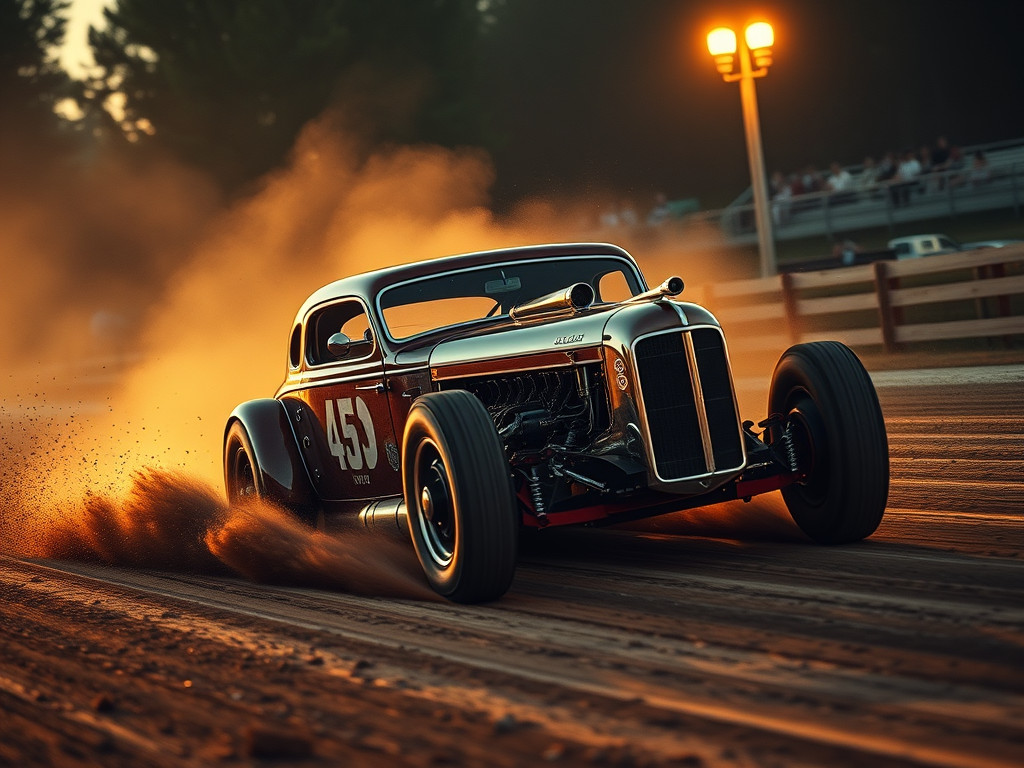
NASCAR, the National Association for Stock Car Auto Racing, is synonymous with high-speed thrills, roaring engines, and fierce competition on oval tracks. But its origins are far from the polished, multi-million-dollar industry we see today. The story of NASCAR is deeply intertwined with American history, particularly the Prohibition era and the ingenuity of individuals who found ways to make ordinary cars extraordinarily fast. What began as informal races among bootleggers has evolved into a meticulously organized, globally recognized motorsport.
At its core, stock car racing was about proving who had the fastest “stock” car – a vehicle that resembled those driven on public roads. While the term “stock car” has evolved considerably, losing much of its literal meaning as cars became purpose-built racing machines, the spirit of fierce, accessible competition has remained. NASCAR’s journey from dusty dirt tracks to gleaming superspeedways is a testament to the vision of its founders, the dedication of its drivers, and the enduring passion of its fanbase. It’s a story of innovation, adaptation, and a distinctly American form of motor racing that has captivated generations.
This article delves into ten key facts about the history of NASCAR and stock car racing, exploring its humble beginnings, significant milestones, and the pivotal moments that shaped it into the spectacle it is today. Understanding these foundational elements provides a deeper appreciation for the unique culture, traditions, and excitement that define NASCAR.
1. Born from Bootlegging: The Unofficial Origins
The true genesis of stock car racing can be traced back to the Prohibition era in the United States (1920-1933). Bootleggers, who illegally transported moonshine (illicitly distilled whiskey) across the rural South, needed fast, modified cars to evade federal agents, often called “revenuers.” These drivers would soup up their otherwise ordinary-looking vehicles, adding powerful engines, reinforced suspensions, and larger fuel tanks. After Prohibition ended, many of these former bootleggers, now legitimate businessmen or still operating on the fringes, continued to modify and race their cars for pride, bragging rights, and small wagers. These informal races on dirt roads and fairgrounds laid the groundwork for organized stock car competition, demonstrating a raw, visceral appeal that captured the imagination of local communities.
2. Bill France Sr.: The Visionary Founder
The transition from informal racing to a professional sport largely rests on the shoulders of William Henry Getty France, Sr., affectionately known as “Big Bill.” A mechanic and former race car driver, France recognized the immense potential in organizing the chaotic world of stock car racing. Drivers were often exploited by unscrupulous promoters who would disappear with the prize money, leading to a lack of trust and consistency. In December 1947, France gathered influential racers, mechanics, and promoters at the Streamline Hotel in Daytona Beach, Florida, to discuss creating a formal sanctioning body. His vision was to establish uniform rules, a consistent schedule, and guaranteed payouts, providing structure and legitimacy to the sport. This pivotal meeting led to the formal incorporation of NASCAR on February 21, 1948.
3. The First “Strictly Stock” Race (1949)
While NASCAR was founded in 1948 with different divisions, the premier series as we know it today, initially called the “Strictly Stock” series (now the NASCAR Cup Series), held its first race on June 19, 1949. This historic event took place at the Charlotte Fairgrounds Speedway in Charlotte, North Carolina. The term “Strictly Stock” was literal: cars were mostly production models with minimal modifications, essentially street cars driven onto the track. Glenn Dunaway initially finished first in a 1947 Ford, but he was later disqualified due to illegal rear springs, making Jim Roper in a 1949 Lincoln the official winner. This race, which drew a large crowd, demonstrated the public’s appetite for competitive racing featuring cars they could relate to, setting the stage for the series’ future growth.
4. Daytona Beach’s Role: Birthplace of Speed
Long before the iconic Daytona International Speedway, Daytona Beach, Florida, was already a legendary site for speed. Its hard-packed sand beaches, combined with a parallel public road (State Road A1A), formed a unique 4.1-mile circuit that became famous for land speed record attempts in the early 20th century. Bill France Sr. himself participated in and promoted races on this “Beach & Road Course” throughout the 1930s and 40s. These challenging races, where cars sped along the beach in one direction and the highway in the other, were foundational to NASCAR’s early identity. The success and popularity of these events in Daytona Beach ultimately convinced France of the need for a permanent, purpose-built track to accommodate growing crowds and faster cars, leading to the construction of Daytona International Speedway.
5. The Evolution of the “Stock Car”
The term “stock car” has undergone a significant transformation throughout NASCAR’s history. In the early days (Generation 1, 1948-1966), race cars were indeed very close to their showroom counterparts, with basic safety modifications like strapped-shut doors and seatbelts. As speeds increased and safety became paramount, rules evolved, allowing for more extensive modifications. By the “Generation 4” era (1992-2006), cars bore little resemblance to street vehicles, being highly customized machines with composite bodies and aero-optimized designs. However, NASCAR has consistently tried to maintain a visual link to production cars. The “Generation 6” (2013-2021) and the current “Next Gen” car (introduced in 2022) have brought back more manufacturer-specific body panels and designs, aiming to put the “stock” back into stock car racing, at least aesthetically, while incorporating advanced safety features and standardized components.
6. The Creation of Superspeedways
As stock car racing grew in popularity, the need for larger, faster, and safer venues became apparent. Bill France Sr.’s vision extended beyond the Beach & Road Course to a new type of track: the superspeedway. In 1959, his dream became a reality with the opening of Daytona International Speedway, a 2.5-mile high-banked tri-oval designed for incredible speeds and spectator visibility. This innovative design became the blueprint for other massive tracks like Talladega Superspeedway (opened 1969), creating a new era of racing defined by pack racing and drafting. These superspeedways not only provided a thrilling spectacle for fans but also allowed cars to reach unprecedented speeds, pushing the boundaries of engineering and driver skill.
7. The Daytona 500: The “Great American Race”
Inaugurated in 1959, the Daytona 500 quickly became the most prestigious race on the NASCAR calendar. Held annually at the Daytona International Speedway, it traditionally kicks off the Cup Series season and is often considered the Super Bowl of stock car racing. The very first Daytona 500 was a thrilling photo finish between Lee Petty and Johnny Beauchamp, with Petty declared the winner only after a three-day review of newsreel footage by Bill France Sr. Over the decades, the Daytona 500 has produced countless iconic moments, dramatic finishes, and launched the careers of many legends. Its rich history, high stakes, and position as the season opener make it a must-watch event that draws millions of viewers annually, solidifying its status as the “Great American Race.”
8. The Modern Era and Corporate Sponsorship
The early 1970s marked a significant turning point for NASCAR, often referred to as the “modern era.” Prior to this, the sport had numerous short tracks and shorter races. In 1972, R.J. Reynolds Tobacco Company’s Winston brand became the title sponsor of the Grand National Series, renaming it the “Winston Cup Series.” This infusion of corporate money brought unprecedented stability, professionalism, and national television exposure to the sport. Winston’s long-term commitment allowed NASCAR to standardize its schedule, focus on larger tracks, and significantly increase prize money. This era saw the rise of legendary drivers like Richard Petty, Dale Earnhardt, and Darrell Waltrip, and transformed NASCAR from a regional Southern sport into a nationally recognized phenomenon, paving the way for its eventual global expansion and numerous corporate partnerships.
9. Safety Innovations: A Constant Evolution
The history of NASCAR, particularly from the 1970s onwards, is also a story of continuous innovation in safety. As cars became faster, the risks to drivers grew exponentially. Tragic accidents spurred significant advancements in vehicle design and track technology. Key innovations include the development of safer seats, stronger roll cages, HANS (Head and Neck Support) devices, SAFER (Steel and Foam Energy Reduction) barriers, and advanced fire suppression systems. The death of Dale Earnhardt Sr. in 2001 at Daytona was a catalyst for even more aggressive safety research and implementation, leading to the “Car of Tomorrow” (Gen 5) and eventually the “Next Gen” car, both designed with enhanced driver protection at their core. NASCAR’s commitment to safety has made it one of the safest forms of motorsports, constantly evolving to protect its competitors.
10. The Legendary Dynasties: Petty, Earnhardt, Gordon, Johnson
NASCAR’s narrative is richly populated with legendary drivers who didn’t just win races but dominated eras, creating dynasties that transcended the sport. Richard Petty, “The King,” holds the record for 200 career wins and seven championships (a record shared with Dale Earnhardt and Jimmie Johnson). Dale Earnhardt Sr., “The Intimidator,” became a cultural icon with his aggressive driving style and earned seven championships. Jeff Gordon, a face of NASCAR’s expansion beyond its Southern roots, amassed four championships and brought a new level of professionalism. More recently, Jimmie Johnson achieved an unprecedented five consecutive championships from 2006 to 2010, followed by a seventh title. These multi-championship drivers and their iconic car numbers have shaped NASCAR’s identity, providing compelling rivalries and memorable moments that define the sport’s history.
The story of NASCAR is one of remarkable growth and transformation, from impromptu races among moonshiners to a multi-billion-dollar global entertainment enterprise. These ten facts highlight the key milestones and enduring characteristics that have shaped stock car racing into the thrilling sport it is today. It’s a testament to ingenuity, passion, and the relentless pursuit of speed, all while maintaining a deep connection to its grassroots American heritage.
Further Reading
- NASCAR Chronicle by Greg Fielden
- Driven: The Men Who Made NASCAR by Bill France Jr. and Joyce McLain
- The Last American Hero: The True Story of the Last of the Great American Heroes by Tom Wolfe (about Junior Johnson)
- Richard Petty: The King by Richard Petty with William Neely
- Dale Earnhardt: The Legend by Larry Woody
Here at Zentara.blog, our mission is to take those tricky subjects and unlock them, making knowledge exciting and easy to grasp for everyone. But the adventure doesn’t stop on this page! We’re constantly exploring new frontiers and sharing discoveries across the digital universe. Want to dive deeper into more mind-bending Top 10s and keep expanding your world? Come join us on our other platforms – we’ve got unique experiences waiting for you on each one!
Get inspired by visual wonders and bite-sized facts: See the world through Zentara’s eyes on Pinterest!
Pin our fascinating facts and stunning visuals to your own boards. Explore Pins on Pinterest: https://uk.pinterest.com/zentarablog/
Discover quick insights and behind-the-scenes peeks: Hop over to Tumblr for snippets, quotes, and unique content you won’t find anywhere else. It’s a different flavour of discovery! Follow the Fun on Tumblr: https://www.tumblr.com/zentarablog
Ready for deep dives you can listen to or watch? We’re bringing our accessible approach to video and potentially audio! Subscribe to our YouTube channel and tune into future projects that make learning pop! Subscribe on YouTube: https://www.youtube.com/@ZentaraUK
Seeking even more knowledge in one place? We’ve compiled some of our most popular topic deep dives into fantastic ebooks! Find them on Amazon and keep the learning journey going anytime, anywhere. Find Our Ebooks on Amazon: https://www.amazon.co.uk/s?k=Zentara+UK&ref=nb_sb_noss
Connect with us and fellow knowledge seekers: Join the conversation on BlueSky! We’re sharing updates, thoughts, and maybe even asking you what wonders we should explore next. Chat with Us on BlueSky: https://bsky.app/profile/zentarablog.bsky.social
Perfect for learning on the move! We post multiple 10-minute podcasts per day on Spotify. Pop on your headphones and fill your day with fascinating facts while you’re out and about! Listen on Spotify: https://open.spotify.com/show/3dmHbKeDufRx95xPYIqKhJFollow us on Instagram for bytesize knowledge! We post multiple posts per day on our official Instagram account. https://www.instagram.com/zentarablog/ Every click helps us keep bringing honest, accessible knowledge to everyone. Thanks for exploring with us today – see you out there in the world of discovery!



Leave a Reply