
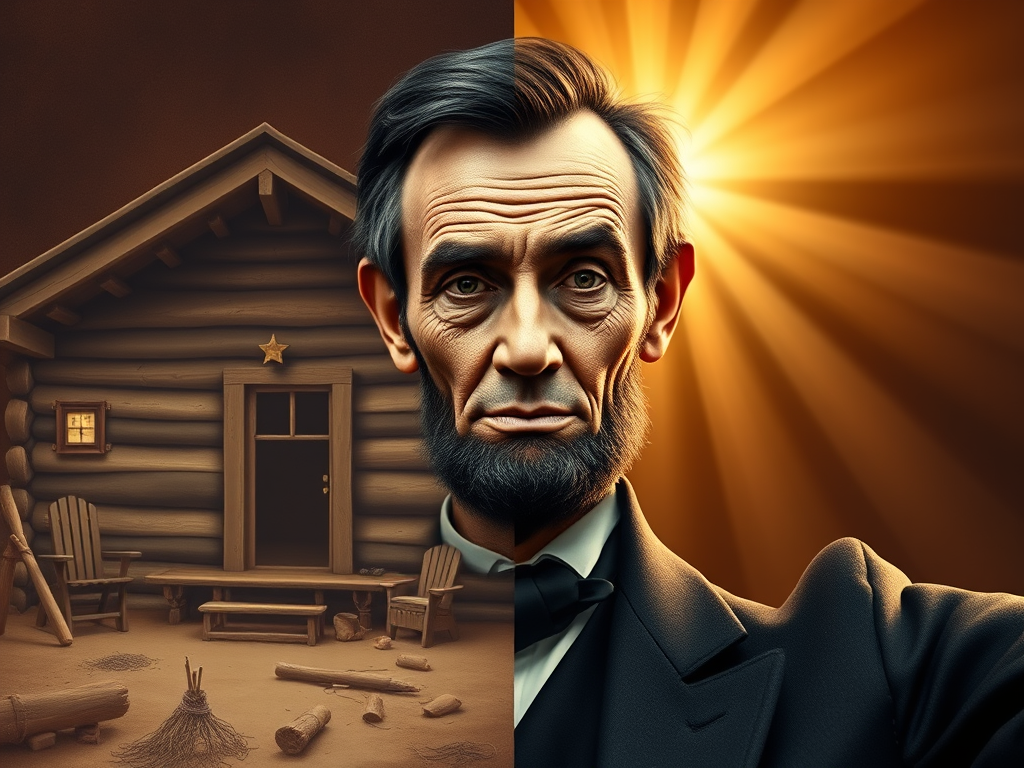
Abraham Lincoln, the 16th President of the United States, stands as arguably the most revered and studied figure in American history. His presidency, from 1861 to 1865, was arguably the most tumultuous period in the nation’s existence, marked by the brutal American Civil War and the monumental struggle to abolish slavery. More than just a political leader, Lincoln emerged as a symbol of unity, resilience, and moral conviction, guiding a deeply divided nation through its darkest hour. His life, from humble beginnings in a Kentucky log cabin to the pinnacle of political power, embodies the American ideal of self-made success and the pursuit of justice.
Lincoln’s impact transcends his role as a wartime president. He fundamentally redefined the nature of American democracy, asserting the indivisibility of the Union and expanding the powers of the executive to meet an unprecedented crisis. His words, from the eloquent brevity of the Gettysburg Address to the profound wisdom of his Second Inaugural, continue to inspire and resonate, shaping the national narrative of liberty and equality. He was a statesman of extraordinary foresight, pragmatism, and empathy, capable of both unwavering resolve and profound compassion.
This article explores the remarkable life and enduring legacy of Abraham Lincoln, delving into his formative years, his rise to power, his pivotal decisions during the Civil War, and the lasting impact of his presidency on the United States and the world. Through his actions, he not only preserved the Union but also laid the groundwork for a more just and inclusive society, forever etching his name into the annals of history as a titan of democracy and human rights.
1. Humble Beginnings and Self-Education
Abraham Lincoln’s early life was far from privileged, a testament to his remarkable self-reliance and intellectual curiosity. Born on February 12, 1809, in a one-room log cabin in rural Kentucky, Lincoln experienced the harsh realities of frontier life. His family later moved to Indiana and then Illinois, constantly battling poverty and the unforgiving wilderness. Formal education was scarce; he famously claimed his schooling amounted to less than a year. However, Lincoln possessed an insatiable appetite for knowledge, devouring every book he could lay his hands on, often reading by firelight after long days of manual labor. This self-education was foundational to his sharp intellect, his mastery of language, and his profound understanding of law and philosophy. It was during these formative years that he cultivated the resilience, wit, and empathy that would define his future leadership. His ability to rise from such humble origins to the nation’s highest office became a powerful symbol of the American dream and remains a key aspect of his biography of Abraham Lincoln.
2. The Prairie Lawyer and Early Political Career
Before ascending to the presidency, Abraham Lincoln established himself as a respected lawyer and a shrewd politician in Illinois. After leaving his father’s home, he worked various jobs, including flatboatman and store clerk, before dedicating himself to studying law. Largely self-taught, he passed the bar exam in 1836 and built a successful legal practice in Springfield, Illinois. His legal career honed his logical reasoning, persuasive speaking, and deep understanding of the Constitution, skills that would prove invaluable during his presidency. Lincoln also embarked on a political career, serving four terms in the Illinois state legislature as a Whig and one term in the U.S. House of Representatives. While his early political career had its ups and downs, including an unsuccessful bid for the U.S. Senate, his experiences cultivated his political acumen and public speaking abilities. These years as a prairie lawyer and state legislator provided the practical foundation for his later national leadership, demonstrating his evolution as a pre-presidency Lincoln and his commitment to public service in Illinois politics.
3. The Lincoln-Douglas Debates: A National Platform
The 1858 Illinois Senate race, specifically the series of seven public debates between Abraham Lincoln and incumbent Senator Stephen A. Douglas, catapulted Lincoln onto the national stage. While Lincoln ultimately lost the Senate election, the Lincoln-Douglas debates were far from a defeat. These highly publicized confrontations primarily centered on the expansion of slavery into new U.S. territories, a critical and divisive issue of the era. Douglas championed “popular sovereignty,” allowing territories to decide for themselves, while Lincoln passionately argued against the expansion of slavery, viewing it as a moral wrong and a threat to the nation’s foundational principles. His clear, logical, and morally resonant arguments showcased his exceptional oratorical skills and deep understanding of the constitutional crisis facing the nation. The debates solidified Lincoln’s reputation as a powerful voice in the burgeoning anti-slavery Republican Party, setting the stage for his successful 1860 presidential election and transforming him from a regional politician into a prominent national political figure.
4. The 1860 Election and Secession Crisis
Abraham Lincoln’s victory in the 1860 presidential election was a pivotal moment that triggered the ultimate crisis of the Union. Running as the Republican candidate, Lincoln opposed the expansion of slavery, though he did not initially advocate for its immediate abolition where it already existed. His win, achieved primarily with support from Northern states, signaled a fundamental shift in American political power and was perceived by Southern states as a direct threat to their way of life, heavily reliant on slave labor. Before Lincoln even took office, South Carolina, followed by other Southern states, began to secede from the Union, forming the Confederate States of America. Lincoln’s inaugural address was a plea for unity, emphasizing that no state had the right to unilaterally leave the Union, but it was too late. The 1860 election results and the subsequent secession crisis immediately plunged the nation into its greatest internal conflict, marking the start of Lincoln’s monumental challenge to preserve the United States. His unwavering stance on preserving the Union became the defining goal of his early presidency.
5. Leading Through the Civil War: Commander-in-Chief
As President, Abraham Lincoln immediately faced the unprecedented challenge of leading the United States through a devastating civil war. From the attack on Fort Sumter in April 1861, Lincoln assumed the role of an assertive and innovative Commander-in-Chief. He expanded presidential powers, suspending habeas corpus in certain areas, instituting the first national conscription (military draft), and overseeing a massive mobilization of troops and resources. His strategic vision involved a naval blockade of Southern ports and a relentless pursuit of the Confederate armies. Lincoln was deeply involved in the war effort, often personally directing military strategy, even cycling through generals until he found effective leaders like Ulysses S. Grant. His ability to adapt to battlefield realities, maintain public morale amidst staggering casualties, and keep the fragmented Union together was a testament to his extraordinary leadership under immense pressure. Lincoln’s wartime presidency fundamentally transformed the role of the chief executive, making him a central figure in Civil War leadership and the Union’s preservation.
6. The Emancipation Proclamation: A Turning Point
One of Abraham Lincoln’s most transformative actions was the issuance of the Emancipation Proclamation. While Lincoln initially framed the Civil War primarily as a fight to preserve the Union, his views on slavery evolved during the conflict. Recognizing the strategic and moral imperative of ending slavery, he issued the Preliminary Emancipation Proclamation in September 1862, followed by the final proclamation on January 1, 1863. This landmark decree declared all enslaved people in Confederate states (those in rebellion against the Union) to be “then, thenceforward, and forever free.” While it did not immediately free all enslaved people, it shifted the war’s moral purpose, adding the abolition of slavery to the preservation of the Union as a Union war aim. It also allowed for African Americans to serve in the Union army, significantly bolstering Union forces. The Emancipation Proclamation impact was immense, transforming the conflict into a fight for human liberty and setting the irreversible course toward the abolition of slavery in the United States.
7. The Gettysburg Address: Defining a Nation’s Purpose
On November 19, 1863, at the dedication of the Soldiers’ National Cemetery in Gettysburg, Pennsylvania, Abraham Lincoln delivered one of the most famous and powerful speeches in American history: the Gettysburg Address. In just 272 words, delivered in approximately two minutes, Lincoln transcended the immediate context of the bloody Civil War battle and articulated a profound vision for the nation. He invoked the ideals of liberty and equality enshrined in the Declaration of Independence, arguing that the war was a test of whether a nation “conceived in Liberty, and dedicated to the proposition that all men are created equal” could long endure. The address redefined the purpose of the war, framing it not just as a struggle for union but as a struggle for universal freedom and the survival of self-government. Its eloquence and timeless message continue to resonate, cementing its place as a cornerstone of American identity and a testament to Lincoln’s extraordinary skill as a presidential orator who shaped the very meaning of the American Civil War.
8. The Thirteenth Amendment: Ending Slavery Constitutionally
Following the Emancipation Proclamation, Abraham Lincoln recognized that a constitutional amendment was necessary to permanently abolish slavery across the entire United States, including in the loyal border states and those areas of the Confederacy under Union control. He tirelessly championed the Thirteenth Amendment to the U.S. Constitution. This arduous process required securing a two-thirds vote in both the House of Representatives and the Senate, and then ratification by three-fourths of the states. Lincoln used all his political acumen and influence to persuade reluctant members of Congress to vote in favor. The amendment passed Congress in January 1865 and was subsequently ratified by the states later that year, officially stating that “Neither slavery nor involuntary servitude, except as a punishment for crime whereof the party shall have been duly convicted, shall exist within the United States, or any place subject to their jurisdiction.” The Thirteenth Amendment’s passage was a monumental achievement, fulfilling Lincoln’s evolving commitment to universal freedom and marking the definitive end of the institution of slavery in America.
9. Reconstruction and “Malice Toward None”
Even as the Civil War neared its end, Abraham Lincoln began to formulate his vision for Reconstruction, the process of reuniting and rebuilding the shattered nation. His approach was characterized by a spirit of reconciliation and leniency, famously articulated in his Second Inaugural Address: “With malice toward none, with charity for all.” Lincoln sought to bring the Southern states back into the Union swiftly and painlessly, believing that a harsh punitive approach would only prolong animosity. He proposed the “10 percent plan,” which offered amnesty to former Confederates who pledged loyalty to the Union and a state could rejoin once 10% of its voters took this oath and established a new government. While his plans for post-Civil War America faced opposition from Radical Republicans in Congress who sought stricter measures against the South, Lincoln’s compassionate approach laid the philosophical groundwork for healing a deeply wounded nation. His assassination tragically prevented him from fully implementing his vision for a reunited United States.
10. Assassination and Enduring Legacy
Abraham Lincoln’s life was tragically cut short on April 14, 1865, just days after the Confederate surrender at Appomattox, when he was assassinated by John Wilkes Booth at Ford’s Theatre in Washington D.C. His death plunged the nation into profound mourning and left a void in leadership during the critical period of Reconstruction. Despite his untimely death, Lincoln’s enduring legacy is immense and multifaceted. He is credited with preserving the Union, a feat that saved the American experiment in democracy. He played a pivotal role in the abolition of slavery, setting the stage for civil rights advancements. His moral leadership, eloquence, and capacity for empathy in the face of unimaginable adversity have cemented his place as arguably the greatest U.S. President. Lincoln transformed the presidency, leaving a model of strong executive leadership during times of crisis. His life and work continue to inspire discussions on freedom, justice, and the fundamental principles of American democracy, making him a timeless figure in American history and a symbol of national unity.
Further Reading
- Team of Rivals: The Political Genius of Abraham Lincoln by Doris Kearns Goodwin
- Lincoln by David Herbert Donald
- Battle Cry of Freedom: The Civil War Era by James M. McPherson
- A. Lincoln: A Biography by Ronald C. White Jr.
- The Fiery Trial: Abraham Lincoln and American Slavery by Eric Foner
Here at Zentara.blog, our mission is to take those tricky subjects and unlock them, making knowledge exciting and easy to grasp for everyone. But the adventure doesn’t stop on this page! We’re constantly exploring new frontiers and sharing discoveries across the digital universe. Want to dive deeper into more mind-bending Top 10s and keep expanding your world? Come join us on our other platforms – we’ve got unique experiences waiting for you on each one!
Get inspired by visual wonders and bite-sized facts: See the world through Zentara’s eyes on Pinterest!
Pin our fascinating facts and stunning visuals to your own boards. Explore Pins on Pinterest: https://uk.pinterest.com/zentarablog/
Discover quick insights and behind-the-scenes peeks: Hop over to Tumblr for snippets, quotes, and unique content you won’t find anywhere else. It’s a different flavour of discovery! Follow the Fun on Tumblr: https://www.tumblr.com/zentarablog
Ready for deep dives you can listen to or watch? We’re bringing our accessible approach to video and potentially audio! Subscribe to our YouTube channel and tune into future projects that make learning pop! Subscribe on YouTube: https://www.youtube.com/@ZentaraUK
Seeking even more knowledge in one place? We’ve compiled some of our most popular topic deep dives into fantastic ebooks! Find them on Amazon and keep the learning journey going anytime, anywhere. Find Our Ebooks on Amazon: https://www.amazon.co.uk/s?k=Zentara+UK&ref=nb_sb_noss
Connect with us and fellow knowledge seekers: Join the conversation on BlueSky! We’re sharing updates, thoughts, and maybe even asking you what wonders we should explore next. Chat with Us on BlueSky: https://bsky.app/profile/zentarablog.bsky.social
Perfect for learning on the move! We post multiple 10-minute podcasts per day on Spotify. Pop on your headphones and fill your day with fascinating facts while you’re out and about! Listen on Spotify: https://open.spotify.com/show/3dmHbKeDufRx95xPYIqKhJ
Follow us on Instagram for bytesize knowledge! We post multiple posts per day on our official Instagram account. https://www.instagram.com/zentarablog/ Every click helps us keep bringing honest, accessible knowledge to everyone. Thanks for exploring with us today – see you out there in the world of discovery!




Leave a Reply