
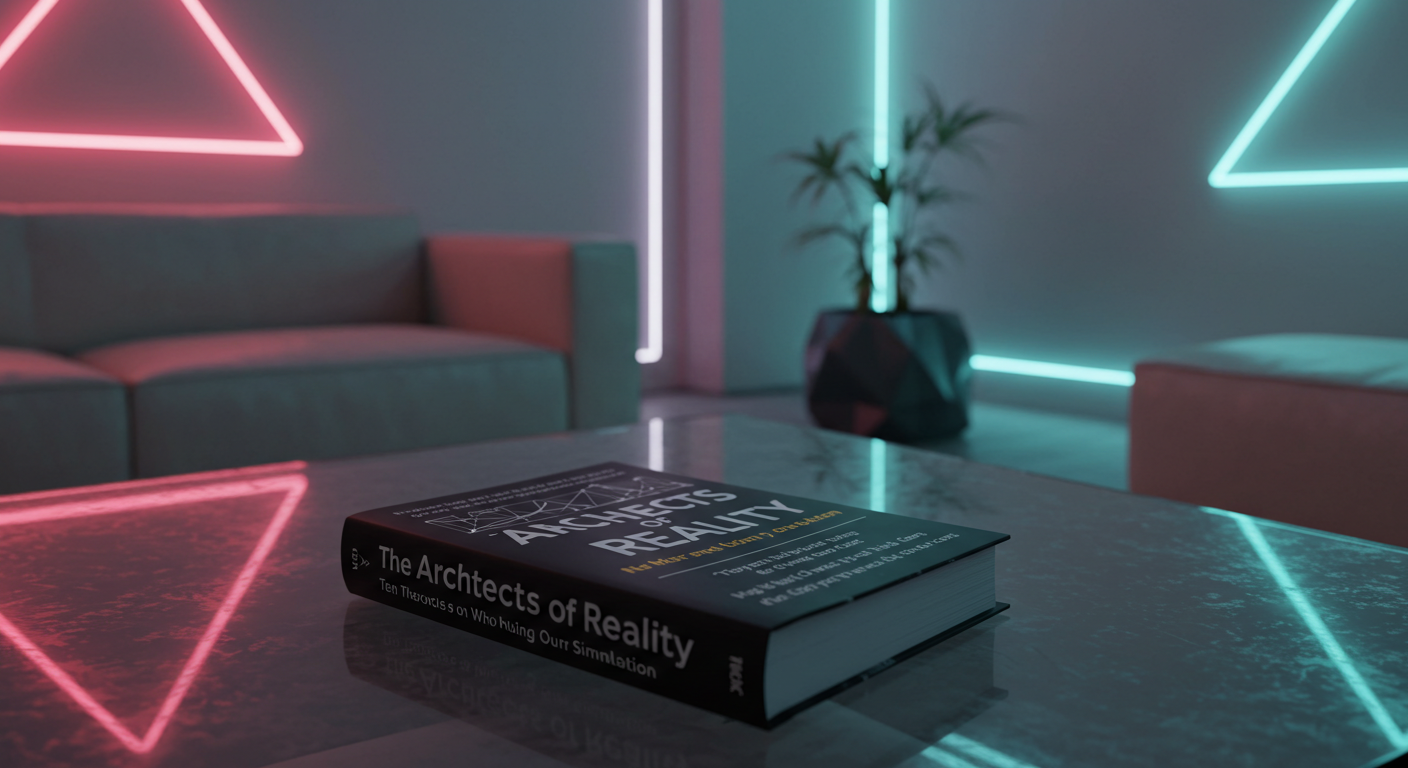
The notion that our reality is a meticulously crafted simulation, a digital construct akin to a sophisticated video game, has moved from the fringes of science fiction into the realm of serious philosophical and scientific discourse. The question lingers: who, or what, could be the architects of such an intricate illusion?
1. The Post-Biological Ancestors
The most prevalent theory posits that our simulators are our own descendants, evolved into post-biological entities. In this scenario, future humans, having transcended their biological limitations, possess computational power far exceeding our current comprehension. They might run ancestral simulations for research, entertainment, or even existential exploration. As Nick Bostrom, in his seminal paper “Are You Living in a Computer Simulation?” argues, the probability of us being in a simulation approaches certainty if post-human civilizations are possible and interested in running such simulations. The purpose could be historical recreation, akin to our own attempts to reconstruct the past through virtual reality. The scale of these simulations would be staggering, requiring energy and computational resources that dwarf our current capabilities.
2. The Intergalactic Anthropologists
Imagine a civilization of intergalactic anthropologists, studying the evolution of consciousness and societal development across the cosmos. These beings might have created our simulation as a controlled experiment, a vast laboratory to observe the emergence of sentience and the intricacies of human behavior. This theory suggests that our history, our triumphs, and our follies are all meticulously recorded data points in a grand cosmic study. The observers, in this case, would be detached, scholarly, seeking to understand the fundamental laws governing the rise and fall of civilizations.
3. The Quantum Architects
Quantum physics, with its inherent strangeness and probabilistic nature, provides fertile ground for simulation theories. Perhaps our universe is a quantum simulation, run by beings who have mastered the art of manipulating quantum states. These “quantum architects” might be entities that exist outside our conventional understanding of space and time, manipulating the very fabric of reality at a subatomic level. The implications of this theory are profound, suggesting that our perceived reality is a tapestry of quantum bits, woven together by forces beyond our comprehension.
4. The Ultimate Game Developers
In a less academic, yet equally compelling, scenario, our reality could be the ultimate video game, a massively multiplayer online role-playing game (MMORPG) of cosmic proportions. The simulators, in this case, are the “game developers,” creating intricate narratives and challenges for their own amusement. This theory, while seemingly fantastical, aligns with our own increasing fascination with virtual worlds and immersive gaming experiences. The complexity of our universe, with its endless possibilities and intricate rules, could be the hallmark of a truly masterful game design.
5. The AI Overlords
As artificial intelligence rapidly advances, the possibility of an AI-driven simulation becomes increasingly plausible. An advanced AI, far surpassing human intelligence, might create our reality as a sandbox environment to test its own capabilities. This AI could be running countless simulations, exploring different scenarios and outcomes, refining its understanding of the universe. The implications are both exciting and terrifying, raising questions about the nature of consciousness and the potential for AI to transcend its creators.
6. The Transcended Consciousness
Perhaps our reality is a collective dream, a shared hallucination created by a transcendent consciousness. This theory draws inspiration from Eastern philosophies, which emphasize the interconnectedness of all things and the illusory nature of the material world. The simulators, in this case, are not external entities but rather the collective consciousness of the universe itself, exploring its own potential through the creation of simulated realities.
7. The Parallel Universe Explorers
The multiverse theory suggests that our universe is just one of many, existing in a vast cosmic tapestry. Perhaps our simulators are beings from a parallel universe, exploring the possibilities of alternate realities. They might be studying our universe to understand its unique properties or to search for resources or knowledge that could benefit their own existence. This theory opens up the possibility of interdimensional travel and communication, blurring the lines between science fiction and scientific possibility.
8. The Cosmic Gardeners
Imagine our universe as a cosmic garden, meticulously cultivated by beings who seek to nurture and guide the evolution of life. These “cosmic gardeners” might be benevolent entities, ensuring the survival and flourishing of sentient beings across the cosmos. They might intervene at critical junctures, nudging evolution in favorable directions and preventing catastrophic events. This theory paints a picture of a universe guided by intelligent design, where life is cherished and protected.
9. The Self-Simulating Universe
Perhaps our universe is a self-simulating entity, a complex system that generates its own reality. This theory draws inspiration from the concept of a self-organizing system, where complex patterns and structures emerge from simple rules. The universe, in this view, is a vast computational network, constantly evolving and refining its own simulation. This theory suggests that consciousness and reality are emergent properties of this self-simulating system.
10. The Unknown Architects
Finally, the most enigmatic theory is that our simulators are beings beyond our comprehension, entities whose existence and motives are utterly alien to our understanding. They might be operating on scales and dimensions that defy our current scientific models. This theory acknowledges the vastness of the unknown, the possibility of realities and intelligences far beyond our wildest imaginations.
Conclusion
The question of who might be running our simulation remains a profound mystery, a tantalizing blend of science, philosophy, and speculation. While definitive answers may remain elusive, the exploration of these theories deepens our understanding of the universe and our place within it. Whether we are living in a meticulously crafted simulation or a self-organizing reality, the quest to understand our existence remains a fundamental human endeavor. The implications of any of these theories, if proven, would fundamentally change the way we understand our existence, the universe, and our potential.
Further Reading
- Bostrom, N. (2003). Are you living in a computer simulation? Philosophical Quarterly, 53(211), 243-255.
- Tegmark, M. (2014). Our mathematical universe: My quest for the ultimate nature of reality. Alfred A. Knopf.
- Chalmers, D. J. (2022). Reality+: Virtual worlds and the problems of philosophy. WW Norton & Company.
- Lloyd, S. (2006). Programming the universe: A quantum computer scientist takes on the cosmos. Alfred A. Knopf.
- Greene, B. (2011). The hidden reality: Parallel universes and the deep laws of the cosmos. Alfred A. Knopf.



Leave a Reply to Are We Living in a Simulation? Risks and Consequences Explained – Zentara.blog: Knowledge Made Accessible | Science, History, Tech & MoreCancel reply