
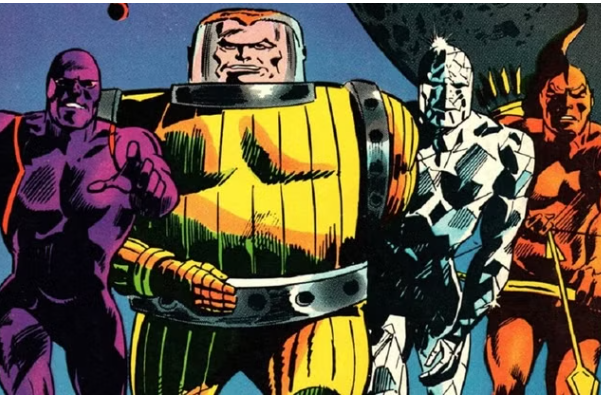
In the cold, unforgiving vacuum of the Marvel Universe, where empires like the Kree and the Skrulls wage eternal wars, there is a third force that thrives in the shadows between the stars: The Ravagers. Often dismissed as mere scavengers or low-life brigands, this intergalactic crime syndicate is actually a complex, multi-layered organization with its own culture, ancient traditions, and a surprisingly strict code of ethics. They are the ultimate wild cards of the cosmos—mercenaries who will save a planet for the right price or strip it bare if the profit margins are higher.
While the name is often associated with the blue-skinned archer Yondu Udonta, the Ravagers are much more than a single crew. They are a sprawling network of thousands, operating out of massive junk-ships and hidden asteroid bases. To understand the Ravagers is to understand the “blue-collar” side of cosmic heroism and villainy. They are the pirates who navigate the slipstreams of reality, seeking fortune while dodging the authorities of the Nova Corps. Whether they are acting as the surrogate family for a young Star-Lord or serving as the vanguard against a galactic invasion, the Ravagers remain the most unpredictable element in the Marvel firmament. Here are ten essential things you should know about these legendary space outlaws.
1. An Intergalactic Syndicate of Thousands
When many people think of the Ravagers, they imagine a single ship like the Eclector drifting through the void. In reality, the Ravagers are a massive, decentralized intergalactic syndicate. They are composed of nearly a hundred distinct factions, each led by its own captain. These crews operate independently across different sectors of the galaxy, ranging from the Andromeda Nebula to the fringes of Shi’ar space. While they often compete for the same scores, they are united by a shared history and a mutual recognition of the Ravager brand.
This scale makes them one of the most difficult organizations for cosmic authorities to dismantle. You cannot simply cut off the “head” of the Ravagers because there are dozens of heads, each with their own loyalists. This structure allows the syndicate to survive even when major captains are killed or imprisoned. It creates a vast ecosystem of crime where information, stolen goods, and black-market technology flow freely. To be a Ravager is to be part of a brotherhood that spans the stars, providing a safety net of sorts for those who have been cast out by “civilized” society.
2. The Sacred Ravager Code: Honor Among Thieves
Despite their reputation as lawless thugs, the Ravagers are governed by a strict set of rules known simply as the Ravager Code. This code is the only thing preventing the syndicate from collapsing into total anarchy. While the specifics can vary between factions, the core tenets are universal: you do not steal from your fellow Ravagers, you do not betray your captain, and—most importantly—you do not deal in “certain types” of cargo. In the most traditional interpretations of the code, the trafficking of children is a forbidden act that carries the penalty of permanent exile or death.
The Code is what separates a Ravager from a common space pirate. It provides a sense of identity and a moral framework, however warped it may be. Captains who break the code are often hunted down by their peers to preserve the integrity of the syndicate. This internal policing ensures that the Ravagers maintain a level of “professionalism” that makes them viable mercenaries for hire. They may be crooks, but they are crooks who stand by their word—at least when it concerns their own kind.
3. Yondu Udonta: The Centaurian Exile
The most iconic face of the Ravagers is undoubtedly Yondu Udonta. However, his history in the comics is a fascinating blend of two distinct eras. Originally, Yondu was a primitive hunter from the planet Centauri IV, the last of his kind in the 31st century. In modern cosmic lore, this identity has evolved, presenting him as a hardened space pirate who was sold into Kree slavery as a child before being liberated and eventually rising to lead his own Ravager clan.
Yondu represents the soul of the organization: a man who has lost everything and found a new life in the stars. His use of the Yaka Arrow—a weapon controlled by high-pitched whistles—is a testament to his Centaurian heritage and his unmatched skill as a combatant. Within the Ravagers, Yondu is a polarizing figure. He is respected for his tactical brilliance and his loyalty to his crew, but his decision to keep Peter Quill rather than delivering him to his father is often cited as a moment where he prioritized personal sentiment over the Ravager Code, leading to significant friction within the syndicate.
4. The Connection to the Original 1969 Guardians
A secret hidden in plain sight is that many high-ranking Ravager captains are actually reimaginings of the original 1969 Guardians of the Galaxy. Characters like Stakar Ogord (Starhawk), Martinex, Charlie-27, and Aleta Ogord were the first heroes to carry the Guardian name in the 31st-century timeline. In the modern Marvel landscape, these legendary figures are portrayed as veteran Ravager leaders who represent the “Old Guard” of the pirate world.
This connection adds a layer of prestige to the Ravagers. They aren’t just random thugs; they are led by beings of immense power and longevity. Stakar Ogord, for instance, is a cosmic entity who has lived through multiple timelines. When these veteran captains gather, it is known as a “Ravager Platoon,” a massive assembly of the most dangerous and experienced pilots in the universe. Seeing these characters in Ravager leather is a nod to the long, storied history of Marvel’s cosmic evolution, bridging the gap between the distant future and the present day.
5. The Colors of Chaos: Factional Identity
Diversity is a hallmark of the Ravagers. Because they recruit from every corner of the galaxy, a single crew might contain a dozen different species, from the bird-like Shi’ar to the crystalline residents of Pluvius. To distinguish themselves, different Ravager factions often adopt specific colors and sigils. While the classic flame-red leather is the most recognizable, other crews may sport different hues to signify their specialization—some focus on heavy ordnance, while others are masters of stealth and cyber-warfare.
This factionalism allows for a high degree of specialization within the syndicate. If a client needs a planetary blockade, they hire one captain; if they need a silent assassination on a high-gravity world, they hire another. This internal variety makes the Ravagers a versatile tool for any cosmic power-player. It also leads to intense rivalries. It is not uncommon for two Ravager crews to engage in a full-scale ship-to-ship battle over a lucrative salvage claim, only to share a drink together at an outlaw space station a week later once the dispute is “settled.”
6. The Eclector: A Fortress in the Void
Every great pirate needs a flagship, and for the Ravagers, that is the Eclector. More than just a ship, the Eclector is a massive, modular vessel that serves as a mobile base of operations, a repair bay, and a treasury. It is designed to be pieced together and broken apart; various “M-Ships” (smaller scout vessels) can dock and undock from the main hull, allowing the Ravagers to disperse in seconds if the Nova Corps arrives.
The interior of a Ravager flagship is a labyrinth of neon-lit hallways, gambling dens, and trophies from a thousand different worlds. It reflects the chaotic, nomadic lifestyle of its inhabitants. For many Ravagers, the ship is the only home they have ever known. The technology aboard these vessels is often a “Frankenstein” mix of different alien designs—Kree engines bolted onto Skrull life-support systems—creating a unique aesthetic of high-tech grime. The Eclector is a symbol of Ravager ingenuity, proving that you don’t need a government budget to build a weapon capable of challenging a starship.
7. Recruitment: Taking in the Galaxy’s Foundlings
The Ravagers grow their ranks through a process that is part kidnapping and part adoption. They frequently take in orphans, refugees, and outcasts—beings who have been chewed up and spat out by the galactic empires. Peter Quill (Star-Lord) is the most famous example, but the syndicate is full of individuals who were “found” by a crew and raised in the Ravager way.
This creates an incredibly loyal, if dysfunctional, family dynamic. For many members, the Ravager captain is a father or mother figure, and the crew is their only kin. This “Foundling” tradition ensures a constant stream of new blood and diverse skill sets. While the life is dangerous and often brutal, it offers a level of freedom and belonging that is hard to find elsewhere in the cosmos. To a kid who has lost their planet to a world-eater or a cosmic war, a seat on a Ravager ship can look a lot like salvation.
8. Their Role as Interstellar Scavengers
While they are often called pirates, a large portion of Ravager income comes from legitimate (or semi-legitimate) scavenging. The Marvel Universe is littered with the debris of ancient civilizations, abandoned space stations, and the wreckage of massive cosmic battles. The Ravagers are the experts at finding these “gold mines” in the dark. They possess specialized sensors and salvage drones that can strip a derelict freighter of its valuable isotopes in a matter of hours.
This role as scavengers makes them an essential part of the galactic economy. They recover lost technology that even the greatest scientists of Earth have yet to dream of. They are the garbage collectors of the gods, picking through the remains of Celestial experiments or discarded Kree weaponry. This expertise gives them a deep knowledge of the galaxy’s hidden corners. If you are looking for a mythical artifact or a piece of tech that hasn’t been manufactured in ten thousand years, the Ravagers are usually the only ones who know where to find it.
9. Friction with the Nova Corps and Cosmic Law
The relationship between the Ravagers and the Nova Corps (Xandar’s interstellar police force) is a classic game of cat and mouse. The Ravagers view the Nova Corps as overbearing bureaucrats who stifle the natural freedom of the stars, while the Corps views the Ravagers as a persistent infection that destabilizes planetary governments. Most Ravager captains have a “Shoot on Sight” warrant out for them in Nova-controlled sectors.
However, there is an underlying complexity to this rivalry. On more than one occasion, the Nova Corps has been forced to “deputize” Ravager crews to deal with threats that the official military cannot handle. Because the Ravagers operate outside the law, they can go places and do things that a Nova Centurion cannot. This creates a grudging respect between some captains and some officers. They are two sides of the same coin: one fighting for order, the other for freedom, both trying to survive in a universe that is often indifferent to both.
10. The Legacy of the Ravager Funeral
Perhaps the most touching aspect of Ravager culture is the Ravager Funeral. When a captain dies who has lived and died by the Ravager Code, their peers from across the galaxy gather for a “Colours” ceremony. This involves dozens of Ravager ships surrounding the deceased’s vessel and igniting their engines in a synchronized display of multi-colored light and energy. It is a breathtaking spectacle that can be seen from across a star system.
This ritual proves that, despite their greed and violence, the Ravagers possess a profound sense of community. The funeral is the ultimate validation of a life spent in the shadows; it is a signal to the rest of the universe that the fallen was part of something bigger than themselves. It is a moment of pure, silent respect among outlaws. To receive the “Colours” is the highest honor a Ravager can achieve, signifying that even in a galaxy of billions, their light was recognized and remembered by their brothers and sisters in arms.
Further Reading
- Guardians of the Galaxy: Cosmic Avengers by Brian Michael Bendis
- Yondu: My Two Yondus by Lonnie Nadler and Zac Thompson
- Guardians of the 3000 by Dan Abnett
- All-New Guardians of the Galaxy: Communication Breakdown by Gerry Duggan



