
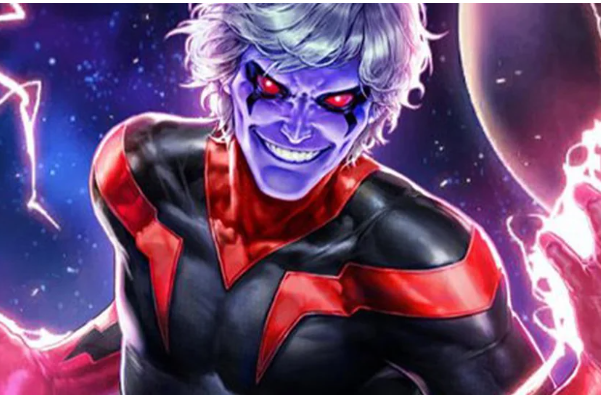
In the infinite reaches of the Marvel Universe, where gods clash with titans and stars are born and extinguished in the blink of an eye, few figures command as much terror as the Magus. He is the ultimate cautionary tale of what happens when a savior lives long enough to become a monster. As the dark, future counterpart of the cosmic hero Adam Warlock, the Magus represents the absolute corruption of power, the perversion of faith, and the terrifying inevitability of destiny.
The Magus is not merely a villain; he is a cosmic phenomenon. While many antagonists seek to conquer planets or hoard wealth, the Magus seeks to dominate the very souls of the living through a terrifying blend of religious zealotry and reality-warping science. He is a mirror held up to one of Marvel’s greatest heroes, showing that even the purest intentions can be twisted into something unrecognizable. To understand the Magus is to delve into the heart of Marvel’s cosmic mythology, where time, soul, and identity blur into a singular, golden-skinned nightmare. Here are the ten essential things you should know about the man who would be the Shadow King of the stars.
1. The Dark Reflection of the Savior, Adam Warlock
At his core, the Magus is the antithesis of Adam Warlock. While Warlock is often depicted as a messianic figure—a “perfect” being created to save the universe—the Magus is the manifestation of Warlock’s suppressed darkness, ego, and capacity for cruelty. In many ways, they are two sides of the same coin, locked in an eternal struggle for the soul of a single man. Whenever Adam Warlock gains too much power or loses his emotional equilibrium, the specter of the Magus looms, waiting to take control.
This relationship is more than just a typical hero-villain rivalry; it is a psychological battleground. The Magus often mocks Warlock for his morality, viewing it as a weakness that prevents him from reaching his true potential. Because the Magus possesses all of Warlock’s memories and tactical brilliance, he is often three steps ahead of his lighter half. He represents the “shadow self” of the hero, a constant reminder that the potential for ultimate evil exists within even the most noble hearts. This duality is what makes their confrontations so personal and high-stakes.
2. The Prophet of the Universal Church of Truth
Unlike many cosmic conquerors who rely on brute force or military might, the Magus uses the power of organized religion to achieve his ends. He is the founder and god-king of the Universal Church of Truth, a massive, intergalactic cult that spans entire star systems. The Church does not offer salvation; it demands absolute “belief,” which the Magus then harvests as a physical energy source to fuel his own divine powers.
The Church operates with a terrifying efficiency, using “Inquisitors” and “Black Knights” to convert populations through fear and indoctrination. The Magus understands that faith is a more potent weapon than any laser or bomb because it captures the will of the people. Under his rule, the Universal Church of Truth becomes a parasitic entity, draining the life and resources of planets while promising a twisted form of enlightenment. This makes the Magus a uniquely dangerous threat—he doesn’t just want to rule your world; he wants to be the only god you are allowed to worship.
3. A Being Born from a Temporal Paradox
The origin of the Magus is a complex web of time travel and destiny. In his primary incarnation, the Magus is a version of Adam Warlock from a future timeline who was driven insane and corrupted by the In-Betweener, a powerful cosmic entity representing the balance between life and death. The In-Betweener plucked Warlock from the stream of time and placed him in a “cocoon of madness,” ensuring that when he emerged, he would be the Magus.
This creates a terrifying loop: Warlock must eventually travel back in time to become the Magus to ensure his own existence. For centuries of comic history, Warlock’s primary goal was to prevent this future from occurring. The Magus is essentially a “living paradox”—a being who shouldn’t exist but does because the timeline was manipulated by cosmic forces beyond human comprehension. This temporal nature makes him incredibly difficult to defeat, as killing him in the present might result in a catastrophic disruption of the past and future.
4. The Corruption of the Soul Gem
Much of the Magus’s power and his eventual fall into madness can be traced back to the Soul Gem, one of the six legendary Infinity Stones. Adam Warlock wore the Soul Gem for much of his life, using it to protect the universe. However, the gem is a sentient, parasitic artifact that hungers for souls. Over time, the constant exposure to the gem’s dark influence began to erode Warlock’s psyche, providing the fertile ground in which the seeds of the Magus could grow.
The Magus has a mastery over the Soul Gem that even Warlock struggles to match. He can use it to trap souls in the “Soul World,” an internal dimension within the gem, or to manipulate the life force of those around him. While Warlock views the gem as a heavy burden and a dangerous tool, the Magus embraces it as his birthright. The gem’s influence ensures that the Magus is always more than just a man; he is a cosmic predator with a direct connection to one of the fundamental building blocks of reality.
5. The Architect of the Intergalactic “Infinity War”
In one of his most ambitious gambits, the Magus orchestrated a massive conflict known as the Infinity War. This was not a war fought with soldiers alone, but with doppelgängers. The Magus created dark, twisted reflections of Earth’s greatest heroes—monstrous versions of Spider-Man, Iron Man, and the Fantastic Four—to sow chaos and replace the originals. His goal was to acquire the Infinity Gauntlet and reshape the universe in his own image.
This event showcased the Magus’s genius as a master manipulator. He managed to pit the heroes of Earth against the forces of Thanos and Adam Warlock, all while staying in the shadows. He nearly succeeded in usurping the power of the universe, proving that he was a threat on par with the Mad Titan himself. The Infinity War remains a landmark moment in cosmic history, highlighting the Magus’s ability to use the heroes’ own identities and insecurities against them, turning their very existence into a weapon of mass destruction.
6. A Rivalry Built on Mutual Hatred: Thanos vs. Magus
One of the most fascinating dynamics in the Marvel Universe is the relationship between Thanos and the Magus. While Thanos is a nihilist who worships death, the Magus is a narcissist who worships himself. This fundamental difference in philosophy makes them bitter enemies. Thanos has often been the only being capable of seeing through the Magus’s deceptions, and on several occasions, the Mad Titan has actually teamed up with Adam Warlock to stop the Magus.
Thanos views the Magus as an “annoying fanatic” who lacks the vision to understand the true nature of the cosmos. Conversely, the Magus sees Thanos as a primitive brute who is obsessed with an abstract concept like “Death” when he could be ruling as a living god. Their battles are epic in scale, often involving reality-warping artifacts and cosmic-level strategy. It is a rare testament to the Magus’s danger that even a villain as powerful as Thanos considers him a threat that must be eliminated at all costs.
7. Mastery of Quantum Magic and Cosmic Energy
The Magus is not just a physical powerhouse; he is one of the most proficient practitioners of Quantum Magic in the galaxy. This is a form of sorcery that blends scientific principles with mystical energy, allowing him to manipulate matter and energy on a subatomic level. He can teleport across galaxies, project devastating blasts of cosmic force, and shield himself from almost any conventional weapon.
Because he possesses the biological advantages of a “perfect human” (Adam Warlock’s physiology), his body acts as a living battery for this energy. He can fly through the vacuum of space, survive without air or food, and heal from injuries that would vaporize a mortal. His mastery of magic gives him an edge over other cosmic beings who rely solely on technology or physical strength. To the Magus, the laws of physics are merely suggestions, and he possesses the will to rewrite them to suit his whims.
8. The Techno-Organic Resurrection and the Phalanx
In various points of cosmic history, the Magus has evolved beyond his biological roots. He has at times merged with techno-organic technology, specifically linked to the Technarchy (the race that includes Warlock of the New Mutants). This version of the Magus is a terrifying fusion of plant, machine, and god, capable of infecting entire worlds with a “transmode virus” that converts all organic life into a techno-organic extension of his own consciousness.
This “Cyber-Magus” represents the ultimate loss of individuality. By turning civilizations into a collective hive mind, he ensures that there is no one left to oppose his “truth.” This evolution shows the character’s adaptability; even when his biological form is destroyed, the Magus can return as a digital ghost or a mechanical titan. His connection to the Phalanx and other techno-organic threats makes him a multiversal danger that can strike from the digital realm as easily as the physical one.
9. The Tragedy of the Inevitable Future
The most haunting aspect of the Magus is the sense of inevitability that surrounds him. For much of his existence, Adam Warlock has lived under the shadow of the knowledge that he is the Magus. This creates a tragic arc where the hero’s every victory feels like a step toward his own damnation. Every time Warlock uses his power to save the day, he risks becoming the very tyrant he despises.
This theme of predestination is a core part of the character’s appeal. It raises profound questions about free will: Can a person truly change their nature if their future is already written? The Magus often taunts Warlock with this fact, claiming that his “heroism” is just a phase that will eventually burn out, leaving only the cold brilliance of the Magus behind. This psychological warfare makes every interaction between the two characters feel like a desperate struggle for Warlock to maintain his own soul.
10. The Eternal Cycle of Rebirth
In the Marvel Universe, death is rarely the end for a being as powerful as the Magus. Because he is so closely tied to the cycle of Warlock’s cocoons and the Soul Gem, the Magus has a habit of “respawning.” Whenever Warlock undergoes a transformation or suffers a mental breakdown, there is a chance that the Magus will emerge instead of the hero. He exists as a latent “virus” in Warlock’s DNA and psyche.
This cycle of rebirth means that the Magus is a permanent fixture of the cosmic landscape. He cannot be truly killed because he is a fundamental part of a being who is immortal. Whether he is returning as a religious zealot, a techno-organic nightmare, or a temporal ghost, the Magus serves as the ultimate reminder that light cannot exist without shadow. As long as there is an Adam Warlock to protect the universe, there will always be a Magus waiting in the dark to tear it all down.
Further Reading
- The Warlock Chronicles by Jim Starlin
- Infinity War by Jim Starlin and Ron Lim
- Annihilation: Conquest by Dan Abnett and Andy Lanning
- Guardians of the Galaxy: The Magus Saga by Dan Abnett




One response to “10 Things You Should Know About The Magus – Marvel Comics”
[…] 10 Things You Should Know About The Magus – Marvel Comics […]