
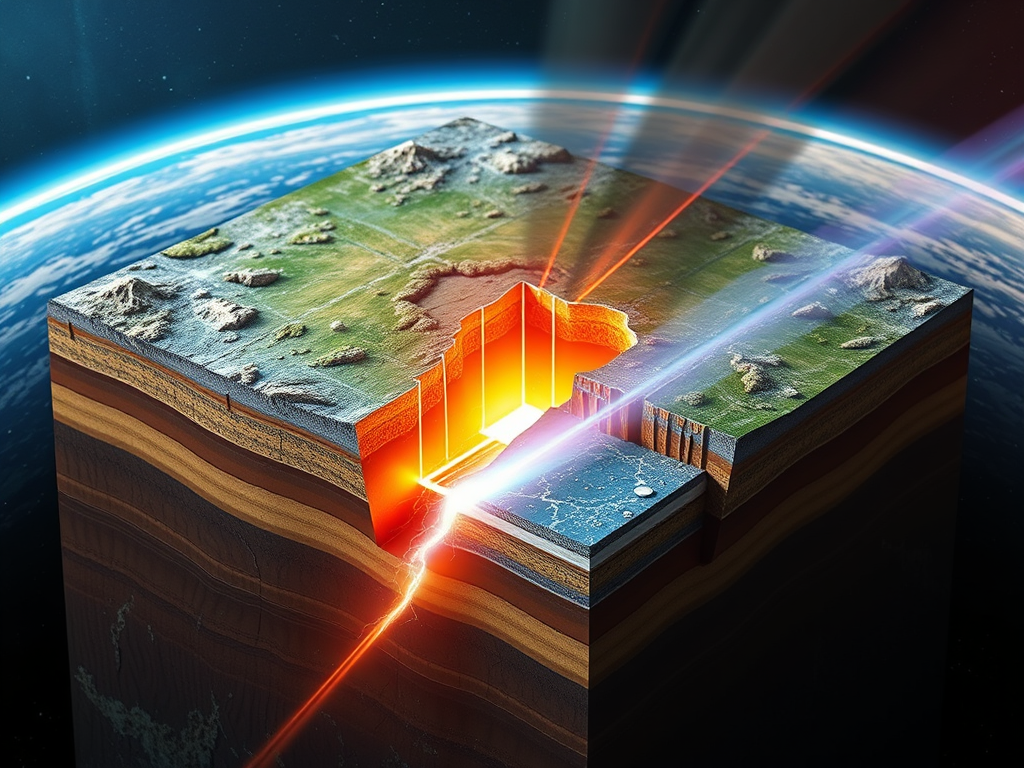
Earthquakes are one of nature’s most powerful and fascinating phenomena. They can shake the ground, change landscapes, and remind us that our planet is a dynamic, ever-moving place. But what exactly causes these rumblings beneath our feet? Why do they happen in certain places more than others? And how do scientists study them?
Join us as we explore 10 astonishing facts about earthquakes that will help you understand these incredible forces of nature. Get ready to learn about everything from the giant puzzle pieces that make up the Earth’s surface to the special tools scientists use to measure the shaking. Understanding earthquakes is the first step to staying safe, so let’s dive in!
1. Earthquakes Are Caused by Moving Plates
Have you ever looked at a map and noticed how some continents look like they could almost fit together, like pieces of a giant puzzle? Well, that’s not a coincidence! The Earth’s outermost layer, called the lithosphere, isn’t one solid shell. Instead, it’s broken up into huge slabs called tectonic plates. Think of them like massive rafts floating on the slightly softer, hotter layer beneath, called the asthenosphere.
These plates are constantly, slowly moving – only a few centimeters each year, about as fast as your fingernails grow! Sometimes they slide past each other, sometimes they collide head-on, and sometimes they pull apart. This constant movement is the main reason we have earthquakes. When these giant plates interact, pressure builds up along their edges, which are called fault lines. It’s like bending a stick – you can bend it a little, and it springs back. But if you keep bending it, eventually, it will snap!
2. Pressure Builds Up Along Fault Lines
Imagine pushing two rough blocks of wood against each other. They might stick for a bit, right? That’s similar to what happens along a fault line where two tectonic plates meet or where there’s a crack within a plate. As the plates move, the rocks on either side of the fault get stuck because of friction and irregularities along the fault surface. Even though the plates are still trying to move, the rocks are locked together.
This is where the pressure, or stress, starts to build up. The rocks start to bend and deform like a stretched rubber band. They store up this energy, called elastic potential energy. The longer the rocks stay locked and the plates keep moving, the more energy gets stored. It’s like pulling back the string on a bow – the more you pull, the more energy is ready to be released. This build-up of stress is crucial to understanding what causes earthquakes.
3. The Sudden Slip is the Earthquake
Okay, so the pressure has been building up along the fault line, and the rocks on either side are locked and storing lots of energy. What happens next? Eventually, the stress built up in the rocks becomes too much for the friction holding them together. The rocks suddenly break and slip past each other! This sudden movement is the earthquake itself.
Think back to the bending stick analogy – the snap is the earthquake! When the rocks slip, all that stored-up elastic potential energy is released in waves that travel through the Earth. These waves are called seismic waves, and they are what cause the ground to shake during an earthquake. The spot underground where the rock first breaks is called the hypocenter, and the point directly above it on the Earth’s surface is the epicenter. The amount of slip and the area of the fault that slips determine the size of the earthquake.
4. Earthquakes Release Energy in Waves
When the rocks on a fault line suddenly slip, they release a burst of energy that travels outwards in all directions, kind of like ripples spreading out from a stone dropped in a pond. These energy waves are called seismic waves. Scientists who study earthquakes, called seismologists, use special instruments to detect and record these waves.
There are different types of earthquake waves, and they travel at different speeds and cause different kinds of ground motion. The fastest waves are called P-waves (Primary waves). They are compressional waves, meaning they push and pull the ground back and forth in the direction they are traveling, like sound waves. Next come S-waves (Secondary waves), which are shear waves. They move the ground from side to side or up and down, perpendicular to the direction they are traveling. P-waves arrive first at seismic stations, followed by S-waves. These body waves travel through the Earth’s interior. After the body waves come the surface waves, which travel along the Earth’s surface. These are often the slowest but cause the most damage because they shake the ground horizontally and vertically.
5. We Measure Earthquakes Using Magnitude Scales
How do scientists describe how big or strong an earthquake is? They use magnitude scales. You’ve probably heard of the Richter scale, which was one of the first scales used. It measures the amplitude (the height) of the largest waves recorded on a seismograph. However, the Richter scale isn’t the best for measuring very large earthquakes.
Today, scientists mostly use the Moment Magnitude Scale (Mw). This scale is a more accurate measure of the total energy released by the earthquake. It’s based on the seismic moment, which considers the area of the fault that slipped, the amount of slip, and the rigidity of the rocks. Both scales are logarithmic, meaning that each whole number increase in magnitude represents a tenfold increase in the amplitude of the seismic waves and about 32 times more energy released. So, a magnitude 6 earthquake is much, much more powerful than a magnitude 5 earthquake. Learning how earthquakes are measured helps us understand their power.
6. Most Earthquakes Happen Along Plate Boundaries
If you look at a map showing where earthquakes occur most frequently, you’ll notice they aren’t scattered randomly across the globe. Instead, they tend to happen in specific belts or zones. These zones line up remarkably well with the edges of the tectonic plates. This is because the plate boundaries are where all the action is – where the plates are colliding, separating, or sliding past each other, causing stress to build up.
One of the most active earthquake zones is around the Pacific Ocean, often called the “Ring of Fire.” This area has a lot of volcanoes too, and both are a result of the intense plate tectonics activity in that region. About 90% of the world’s earthquakes, and about 80% of the world’s largest earthquakes, happen along the Ring of Fire. Knowing where do earthquakes happen most helps us understand the Earth’s structure.
7. The Biggest Earthquake Ever Recorded Was Huge
The biggest earthquake ever recorded by modern instruments was the Great Chilean Earthquake on May 22, 1960. It had a moment magnitude of 9.5! Earthquakes of this size are incredibly rare but release an immense amount of energy. This earthquake caused shaking that lasted for many minutes and affected a huge area.
Beyond the shaking, this massive earthquake also generated a devastating tsunami that traveled across the entire Pacific Ocean, causing damage and fatalities in places as far away as Hawaii and Japan. Studying the effects of the biggest earthquake recorded helps scientists understand the potential impact of future large quakes and improve warning systems, especially for tsunamis.
8. Earthquakes Can Happen Underwater and Cause Tsunamis
When an earthquake happens beneath the ocean floor, especially in areas where one tectonic plate is sliding under another (subduction zones), it can displace a massive amount of water. Imagine suddenly lifting or dropping a large section of the ocean floor. This powerful disturbance creates a series of large waves that can travel across entire ocean basins – these are called tsunamis.
Unlike regular waves caused by wind, tsunamis are tidal waves in the sense that they affect the entire water column from the surface to the seafloor. In the deep ocean, they are not very tall but travel at incredible speeds, sometimes as fast as a jet airplane! As they approach shallow coastal areas, the waves slow down but grow much taller, crashing ashore with immense force and causing widespread destruction. Not all underwater earthquakes cause tsunamis, but large ones in subduction zones are particularly dangerous.
9. Aftershocks Are Common After a Big Earthquake
After a major earthquake, it’s very common for the ground to keep shaking with smaller earthquakes. These are called aftershocks. The main earthquake is the sudden, large release of stress along a section of the fault line. However, this doesn’t always release all the stress that has built up in the surrounding rocks.
The rocks around the fault need time to adjust to their new position. This adjustment causes smaller slips and breaks in the rocks nearby, resulting in aftershocks. Aftershocks can continue for days, weeks, months, or even years after a large earthquake, although they usually become less frequent and less strong over time. While usually smaller than the main quake, aftershocks can still cause further damage to buildings already weakened by the initial shaking.
10. Knowing What to Do During an Earthquake is Important
Even though earthquakes are natural events we can’t prevent, knowing what to do when one happens can help keep you safe. If you feel the ground start to shake, the most important thing to remember is “Drop, Cover, and Hold On.”
- Drop onto your hands and knees. Doing this before the shaking gets strong makes it less likely you’ll be knocked over.
- Cover your head and neck with your arms. If you can, crawl under a sturdy piece of furniture like a table or desk for protection from falling objects.
- Hold On to your shelter (like the leg of a table) until the shaking stops. If you are not under shelter, hold onto your head and neck.
Stay away from windows, mirrors, and anything that could fall on you. If you are outside, move to an open area away from buildings, trees, and power lines. Learning earthquake safety for kids is a vital part of living in earthquake-prone areas.
Earthquakes are a powerful reminder of the incredible forces at work deep inside our planet. By understanding what causes earthquakes, how earthquakes are measured, and how to stay safe, we can better prepare for and live with these natural events.
Further Reading
Here are some books that can help you learn more about earthquakes:
- Earthquakes by Franklyn M. Branley (Lets-Read-and-Find-Out Science)
- Can You Feel the Force? About Forces and Motion by Richard Hammond (specifically the section on plate tectonics and earthquakes)
- National Geographic Little Kids First Big Book of Science by Kathleen Weidner Zoehfeld (includes a section on Earth and earthquakes)
- Earthquakes (A True Book) by spookyearthquakes* by Seymour Simon
Here at Zentara.blog, our mission is to take those tricky subjects and unlock them, making knowledge exciting and easy to grasp for everyone. But the adventure doesn’t stop on this page! We’re constantly exploring new frontiers and sharing discoveries across the digital universe.
Want to dive deeper into more mind-bending Top 10s and keep expanding your world? Come join us on our other platforms – we’ve got unique experiences waiting for you on each one!
- Get inspired by visual wonders and bite-sized facts: See the world through Zentara’s eyes on Pinterest! Pin our fascinating facts and stunning visuals to your own boards. Explore Pins on Pinterest: https://uk.pinterest.com/zentarablog/
- Discover quick insights and behind-the-scenes peeks: Hop over to Tumblr for snippets, quotes, and unique content you won’t find anywhere else. It’s a different flavour of discovery! Follow the Fun on Tumblr: https://www.tumblr.com/zentarablog
- Ready for deep dives you can listen to or watch? We’re bringing our accessible approach to video and potentially audio! Subscribe to our YouTube channel and tune into future projects that make learning pop! Subscribe on YouTube: https://www.youtube.com/@ZentaraUK
- Seeking even more knowledge in one place? We’ve compiled some of our most popular topic deep dives into fantastic ebooks! Find them on Amazon and keep the learning journey going anytime, anywhere. Find Our Ebooks on Amazon: https://www.amazon.co.uk/s?k=zentara+uk&crid=2273NA7RAJ1EU&sprefix=zentara+uk%2Caps%2C90&ref=nb_sb_noss
- Connect with us and fellow knowledge seekers: Join the conversation on BlueSky! We’re sharing updates, thoughts, and maybe even asking you what wonders we should explore next. Chat with Us on BlueSky: https://bsky.app/profile/zentarablog.bsky.social
- Perfect for learning on the move! We post multiple 10-minute podcasts per day on Spotify. Pop on your headphones and fill your day with fascinating facts while you’re out and about! Listen on Spotify: https://open.spotify.com/show/3dmHbKeDufRx95xPYIqKhJ
Every click helps us keep bringing honest, accessible knowledge to everyone. Thanks for exploring with us today – see you out there in the world of discovery!




Leave a Reply