
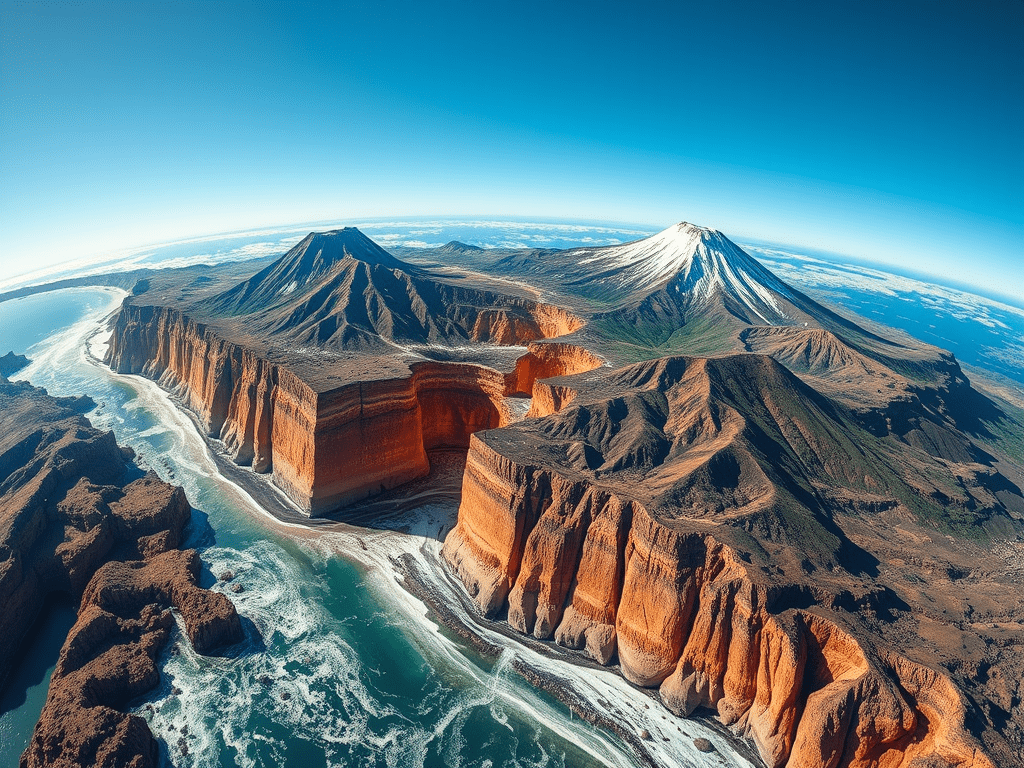
Our planet feels solid beneath our feet, a stable, unchanging rock. But that’s just an illusion. The Earth’s surface is a dynamic, violent, and incredibly active place, broken into massive pieces that are in a constant, slow-motion demolition derby. This is the science of plate tectonics, and geologists have just made a stunning new discovery.
They are, for the first time, watching a tectonic plate—a slab of crust the size of a small country—get ripped apart in real time. This “tearing” plate, located just off the coast of the Pacific Northwest, is a major geological event. It’s like finding a chapter of the planet’s instruction manual we never knew existed.
Table of Contents
This isn’t just an abstract scientific curiosity. This plate is the engine behind the “Big One,” the massive earthquake that looms over Seattle, Portland, and Vancouver. It’s the “fire” that fuels the volcanoes of the Cascade Range, from Mount St. Helens to Mount Rainier.
So, what does it mean when a plate “tears”? And how did scientists even see it? Let’s dive into the 10 amazing things you need to know about this mind-bending discovery.
1. The Cracked Eggshell: What Are Tectonic Plates?
Before we can understand a tearing plate, we need to know what one is. The easiest way to think about the Earth’s surface is to picture a hard-boiled egg that you’ve gently cracked. The planet is not one solid piece. It’s covered in about a dozen major “plates” of rigid rock (the shell) that are all floating on a hot, semi-molten layer of mantle beneath (the hot egg white).
These plates are called tectonic plates. They are massive. The Pacific Plate, for example, underpins almost the entire Pacific Ocean. The North American Plate holds most of our continent. These plates are not static; they are constantly moving, grinding past, pulling away from, and colliding with each other at a speed of about two to five centimeters per year—roughly the same speed your fingernails grow.
This tiny, relentless movement is the “engine” of our planet. It’s the force that builds mountains, carves oceans, and fuels the most destructive natural disasters on Earth: earthquakes and volcanoes. Where these plates meet, you get all the action.
2. The Planet’s “Fault Line”: The “Ring of Fire” Explained
If you look at a map of the world’s earthquakes and volcanoes, you’ll see they aren’t random. They form a nearly perfect, 25,000-mile-long horseshoe around the rim of the Pacific Ocean. This “horseshoe” runs up the coast of South America, along the western United States and Canada, through Alaska, and down through Japan, the Philippines, and New Zealand.
This is the Pacific Ring of Fire, and it is, without a doubt, the most geologically active place on Earth. It’s home to over 75% of the world’s active volcanoes and is where 90% of all earthquakes occur.
But why? The Ring of Fire isn’t a single thing. It’s a massive “battleground” where the giant Pacific Plate is crashing into all the other plates that surround it (the North American plate, the South American plate, etc.). This continuous, high-speed collision is what makes the Ring “fiery.” It’s not a ring of fire; it’s a ring of tectonic plate boundaries. And the most important type of boundary in this ring is the subduction zone.
3. The Great Conveyor Belt: What Is a “Subduction Zone”?
If tectonic plates are in a demolition derby, the subduction zone is the most dramatic crash site. It’s a place where two plates collide head-on. But since both can’t occupy the same space, one has to give.
When a dense, heavy oceanic plate (made of dark, heavy basalt rock) collides with a lighter, more buoyant continental plate (made of lighter granite), the oceanic plate always loses. It gets forced, or “subducted,” beneath the continental plate, diving deep into the Earth’s hot mantle.
Think of it as a giant, planet-sized conveyor belt. The oceanic plate is the belt, and it’s slowly but unstoppably sliding down into the planet, while the continental plate rides up and over it. This process is anything but smooth. The two plates get “stuck” on each other, building up incredible amounts of stress over centuries. When that stress is finally released, the continental plate snaps back in a matter of minutes, causing the most powerful earthquakes on the planet: megathrust earthquakes. This is the engine of the Ring of Fire.
4. The Main Character: The Plate That’s Tearing (Juan de Fuca)
Now we get to our main character: the Juan de Fuca Plate. This is a small, relatively young tectonic plate off the coast of Washington, Oregon, and southern British Columbia. But what it lacks in size, it makes up for in significance.
The Juan de Fuca plate is subducting directly beneath the North American plate. This one boundary, known as the Cascadia Subduction Zone, is the reason the Pacific Northwest has volcanoes like Mount St. Helens and faces the threat of a magnitude 9.0 earthquake.
But recent scientific reports, published in journals like Science Advances, have revealed something astonishing. The Juan de Fuca plate is not one solid piece. It’s “dying.” It’s in the active process of being torn apart. A smaller northern section of it, known as the Explorer microplate, is literally ripping away from the main body of the Juan de Fuca. Geologists are witnessing the slow-motion death and fragmentation of an entire tectonic plate.
5. An “Ultrasound” for the Earth: How Did Scientists See This?
You can’t just drill a hole and look at a tectonic plate. The tear is happening dozens of miles beneath the ocean floor, deep within the Earth’s mantle. So how did scientists “see” it? They used a brilliant technique called seismic tomography.
The simplest analogy is a medical CT scan or an ultrasound. An ultrasound machine sends sound waves into a body and listens for the echoes. By measuring how those waves bounce off different tissues (bone, muscle, fluid), a computer can build a 3D image of what’s inside.
Geologists do the same thing to the Earth. They use ships to create powerful sound waves (or they use the “noise” from natural earthquakes) that travel deep into the planet. By placing hundreds of ultra-sensitive sensors, called seismometers, on the ocean floor and on land, they can track how those waves bend, speed up, or slow down as they pass through different types of rock.
By running this data through a supercomputer, they built a “CT scan” of the Juan de Fuca plate. This detailed 3D map showed it clear as day: a massive, 75-kilometer-long tear, a gaping “hole” or “window” opening up in the plate.
6. The “Tug-of-War”: Why Is the Plate Tearing Apart?
A massive slab of rock doesn’t just tear for no reason. The Juan de Fuca plate is being ripped apart by two powerful, competing forces in a geological “tug-of-war.”
- Force 1: The Anchor (Slab Pull): The leading edge of the Juan de Fuca plate, which has already subducted deep into the mantle, is cold and incredibly dense. Gravity is pulling this heavy “anchor” (called the “slab”) straight down into the planet. This is the main engine of subduction, known as “slab pull.”
- Force 2: The Sideways Tug (Transform Fault): To the north, the plate boundary changes. It’s no longer a subduction zone; it’s a “transform fault” (like the San Andreas Fault) where the giant Pacific Plate is just sliding past.
The new research shows that the subduction zone is “dying off from north to south.” The northern part (the Explorer microplate) is being twisted and torn by its interaction with the Pacific Plate, while the southern part is still being pulled down by its heavy slab anchor. This fatal combination of twisting and pulling is causing the plate to rupture, creating a massive tear between the two sections. It’s like a piece of paper being pulled down and to the side at the same time—it’s guaranteed to rip.
7. What This Means for Earthquakes: The “Big One”
This is the question on everyone’s mind in the Pacific Northwest. If the plate is tearing, does that make the “Big One” more or less likely? The answer, for now, is complicated but clear: this discovery does not change the short-term earthquake risk.
The Cascadia Subduction Zone is still considered “locked and loaded.” The part of the plate that is stuck under North America is still building up stress, just as it has been for over 300 years. The last “Big One” was in the year 1700, and geologists believe the zone ruptures, on average, every 300-500 years. We are squarely in that window.
The new tear is generating its own, smaller earthquakes along the rip, but scientists believe this tearing has been happening slowly for millions of years. What this discovery does do is help us understand the long-term future. It tells us that the subduction zone is “dying” over geological time. It’s like watching a train derail car by car. The tear is one car breaking off, but the rest of the train is still plowing forward, and the “locked” section under Seattle is still very much a part of that train.
8. What This Means for Volcanoes: Opening a “Slab Window”
The Cascade Volcanoes (like Mount St. Helens, Mount Rainier, and Mount Hood) exist for a very specific reason. When the Juan de Fuca plate subducts, it carries seawater down with it. As the plate sinks to about 60 miles deep, the heat and pressure “squeeze” this water out. This water rises into the hot mantle rock above it, and just like adding salt to ice, the water lowers the mantle’s melting point. This creates blobs of magma that rise to the surface to form volcanoes.
This new tear changes the recipe. As the plate rips open, it could create a “slab window”—a hole where the cold plate is no longer present. This would allow hot, “dry” mantle material (rock that hasn’t been mixed with water) to rise up directly from deep within the Earth.
Over the next few million years, this could have two effects. First, it could shut off the volcanoes that were fed by the torn-off piece. Second, this new, rising hot rock could create a brand new chain of volcanoes in a completely different location. Again, this is not a “next week” problem, but it’s a profound change in the deep plumbing of the entire region.
9. Rewriting the Textbooks: How This Changes Earth Science
This discovery is a big deal for geologists. For a long time, the basic models of plate tectonics have treated plates as rigid slabs. They bend, they buckle, they slide, but they are fundamentally solid, like a dinner plate.
This new evidence turns that old model on its head. It provides the first clear, high-resolution proof that plates can be weak, flexible, and can tear apart. Scientists are not just looking at a past tear; they are watching one in progress.
It’s the first time we’ve ever seen a subduction zone in the act of dying. We knew they had to die off eventually (as continents crash into each other), but we never knew what that process looked like. The assumption was that it might just “shut down” all at once. This discovery shows it’s a much messier, more complex process of “piecewise” fragmentation. It’s a huge step forward in understanding the full life-cycle of plate tectonics, from birth at mid-ocean ridges to death by subduction and tearing.
10. A Window into the Planet’s Engine: Why This Discovery Is So Important
This isn’t just a local story about the Pacific Northwest. This is a story about the entire planet. The Juan de Fuca plate is a perfect natural laboratory. Because it’s so small and so active, it allows us to see processes that on other, larger plates might take tens of millions of years.
Understanding how a subduction zone dies is just as important as understanding how it works. It reveals the fundamental physics of the Earth’s “engine.” This new knowledge can be applied to other, more complex subduction zones all over the Ring of Fire, like in Japan or South America.
By seeing how a plate deforms, bends, and tears, scientists can build much more accurate computer models. These models can help us refine our long-term (and eventually, even short-term) hazard assessments for the most dangerous geological zones on Earth. It’s a rare, exciting, and slightly terrifying glimpse under the hood of our living, breathing planet.
Further Reading
For those who want to explore the incredible power of our planet further, here are some accessible books that bring geology to life.
- Krakatoa: The Day the World Exploded by Simon Winchester
- The Quake-Proof Portlander: Resiliency in the Aftermath of the Big One by Robert J.T. Hadlow
- Annals of the Former World by John McPhee
- The Mount St. Helens Eruption: What We’ve Learned by U.S. Geological Survey (available online)
- Ring of Fire: An Encyclopedia of the Pacific Rim’s Earthquakes, Tsunamis, and Volcanoes by Bethany D. Rinard Hinga
Here at Zentara.blog, our mission is to take those tricky subjects and unlock them, making knowledge exciting and easy to grasp for everyone. But the adventure doesn’t stop on this page! We’re constantly exploring new frontiers and sharing discoveries across the digital universe. Want to dive deeper into more mind-bending Top 10s and keep expanding your world? Come join us on our other platforms – we’ve got unique experiences waiting for you on each one!
Get inspired by visual wonders and bite-sized facts: See the world through Zentara’s eyes on Pinterest!
Pin our fascinating facts and stunning visuals to your own boards. Explore Pins on Pinterest: https://uk.pinterest.com/zentarablog/
Discover quick insights and behind-the-scenes peeks: Hop over to Tumblr for snippets, quotes, and unique content you won’t find anywhere else. It’s a different flavour of discovery! Follow the Fun on Tumblr: https://www.tumblr.com/zentarablog
Ready for deep dives you can listen to or watch? We’re bringing our accessible approach to video and potentially audio! Subscribe to our YouTube channel and tune into future projects that make learning pop! Subscribe on YouTube: https://www.youtube.com/@ZentaraUK
Seeking even more knowledge in one place? We’ve compiled some of our most popular topic deep dives into fantastic ebooks! Find them on Amazon and keep the learning journey going anytime, anywhere. Find Our Ebooks on Amazon: https://www.amazon.co.uk/s?k=Zentara+UK&ref=nb_sb_noss
Connect with us and fellow knowledge seekers: Join the conversation on BlueSky! We’re sharing updates, thoughts, and maybe even asking you what wonders we should explore next. Chat with Us on BlueSky: https://bsky.app/profile/zentarablog.bsky.social
Perfect for learning on the move! We post multiple 10-minute podcasts per day on Spotify. Pop on your headphones and fill your day with fascinating facts while you’re out and about! Listen on Spotify: https://open.spotify.com/show/3dmHbKeDufRx95xPYIqKhJFollow us on Instagram for bytesize knowledge! We post multiple posts per day on our official Instagram account. https://www.instagram.com/zentarablog/ Every click helps us keep bringing honest, accessible knowledge to everyone. Thanks for exploring with us today – see you out there in the world of discovery!




Leave a Reply