
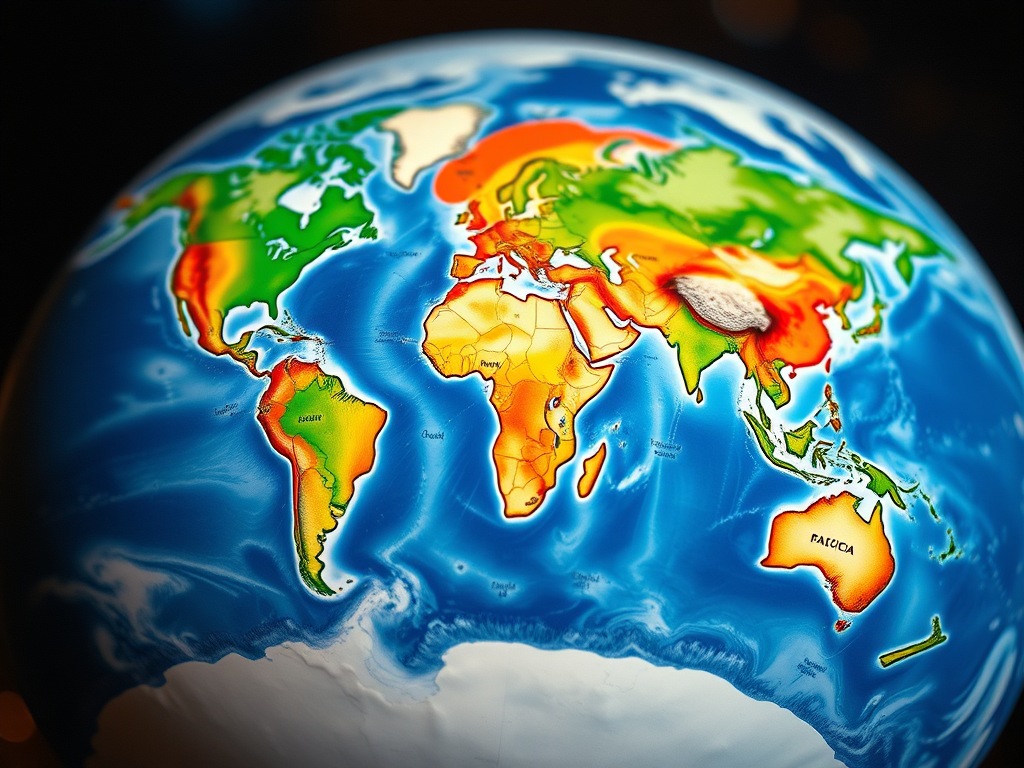
Have you ever looked at a world map and noticed how some continents, like South America and Africa, look like they could fit together like giant puzzle pieces? It’s not just a coincidence! Our planet’s surface isn’t one solid, unbroken shell. Instead, it’s made up of enormous, slowly moving slabs called tectonic plates. Understanding plate tectonics is like uncovering the secret of why the Earth’s surface moves for children and how these movements shape our world, creating mountains, causing earthquakes, and fueling volcanoes. It’s a super exciting part of Earth science for kids: moving continents! Let’s dive into 10 amazing facts that explain what are tectonic plates and how do they move, revealing the powerful forces constantly reshaping our planet.
1. Earth’s Giant Puzzle Pieces: Meet the Tectonic Plates!
So, what are tectonic plates and how do they move? Imagine the Earth’s outer layer, called the lithosphere (which includes the crust and the very top part of the mantle), is broken into about a dozen major pieces and many smaller ones. These giant, rigid slabs are the tectonic plates! They “float” on a hotter, softer, slightly gooey layer beneath them called the asthenosphere, which is part of the Earth’s mantle. These plates can be huge, carrying entire continents (continental plates) or vast stretches of ocean floor (oceanic plates). Some plates, like the massive Pacific Plate, are mostly oceanic, while others, like the North American Plate, carry both a continent and parts of the ocean floor. Learning about these pieces is the first step in plate tectonics for kids explained simply.
2. The Engine Room Below: Convection Currents Drive the Plates
If the plates are floating, what makes them move? The main driving force behind why the Earth’s surface moves for children to understand comes from deep within our planet. The Earth’s mantle isn’t solid rock all the way through; parts of it can slowly flow, like super thick honey. Heat from the Earth’s core (which is incredibly hot, like the surface of the sun!) warms up rock in the lower mantle. This heated rock becomes less dense and rises, while cooler, denser rock sinks back down. This slow, circular movement of heat is called a convection current, similar to how water boils in a pot – hot water rises, cool water sinks. These massive convection currents in the mantle act like giant conveyor belts, dragging the tectonic plates along with them. This is a key concept in understanding plate tectonics.
3. Drifting Apart: Divergent Boundaries and New Crust
Tectonic plates don’t just drift around randomly; they interact with each other at their edges, called plate boundaries. There are three main types. The first type is a divergent boundary, where two plates are moving away from each other. Different types of plate boundaries for students include this “pulling apart” motion. As the plates separate, magma (molten rock) from the mantle rises up to fill the gap, cools, and solidifies to form new crust. This is happening right now in the middle of the Atlantic Ocean at the Mid-Atlantic Ridge, where new ocean floor is constantly being created, making the Atlantic Ocean wider by a few centimeters each year! Sometimes, divergent boundaries can also happen on land, like in the East African Rift Valley, which might one day split Africa apart.
4. Crashing Continents: Convergent Boundaries and Mountain Building
The second type is a convergent boundary, where two plates are moving towards each other – a cosmic collision! What happens next depends on what kind of plates are crashing. If two continental plates collide (like India crashing into Asia), neither one wants to sink under the other because they are both relatively light and thick. So, the land buckles and folds upwards, creating enormous mountain ranges like the Himalayas! This is how many of the world’s great mountain ranges were formed, a dramatic example of earthquakes volcanoes and mountains plate tectonics. If an oceanic plate (which is denser) collides with a continental plate, the oceanic plate will usually bend and slide beneath the continental plate in a process called subduction.
5. Deep Ocean Dips and Fiery Volcanoes: Subduction Zones
When an oceanic plate subducts (dives beneath) another plate (either continental or another oceanic plate) at a convergent boundary, it creates some amazing features. As the oceanic plate sinks into the hot mantle, it starts to melt. This molten rock, or magma, is less dense than the surrounding rock, so it rises towards the surface. If it finds a way through, it can erupt as a volcano! Many of the world’s volcanoes are found in long chains along subduction zones, like the “Ring of Fire” around the Pacific Ocean. Subduction also creates deep ocean trenches, which are the deepest parts of the ocean, like the Mariana Trench. This process is a key link between earthquakes volcanoes and mountains plate tectonics.
6. Sliding Sideways: Transform Boundaries and Earthquakes
The third main type of plate boundary is a transform boundary, where two plates are sliding past each other horizontally. Imagine two giant blocks of rock trying to scrape by one another. They don’t usually slide smoothly! The rocks get stuck, and pressure builds up. When the pressure gets too much, the rocks suddenly slip, releasing a huge amount of energy and causing an earthquake. The San Andreas Fault in California is a famous example of a transform boundary between the Pacific Plate and the North American Plate. There are no volcanoes or big mountains formed at transform boundaries, but they are definitely hotspots for earthquakes volcanoes and mountains plate tectonics (well, mostly earthquakes here!).
7. Before Plate Tectonics: The Idea of Continental Drift
The full theory of plate tectonics is relatively new (mostly developed in the 1960s), but the idea that continents might move around isn’t. In the early 1900s, a German scientist named Alfred Wegener proposed the theory of “continental drift.” He noticed that the coastlines of continents like South America and Africa seemed to fit together. He also found similar fossils and rock formations on continents that are now widely separated. He suggested that all the continents were once joined together in a single supercontinent he called Pangaea (meaning “all lands”), which then broke apart and drifted to their current positions. This is an important introduction to continental drift and Pangaea for kids.
8. Pangaea and Beyond: Earth’s Ever-Changing Map
Wegener’s idea of continental drift and a supercontinent called Pangaea was a big step in understanding plate tectonics. Pangaea is thought to have existed about 335 to 175 million years ago. Before Pangaea, there were other supercontinents, and since Pangaea broke up, the continents have continued to move and rearrange themselves. This means the map of the Earth has changed dramatically over geological time, and it’s still changing today! The continents are moving at about the same speed your fingernails grow – just a few centimeters per year – but over millions of years, that adds up to huge distances. Earth science for kids: moving continents shows us our planet is a dynamic, ever-evolving place.
9. Proof in the Pudding (or the Ocean Floor!): Evidence for Plate Tectonics
Alfred Wegener had good evidence for continental drift, but he couldn’t explain how the continents moved, so many scientists didn’t believe him at first. It wasn’t until the 1950s and 60s that new evidence, especially from studying the ocean floor, really cemented the theory of plate tectonics. Scientists discovered mid-ocean ridges (where new crust forms at divergent boundaries) and found patterns of magnetic stripes in the ocean floor rocks that showed the seafloor was spreading. They also got much better at detecting and locating earthquakes, which mostly happen along plate boundaries. All these pieces of evidence helped to show what are tectonic plates and how do they move, turning Wegener’s ideas into a well-accepted scientific theory.
10. Living on a Moving Planet: Why Plate Tectonics Matters
Understanding plate tectonics isn’t just cool science; it’s incredibly important for understanding our planet and our lives. It explains where we find most earthquakes and volcanoes, helping us to prepare for these natural hazards. It explains how mountain ranges are formed, how oceans open and close, and even influences the distribution of minerals and fossil fuels. Plate tectonics is also involved in the long-term carbon cycle, which affects Earth’s climate over millions of years. By studying plate tectonics for kids explained simply, we learn about the powerful forces that have shaped our world and continue to sculpt its surface every single day. It’s a reminder that we live on a dynamic and ever-changing planet!
The ground beneath our feet might seem solid, but it’s actually a giant, slow-motion dance of massive plates, constantly reshaping the face of our amazing Earth!
Further Reading
If you’re ready to dig deeper into the fascinating world of our moving planet, here are some books you might enjoy (as of May 21, 2025):
- Plate Tectonics (A True Book: Earth Science) by Stephanie Bearce or similar titles in children’s Earth science series. (These books are specifically designed to explain concepts like plate tectonics to young readers.)
- DKfindout! Earth or DK Eyewitness Books: Earth by DK (These books are packed with amazing photos and illustrations, with clear explanations of Earth’s structure, volcanoes, earthquakes, and plate tectonics.)
- How the World Works: A Hands-On Guide to Our Amazing Planet by Christiane Dorion, illustrated by Beverley Young (Often includes sections on Earth’s geology and the forces that shape it, in an interactive format.)
- National Geographic Kids Everything Volcanoes and Earthquakes: Earthshaking photos, facts, and fun! by Kathy Furgang (Connects the excitement of volcanoes and earthquakes directly to the science of plate tectonics.)
- The Magic School Bus Inside the Earth by Joanna Cole, illustrated by Bruce Degen (A classic that takes kids on a fun adventure to learn about the Earth’s layers, rocks, volcanoes, and the forces at work – a great introduction to related concepts.)




Leave a Reply