
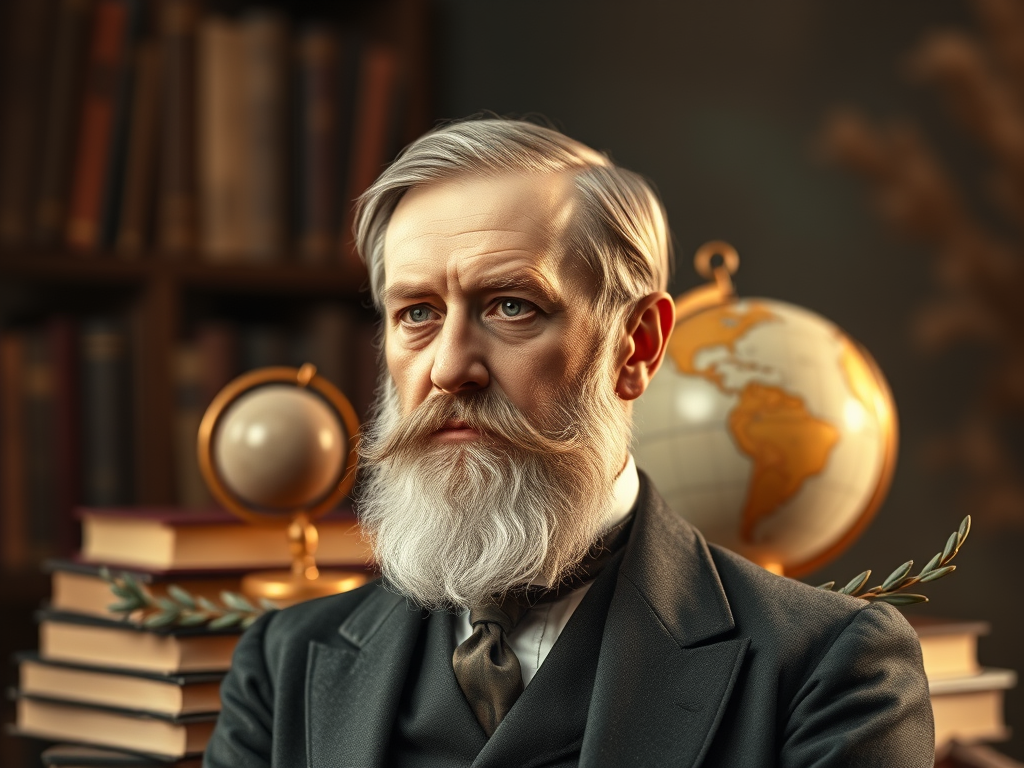
Imagine a prize given to people who have done amazing things to help humanity – in science, writing, and even working for peace. That’s what the Nobel Prize is! It’s one of the most famous and respected awards in the world, celebrating incredible achievements that benefit all of us. But where did this prize come from, and why is it so special?
The story of the Nobel Prize starts with a fascinating person named Alfred Nobel, an inventor who had a big impact on the world, not just through his creations but also through his thoughtful last wishes. He wanted to leave behind a legacy that would encourage people to do great things for society long after he was gone.
Learning about the History of the Nobel Prize is like taking a journey through important moments in science, literature, and the effort to make the world a more peaceful place. It’s a story of brilliant minds, groundbreaking discoveries, powerful words, and tireless work for peace. Get ready to discover Who created the Nobel Prize, Why is the Nobel Prize given, and lots of other interesting facts about the Nobel Prize. Let’s explore the fascinating history behind this prestigious award!
1. The Prize Was Created by a Famous Inventor Named Alfred Nobel
The Nobel Prize exists because of one man: Alfred Nobel. Born in Sweden in 1833, Alfred was a brilliant chemist, engineer, and inventor. His family was also involved in engineering and manufacturing, so he grew up surrounded by innovation and industry.
Alfred was interested in explosives, which were important for mining and building roads and tunnels at the time. He conducted many experiments and held over 350 patents during his lifetime – that’s a huge number of inventions! He traveled widely for his work and business, becoming a successful and wealthy man. However, he is most famously known for one particular invention, which had a complicated impact on the world. Understanding Who created the Nobel Prize starts with knowing about Alfred Nobel’s life as a prolific inventor and businessman. His story isn’t just about science; it’s about the ideas and motivations that led him to create something lasting and impactful for humanity.
2. Alfred Nobel Invented Dynamite
Alfred Nobel’s most famous and impactful invention was dynamite, patented in 1867. Before dynamite, explosives were very dangerous and unstable, often causing terrible accidents. Alfred Nobel found a way to make nitroglycerine, a powerful explosive liquid, much safer to handle by mixing it with an absorbent material like sawdust or clay. This made it stable enough to transport and use more safely with a detonator (a blasting cap) to control when it exploded.
Dynamite was quickly adopted for use in construction, mining, and quarrying because it made these jobs much faster and easier. It helped build canals, railways, and tunnels, literally changing landscapes and enabling huge engineering projects. However, dynamite could also be used for destructive purposes, like in warfare. This dual nature of his invention – helping build but also capable of destroying – is believed to have influenced Alfred Nobel later in his life and is a key detail when learning Alfred Nobel facts. The invention of dynamite shaped the world and played a significant role in the eventual creation of the Nobel Prize.
3. He Created the Prize in His Will to Leave a Better Legacy
Alfred Nobel became very wealthy from his inventions, especially dynamite. As he got older, he started thinking about how he would be remembered after his death. There’s a story that a newspaper once mistakenly published an obituary for him, calling him a “merchant of death” because of his invention. This is thought to have deeply affected him and made him want to be remembered for something more positive than explosives.
So, Alfred Nobel wrote a will unlike any other. Instead of leaving most of his fortune to his family, he decided to use the majority of his wealth to create a series of prizes. He stated that these prizes should be awarded annually to people who “shall have conferred the greatest benefit to mankind” in different fields. He specifically listed Physics, Chemistry, Physiology or Medicine, Literature, and Peace. This incredible act of using his wealth to encourage global progress and peace explains Why is the Nobel Prize given and is the founding principle of the History of the Nobel Prize. He wanted his legacy to be about celebrating human achievement and making the world a better place.
4. The Prizes Were First Awarded in 1901
Alfred Nobel died in 1896, but setting up the Nobel Prize according to his wishes took some time. His will was initially a surprise, and there were legal challenges and arrangements that needed to be made to create the Nobel Foundation, the organization that would manage his fortune and oversee the awarding of the prizes.
Finally, the first Nobel Prizes were awarded in 1901, five years after Alfred Nobel’s death. This marked the beginning of a tradition that has continued every year since (with a few interruptions during major wars). The First Nobel Prize winners were individuals who had made significant contributions in the fields Nobel specified. For example, the first Peace Prize was jointly awarded to two men who had worked tirelessly for international peace efforts. This date, 1901, is a landmark in the History of the Nobel Prize, marking the moment Alfred Nobel’s vision became a reality and the world began celebrating achievements in a new way.
5. There Were Originally Five Main Categories
When Alfred Nobel wrote his will, he specifically outlined the five areas in which prizes should be awarded:
- Physics: For the most important discovery or invention in the field of physics.
- Chemistry: For the most important discovery or improvement in the field of chemistry.
- Physiology or Medicine: For the most important discovery within the domain of physiology or medicine.
- Literature: For the most outstanding work in the field of literature in an idealistic direction.
- Peace: For the person who shall have done the most or the best work for fraternity between nations, for the abolition or reduction of standing armies and for the holding and promotion of peace congresses.
These Different Nobel Prize categories reflected the areas that Alfred Nobel believed were most crucial for the benefit of humanity. Physics, Chemistry, and Medicine cover groundbreaking scientific research that expands our understanding of the world and improves health. Literature celebrates the power of words and storytelling to enlighten and inspire. And the Peace Prize honors efforts to bring people and nations together and prevent conflict. These five categories remained the core of the Nobel Prizes for many decades.
6. Winners Are Chosen After a Long, Secret Process
Deciding who wins a Nobel Prize is a very serious and detailed process that takes a long time. It starts with nominations – thousands of people like university professors, scientists, previous Nobel Laureates, and members of academies in relevant fields are invited to suggest candidates. You cannot nominate yourself!
These nominations are then reviewed by special Nobel Committees for each prize area. These committees are made up of experts who carefully study the work of the nominees. They read research papers, books, and evaluate the impact of the discoveries or achievements. This evaluation process can take many months, sometimes looking at decades of work. The committees then make recommendations to larger prize-awarding institutions (like the Royal Swedish Academy of Sciences for Physics and Chemistry, or the Norwegian Nobel Committee for Peace). The final decision is made through a vote by members of these institutions. The whole process, from nomination to the final announcement in October, is kept secret for 50 years! This complex method is How Nobel Prize winners are chosen, ensuring that only the most significant contributions are recognized.
7. Winners Receive a Gold Medal, a Diploma, and Money
Winning a Nobel Prize is one of the highest honors a person can receive, but what do the winners actually get? Besides immense recognition and prestige, each Nobel Laureate (the term for a Nobel Prize winner) receives three things at the official award ceremonies held in Stockholm, Sweden (for most prizes) and Oslo, Norway (for the Peace Prize) on December 10th, the anniversary of Alfred Nobel’s death.
First, they receive a Nobel Medal made of 18-karat gold, unique to each prize category. They also get a Nobel Diploma, a personalized work of art that contains a citation explaining why they received the prize. Finally, they receive a sum of money, which can vary each year depending on the income from the Nobel Foundation’s investments. The monetary prize is intended to allow winners to continue their work without financial worries. So, What Nobel Prize winners get is a combination of symbolic honors and practical support, celebrating their past achievements and hopefully enabling future ones.
8. The Nobel Peace Prize Has a Unique Location
While the prizes in Physics, Chemistry, Physiology or Medicine, Literature, and the prize in Economic Sciences are all awarded in Stockholm, Sweden, there’s one prize that’s different: the Nobel Peace Prize. Alfred Nobel specified in his will that the Peace Prize should be awarded by a committee chosen by the Norwegian Parliament (Storting).
This is why the Nobel Peace Prize ceremony takes place in Oslo, Norway, while the other ceremonies are in Stockholm. The decision to have a Norwegian committee award the Peace Prize is thought to be because Norway and Sweden were in a union at the time (though it dissolved in 1905), and Alfred Nobel may have wanted to involve both countries. It also reflected the growing peace movement in Norway at the turn of the century. The unique location of the ceremony is a distinctive interesting fact about the Nobel Prize and specifically What is the Nobel Peace Prize‘s awarding process, highlighting its special status among the Nobel categories.
9. A Prize in Economic Sciences Was Added Later
While Alfred Nobel’s will created five prizes, there is now a sixth prize awarded each year. This is the Sveriges Riksbank Prize in Economic Sciences in Memory of Alfred Nobel. It was established much later, in 1968, by Sweden’s central bank (Sveriges Riksbank) on its 300th anniversary.
This prize is often incorrectly referred to as “the Nobel Prize in Economics,” and it is awarded together with the other Nobel Prizes at the ceremony in Stockholm, and the selection process is similar, managed by the Royal Swedish Academy of Sciences. However, it was not part of Alfred Nobel’s original will. It was created in his memory to honor significant work in economic science. Understanding this distinction is part of knowing the full History of the Nobel Prize and how the Different Nobel Prize categories have evolved slightly over time.
10. Many Famous People Throughout History Have Been Nobel Laureates
Looking at the list of Nobel Prize winners over the years is like looking at a who’s who of people who have changed the world. In science, it includes pioneers like Marie Curie (Physics and Chemistry), Albert Einstein (Physics), and James Watson, Francis Crick, and Rosalind Franklin (their work led to the Medicine prize for DNA structure). In literature, authors like Ernest Hemingway, Toni Morrison, and Gabriel García Márquez have been honored. Peace Prize winners include figures like Martin Luther King Jr., Nelson Mandela, and Malala Yousafzai.
These are just a tiny fraction of the thousands of individuals and organizations who have received the prize since 1901. Learning about these Famous Nobel Prize winners facts reveals the incredible range of human achievement the prize recognizes. Each winner has a unique story of dedication, hard work, and often overcoming challenges to make a significant contribution to their field and, ultimately, to benefit humanity, just as Alfred Nobel intended.
Further Reading
Want to learn more about the people who changed the world and the history of invention? Check out these books:
- The Kid Who Invented the Popsicle: And Other Extraordinary Stories About Everyday Things by Don L. Wulffson (Explores the stories behind inventions)
- Marie Curie for Kids: Her Life and Scientific Achievements by Amy O’Quinn (Biography of a famous Nobel Laureate)
- Peace Begins with You by Katherine Scholes (Discusses peace and conflict resolution in a way accessible to young readers)
- Ada Twist, Scientist by Andrea Beaty (A fictional story encouraging curiosity and scientific exploration)
The Nobel Prize is more than just an award; it’s a powerful symbol of human ingenuity, creativity, and the persistent effort to improve the world. From the vision of Alfred Nobel, who wanted to leave behind a positive mark on history, to the rigorous process of selecting laureates who have conferred the greatest benefit to mankind, the History of the Nobel Prize is filled with interesting facts about the Nobel Prize. It continues to inspire people to push the boundaries of knowledge, create impactful art, and work tirelessly for peace, celebrating achievements that truly make a difference in our lives.
Here at Zentara.blog, our mission is to take those tricky subjects and unlock them, making knowledge exciting and easy to grasp for everyone. But the adventure doesn’t stop on this page! We’re constantly exploring new frontiers and sharing discoveries across the digital universe.
Want to dive deeper into more mind-bending Top 10s and keep expanding your world? Come join us on our other platforms – we’ve got unique experiences waiting for you on each one!
- Get inspired by visual wonders and bite-sized facts: See the world through Zentara’s eyes on Pinterest! Pin our fascinating facts and stunning visuals to your own boards. Explore Pins on Pinterest: https://uk.pinterest.com/zentarablog/
- Discover quick insights and behind-the-scenes peeks: Hop over to Tumblr for snippets, quotes, and unique content you won’t find anywhere else. It’s a different flavour of discovery! Follow the Fun on Tumblr: https://www.tumblr.com/zentarablog
- Ready for deep dives you can listen to or watch? We’re bringing our accessible approach to video and potentially audio! Subscribe to our YouTube channel and tune into future projects that make learning pop! Subscribe on YouTube: https://www.youtube.com/@ZentaraUK
- Seeking even more knowledge in one place? We’ve compiled some of our most popular topic deep dives into fantastic ebooks! Find them on Amazon and keep the learning journey going anytime, anywhere. Find Our Ebooks on Amazon: https://www.amazon.co.uk/s?k=Zentara+UK&ref=nb_sb_noss
- Connect with us and fellow knowledge seekers: Join the conversation on BlueSky! We’re sharing updates, thoughts, and maybe even asking you what wonders we should explore next. Chat with Us on BlueSky: https://bsky.app/profile/zentarablog.bsky.social
- Perfect for learning on the move! We post multiple 10-minute podcasts per day on Spotify. Pop on your headphones and fill your day with fascinating facts while you’re out and about! Listen on Spotify: https://open.spotify.com/show/3dmHbKeDufRx95xPYIqKhJ
Every click helps us keep bringing honest, accessible knowledge to everyone. Thanks for exploring with us today – see you out there in the world of discovery!




Leave a Reply