
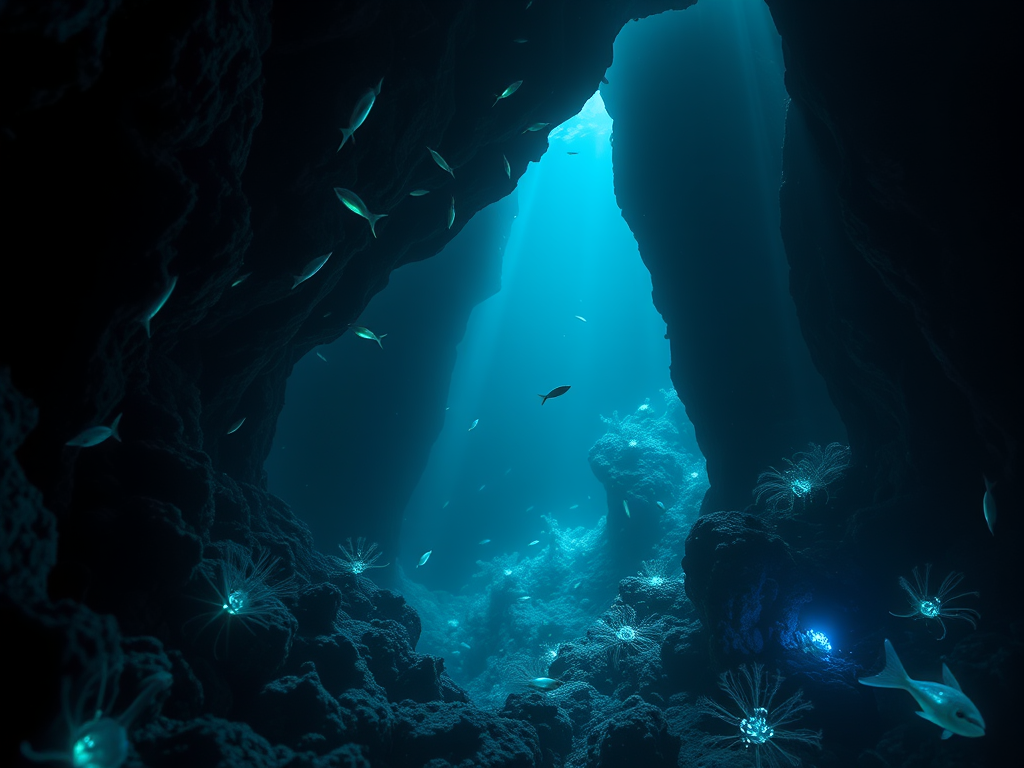
The ocean covers over 70% of our planet, a vast, watery world teeming with life and hidden wonders. While we’ve explored space and even walked on the moon, large parts of our own oceans remain a mystery. The deeper you go, the stranger and more unknown things become!
Imagine a place with crushing pressure, complete darkness, and bizarre creatures that seem like something from another planet. This is the deep sea, a frontier right here on Earth that holds some of the most mind-bending scientific puzzles. Why is it so hard to explore? The extreme conditions make it tough for humans and even our toughest machines to visit for long.
In this article, we’ll dive into the deepest mysteries of the ocean explained simply. We’ll explore strange life forms, hidden landscapes, and puzzling phenomena that scientists are still trying to understand. Get ready to explore the unknown depths and learn some amazing ocean mysteries explained simply!
1. Life in the Mariana Trench: The Deepest Dwellers
The Mariana Trench in the western Pacific Ocean is the deepest known part of any ocean on Earth. Its lowest point, the Challenger Deep, is nearly 11 kilometers (about 7 miles) down! The pressure there is immense – over 1,000 times the pressure at the surface. You might think nothing could survive there, but you’d be wrong!
Scientists have sent special submersibles and robotic explorers down and found life thriving in this extreme environment. They’ve discovered unique fish, crustaceans (like shrimp-like amphipods), and tiny microbes. These creatures have amazing adaptations to handle the crushing pressure and lack of light. Studying Mariana Trench life explained simply shows us how resilient life can be, adapting to conditions that seem impossible to us. It’s a constant reminder that there are probably countless other life forms in the deep sea we haven’t even imagined yet!
2. Bioluminescence: The Ocean’s Living Lights
Imagine swimming in the dark and seeing flashes, sparkles, and glows all around you – like an underwater light show! This is bioluminescence, the ability of living creatures to produce their own light through chemical reactions in their bodies. It’s surprisingly common in the deep ocean, where sunlight doesn’t reach.
Many deep-sea creatures use bioluminescence ocean facts to survive. Some use it to attract prey, dangling a glowing lure like the famous anglerfish. Others use light to hide, matching the faint light filtering down from above (called counter-illumination). Some use flashes to startle predators or signal to potential mates. The colors of this living light are often blue or green because these colors travel best through water. Understanding this incredible ability helps us appreciate the clever ways life has adapted to the perpetual darkness of the deep.
3. The Global Ocean Conveyor Belt: Giant Underwater Rivers
The ocean isn’t just a giant bathtub; it’s constantly moving with powerful currents. While we see surface currents that move with the wind, there’s also a massive system of deep ocean currents that acts like a giant global conveyor belt. This system is driven by differences in water temperature and saltiness (salinity) – hence its scientific name, thermohaline circulation.
In cold regions near the poles, surface water gets very cold and some freezes, leaving the unfrozen water saltier and denser. This cold, salty, dense water sinks to the bottom and flows across the ocean floor. Elsewhere, warmer, less salty water rises to the surface. These slow, deep currents move water, heat, nutrients, and gases like oxygen around the entire planet. Understanding ocean currents basics is crucial because this global conveyor belt plays a huge role in regulating Earth’s climate and distributing marine life. Changes to this system due to climate change are one of the big mysteries of the deep sea.
4. Hydrothermal Vents: Oases in the Abyss
Deep on the ocean floor, far from sunlight, you might find amazing underwater chimneys spewing hot, mineral-rich water. These are hydrothermal vents. They occur along volcanic ridges and cracks in the Earth’s crust where seawater seeps down, gets heated by molten rock, and then erupts back out, carrying dissolved minerals.
These vents support incredible ecosystems teeming with life, completely independent of sunlight! Instead of photosynthesis, the base of the food web here is chemosynthesis. Tiny microbes use the chemicals from the vents, like hydrogen sulfide, to create energy and produce food. Other creatures, like giant tube worms, clams, mussels, and strange deep-sea shrimp, feed on these microbes or have them living inside their bodies. Hydrothermal vents explained easy show us that life can find a way to flourish even in the most extreme and unexpected places on Earth, using chemistry instead of sunlight as its energy source.
5. The Ocean Twilight Zone: A World of Shadows
Below the sunlit surface layer of the ocean lies a vast, dim realm called the Twilight Zone (or mesopelagic zone). It stretches from about 200 meters (650 feet) down to 1,000 meters (3,300 feet). Only a faint blue light penetrates this far, making it a world of shadows where visibility is low.
Despite the low light, the Twilight Zone is home to an incredible amount of marine life, maybe more than all the rest of the ocean combined! Many creatures here have huge eyes to capture the little light available or use bioluminescence. Every night, billions of these animals, including fish, squid, and crustaceans, migrate up to the surface waters under the cover of darkness to feed, then return to the safety of the depths before dawn. This massive daily migration is the largest animal migration on Earth! Exploring the ocean Twilight Zone facts for kids reveals a hidden world vital to the ocean’s food web and global carbon cycle.
6. Giant and Colossal Squid: Elusive Deep-Sea Giants
Tales of giant squid have been around for centuries, often the subject of myths and sea monster legends. For a long time, these creatures were rarely seen, adding to their mystery. We now know that giant squid (Architeuthis dux) and the even larger colossal squid (Mesonychoteuthis hamiltoni) are real inhabitants of the deep ocean.
Giant squid can grow up to 13 meters (43 feet) long, while colossal squid are even bulkier and have sharp hooks on their tentacles. We still don’t know a lot about their lives because they live so deep. Most of what we’ve learned comes from studying remains found in the stomachs of deep-diving whales, like sperm whales, which are known to hunt them. Scientists have only recently managed to film these elusive creatures in their natural habitat. These deep sea creatures explained simply highlight how much large, fascinating life might still be hidden in the ocean’s depths.
7. The Mysterious Sounds of the Deep Ocean
The deep ocean is not a silent place. It’s filled with a complex soundscape – from the clicks and whistles of dolphins and whales to the crackling of snapping shrimp and the rumble of underwater earthquakes. But sometimes, scientists listening with underwater microphones (hydrophones) pick up strange, powerful sounds that they can’t easily identify.
Some of these sounds, like the famous “Bloop” recorded in 1997, were so loud they were detected across vast distances. While many mystery sounds have eventually been identified (often linked to ice movements or geological activity), others remain unexplained or their sources are still being pinpointed. These sounds of the deep ocean mysteries remind us that there are natural processes and potentially even unknown life forms creating noise in the depths. Listening to the ocean helps scientists track migration patterns, study marine life behavior, and monitor geological events.
8. Plastic Pollution Reaching the Abyss
We often see pictures of plastic waste floating on the ocean surface or washing up on beaches. But sadly, plastic pollution doesn’t just stay at the top. Much of it sinks, and scientists are finding plastic debris and tiny pieces called microplastics in the deepest parts of the ocean, including the Mariana Trench.
This is one of the most concerning unknown ocean facts. Even in remote areas far from human activity, plastic has found its way into the food web, being ingested by deep-sea creatures. Because the deep ocean is so cold and has low oxygen levels, plastic breaks down much more slowly there, meaning it could persist for centuries. Understanding the full extent of plastic pollution deep sea facts is a major scientific and environmental challenge. It shows that human impact reaches even the most inaccessible parts of our planet and highlights the urgent need to reduce plastic waste.
9. Mapping the Ocean Floor: An Unseen World
It might surprise you to learn that we have better maps of the surfaces of the Moon and Mars than we do of our own ocean floor! While we have a general idea of the major features, only about 20-25% of the global seafloor has been mapped in detail using modern technology like sonar. The rest remains largely uncharted territory.
Why is it so hard to map the deep ocean floor? Water absorbs and scatters light and radio waves, making it impossible to use the satellite technology we use to map land. Instead, ships use sonar, sending sound pulses down and listening for the echoes. This process is slow and challenging, especially in deep water where the sound has to travel further. Mapping the ocean floor challenges easy to understand include the sheer size of the ocean, the difficulty of deploying equipment, and the immense pressure in the deepest areas. Much of the ocean bottom, with its mountains, valleys, and potential hidden wonders, is still waiting to be explored and mapped.
10. Deep Sea Adaptations: Surviving the Extremes
Life in the deep sea faces incredible challenges: crushing pressure, pitch darkness, near-freezing temperatures, and limited food. Yet, a vast array of creatures not only survives but thrives there, showcasing amazing adaptations.
Many deep-sea fish have soft, gelatinous bodies with no swim bladders (gas-filled sacs that would collapse under pressure). Some have tiny eyes or are completely blind, relying instead on other senses like touch and smell. Others have huge mouths and expandable stomachs to gulp down any meal they find in the scarce environment. Deep sea creature adaptation explained easy involves things like producing their own light (bioluminescence), having slow metabolisms to conserve energy, and even chemicals in their cells that help their proteins function under high pressure. These adaptations are a testament to the incredible power of evolution and the diversity of life on Earth, even in the harshest environments.
The ocean’s depths hold many secrets, from the bizarre life that thrives under immense pressure to the vast currents that shape our climate and the unexplored landscapes of the seafloor. Scientists continue to use advanced technology to probe these mysteries, but there is still so much more to discover. The deep ocean remains one of the last great frontiers on our planet, full of wonder and waiting to reveal its hidden truths.
Further Reading
Here are a few books that can help you explore the ocean’s mysteries further:
- The Brilliant Abyss: Exploring the Majestic, Hidden Life of the Deep Ocean, and the Looming Threat That Imperils It by Helen Scales
- Ocean Speaks: How Mapping the Seabed Revealed Earth’s Biggest Secrets by Carrie Arnold
- The Deep: The Extraordinary Creatures of the Abyss by Claire Nouvian
To continue your journey of discovery and learning with Zentara:
🎙️ Tune into our daily Zentara Unlocked podcast for more fascinating insights across a universe of topics. 🎧 Catch our Spotify Channel here: https://open.spotify.com/show/3dmHbKeDufRx95xPYIqKhJ 📺 Explore engaging visual content and dive deeper on our Zentara YouTube Channel. 📚 Deepen your understanding with our ebooks, available for purchase on Amazon, and our audiobooks, ready for listening on Audible. Many of these compile our most sought-after topics for easy, on-the-go access!




Leave a Reply