
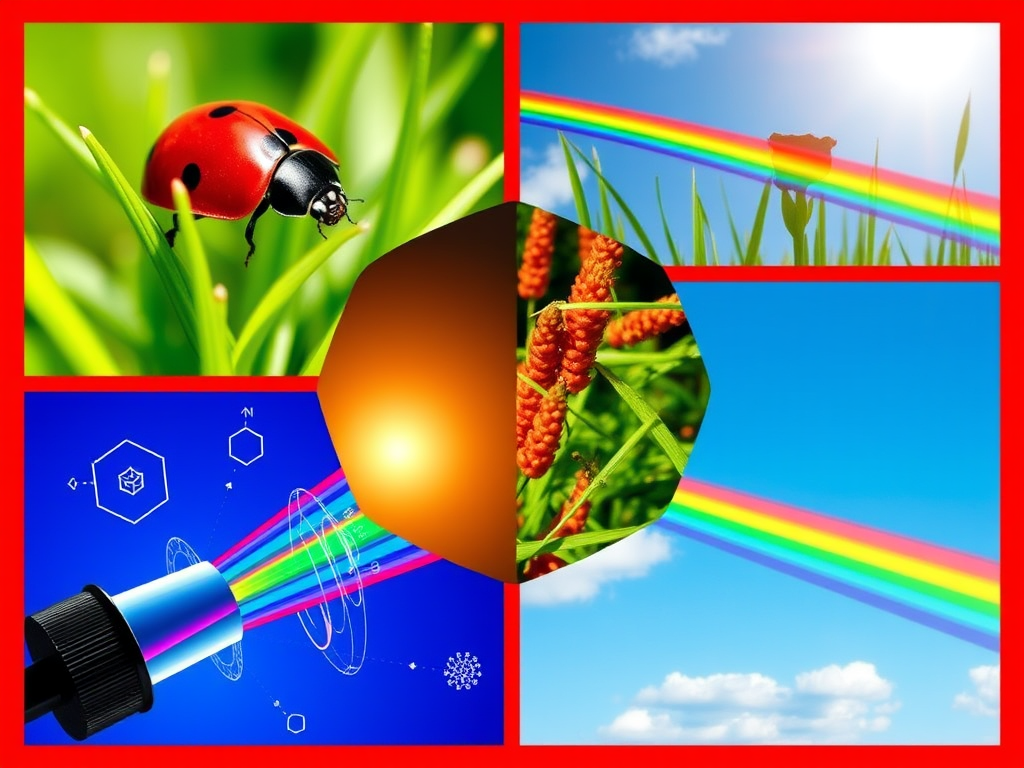
Have you ever stopped to wonder why a ladybug is bright red, the grass is a vibrant green, or why the sky can be such a beautiful blue? Colour is all around us, making the world a more exciting and interesting place! But have you ever thought about what colour actually is and how we see all those different shades, or hues? It’s not magic – it’s amazing science!
Get ready to dive into the science of colour! We’re going on an adventure to explore how light, objects, and our incredible eyes and brain work together to paint the world. You’ll discover why your favourite blue t-shirt looks blue and how you can see a whole rainbow of colours. It’s a fascinating journey that will change the way you look at everything!
Here are 10 key concepts to help you understand how we see colour:
1. Colour Starts with Light: No Light, No Colour!
Imagine you’re in a room with no windows and you switch off all the lights. What do you see? Nothing but darkness, right? You can’t see the colour of your bedspread or your toys. That’s because colour begins with light. Without any light source, like the sun, a lamp, or even a phone screen, our eyes can’t detect any colours.
Light is a type of energy that travels in waves, a bit like ripples in a pond. These waves zoom out from a light source, like the sun, and bounce off everything around us. When this light reaches our eyes, our brain gets to work figuring out what colours we’re looking at. So, the very first ingredient for seeing any colour at all is having some light. It’s the starting point for the whole amazing process of how light creates colour.
2. White Light is a Rainbow Surprise: All Colours Hidden Inside!
You might think sunlight or the light from a bright flashlight looks white or yellowish, but it’s actually a secret superstar hiding a whole rainbow of colours! This is known as the visible light spectrum. If you’ve ever seen a rainbow after a rain shower, you’ve witnessed this firsthand. Rainbows happen when sunlight passes through raindrops, and the raindrops act like tiny prisms.
A prism is a special piece of glass or plastic that can split white light into all the colours it’s made of: red, orange, yellow, green, blue, indigo, and violet (you can remember this with the name ROY G. BIV!). Each of these colours has a slightly different wavelength. Red light has longer, lazier waves, while blue and violet light have shorter, more energetic waves. So, that ordinary white light is actually a super-mix of all the colours you can see, patiently waiting to be revealed!
3. Objects Play “Catch and Release” with Light: The Secret to Their Colour!
So, if white light contains all colours, why does a banana look yellow and an apple look red? It’s all about how objects interact with the light that hits them. Think of objects playing a game of “catch and release” with the different coloured light waves in white light.
When white light (containing all colours) shines on an object, like a red apple, the surface of the apple absorbs – or “catches” – most of the light waves. However, it doesn’t absorb the red light waves. Instead, it reflects – or “releases” – the red light waves, which then bounce off the apple and into our eyes. Our brain then says, “Aha! That’s red!” Similarly, a blue car absorbs all colours except blue, which it reflects. This absorption and reflection is what makes objects different colors and is a key part of the science of color explained simply.
4. Your Eyes are Amazing Colour Detectors: The Light Catchers!
Once light has bounced off an object, it needs to get into your eyes for you to see any colour. Your eyes are incredible organs designed to catch this light! When light enters your eye, it first passes through the clear outer layer called the cornea, then through an opening called the pupil (the black dot in the centre of your eye). The light then goes through the lens, which focuses it onto the back part of your eye called the retina.
The retina is like the movie screen at the back of your eyeball. It’s packed with millions of tiny, light-sensitive cells. These cells are the real heroes when it comes to detecting light and starting the process of seeing colour. Think of the retina as the super-sensitive film in a camera, ready to capture all the light information that comes its way. Understanding how eyes and color perception work together starts here.
5. Meet the Cone Crew: Your Colour Super Sensors!
Inside your retina, you have two main types of light-sensitive cells, but the ones responsible for seeing colour are called cone cells. You have about 6 to 7 million of these tiny cone cells in each eye! They are called “cones” because of their cone-like shape. These are your colour super sensors.
Most people have three types of cone cells, and each type is most sensitive to a different range of light wavelengths:
- Red-sensitive cones: These get most excited by red and orange light (long wavelengths).
- Green-sensitive cones: These respond best to green and yellow light (medium wavelengths).
- Blue-sensitive cones: These are most sensitive to blue and violet light (short wavelengths). When light hits these cones, they send signals to your brain. Your brain then mixes and balances the signals from these three types of cones to let you see millions of different colours! This is fundamental to how we see color.
6. Rods Help You See in the Dark (But Not Much Colour!):
Besides the cone cells, your retina also has another type of light-sensitive cell called rod cells. You have way more rods than cones – about 120 million in each eye! Rods are super sensitive to light, much more so than cones. This means they are fantastic for helping us see in very dim light, like when you’re in a dark room or outside on a moonlit night.
However, rods don’t really detect colour. They mostly see in shades of black, white, and grey. That’s why, when it’s very dark, it’s hard to tell different colours apart; everything looks a bit greyish. So, while cones are the colour specialists for bright conditions, rods are your go-to guys for seeing shapes and movement when the lights are low. Both cones and rods work for color vision (or lack thereof in dim light) in a team.
7. Your Brain is the Colour Artist: Turning Signals into Sights!
So, your eyes have done their job: light came in, objects reflected certain wavelengths, and your cones (and rods) got excited and sent signals. But the journey isn’t over yet! These signals travel along the optic nerve from your eyes to your brain. And it’s your amazing brain that acts as the final colour artist.
The visual cortex, a part of your brain at the back of your head, receives these electrical signals. It then processes and interprets them, almost like decoding a secret message. It compares the information from all the different cone cells and figures out, “Okay, that combination of signals means ‘bright red,’ and that one means ‘sky blue.’” It’s your brain that actually creates the experience or perception of colour. So, seeing colour is truly a team effort between your eyes and your brain!
8. Mixing Light vs. Mixing Paint: Additive and Subtractive Colours!
Have you ever mixed yellow and blue paint in art class to get green? That’s called subtractive colour mixing. When you mix paints, each pigment absorbs (subtracts) certain wavelengths of light. The colours you see are the wavelengths that are not absorbed by the mix. The primary colours for subtractive mixing (like in printer ink) are typically cyan, magenta, and yellow. If you mix all of them, you get a dark, muddy colour close to black because most light is absorbed.
But when you mix light itself, it works differently! This is called additive colour mixing. The primary colours of light are red, green, and blue (RGB) – just like your cone cells! If you shine red, green, and blue light together onto a white screen, they add up to create white light. Your TV, phone, and computer screens use additive mixing, with tiny red, green, and blue dots of light to create all the colours you see. Understanding this difference is a fun part of primary secondary colors explained.
9. What About Black and White? The Special Colour Cases!
We’ve talked a lot about colours like red, green, and blue. But what about black and white? How do they fit into the science of colour? An object appears white when it reflects almost all the wavelengths of white light that hit it. It doesn’t absorb much light at all; it just bounces all the colours back to your eyes, and your brain sees this combination as white. Think of fresh snow or a plain white piece of paper.
An object appears black, on the other hand, when it absorbs almost all the wavelengths of light that hit it. Very little light is reflected back to your eyes. Because there’s not much light reaching your eyes from that object, your brain perceives it as black. A black t-shirt on a sunny day can get quite warm because it’s absorbing all that light energy! These are important aspects of understanding hues and shades for kids.
10. Why Colour Matters: More Than Just Pretty!
Colours make the world beautiful, but they are also incredibly important for many other reasons. In nature, colours can be used as signals. Brightly coloured flowers attract bees and butterflies to help with pollination. The colours of some animals can warn predators that they are poisonous (like a brightly coloured frog) or help them blend in with their surroundings (camouflage, like a green grasshopper on a leaf).
For humans, colours can affect our emotions – some colours might make us feel calm (like blue) while others feel energetic (like red). We use colours for safety, like red for stop signs and traffic lights. Artists use colours to express ideas and create beautiful paintings. So, while learning why do we see different colors is fascinating science, it also helps us appreciate how vital colour is in our everyday lives and in the natural world.
Isn’t the science of colour amazing? From sunlight starting its journey to your brain creating a vibrant world, it’s a complex but beautiful dance of physics and biology. Next time you look at a rainbow or choose your favourite coloured crayon, you’ll know a little more about the incredible science behind those wonderful hues!
Further Reading
Want to explore the colourful world even more? Check out these books:
- Pantone: Colors by Pantone – A simple and visually engaging board book introducing many shades and their names. (Good for starting to name hues)
- The Day the Crayons Quit by Drew Daywalt, illustrated by Oliver Jeffers – A fun, imaginative story that brings colours to life, sparking curiosity about them.
- Light: Shadows, Mirrors, and Rainbows by Natalie M. Rosinsky, illustrated by Sheree Boyd – Explains the basics of light, which is essential for understanding colour.
- Wow! The Good-Tasting Book (About the Sense of Taste and the Sense of Sight) by Joy Wilt Berry (part of the “Ready-Set-Grow!” series) – Often covers senses in a kid-friendly way, and sight/color are linked. (This is a general series, specific content might vary).
- DK Eyewitness Books: Light by David Burnie – A visually rich guide that explores the science of light, including how we see colours and the spectrum.




Leave a Reply