
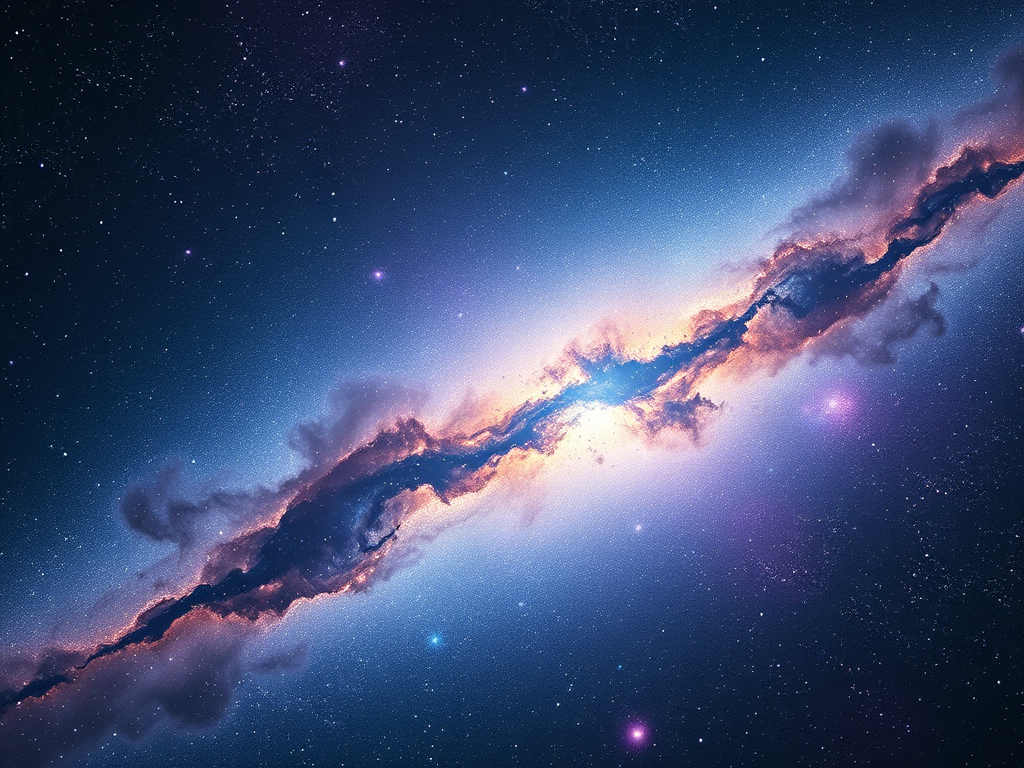
Get ready to have your mind blown! The universe is a place of incredible wonders, mind-boggling sizes, and mysteries that scientists are still trying to unravel. From the tiniest particles to giant star cities, there’s so much to explore. Let’s dive into ten fascinating facts and stories that will give you a glimpse into the amazing universe we’re all a part of. These are some of the coolest space facts you’ll ever hear, perfect for anyone curious about what lies beyond our world. Prepare for an adventure through space and time!
1. The Universe is Unimaginably BIG! Just How Big is the Universe?
Imagine the biggest thing you can think of – maybe an elephant, a mountain, or even planet Earth. Now, try to imagine something a million times bigger! That still doesn’t even come close to how enormous the universe is. Scientists talk about its size in “light-years.” A light-year isn’t a measure of time; it’s the distance light travels in one year. Light is the fastest thing we know, zipping along at about 300,000 kilometers per second! So, one light-year is roughly 9.5 trillion kilometers. Our own Milky Way galaxy, which is like our star city, is about 100,000 light-years across. But that’s just one galaxy! The part of the universe we can currently see, called the “observable universe,” is estimated to be about 93 billion light-years wide. Think of all the grains of sand on all the beaches in the world – the number of stars in the universe could be even greater! It’s so vast, it’s hard to picture, but these amazing universe facts help us understand its incredible scale.
2. It All Started with a BANG! The Big Bang Theory Explained Simply
Have you ever wondered how this enormous universe began? The most widely accepted scientific idea is called the Big Bang Theory. This isn’t like an explosion in a movie, but rather the idea that about 13.8 billion years ago, everything in the entire universe – all matter, energy, space, and even time itself – was squished into an incredibly tiny, hot, and dense point, smaller than an atom! Then, in an instant, it started expanding rapidly, like blowing up a balloon super-fast. As it expanded, it cooled down, allowing the first tiny particles to form, then atoms (mostly hydrogen and helium), and eventually these atoms clumped together because of gravity to create the first stars and galaxies. It’s one of the most fundamental facts about the universe: it had a beginning and has been growing ever since. It’s not an explosion in space, but rather the expansion of space itself.
3. You’re Made of Stardust! Amazing Universe Facts About Your Connection to Stars
This might sound like something from a fairy tale, but it’s true: you are made of stardust! The very atoms that make up your body – the carbon in your cells, the calcium in your bones, the iron in your blood – were created inside stars that lived and died long before our Sun was even born. When the universe first formed after the Big Bang, there were mostly only very light elements like hydrogen and helium. Stars are like giant cosmic ovens. Deep inside their fiery cores, under immense pressure and heat, hydrogen and helium atoms fuse together to create heavier elements like oxygen, carbon, nitrogen, and iron. When massive stars reach the end of their lives, they often explode in a spectacular event called a supernova. These explosions blast all those newly created elements out into space. Over billions of years, this “stardust” mixed with gas clouds, which then collapsed to form new stars, planets, and eventually, everything on Earth, including us! So, stars and galaxies facts tell us we have a direct cosmic connection.
4. Billions and Billions of Star Cities: Exploring Galaxies
Our Sun is just one star out of hundreds of billions in our home galaxy, the Milky Way. And the Milky Way is just one galaxy among an estimated two trillion galaxies in the observable universe! That’s a 2 with twelve zeros after it: 2,000,000,000,000! Each of these galaxies is a massive collection of stars, gas, dust, and dark matter, all held together by gravity. They come in different shapes and sizes. Some, like our Milky Way, are beautiful spiral galaxies with swirling arms. Others are elliptical galaxies, which are more like giant, fuzzy ovals. And then there are irregular galaxies that don’t have a specific shape at all, often because they’ve bumped into other galaxies. These “star cities” are constantly moving, sometimes even crashing into each other and merging over millions of years. Understanding these stars and galaxies facts helps us appreciate the grand structure of the cosmos. It’s one of the most amazing universe facts to think about how many other stars, and potentially planets, exist out there.
5. Most of the Universe is INVISIBLE! What is the Universe Made Of?
Here’s a real head-scratcher: everything we can see – stars, planets, galaxies, you and me – makes up less than 5% of the total stuff in the universe! So, what is the universe made of mostly? Scientists believe the rest is made of two mysterious ingredients: dark matter (about 27%) and dark energy (about 68%). We call it “dark” matter because it doesn’t give off light, reflect it, or absorb it, so we can’t see it directly. However, scientists know it’s there because they can see its gravitational effects on visible matter, like how galaxies spin faster than they should if only visible matter existed. It’s like an invisible puppeteer pulling the strings. Dark energy is even more baffling. It seems to be a strange force that’s causing the expansion of the universe to speed up. Unraveling these mysteries of the universe is one of the biggest challenges in science today.
6. Black Holes: The Universe’s Ultimate Vacuum Cleaners – Mysteries of the Universe
Imagine a place where gravity is so incredibly strong that nothing, not even light, can escape its grasp. That’s a black hole! These are some of the most extreme and fascinating objects in the cosmos. Black holes often form when a very massive star runs out of fuel and collapses under its own gravity, squishing an enormous amount of matter into an incredibly tiny space. The point of no return around a black hole is called the “event horizon.” Once something crosses the event horizon, it’s trapped forever. It’s not quite like a cosmic vacuum cleaner sucking up everything around it randomly; things have to get very close to be pulled in. Scientists have found evidence for supermassive black holes, millions or even billions of times the mass of our Sun, at the centers of most large galaxies, including our own Milky Way! These mysteries of the universe continue to captivate and puzzle astronomers.
7. Time Can Bend and Stretch! Einstein’s Trippy Universe (Cool Space Facts for Kids)
Get ready for a mind-bending idea: time isn’t constant everywhere in the universe! The famous scientist Albert Einstein figured out that time and space are connected, forming a fabric called spacetime. He also showed that massive objects, like planets and stars, can warp or bend this spacetime fabric, a bit like a bowling ball placed on a trampoline. This warping of spacetime is what we feel as gravity. And here’s the really cool part: gravity also affects time! The stronger the gravity, the slower time passes. This means that time actually runs slightly slower for someone living at sea level compared to someone living on a mountaintop because gravity is a tiny bit stronger closer to the Earth’s center. The difference is incredibly small for us, but for objects near black holes where gravity is immense, time can slow down dramatically. These cool space facts for kids (and adults!) show how wonderfully weird the universe can be.
8. Looking at Stars is Looking Back in Time – Easy to Understand Space Facts
Whenever you gaze up at the night sky and see the twinkling stars, you’re actually looking back in time! This is because light, though incredibly fast, still takes time to travel across the vast distances of space. For example, the closest star system to us, Alpha Centauri, is about 4.3 light-years away. This means the light we see from Alpha Centauri tonight actually left those stars 4.3 years ago. So, we see them as they were 4.3 years in the past. For more distant stars and galaxies, we’re looking even further back. Some of the galaxies seen by powerful telescopes like the Hubble Space Telescope are so far away that their light has taken over 13 billion years to reach us. This means we are seeing them as they were when the universe was very young! It’s like having a time machine that only looks into the past. This is one of the most easy to understand space facts that completely changes how you view the night sky.
9. The Universe is Still Expanding… and Speeding Up! More Mysteries of the Universe
Remember the Big Bang and how the universe started expanding? Well, it’s still going! Scientists discovered in the 1920s that galaxies are generally moving away from each other, meaning the space between them is stretching. For a long time, they thought this expansion might be slowing down due to gravity pulling everything back together. But in the late 1990s, astronomers made a shocking discovery: the expansion of the universe isn’t slowing down at all. It’s actually speeding up! This was a huge surprise and led to the idea of “dark energy,” that mysterious force we talked about earlier, which seems to be pushing everything apart faster and faster. Figuring out why the universe is accelerating its expansion is one of the biggest mysteries of the universe that scientists are working hard to solve. It tells us the ultimate fate of the universe is still an open question.
10. Are We Alone? The Search for Alien Life (Easy to Understand Space Facts)
With billions of galaxies, each containing billions of stars, one of the most exciting questions is: are we alone in the universe? For a long time, we only knew about the planets in our own solar system. But in recent decades, astronomers have discovered thousands of planets orbiting other stars. These are called “exoplanets.” Some of these exoplanets are even located in the “habitable zone” of their star, which is the region where temperatures might be just right for liquid water to exist on the surface – and water is a key ingredient for life as we know it. While we haven’t found any definite proof of alien life yet, the sheer number of potential homes for life makes many scientists optimistic. Telescopes are constantly searching for signs of life elsewhere, perhaps by looking for certain gases in the atmospheres of exoplanets. This search is one of the most exciting frontiers in science and provides easy to understand space facts that spark our imagination about what (or who) else might be out there.
Further Reading
If these amazing universe facts have made you even more curious, here are some fantastic books to continue your cosmic journey:
- A Short History of Nearly Everything by Bill Bryson (Young Readers Edition available) – A fun and accessible look at, well, nearly everything, including the universe.
- Cosmos by Carl Sagan – A classic that beautifully explains the wonders of the universe.
- Astrophysics for Young People in a Hurry by Neil deGrasse Tyson (adapted from his bestseller) – A concise and engaging guide to the cosmos.
- George’s Secret Key to the Universe by Lucy & Stephen Hawking – A fun fictional story for younger readers that explains complex science concepts.
- The Mysteries of the Universe (DK) by Will Gater – A visually stunning book packed with facts and explanations about space.
Here at Zentara.blog, our mission is to take those tricky subjects and unlock them, making knowledge exciting and easy to grasp for everyone. But the adventure doesn’t stop on this page! We’re constantly exploring new frontiers and sharing discoveries across the digital universe.
Want to dive deeper into more mind-bending Top 10s and keep expanding your world? Come join us on our other platforms – we’ve got unique experiences waiting for you on each one!
- Get inspired by visual wonders and bite-sized facts: See the world through Zentara’s eyes on Pinterest! Pin our fascinating facts and stunning visuals to your own boards. Explore Pins on Pinterest: https://uk.pinterest.com/zentarablog/
- Discover quick insights and behind-the-scenes peeks: Hop over to Tumblr for snippets, quotes, and unique content you won’t find anywhere else. It’s a different flavour of discovery! Follow the Fun on Tumblr: https://www.tumblr.com/zentarablog
- Ready for deep dives you can listen to or watch? We’re bringing our accessible approach to video and potentially audio! Subscribe to our YouTube channel and tune into future projects that make learning pop! Subscribe on YouTube: https://www.youtube.com/@ZentaraUK
- Seeking even more knowledge in one place? We’ve compiled some of our most popular topic deep dives into fantastic ebooks! Find them on Amazon and keep the learning journey going anytime, anywhere. Find Our Ebooks on Amazon: https://www.amazon.co.uk/s?k=Zentara+UK&ref=nb_sb_noss
- Connect with us and fellow knowledge seekers: Join the conversation on BlueSky! We’re sharing updates, thoughts, and maybe even asking you what wonders we should explore next. Chat with Us on BlueSky: https://bsky.app/profile/zentarablog.bsky.social
- Perfect for learning on the move! We post multiple 10-minute podcasts per day on Spotify. Pop on your headphones and fill your day with fascinating facts while you’re out and about! Listen on Spotify: https://open.spotify.com/show/3dmHbKeDufRx95xPYIqKhJ
Every click helps us keep bringing honest, accessible knowledge to everyone. Thanks for exploring with us today – see you out there in the world of discovery!



Leave a Reply to Top 10 Mind-Blowing Facts About the Earth’s Core (It’s Weirder Than You Think!): – Zentara.blog: Knowledge Made Accessible | Science, History, Tech & MoreCancel reply