
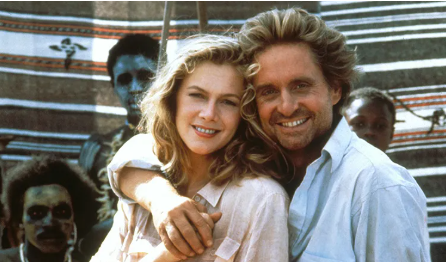
Cast your mind back to the mid-1980s. Adventure was in the air, and one on-screen couple captured the world’s imagination with their sizzling chemistry and daredevil escapades: Michael Douglas as the roguish adventurer Jack T. Colton and Kathleen Turner as the romance novelist-turned-heroine Joan Wilder. After the smash-hit success of Romancing the Stone, a sequel was inevitable. In 1985, audiences were whisked away on another whirlwind journey in The Jewel of the Nile. The film delivered more action, more laughs, and more exotic locales, cementing the duo’s place in the pantheon of great cinematic pairings.

But while the on-screen adventure seemed like a thrilling, seamless ride, the journey to bring The Jewel of the Nile to theaters was anything but. It was a production fraught with danger, creative clashes, last-minute changes, and even heartbreaking tragedy. The story behind the movie is, in many ways, as dramatic and unpredictable as the film itself. Here at Zentara.blog, we’re peeling back the curtain to reveal the incredible, untold stories from the set. Get ready to dive into 10 fascinating facts that will give you a brand-new appreciation for this beloved 80s classic.
1. The Stars Were Forced to Make the Movie
It’s hard to imagine anyone but Michael Douglas and Kathleen Turner in these iconic roles, but both stars were incredibly reluctant to return for a sequel. In fact, they actively tried to get out of it. Why? It all came down to the contract they signed for the first film, Romancing the Stone. Tucked away in the legal paperwork was a clause that contractually obligated them to star in a sequel if the studio, 20th Century Fox, decided to make one. This is a common practice in Hollywood, especially when a studio suspects they might have a hit on their hands.
When Romancing the Stone became a box office juggernaut, the studio immediately exercised its option for a follow-up. Kathleen Turner was so unhappy with the initial script for Jewel that she tried to legally exit the project. This led to a massive lawsuit, with 20th Century Fox suing the actress for a staggering $25 million for breach of contract. Faced with a costly and career-damaging legal battle, Turner eventually relented and agreed to do the film. Michael Douglas, who was also a producer on the film, shared her reservations about the script’s quality but was in a less adversarial position. He worked from within to try and improve it, knowing that the success of the sequel rested squarely on their shoulders. Their on-screen chemistry might be electric, but off-screen, the film began with a cloud of legal threats and creative frustration.
2. The Original Script Was Thrown Out Completely
The main source of the actors’ frustration was the screenplay. The first draft for The Jewel of the Nile, written by Diane Thomas who had so brilliantly penned Romancing the Stone, was reportedly considered weak by the stars. They felt it was a lazy, uninspired retread of the first film, simply swapping the jungles of Colombia for a desert setting without bringing anything new to the characters or their relationship. It was, in their view, a “carbon copy,” and they feared it would tarnish the legacy of the original.
This is where things get interesting. With their stars unhappy, the studio knew they had a major problem. Michael Douglas, leveraging his power as both star and producer, brought in new writers, Mark Rosenthal and Lawrence Konner, to perform a complete overhaul. They were tasked with starting from scratch while the production was already gearing up to begin filming. This is an incredibly stressful and high-stakes situation in filmmaking. Sets are being built and locations are being scouted based on a story that is actively being rewritten. The writers worked tirelessly to craft a new narrative that would satisfy the actors, focusing on developing the relationship between Jack and Joan, who begin the film in a comfortable but boring rut. This last-minute creative pivot is responsible for the story we know today, where the “Jewel” is not a gem but a holy man, a twist that added a much-needed layer of depth and surprise.
3. Danny DeVito Only Returned After His Part Was Beefed Up
You can’t have a proper Jack and Joan adventure without their hilarious, double-crossing frenemy, Ralph, played to perfection by Danny DeVito. But just like his co-stars, DeVito was not impressed with his character’s role in the initial script. In the early drafts, Ralph’s appearance was little more than a brief cameo, a quick nod to the first film before the main plot kicked in.
DeVito felt that if he was going to fly all the way to North Africa to be in the movie, he deserved a more substantial and funny part to play. He wanted Ralph to be an integral part of the adventure, not just a fleeting joke. The producers and writers agreed. They saw the value in the comedic triangle between Jack, Joan, and Ralph. So, during the frantic rewrite process, his role was significantly expanded. They wove him into the main plot, making him a reluctant partner to the story’s villain before he inevitably (and hilariously) switches sides. This decision was crucial, as DeVito’s manic energy and his character’s desperate attempts to finally get his big score provide some of the film’s biggest laughs and most memorable moments. It’s a testament to the actor’s star power and comedic genius that he was able to ensure his character got the screen time he deserved.
4. A Heartbreaking Tragedy Struck the Production
Making movies in remote and challenging locations always comes with risks, but the production of The Jewel of the Nile was struck by a devastating and unimaginable tragedy before filming even properly began. While scouting for locations in the rugged terrain of Morocco, a private jet carrying members of the film crew crashed. The accident claimed the lives of five people, including two of the film’s key creative leaders: production designer Richard Dawking and production manager Brian Coates.
The loss was profoundly felt across the entire cast and crew. These weren’t just colleagues; they were friends who had been with the project from its early stages. Arriving in Morocco to begin filming, the team was met with this horrific news, casting a dark shadow over the entire production. Michael Douglas later recalled the immense difficulty of trying to rally everyone’s spirits and move forward in the face of such grief. In a testament to their professionalism and their desire to honor their fallen friends, the team dedicated themselves to completing the film. Director Lewis Teague, in particular, was deeply affected, having lost two of his closest collaborators. The movie is dedicated to the memory of Dawking and Coates, a somber tribute hidden at the end of what is, on the surface, a fun-loving adventure film.
5. Filming in Morocco Was an Absolute Nightmare
The decision to shoot on location in Morocco provided the film with its stunning, authentic backdrop of sweeping deserts, bustling markets, and ancient kasbahs. However, the reality of filming there was incredibly arduous. The crew battled extreme weather conditions, with scorching daytime temperatures that would plummet to freezing levels at night. Dehydration and heatstroke were a constant concern for everyone on set.
Logistics were a recurring nightmare. Transporting heavy camera equipment, entire set pieces, and hundreds of cast and crew members across the Moroccan landscape was a monumental task. But the most legendary story from the set involves the U.S. and Moroccan Air Forces. During the filming of a scene, two genuine F-16 fighter jets, one American and one Moroccan, were scheduled to do a fly-by for the camera. Due to a miscommunication in timing—a simple mistake of confusing “12:30 PM” with “as soon as possible”—the jets screamed over the set unexpectedly. The deafening roar shattered windows, ruined the audio for the scene they were shooting, and sent the cast and crew diving for cover, thinking a real military event was unfolding. It was a chaotic and expensive mistake that perfectly encapsulated the unpredictable nature of the entire shoot.
6. The “Jewel” is a Person, Not a Gemstone
One of the cleverest parts of the film is its central twist. Audiences went in expecting Jack and Joan to be chasing after another priceless treasure, just like the giant emerald in Romancing the Stone. The title, The Jewel of the Nile, and all the marketing deliberately led everyone to believe they were after a literal jewel. The film masterfully plays with this expectation for more than half of its runtime.
The moment of revelation, when Joan realizes that “Al-Julhara” (The Jewel) is not a stone but a wise and gentle holy man, is a brilliant subversion of the standard adventure movie trope. This creative choice, born out of the script rewrites, accomplishes two things. First, it avoids simply repeating the formula of the first movie. Second, it raises the stakes of the story. Jack and Joan are no longer just fighting for treasure; they are fighting to save a man’s life and protect the soul of a nation from a ruthless dictator. It transforms their adventure from a selfish quest for riches into a noble and heroic cause. This shift adds an emotional weight to the story that a simple treasure hunt could never have achieved, giving our heroes a more compelling reason to risk their lives.
7. The Incredible F-16 Fighter Jet Heist
The sequence where Jack and Joan escape from the clutches of the villain, Omar, by stealing his personal F-16 fighter jet is pure, over-the-top, 80s action gold. It’s one of the most memorable scenes in the entire film, but how on earth did they film it? It was a masterful combination of practical effects, clever props, and old-school movie magic.
The production didn’t actually use a real, functional F-16. Instead, they built a full-scale replica of the jet on a special rig called a gimbal. A gimbal is a large, powerful hydraulic platform that can pivot and rotate, allowing the filmmakers to simulate the motion of the jet taking off, banking, and flying. Michael Douglas and Kathleen Turner were strapped into the cockpit of this replica, and the gimbal was used to toss them around convincingly. For the shots of the jet soaring through the air and crashing through buildings, the special effects team used highly detailed miniatures. These were small-scale models of the jet and the locations that were filmed with special high-speed cameras to make them look massive and realistic. By seamlessly editing together shots of the actors in the gimbal-mounted cockpit, the miniature effects, and real footage of the Moroccan landscape, they created a thrilling and believable action sequence that still holds up today.
8. The Story Behind the Iconic Theme Song
“When the going gets tough, the tough get going!” Even if you haven’t seen the movie in years, you can probably still hear that infectiously catchy chorus in your head. The theme song, performed by the Trinidadian-British singer Billy Ocean, was a global phenomenon. It shot to number one on the charts in the UK and number two in the U.S., becoming one of the defining pop anthems of the decade.
The song perfectly captured the fun-loving, adventurous spirit of the film. But what truly cemented it in pop culture history was its iconic music video. In a stroke of marketing genius, the film’s stars—Michael Douglas, Kathleen Turner, and Danny DeVito—agreed to appear in the video. Dressed in white tuxedos and acting as Billy Ocean’s comically inept backup singers and saxophonists, the trio looked like they were having the time of their lives. Their willingness to not take themselves too seriously and just have fun was completely charming. The video was played in heavy rotation on MTV and became almost as famous as the movie itself, creating a perfect symbiotic relationship where the song promoted the movie and the movie promoted the song.
9. The Director Was a Last-Minute Replacement
The director of a film is the captain of the ship, and the original plan was for Robert Zemeckis, the visionary director of Romancing the Stone, to return for the sequel. However, Zemeckis had just been given the opportunity of a lifetime: directing a film he had co-written called Back to the Future. Given the choice, he opted to create what would become one of the most beloved films of all time, leaving the director’s chair for Jewel of the Nile empty.
The studio then hired Lewis Teague to take the helm. Teague was known for directing thrillers like Cujo and Alligator. While he was a competent filmmaker, he was stepping into a very difficult situation. He had to manage disgruntled stars, oversee a chaotic script rewrite, and navigate a brutal filming environment in a foreign country, all while trying to live up to the massive success of the first film. The tragic death of his production designer and manager early on made an already challenging job almost unbearable. Despite these immense hurdles, Teague managed to pull it all together, delivering a visually exciting film that successfully captured the spirit of its predecessor and pleased audiences worldwide.
10. It Was a Huge Success, Despite Everything
Given the on-set tragedies, the unhappy stars, the frantic rewrites, and the logistical nightmares, The Jewel of the Nile had all the ingredients of a legendary Hollywood disaster. Many productions have crumbled under far less pressure. And yet, when the film was released in December 1985, it was a resounding box office hit. It grossed over $96 million worldwide, proving that audiences were more than ready for another adventure with Jack, Joan, and Ralph.
What was the secret to its success? Ultimately, it came down to chemistry. Despite their off-screen frustrations, the magnetic pull between Michael Douglas and Kathleen Turner was undeniable. Audiences loved them together, and their witty banter and romantic tension were just as potent in the sequel. The addition of more comedy from Danny DeVito, spectacular action set-pieces like the F-16 chase, and the beautiful Moroccan scenery all combined to create a purely entertaining package. The film proved that sometimes, even with a troubled production, the magic captured on screen is all that matters to the audience. It stands as a testament to the resilience and professionalism of its cast and crew, who overcame incredible adversity to deliver a fun and enduring piece of 80s pop culture.
Conclusion
The Jewel of the Nile is more than just a sequel; it’s a cinematic miracle. It’s a film that survived creative battles, a high-stakes lawsuit, a frantic race to rewrite the script, and heartbreaking loss. Through it all, the cast and crew persevered, bound by a shared goal to entertain the millions of fans who had fallen in love with Jack and Joan. The result is a film that, while perhaps not as fresh as its predecessor, is bursting with its own unique charm, spectacular action, and undeniable heart.
Learning about the immense challenges they faced behind the scenes only deepens our admiration for the final product. It reminds us that filmmaking is a collaborative, and often chaotic, art form. The next time you watch Jack and Joan bicker their way across the desert, you’ll know the real adventure was just getting the movie made. It’s a wild, wonderful ride that remains a treasured classic for anyone who loves a grand Hollywood adventure.
What is your favorite moment from Jack and Joan’s adventure in The Jewel of the Nile? Share your memories in the comments below!
Dive Deeper
Want to learn more about the era of blockbusters and the stars who defined it? Check out these amazing books for a deeper dive into the world of 80s cinema.
- Wild and Crazy Guys: How the Comedy Mavericks of the ’80s Changed Hollywood Forever by Nick de Semlyen: This book explores the careers of the comedic giants of the 80s, including Michael Douglas and Danny DeVito, providing context for the era in which Jewel of the Nile was made.
- Michael Douglas: A Biography by Marc Eliot: A comprehensive look at the life and career of the film’s star and producer, covering his journey from television star to Oscar-winning actor and powerhouse producer.
- The Big Picture: The Fight for the Future of Movies by Ben Fritz: While focused on modern Hollywood, this book gives incredible insight into the studio thinking, franchise-building, and high-stakes decision-making that has its roots in the blockbuster sequels of the 1980s.




Leave a Reply