
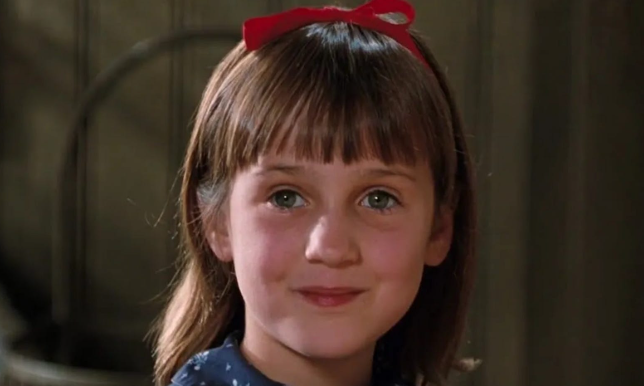
In the history of family cinema, few films capture the whimsical yet wickedly dark spirit of childhood quite like the adaptation of Roald Dahl’s Matilda. Released during a golden era of practical effects and imaginative storytelling, the film tells the story of an extraordinary young girl with a brilliant mind and a touch of telekinesis who survives a neglectful family and a tyrannical headmistress. It is a story where the library is a sanctuary, kindness is a superpower, and a small child can topple a giant with nothing more than a well-placed chalkboard drawing.
What makes this film an evergreen classic is its refusal to talk down to children. Like the books of Roald Dahl himself, the movie understands that the world can be a scary place and that adults are often the ones causing the trouble. However, it balances that darkness with a sense of wonder and the comforting presence of Miss Honey. For fans who grew up watching the “Little Sticky” dance and cheering for Bruce Bogtrotter, the behind-the-scenes world of the movie is just as magical—and occasionally as intense—as the story on screen. From the technical wizardry used to make pancakes fly to the deep emotional bonds formed behind the camera, here are ten facts every fan should know about the movie that turned a generation into bookworms.
1. Danny DeVito: The Creative Force Behind the Camera
While most audiences recognize Danny DeVito as the sleazy, used-car-selling patriarch Mr. Wormwood, many may not realize that he was the primary creative engine behind the entire project. DeVito served as the film’s director, producer, and narrator, balancing multiple high-stakes roles simultaneously. His vision was to create a world that felt slightly “tilted”—a cinematic style that mirrored the quirky, exaggerated illustrations of Quentin Blake found in the original novel.
DeVito’s directorial style focused on low-angle shots and wide-angle lenses, which made the adult characters look imposing and grotesque, effectively putting the audience into the shoes of a small child. Despite playing a character who was monstrously mean to Matilda, DeVito was famously protective of the child actors on set. He treated the production like a massive family gathering, ensuring the set was a place of joy and creativity even when the scenes being filmed were intense or frightening. This duality—the “mean” father on screen and the nurturing mentor off-screen—is what allowed the film to maintain its unique emotional balance.
2. The Chilling Transformation into Miss Trunchbull
The legendary Pam Ferris delivered one of the most iconic villain performances in cinema history as Agatha Trunchbull. To achieve the character’s formidable presence, Ferris underwent a grueling transformation every day. The makeup department used various techniques to make her skin look weathered and broken-veined, and she wore a heavy “fat suit” and padding to create the Trunchbull’s imposing, athletic physique. Ferris even stayed in character between takes to a certain extent, avoiding too much friendly interaction with the children to ensure their reactions of fear on camera were genuine.
Beyond the physical transformation, Ferris studied the movement of historical dictators and athletes to give the Trunchbull a sense of disciplined, terrifying power. Despite her frightening appearance, the actress was known by the crew to be incredibly kind and gentle. Her ability to switch from a warm professional to a child-tossing tyrant at the sound of “action” is a testament to her incredible range. The Trunchbull remains a masterclass in how to play a villain that is simultaneously a caricature and a very real, existential threat to the safety of the protagonists.
3. The Culinary Endurance of the Bruce Bogtrotter Scene
The scene where Bruce Bogtrotter is forced to eat an entire, massive chocolate cake in front of the whole school is perhaps the most memorable sequence in the film. For the young actor Jimmy Karz, filming this scene was an endurance test of a different kind. Contrary to what most kids might think, eating that much cake was a chore. The sequence took weeks to film, and because of the continuity requirements, Karz had to look like he was constantly consuming the same messy dessert.
The production team used a spit bucket between takes so the actor wouldn’t actually get sick from the sugar intake. Furthermore, the cake itself wasn’t always the most appetizing thing to look at under the hot studio lights for hours on end. To make the scene work, the makeup department smeared extra chocolate on Karz’s face and hands manually. Despite the “gross-out” nature of the scene, it became a symbol of rebellion and triumph, proving that with enough support from your peers, you can swallow even the most impossible challenges whole.
4. A Real-Life Bond Beyond the Screen
One of the most moving aspects of the film’s production is the real-life relationship between Mara Wilson (Matilda) and Danny DeVito and his wife, Rhea Perlman (Mrs. Wormwood). During the filming of Matilda, Mara Wilson’s mother, Suzie, was diagnosed with terminal cancer. In a beautiful display of compassion that mirrored the themes of the movie, DeVito and Perlman became a support system for Wilson, taking her to the movies and spending time with her family to offer a sense of normalcy during a traumatic time.
Suzie Wilson passed away before the film was officially released in theaters. However, in a final act of kindness, Danny DeVito took a near-finished cut of the movie to the hospital so Suzie could see her daughter’s performance before she died. Mara Wilson did not know about this until years later. This deep, personal connection between the cast added a layer of genuine emotional resonance to the film. When you see Matilda looking for a family that truly cares for her, the comfort she finds in the adults around her was, in many ways, reflecting the reality of the set.
5. The Physics of the Pigtail Toss
In one of the film’s most “Dahl-esque” moments, Miss Trunchbull grabs a student named Amanda Thripp by her pigtails and hammers-throws her across the school yard. While it looks like a feat of superhuman strength, the scene was achieved through a clever combination of practical effects and wirework. The actress playing Amanda was wearing a sophisticated harness that was attached to a crane, allowing her to be “spun” and “thrown” safely through the air.
To make the pigtails look real, they were attached to a strong, hidden headpiece that could support the weight and tension of the “toss.” Pam Ferris had to practice the spinning motion carefully to ensure the timing matched the wire-release. The result was a scene that felt dangerous and visceral but was entirely controlled. This sequence perfectly captured the “cartoonish violence” of the book, where the stakes are high, but the physics are just whimsical enough to keep it from becoming a horror movie.
6. The “Liccy Doll” and Roald Dahl’s Legacy
The film is filled with small tributes to the author of the original book, Roald Dahl. One of the most significant is the doll that Matilda carries, which Miss Honey eventually identifies as a relic from her own childhood. The doll is named “Liccy,” which is the nickname of Roald Dahl’s wife, Felicity Dahl. This was a deliberate choice by the filmmakers to honor the Dahl estate and stay true to the personal nature of the story.
Additionally, a portrait of Miss Honey’s father, Magnus, can be seen in the film. In reality, that portrait is a picture of Roald Dahl himself as a young man. These Easter eggs serve as a bridge between the literary world and the cinematic one. They remind the audience that while the movie is a modern American interpretation of the story, its heart belongs to the British countryside and the imaginative mind of the man who first dreamt of a girl with a library card and a secret power.
7. The Magic of Magnets and Wires
In an age before high-end digital compositing was the standard for every frame, Matilda relied heavily on practical “on-set” magic. When Matilda practices her powers in her living room—making the cards fly, the lamps dim, and the blinds shut—most of those effects were achieved using thin wires, magnets, and air pumps. The crew spent hours rigging the furniture so that objects would move precisely on cue when Mara Wilson gestured toward them.
The most famous “practical” effect is the scene where Matilda writes on the chalkboard using only her mind. This was done using a magnet on the back of the board and a piece of chalk with a metal core. A crew member stood behind the board and wrote the message in reverse to ensure the chalk moved correctly on the front. This tactile approach to special effects gives the film a “weighted” feel that CGI often lacks; you can sense the physical presence of the objects, making the magic feel like a natural extension of the world.
8. The Dreaded “Chokey” Was a Real Set Piece
The Chokey—the narrow, spike-filled closet where Miss Trunchbull punishes students—is the stuff of childhood nightmares. To make the fear feel real for the young actors, the production team built a physical Chokey that was just as dark and cramped as it appeared on screen. While the “spikes” were made of soft material and the set was perfectly safe, the enclosed space helped the child actors portray a genuine sense of claustrophobia and unease.
The design of the Chokey was intended to look like a medieval torture device repurposed for a school, emphasizing the Trunchbull’s complete lack of regard for educational standards. Whenever a character was placed inside, the sound design—featuring the heavy thud of the door and the scraping of metal—amplified the terror. It remains one of the most effective psychological tools in family cinema, representing the ultimate loss of freedom and the cold, unfeeling nature of the film’s primary antagonist.
9. Embeth Davidtz and the Heart of Miss Honey
Finding the perfect Miss Honey was crucial to the film’s success. The character needed to be a beacon of light in a very dark world, but she also needed to have a believable sense of trauma and repressed strength. Embeth Davidtz was cast because she possessed a natural grace and a “quiet power.” She played the role not as a victim, but as a survivor who was waiting for the right catalyst to reclaim her life.
Davidtz worked closely with Mara Wilson to build a rapport that felt like a genuine mother-daughter bond. Her performance provided the “soul” of the movie, acting as the emotional anchor for the audience. Without the warmth and sincerity of Miss Honey, the film’s more absurd and cruel elements would have felt too harsh. Davidtz’s ability to project vulnerability while standing up to the Trunchbull in the final act provided the film with its most satisfying emotional payoff.
10. A Celebration of Literacy and Intellectualism
At its core, Matilda is a love letter to books. In a world that often prizes physical strength or material wealth (represented by the Trunchbull and the Wormwoods, respectively), Matilda’s greatest weapon is her mind. The film portrays the local library as a place of infinite possibility and the librarian as a gatekeeper to new worlds. This theme has made the film an evergreen resource for educators and parents who want to instill a love of reading in children.
The movie suggests that knowledge is the ultimate form of rebellion. By reading, Matilda gains the vocabulary to understand her situation and the imagination to see a way out of it. This message is as relevant today as it was when the book was first written. The film doesn’t just entertain; it empowers its young audience to believe that being “smart” is better than being “loud” and that the stories we read can give us the strength to change our own stories in the real world.
Further Reading
- Matilda by Roald Dahl
- Where Am I Now?: True Stories of Girlhood and Accidental Fame by Mara Wilson
- Storyteller: The Authorized Biography of Roald Dahl by Donald Sturrock
- Roald Dahl’s Marvellous Medicine by Tom Solomon
- Podcast Episode: Classic Films And Horror Icons

- 10 The Exorcist III (1990) Movie Facts You Didn’t Know

- 10 Scream (1996) Movie Facts That Changed Horror

- 10 The Lion King (1994) Facts That Made It Iconic – Classic Movie

- 10 Forrest Gump (1994) Facts That Make It Timeless – Classic Movie




