
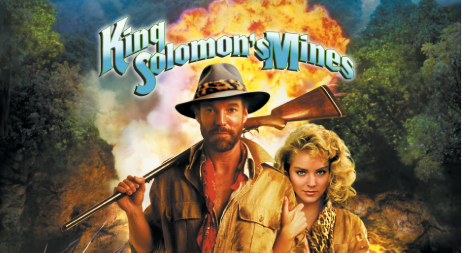
“The name’s Allan Quatermain. I arrange things.” Welcome, fellow adventurers and lovers of 80s pulp action! Today, we’re dusting off our fedoras, grabbing our bullwhips—wait, wrong franchise—and hacking our way through the dense jungle of cinematic history to explore a true gem of the VHS era: 1985’s King Solomon’s Mines. Produced by the infamous and prolific Cannon Films, this movie was a gleeful, no-holds-barred attempt to cash in on the phenomenal success of Indiana Jones. Starring Richard Chamberlain as the rugged adventurer-for-hire Allan Quatermain and introducing the world to a young Sharon Stone as the feisty Jesse Huston, the film was a rollicking, over-the-top adventure filled with giant spiders, bubbling cooking pots, and warring tribes. It was less a faithful adaptation of H. Rider Haggard’s classic 1885 novel and more a live-action cartoon, a film that prized fun over fidelity and spectacle over subtlety. But the story behind its creation in the wilds of Africa is just as adventurous and chaotic as the on-screen action. So, let’s follow the map, avoid the crocodiles, and uncover 10 surprising, little-known facts about the making of King Solomon’s Mines.
1. It Was a Blatant Indiana Jones Knock-Off (And Proud of It)
In the mid-1980s, Indiana Jones was the undisputed king of adventure. After the massive success of Raiders of the Lost Ark and Indiana Jones and the Temple of Doom, every studio in Hollywood was scrambling to create their own fedora-wearing, treasure-hunting hero. No studio was more shameless or effective in this pursuit than Cannon Films, run by the legendary B-movie mavens Menahem Golan and Yoram Globus. They saw the public’s appetite for pulp adventure and fast-tracked an adaptation of H. Rider Haggard’s public-domain novel King Solomon’s Mines. They made no secret of their intention to create their own version of Indy. The film’s poster, font, and marketing campaign were all designed to evoke the look and feel of Spielberg’s blockbusters. The film even cheekily references its inspiration, with Quatermain at one point remarking about snakes, “I hate ’em!”—a clear nod to Indy’s famous fear of snakes.
2. Sharon Stone Won Her Role by Dressing the Part
The role of the smart and spirited Jesse Huston was a breakout part for a young and relatively unknown actress named Sharon Stone. The competition for the role was fierce, but Stone took a novel approach to her audition that made her stand out from the crowd. Instead of just reading her lines, she decided to fully embody the character. She showed up to her audition with producers Menahem Golan and Yoram Globus dressed in a complete, head-to-toe safari outfit. This bold and confident move impressed the producers, who saw that she not only looked the part but also had the adventurous and slightly audacious spirit required to play Jesse. Her commitment to the character before she was even cast won them over, and she was hired for the role that would launch her into the Hollywood spotlight.
3. The Film Was Shot on Location in Zimbabwe
To capture an authentic sense of adventure, the production team traveled to the wilds of Africa, shooting the entire film on location in Zimbabwe. Filming in the vast and beautiful landscapes of the country, including areas near the magnificent Victoria Falls, provided the movie with a scale and authenticity that could never be replicated on a studio backlot. However, filming in such a remote location during the mid-1980s presented numerous challenges. The cast and crew had to contend with extreme weather, unpredictable wildlife, and the logistical nightmare of transporting equipment deep into the bush. The production was a major international event for Zimbabwe, which had only recently gained its independence, and the filmmakers worked closely with local communities and employed hundreds of local extras for the large-scale village and tribal scenes.
4. It Was Directed by an Oscar-Nominated Veteran
While Cannon Films was known for its low-budget schlock, they often attracted surprisingly prestigious talent. At the helm of King Solomon’s Mines was J. Lee Thompson, a veteran British director with a long and distinguished career. This wasn’t some B-movie upstart; Thompson had directed the Oscar-winning 1961 classic The Guns of Navarone and the terrifying 1962 thriller Cape Fear. His experience with large-scale action and suspense was a major asset to the production. Though the tone of King Solomon’s Mines was much more comedic and cartoonish than his earlier work, Thompson’s steady hand and expertise in staging complex action sequences gave the film a level of craftsmanship that elevated it above a typical knock-off.
5. The Infamous Cooking Pot Scene Required Some Clever Engineering
One of the most memorable and famously risqué scenes in the film involves Quatermain and Jesse being captured by a cannibal tribe and lowered into a giant cooking pot. As the water heats up, they are forced to shed their clothes, leading to some classic 80s comedic tension. This sequence was filmed using a giant, custom-built cauldron. To create the bubbling effect without actually boiling the actors, the crew pumped compressed air through pipes hidden at the bottom of the pot. The “steam” was created by smoke machines. Richard Chamberlain and Sharon Stone spent hours in this giant “hot tub,” filming the scene that would become one of the movie’s most talked-about moments and a staple of its promotional campaign.
6. The Score Was Composed by the Legendary Jerry Goldsmith
Adding another layer of A-list talent to the B-movie production was the film’s composer, the legendary Jerry Goldsmith. One of the most respected and prolific composers in Hollywood history, Goldsmith created iconic scores for films like Planet of the Apes, Alien, Poltergeist, and Rambo: First Blood Part II. He was approached by the producers to create a swashbuckling, adventurous score in the vein of John Williams’s work on Indiana Jones. Goldsmith delivered a rousing, powerful, and fun score that perfectly captured the film’s spirit. The main theme is a classic piece of adventure music that is instantly recognizable to fans and is often cited as one of the best elements of the film.
7. The Sequel Was Filmed Immediately Back-to-Back
In a classic cost-saving move typical of Cannon Films, the sequel, Allan Quatermain and the Lost City of Gold, was filmed immediately after production wrapped on King Solomon’s Mines. The producers knew they had a potential hit on their hands and wanted to have a sequel ready to go as quickly as possible. By shooting the two films back-to-back, they could save millions of dollars by keeping the cast and crew on location in Zimbabwe, reusing sets, and maximizing their production schedule. This practice, while efficient, was gruelling for the actors and crew, who had to work for months on end in the challenging African environment. When King Solomon’s Mines became a modest box office hit, its sequel was already in the can and was released just over a year later.
8. It Almost Completely Abandons the Original Novel
Fans of H. Rider Haggard’s 1885 novel of the same name would be hard-pressed to find much of the book’s plot in the 1985 film. While previous film adaptations in 1937 and 1950 had tried to remain somewhat faithful to the source material, this version jettisoned almost everything in favour of a comedic, action-packed romp. The novel is a much more serious and sprawling adventure story, featuring a grim quest, complex characters, and a detailed exploration of the African continent. The Cannon Films version keeps the main character names and the basic goal of finding the legendary mines, but discards the rest. The tone is completely different, replacing the novel’s sense of gritty realism and colonial-era adventure with slapstick humour, cartoonish villains, and non-stop action sequences.
9. Richard Chamberlain Was Already an Adventure Movie Veteran
While the role of Allan Quatermain was new to him, star Richard Chamberlain was no stranger to playing classic adventure heroes. In the 1970s, he had starred in a series of popular and well-regarded literary adaptations, including The Three Musketeers (and its sequel, The Four Musketeers) and The Count of Monte-Cristo. His experience playing dashing, swashbuckling characters made him a natural, if somewhat older, choice for the rugged Quatermain. At 51 years old during filming, he performed many of his own stunts and brought a sense of classic Hollywood charm and gravitas to a role that could have easily been a one-dimensional caricature.
10. The Film Was a Modest Hit but a Home Video Giant
Upon its release, King Solomon’s Mines received largely negative reviews from critics, who dismissed it as a cheap and silly Indiana Jones imitation. However, it still managed to be a modest financial success at the box office, grossing around $15 million in the U.S. against its estimated $12.5 million budget. But its real success, like so many Cannon films, was found in the booming home video market. It became a massive hit on VHS, with its exciting poster art and promise of adventure making it an irresistible choice for a weekend rental. It was on television screens in living rooms around the world that the film found its true audience and cemented its legacy as a beloved cult classic of the 80s.
Conclusion
King Solomon’s Mines is a perfect time capsule of 80s B-movie magic. It’s a film born of pure commercial opportunism that somehow, against all odds, managed to be incredibly fun. It’s a testament to the Cannon Films mantra that entertainment doesn’t have to be high art to be a good time. With its charming leads, beautiful locations, incredible score, and relentless sense of adventure, the film is a joyous and unapologetic romp. It may not be the most faithful adaptation or the most original adventure, but it has a playful, campy spirit that is impossible to resist. It’s a film that reminds us that sometimes, the greatest treasure is just having a good laugh. What is your favourite over-the-top moment from Allan Quatermain’s adventure? Let us know in the comments below!
Dive Deeper
- Allan Quatermain and the Lost City of Gold (1986 film): The essential follow-up, filmed back-to-back with the original. Richard Chamberlain and Sharon Stone return for another adventure that is just as, if not more, campy and ridiculous than the first.
- Electric Boogaloo: The Wild, Untold Story of Cannon Films (2014 documentary film): This hilarious and insightful documentary is a must-see for any fan of 80s action. It details the insane rise and fall of producers Menahem Golan and Yoram Globus, the masterminds behind King Solomon’s Mines.
King Solomon’s Mines(1885 novel) by H. Rider Haggard: To experience the story that started it all, read the original adventure novel. It’s a classic of the genre and provides a fascinating contrast to the wild and comedic tone of the 1985 film adaptation.




Leave a Reply