
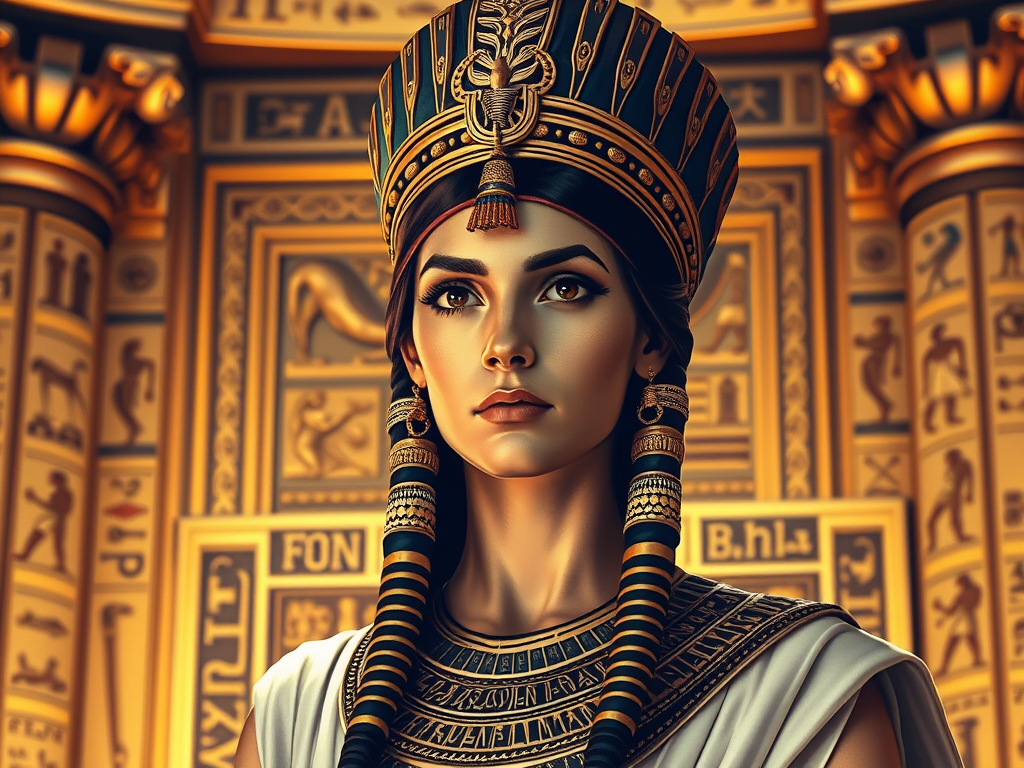
Cleopatra VII Thea Philopator, often simply known as Cleopatra, was more than just a captivating figure in ancient history; she was the last active pharaoh of the Ptolemaic Kingdom of Egypt, a ruler who masterfully navigated a turbulent world dominated by the rising power of Rome. Her reign, from 51 to 30 BC, marked the twilight of an ancient empire and the dawn of a new era under Roman rule. While popular culture often reduces her to a seductive queen who charmed powerful Roman generals, Cleopatra’s true legacy lies in her astute political maneuvering, intellectual prowess, and unwavering determination to preserve Egypt’s independence. This article delves into the ten most enduring aspects of her reign and the multifaceted legacy she left behind, revealing a woman far more complex and influential than the myths often suggest.
1. The Last Pharaoh of Egypt: A Defining End to an Era
Cleopatra VII’s reign holds immense historical significance simply because she was the last active Hellenistic pharaoh of Egypt. For nearly three centuries, since the death of Alexander the Great, Egypt had been ruled by the Ptolemaic dynasty, a line of Macedonian Greek kings and queens. Cleopatra’s death in 30 BC effectively marked the end of this dynasty and the 3,000-year-long tradition of pharaonic rule in Egypt. Imagine a long-running play, centuries in the making, finally drawing its curtain. Cleopatra was the final, climactic act. Her reign wasn’t just a personal story; it was the final chapter of an independent Egypt before it became a Roman province. This transition was a pivotal moment in ancient history, shifting the balance of power in the Mediterranean and irrevocably altering the course of both Egyptian and Roman destinies. Her end signaled the definitive absorption of a vast, rich, and ancient kingdom into the ever-expanding Roman Empire.
2. A Master of Diplomacy and Political Acumen: Navigating Roman Power
Beyond the romanticized narratives, Cleopatra was a shrewd and pragmatic politician with remarkable diplomatic skills. She understood that Egypt, though wealthy, could not withstand the might of the burgeoning Roman Republic alone. Her alliances with Julius Caesar and later Mark Antony were not merely affairs of the heart but calculated political strategies to secure Egypt’s sovereignty and her own throne. Think of her as a chess grandmaster, meticulously planning each move not for personal gain but for the survival of her kingdom. She skillfully used her charm, intellect, and resources to influence the most powerful men in the Roman world, playing their rivalries against each other to her advantage. Her ability to command respect and forge crucial alliances with these Roman heavyweights, even temporarily, showcases her exceptional political acumen and her determination to preserve Egypt’s independence in a rapidly changing geopolitical landscape.
3. Multilingualism and Intellectual Prowess: A Scholar Queen
Unlike her Ptolemaic predecessors, who often clung solely to Greek, Cleopatra was famously multilingual, reportedly speaking nine languages, including Egyptian. This was a revolutionary act for a Ptolemaic ruler and allowed her to communicate directly with her subjects, fostering a deeper connection and understanding. Picture a modern-day leader addressing their diverse populace in their native tongues—it immediately builds trust and rapport. Her intellect extended beyond languages; she was educated in mathematics, philosophy, rhetoric, and astronomy. Ancient sources credit her with treatises on various subjects, from cosmetics to coinage. She was a patron of the famed Library of Alexandria, a beacon of knowledge in the ancient world. This intellectual depth provided her with a comprehensive understanding of her realm and its place in the world, allowing her to make informed decisions and engage with foreign dignitaries on an equal footing.
4. Strategic Alliances with Roman Leaders: Caesar and Antony
Cleopatra’s relationships with Julius Caesar and Mark Antony are arguably the most famous aspects of her life, and for good reason. These were not simply romantic entanglements but strategic partnerships that aimed to safeguard Egypt’s independence. With Caesar, she sought support against her brother and co-ruler, Ptolemy XIII, solidifying her power and ensuring Roman protection. Later, her bond with Mark Antony, one of the Triumvirs who ruled Rome after Caesar’s death, was an attempt to forge a powerful eastern alliance against Octavian, Caesar’s adopted heir. Imagine two powerful nations forming a military pact; these were alliances of that magnitude, albeit with a deeply personal dimension. These relationships underscore her willingness to engage with Rome on its own terms, using personal connections to achieve political objectives and secure vital military and economic support for Egypt.
5. Economic Prosperity and Egyptian Revival: A Resourceful Ruler
Under Cleopatra’s astute leadership, Egypt experienced a period of relative economic prosperity and cultural revival. She inherited a kingdom facing internal strife and external threats, but she worked diligently to stabilize its economy. Egypt’s immense agricultural wealth, particularly its grain supply, was a vital resource that Rome heavily relied upon, giving Cleopatra significant leverage. She implemented monetary reforms and engaged in extensive trade, ensuring that Egypt’s resources were leveraged to its advantage. She also presented herself as a legitimate Egyptian pharaoh, embracing traditional Egyptian religious practices and commissioning temples, such as the Temple of Hathor at Dendera, to connect with her people and legitimize her rule. This strategic focus on revitalizing Egypt’s economic and cultural standing was crucial in maintaining its power and influence.
6. The Divine Queen: Connecting with Egyptian Deities
Cleopatra was a master of self-presentation and used religious symbolism to solidify her authority. She strategically associated herself with Isis, the Egyptian goddess of motherhood, magic, and fertility. This connection was not merely symbolic; it was a powerful tool to resonate with her Egyptian subjects and present herself as a living deity, a direct link to the ancient traditions of pharaonic rule. Envision a modern monarch drawing upon deep-seated national myths to gain widespread public support. By embracing Egyptian religious rites and iconography, she distinguished herself from her Hellenistic predecessors and cultivated a deep loyalty among her people, even as she engaged with Roman powerbrokers. This clever blending of Egyptian tradition and Hellenistic rule made her a unique and compelling figure in a complex cultural landscape.
7. Impact on Roman Politics: A Foreign Queen’s Influence
Cleopatra’s presence profoundly impacted Roman politics, particularly during the tumultuous period of the late Roman Republic. Her relationships with Caesar and Antony were not just personal matters but significant factors in the Roman civil wars. Her wealth, military support, and influence over these powerful figures made her a formidable player on the Roman stage. Octavian, Caesar’s heir, famously used propaganda to demonize Cleopatra, portraying her as an exotic seductress who was corrupting Antony and threatening Roman values. This illustrates her undeniable impact on the Roman narrative, even from afar. She was seen as a force to be reckoned with, capable of swaying Roman leaders and shaping the destiny of the Republic, ultimately leading to the final confrontation between Octavian and Antony.
8. The Tragic Downfall and Suicide: A Powerful End
Cleopatra’s story culminates in her dramatic downfall and suicide following the defeat of Antony and Cleopatra’s forces by Octavian at the Battle of Actium. Facing the humiliation of being paraded as a captive in a Roman triumph, Cleopatra chose to end her own life, famously by an asp bite, although the exact method remains debated. Her suicide was not an act of despair but a final defiant act of sovereignty, refusing to be subjected to Rome’s will. It was a conscious choice to preserve her dignity and the legacy of her kingdom. Her death marked the definitive end of independent Egypt and its annexation as a Roman province. This powerful and tragic end cemented her place in history as a figure of immense strength and resolve, forever etched into the annals of dramatic human narrative.
9. Enduring Cultural Symbolism: Myth, Art, and Literature
Centuries after her death, Cleopatra remains an enduring cultural symbol, captivating imaginations across art, literature, and film. She has been portrayed as a tragic heroine, a cunning seductress, a wise ruler, and a romantic ideal. From Shakespeare’s Antony and Cleopatra to countless Hollywood epics, her story has been retold and reinterpreted countless times, shaping popular perceptions of ancient Egypt and powerful women. This consistent fascination speaks to the timeless appeal of her narrative: a powerful queen, a forbidden love, and a tragic end. Her image continues to inspire discussions about power, gender, and the clash of civilizations, solidifying her place as one of the most recognizable and impactful figures in all of human history.
10. Legacy of Female Power and Leadership: Defying Gender Norms
In a fiercely patriarchal ancient world, Cleopatra stands out as a remarkable example of female power and leadership. She not only ruled a powerful kingdom but actively engaged in military campaigns, strategic negotiations, and intellectual pursuits, challenging conventional gender roles of her time. She demonstrated that a woman could wield authority, command armies, and influence global politics with intelligence and determination. Her story continues to inspire discussions about women in leadership and the challenges they face in male-dominated environments. Cleopatra’s legacy is a testament to her extraordinary capabilities as a ruler, proving that charisma, intellect, and strategic thinking transcended the limitations imposed by gender in the ancient world, leaving an indelible mark on history.
Further Reading
- Cleopatra: A Life by Stacy Schiff
- The Life and Death of Cleopatra by George Willis
- Cleopatra the Great: The Woman Behind the Legend by Joann Fletcher
- Cleopatra: Last of the Pharaohs by Toby Wilkinson
- Antony and Cleopatra by William Shakespeare
Here at Zentara.blog, our mission is to take those tricky subjects and unlock them, making knowledge exciting and easy to grasp for everyone. But the adventure doesn’t stop on this page! We’re constantly exploring new frontiers and sharing discoveries across the digital universe. Want to dive deeper into more mind-bending Top 10s and keep expanding your world? Come join us on our other platforms – we’ve got unique experiences waiting for you on each one!
Get inspired by visual wonders and bite-sized facts: See the world through Zentara’s eyes on Pinterest!
Pin our fascinating facts and stunning visuals to your own boards. Explore Pins on Pinterest: https://uk.pinterest.com/zentarablog/
Discover quick insights and behind-the-scenes peeks: Hop over to Tumblr for snippets, quotes, and unique content you won’t find anywhere else. It’s a different flavour of discovery! Follow the Fun on Tumblr: https://www.tumblr.com/zentarablog
Ready for deep dives you can listen to or watch? We’re bringing our accessible approach to video and potentially audio! Subscribe to our YouTube channel and tune into future projects that make learning pop! Subscribe on YouTube: https://www.youtube.com/@ZentaraUK
Seeking even more knowledge in one place? We’ve compiled some of our most popular topic deep dives into fantastic ebooks! Find them on Amazon and keep the learning journey going anytime, anywhere. Find Our Ebooks on Amazon: https://www.amazon.co.uk/s?k=Zentara+UK&ref=nb_sb_noss
Connect with us and fellow knowledge seekers: Join the conversation on BlueSky! We’re sharing updates, thoughts, and maybe even asking you what wonders we should explore next. Chat with Us on BlueSky: https://bsky.app/profile/zentarablog.bsky.social
Perfect for learning on the move! We post multiple 10-minute podcasts per day on Spotify. Pop on your headphones and fill your day with fascinating facts while you’re out and about! Listen on Spotify: https://open.spotify.com/show/3dmHbKeDufRx95xPYIqKhJFollow us on Instagram for bytesize knowledge! We post multiple posts per day on our official Instagram account. https://www.instagram.com/zentarablog/ Every click helps us keep bringing honest, accessible knowledge to everyone. Thanks for exploring with us today – see you out there in the world of discovery!




Leave a Reply