
Table of Contents
Ancient Egypt. The very name conjures images of golden masks, shadowy tombs, colossal pyramids rising from the desert, and enigmatic pharaohs. It’s a civilization that has captivated the human imagination for millennia, influencing our art, architecture, and even our movies. But with great fascination comes great fiction. The line between Hollywood fantasy and historical fact has blurred, creating a popular version of ancient Egypt populated by vengeful mummies, alien architects, and one-dimensional characters.
The truth, however, is far more compelling. The real ancient Egyptians were not supernatural beings or the beneficiaries of extraterrestrial aid; they were brilliant, innovative, and complex human beings. They were engineers, artists, bureaucrats, farmers, and priests who built one of the longest-lasting civilizations in history. Their accomplishments are impressive not because they had magic or alien tech, but because they achieved them with ingenuity, mathematics, and an incredible mobilization of human effort.
Today, we’re pulling back the veil of myth. We’re trading in the sensationalism for the story, the curses for the culture. Prepare to have your perceptions challenged as we debunk the top 10 myths about ancient Egypt.
1. Myth: Aliens Built the Pyramids
The Truth: Brilliant Engineering and a National Project Built the Pyramids
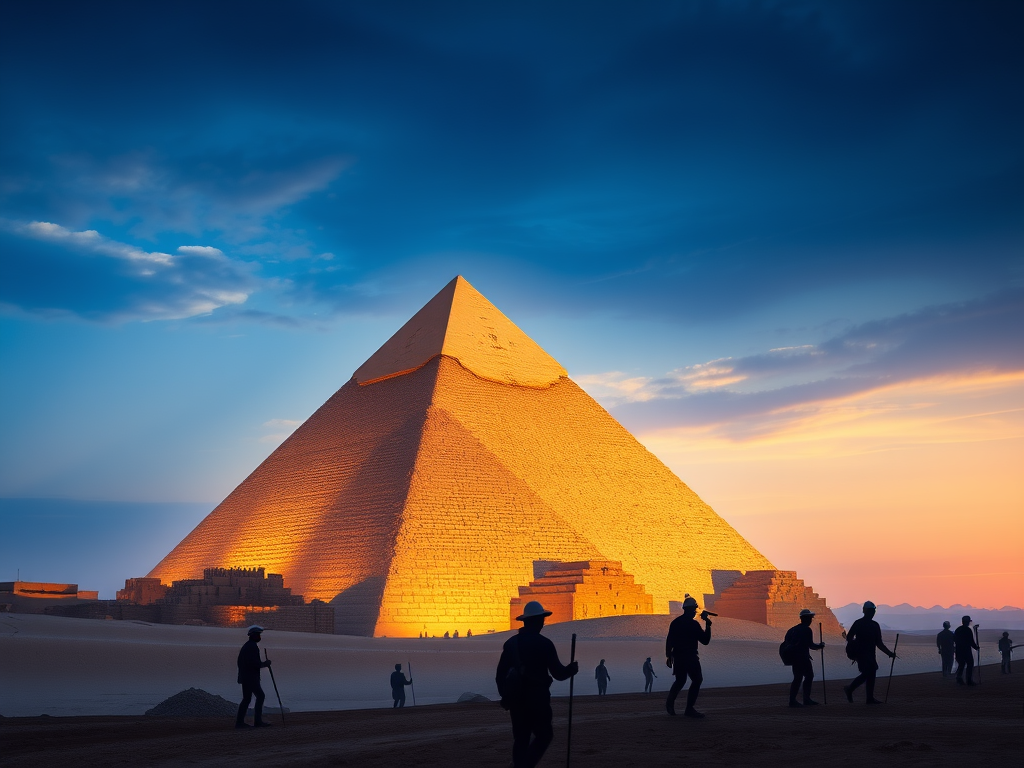
This is perhaps the most persistent and, frankly, most insulting myth of all. The idea that the Great Pyramid of Giza is so mathematically precise and so monstrously large that primitive humans couldn’t possibly have built it—so it must have been aliens—is a staple of “ancient mysteries” television. This theory, however, completely disregards the overwhelming evidence of human ingenuity.
First, the pyramids weren’t built in a vacuum. They are the culmination of a long, clear progression of Egyptian burial architecture. You can literally see them learning and iterating, starting with simple rectangular tombs called mastabas, progressing to Djoser’s “Step Pyramid” (essentially several mastabas stacked on top of each other), and even a “failed” attempt at a smooth-sided pyramid at Meidum. The Bent Pyramid at Dahshur famously changes its angle halfway up, a clear sign the builders realized their initial design was unstable. The Great Pyramid wasn’t a sudden miracle; it was the final, perfected model after generations of trial and error.
Furthermore, we have found the evidence. Archaeologists have excavated the worker’s village, a massive, purpose-built city that housed and fed a skilled, rotating workforce of thousands. We’ve found their bakeries, their breweries, and even their medical records (skeletons show evidence of healed bones, indicating they received care). Most recently, the discovery of the Wadi al-Jarf papyri, a logbook kept by an official named Merer, details the transportation of the massive limestone blocks from the Tura quarry to Giza. It’s a 4,500-year-old spreadsheet, a testament to a bureaucracy and logistical operation so advanced, it didn’t need aliens—it just needed good project managers.
2. Myth: The “Mummy’s Curse” Strikes Down Tomb Raiders
The Truth: Coincidence, Sensationalism, and Modern Microbiology Explain the “Curse”
When Howard Carter and Lord Carnarvon opened Tutankhamun’s tomb in 1922, it sparked a global sensation. But when Lord Carnarvon died a few months later from an infected mosquito bite, newspapers—eager for a spooky angle—invented the “Mummy’s Curse.” They claimed a magical inscription over the tomb’s entrance promised death to all who entered. (No such inscription existed.)
Let’s look at the facts. Of the 58 people present when the tomb was opened, only eight died within the following 12 years. Howard Carter, the man who actually led the excavation and spent the most time in the tomb, lived for another 16 years, dying at the ripe old age of 64. Most of the “curse” victims died of natural, age-appropriate causes. It’s a classic case of confirmation bias: when something bad did happen to someone on the team, it was blamed on the curse, while the long, healthy lives of the others were ignored.
If there is any “curse” at all, it’s a biological one. A sealed tomb, filled with organic materials (food offerings, mummified remains, even bird droppings) and left undisturbed for 3,000 years, is the perfect breeding ground for dormant, potentially toxic mold and bacteria. Modern archaeologists now enter tombs with respirators and protective gear, not because of a pharaoh’s magic, but because of airborne pathogens like Aspergillus niger. Lord Carnarvon’s death was likely a tragic coincidence, but the legend was just too good for the media to pass up.
3. Myth: Cleopatra VII Was Only a Beautiful Seductress
The Truth: Cleopatra Was a Formidable Intellectual and Political Leader
Our modern image of Cleopatra is almost entirely based on Roman propaganda and Shakespearean drama: a glamorous Egyptian queen who used her beauty to seduce and manipulate powerful Roman men like Julius Caesar and Mark Antony. This depiction does her a profound disservice.
First, she wasn’t even ethnically Egyptian in the way we might think. She was the last ruler of the Ptolemaic dynasty, a line of Greek rulers descended from one of Alexander the Great’s generals. While she embraced Egyptian religion and culture, her first language was Greek. In fact, she was the first ruler in her 300-year-old dynasty to bother learning the Egyptian language.
More importantly, Cleopatra was a brilliant and ruthless politician, not just a romantic figure. She commanded navies, managed an economy, and played a deadly game of geopolitical chess in a world dominated by the rising power of Rome. Her “romances” with Caesar and Antony were, first and foremost, political and military alliances. By allying with Caesar, she secured her throne against her brother. By allying with Antony, she attempted to preserve her kingdom’s independence and create an Eastern empire to rival that of Octavian (later Augustus). She was a polyglot, reportedly speaking at least nine languages, and was well-versed in mathematics, astronomy, and philosophy. The Romans, particularly her enemy Octavian, launched a successful smear campaign to portray her as an exotic, decadent, and morally corrupt “foreign” woman who bewitched their men—a sexist and xenophobic narrative that has, unfortunately, proven more durable than the truth of her political acumen.
4. Myth: Hieroglyphs Are Just Magical Symbols and Curses
The Truth: Hieroglyphs Form a Complex, Sophisticated Writing System
When we see the intricate birds, snakes, and human figures covering tomb walls, it’s easy to see why people assumed they were all magical spells or pictograms. For centuries, scholars believed hieroglyphs were a primitive form of “picture writing,” where the drawing of a bird simply meant “bird.” This misunderstanding is why the script remained undecipherable for nearly 1,500 years after its use died out.
The breakthrough came with the discovery of the Rosetta Stone, which featured the same text in three scripts: formal hieroglyphs, everyday demotic script, and Greek. Using the Greek as a key, scholars like Jean-François Champollion finally cracked the code. What they found was a system far more complex and brilliant than simple pictures.
Hieroglyphs are a hybrid system, much like modern Japanese. Some signs, called ideograms, do represent the thing they picture (a drawing of a sun can mean “sun”). But most signs are phonograms, representing sounds, just like our alphabet. The picture of an owl, for example, represents the sound “m.” Other signs are determinatives, which are placed at the end of a word to clarify its meaning (like adding a little drawing of a man to a name to show it’s a person’s name). So, to write “cat,” an Egyptian scribe might combine a sound sign for “m,” a sound sign for “i,” and a sound sign for “w,” and then add a determinative picture of a cat to make the meaning crystal clear. It’s an elegant, flexible, and fully developed language system, capable of expressing everything from complex theological ideas to tax records.
5. Myth: The Pyramids Were Built by Slaves
The Truth: The Pyramids Were Built by a Paid, Skilled, and Respected Workforce
This is the myth we see in every old Hollywood epic: a cruel pharaoh, a whip-cracking overseer, and hundreds of thousands of slaves toiling and dying in the desert sun. This entire image, popularized by the Greek historian Herodotus (who wrote 2,000 years after the pyramids were built) and the biblical story of the Exodus, is almost certainly false.
The archaeological evidence paints a very different picture. As mentioned earlier, excavations at Giza have uncovered the “workers’ village,” a well-organized city that housed the builders. The skeletons found there show that these were native Egyptians, not foreign slaves. They were well-fed, receiving daily rations of bread, beer (a staple food), and protein-rich fish and meat. This was not the diet of an enslaved, expendable population.
This was a skilled, rotating workforce, likely conscripted in a form of national service or taxation called corvée labor, where citizens owed the state a certain amount of work each year. This was especially true during the annual Nile flood, when farmland was underwater and a large agricultural workforce was temporarily unemployed. Building the pharaoh’s pyramid was seen as a sacred, nation-building duty, a way to ensure the king’s successful transition to the afterlife and, by extension, the continued prosperity and order (known as ma’at) of the entire universe. It was a massive public works project, built by Egyptians, for Egyptians.
6. Myth: Mummies Were Always Cursed, Scary Monsters
The Truth: Mummification Was a Sacred Ritual to Preserve Life, Not Create Monsters
Thanks to Hollywood B-movies and Halloween costumes, our primary image of a mummy is a shambling, linen-wrapped corpse lurching out of a sarcophagus to strangle the living. This supernatural horror trope couldn’t be further from the ancient Egyptian understanding of the practice.
For the Egyptians, mummification wasn’t about creating a monster; it was a deeply sacred, religious process designed to prevent decay and preserve the body for the afterlife. They believed the soul had several parts, including the Ka (life force) and Ba (personality), which needed to reunite with the physical body in the tomb to be “reborn” in the afterlife. If the body decayed, the soul would be left homeless and perish, an eternal death that was their greatest fear.
The entire 70-day process was a sophisticated ritual. Specialists removed the organs (placing them in canopic jars), dried the body out for 40 days using natron (a type of salt), and then carefully anointed, perfumed, and wrapped the body in hundreds of yards of linen, often placing protective amulets within the folds. The goal was to make the body a permanent, recognizable, and idealized vessel for the spirit. Far from being a source of horror, a well-preserved mummy was a triumph, a beautiful “house of eternity” that guaranteed the deceased’s eternal life. The monster myth is a purely modern invention.
7. Myth: Ancient Egyptians Were Obsessed with Death
The Truth: They Were Obsessed with Life and Wanted it to Continue
Walk through any museum’s Egyptian wing, and you’ll be surrounded by objects from tombs. Sarcophagi, canopic jars, Books of the Dead, mummies, and grave goods. It’s easy to see why the Victorians, who first popularized Egyptology, concluded that the Egyptians were a gloomy, morbid people, singularly focused on death.
This is a fundamental misunderstanding of their worldview. The Egyptians were so obsessed with life that they couldn’t stand the thought of it ending. All of their elaborate funerary practices and tomb building were driven by a profound optimism: they believed life was so good that they wanted to make sure it continued, uninterrupted, after death.
Their “afterlife,” known as the Field of Reeds, wasn’t a wispy, ethereal heaven. It was a perfect, idealized version of Egypt—a place with no sickness, no crop failures, and no pain, where you would be reunited with your family and continue your favorite activities (eating, drinking, farming, hunting) forever. The Book of the Dead wasn’t a book of the dead; it was a “Book of Coming Forth by Day,” a guidebook filled with the spells and “cheat codes” the deceased needed to navigate the trials of the underworld and successfully reach this paradise. The tombs were decorated with happy scenes of the deceased’s life, not to look back, but to magically recreate those perfect moments for eternity. They didn’t worship death; they built a bulwark against it using magic, ritual, and art.
8. Myth: King Tut’s Tomb Was Found Completely Undisturbed
The Truth: Tut’s Tomb Was Robbed at Least Twice in Antiquity
The discovery of Tutankhamun’s tomb is legendary because it was so intact compared to every other royal tomb found. Most tombs in the Valley of the Kings had been plundered and emptied thousands of years ago. By comparison, Tut’s tomb felt like a miracle, packed to the brim with over 5,000 golden, alabaster, and wooden treasures.
However, “intact” doesn’t mean “undisturbed.” When Howard Carter and his team finally breached the antechamber, they didn’t find pristine, orderly rooms. They found signs of a hurried, chaotic mess. Objects were piled up, boxes were left open, and furniture was overturned. Carter’s meticulous notes, and the physical evidence on the sealed doorways, showed that the tomb had been entered and robbed at least twice, very shortly after the pharaoh’s burial.
The robbers, however, seemed to be in a hurry. They were likely after small, portable, high-value items like precious metals, jewelry, oils, and fine linens. They “cherry-picked” the tomb, and in their haste, they left behind the large, bulky items: the chariots, the couches, the shrines, and the iconic golden sarcophagi. After the robberies were discovered, ancient necropolis officials did their best to tidy up, reseal the doors, and cover the entrance, where it lay hidden by debris from later tomb construction for over 3,000 years. So, while Tut’s tomb is the most complete we’ve ever found, it wasn’t a pristine, untouched time capsule—it was just the victim of a failed robbery.
9. Myth: All Pharaohs Were Men (and They All Wore Fake Beards)
The Truth: A Number of Powerful Women Ruled Egypt as Pharaoh
The image of the pharaoh is stereotypically male: a strong king in a kilt, smiting his enemies and wearing the distinctive false beard of kingship. While the vast majority of rulers were men, Egyptian society was far more progressive in its view of women’s rights than many other ancient (and even modern) cultures. Women could own property, sign contracts, and initiate divorce. And on rare, critical occasions, women could and did rule as full-fledged pharaohs.
The most famous and successful of these was Hatshepsut. After her husband (who was also her half-brother) died, her stepson was too young to rule. Hatshepsut, initially serving as regent, took the unprecedented step of declaring herself pharaoh. She ruled for over 20 years during a time of great peace and prosperity, launching massive building projects and re-establishing trade routes.
To legitimize her reign in a deeply patriarchal system, she used propaganda. In statues and reliefs, she was often depicted with all the traditional trappings of a male king: the kilt, the muscular physique, and yes, the false beard. This wasn’t about denying her gender; it was a political statement. The “pharaoh” was an office, a sacred role with a specific visual language, and to be a successful pharaoh, she had to look like one. Other women, like Sobekneferu and Twosret, also held the throne, proving that royal power in Egypt was not an exclusively male domain.
10. Myth: Ancient Egyptians Were All One Single Race
The Truth: Ancient Egypt Was a Diverse, Multicultural “Melting Pot”
This is a modern debate, often heated, that is projected back onto the past: what “race” were the ancient Egyptians? Were they Black, white, or Middle Eastern? The answer is that they wouldn’t have understood the question. Our modern, skin-color-based concepts of “race” did not exist.
Ancient Egypt, from its very beginning, was a “melting pot” of the Nile Valley. It was an African civilization, and its core population was indigenous to that part of northeast Africa. They depicted themselves in their art with a wide range of skin tones, from light tan to dark brown, though men were often conventionally shown with a reddish-brown color (representing an outdoor, active life) and women with a lighter yellow-tan (representing a more domestic, sheltered life). These were artistic conventions, not literal photographs.
Furthermore, Egypt’s location at the crossroads of Africa, the Mediterranean, and the Middle East made it a hub of constant migration, trade, and conquest. Over its 3,000-year history, it saw massive immigration from Nubians (from modern-day Sudan, who were often deeply integrated and even ruled as the 25th Dynasty), Libyans, and people from the Levant (Asiatics). Later, it was conquered and ruled by Persians, Greeks (the Ptolemies, like Cleopatra), and finally, Romans. To ask what “race” the Egyptians were is to miss the point. They were Egyptian—a cultural and national identity that encompassed a diverse range of peoples who lived along the Nile and were united by their language, religion, and service to the pharaoh.
Conclusion
The myths of ancient Egypt—the aliens, the curses, the comic-book characters—can be entertaining, but they obscure a far more impressive reality. The truth is about a civilization of real people who, through sheer force of will, intellect, and sophisticated organization, built a culture that lasted for 30 centuries and still has the power to awe us today.
They were not “otherworldly”; they were pioneers of mathematics, medicine, and engineering. They weren’t obsessed with death; they were the ultimate lovers of life. By debunking these myths, we don’t lessen their magic. We simply move it from the realm of fantasy to its rightful place: as one of the most staggering testaments to human potential in history.
Further Reading
For those eager to continue their journey beyond the myths, here are a few accessible books that dive deep into the real world of ancient Egypt:
- Red Land, Black Land: Daily Life in Ancient Egypt by Barbara Mertz.
- Written by a respected Egyptologist under her pen name, this book is a fun, engaging, and incredibly detailed look at how ordinary Egyptians actually lived, ate, worked, and loved.
- The Complete Pyramids: Solving the Ancient Mysteries by Mark Lehner.
- If you have any lingering questions about the pyramids, this is the definitive guide. Lehner, one of the foremost experts on Giza, details the evolution, construction, and purpose of every major pyramid, grounding them in hard archaeological fact.
- The Rise and Fall of Ancient Egypt by Toby Wilkinson.
- A comprehensive, compelling, and readable history of the entire 3,000-year span of ancient Egypt. Wilkinson weaves together politics, religion, and culture into a grand, epic story.
- Cleopatra: A Life by Stacy Schiff.
- This Pulitzer Prize-winning biography masterfully sifts through the Roman propaganda to reconstruct the life of the real Cleopatra. It’s a thrilling portrait of her as a brilliant and capable political leader.
Here at Zentara.blog, our mission is to take those tricky subjects and unlock them, making knowledge exciting and easy to grasp for everyone. But the adventure doesn’t stop on this page! We’re constantly exploring new frontiers and sharing discoveries across the digital universe. Want to dive deeper into more mind-bending Top 10s and keep expanding your world? Come join us on our other platforms – we’ve got unique experiences waiting for you on each one!
Get inspired by visual wonders and bite-sized facts: See the world through Zentara’s eyes on Pinterest!
Pin our fascinating facts and stunning visuals to your own boards. Explore Pins on Pinterest: https://uk.pinterest.com/zentarablog/
Discover quick insights and behind-the-scenes peeks: Hop over to Tumblr for snippets, quotes, and unique content you won’t find anywhere else. It’s a different flavour of discovery! Follow the Fun on Tumblr: https://www.tumblr.com/zentarablog
Ready for deep dives you can listen to or watch? We’re bringing our accessible approach to video and potentially audio! Subscribe to our YouTube channel and tune into future projects that make learning pop! Subscribe on YouTube: https://www.youtube.com/@ZentaraUK
Seeking even more knowledge in one place? We’ve compiled some of our most popular topic deep dives into fantastic ebooks! Find them on Amazon and keep the learning journey going anytime, anywhere. Find Our Ebooks on Amazon: https://www.amazon.co.uk/s?k=Zentara+UK&ref=nb_sb_noss
Connect with us and fellow knowledge seekers: Join the conversation on BlueSky! We’re sharing updates, thoughts, and maybe even asking you what wonders we should explore next. Chat with Us on BlueSky: https://bsky.app/profile/zentarablog.bsky.social
Perfect for learning on the move! We post multiple 10-minute podcasts per day on Spotify. Pop on your headphones and fill your day with fascinating facts while you’re out and about! Listen on Spotify: https://open.spotify.com/show/3dmHbKeDufRx95xPYIqKhJFollow us on Instagram for bytesize knowledge! We post multiple posts per day on our official Instagram account. https://www.instagram.com/zentarablog/ Every click helps us keep bringing honest, accessible knowledge to everyone. Thanks for exploring with us today – see you out there in the world of discovery!




Leave a Reply