
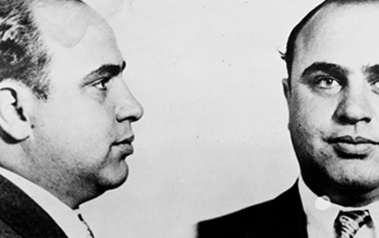
The name Al Capone conjures images of fedora-wearing mobsters, tommy guns, and illicit speakeasies. He is, without a doubt, one of America’s most infamous and enduring figures in the history of organized crime. Rising to power during the Prohibition era, Capone’s reign over the Chicago underworld was marked by brutal violence, shrewd business acumen, and an uncanny ability to evade justice – at least for a time. His story is not just one of criminality but also a fascinating, albeit dark, reflection of a tumultuous period in American history when societal norms were challenged, and the illicit alcohol trade fueled immense wealth and power for those willing to seize it.
Born Alphonse Gabriel Capone in Brooklyn, New York, in 1899, he began his ascent from humble immigrant origins to become the undisputed boss of the Chicago Outfit. His notorious nickname, “Scarface,” a result of a barroom brawl, only added to his menacing mystique. During the Roaring Twenties, as the federal government struggled to enforce the nationwide ban on alcohol, Capone capitalized on the insatiable public demand. He built a vast criminal empire founded on bootlegging, gambling, prostitution, and various rackets, generating astronomical profits and exerting a powerful, often terrifying, influence over Chicago’s political and social landscape.
Capone’s ruthless efficiency in eliminating rivals and his audacious disregard for the law made him a symbol of the era’s lawlessness. Yet, he also cultivated a public image as a modern-day Robin Hood, providing soup kitchens and charity during the Great Depression, a stark contrast to his violent methods. This duality, coupled with his ultimate downfall not for murder or racketeering but for tax evasion, cemented his legendary status. This article delves into ten compelling facts about Al Capone, exploring his life, rise, crimes, and ultimate demise, shedding light on the man behind the myth and his indelible mark on American history.
1. His Early Life and the Origin of “Scarface”
From Brooklyn Streets to Gangster Life: Alphonse Gabriel Capone was born on January 17, 1899, in Brooklyn, New York, to Italian immigrant parents. He grew up in a working-class family and, like many children of the era, left school early – at age 14, after striking a teacher. His early years were spent working odd jobs, but he quickly fell in with local “kid gangs” like the South Brooklyn Rippers and the Forty Thieves Juniors, engaging in petty crime and vandalism. It was during this period that he met his lifelong mentor, Johnny Torrio. The famous “Scarface” nickname originated from a fight at the Harvard Inn, a saloon where Capone worked as a bouncer for mobster Frankie Yale. After Capone made a crude comment to a woman, her brother, Frank Galluccio, slashed him across the face with a knife or razor, leaving him with three prominent scars on his left cheek. Capone reportedly hated the nickname and often tried to conceal the scars in photographs.
2. He Rose to Power During the Prohibition Era
The Empire Built on Illegal Alcohol: The 18th Amendment, which ushered in Prohibition in 1920, inadvertently created the perfect environment for organized crime to flourish, and Al Capone seized the opportunity. He moved to Chicago in 1919 at the invitation of Johnny Torrio, who was running the city’s vast brothel business for crime boss Big Jim Colosimo. Following Colosimo’s assassination (allegedly orchestrated by Torrio and Capone), Torrio took control, with Capone as his loyal lieutenant. When Torrio was seriously wounded in an assassination attempt in 1925, he retired, effectively handing over the reins to Capone. Capone’s Chicago Outfit quickly dominated the city’s illegal alcohol trade, operating hundreds of speakeasies, breweries, and distribution networks, generating massive profits from the public’s thirst for liquor.
3. The St. Valentine’s Day Massacre Solidified His Ruthless Reputation
A Bloody Display of Power: One of the most infamous events associated with Al Capone is the St. Valentine’s Day Massacre on February 14, 1929. This brutal act of violence was aimed at eliminating his chief rival, George “Bugs” Moran, and his North Side Gang. Seven members and associates of Moran’s gang were gunned down in a garage on Chicago’s North Side by Capone’s men, some of whom were dressed as police officers, leading the victims to believe it was a legitimate raid. While Capone himself was in Florida at the time, establishing an alibi, the massacre was widely attributed to him and shocked the nation. It underscored Capone’s ruthless determination to maintain control over Chicago’s lucrative criminal rackets and solidified his image as a fearsome and brutal gangster.
4. His Empire Extended Beyond Bootlegging
A Multi-Faceted Criminal Enterprise: While bootlegging was the foundation of his fortune, Capone’s criminal empire was far more diverse. His Chicago Outfit controlled a vast network of illicit activities, including gambling dens, prostitution rings (brothels), protection rackets, narcotics trafficking, and legitimate businesses used as fronts. At its peak, his organization reportedly generated annual revenues exceeding $100 million (equivalent to well over a billion dollars today). This immense wealth allowed Capone to bribe politicians, police officers, and judges, effectively neutralizing law enforcement efforts against him and ensuring his operations ran with impunity. He demonstrated a keen, albeit illicit, business sense, understanding market demand and logistics.
5. He Was Never Convicted of Murder or Racketeering
The Elusive Target for Law Enforcement: Despite being widely suspected of orchestrating numerous murders, including the St. Valentine’s Day Massacre, and running one of the most powerful criminal syndicates in American history, Al Capone was never successfully prosecuted for his most violent crimes or for racketeering. The challenges of obtaining evidence, witness intimidation, and widespread corruption made it incredibly difficult for local and federal authorities to build solid cases against him for these offenses. He became a symbol of the struggle law enforcement faced against organized crime, highlighting the limitations of traditional policing methods when confronted with such a powerful and entrenched criminal network.
6. He Was Eventually Brought Down by Tax Evasion
The Unconventional Downfall: The man who evaded justice for countless acts of violence and intimidation was ultimately brought down by the Internal Revenue Service (IRS). Led by Agent Frank Wilson, a special team of “Untouchables” (a nickname famously given to them by the media) meticulously built a case against Capone for income tax evasion. In 1931, Al Capone was indicted on 22 counts of tax evasion. Despite his attempts to bribe jurors and influence the proceedings, he was convicted on five counts and sentenced to 11 years in federal prison, marking a pivotal moment in the fight against organized crime. This conviction demonstrated that even the most powerful gangsters were not above the law, if the right legal strategy could be found.
7. He Spent Time in Alcatraz
The Rock’s Most Famous Inmate: Following his conviction, Al Capone was initially incarcerated at the U.S. Penitentiary in Atlanta. However, due to his continued influence even behind bars, he was transferred to Alcatraz Federal Penitentiary, the notorious maximum-security prison on an island in San Francisco Bay, in August 1934. Registered as inmate No. 85, Capone found life on “The Rock” far more difficult than his previous incarceration. He was treated like any other prisoner, subjected to strict discipline, and isolated from his criminal contacts. His health, already declining due from untreated syphilis, deteriorated further during his time at Alcatraz, making him increasingly frail. His imprisonment at Alcatraz solidified its reputation as the ultimate destination for America’s most dangerous criminals.
8. His Health Deteriorated Due to Syphilis
The Silent Killer: While his criminal career was cut short by imprisonment, Al Capone’s physical and mental decline was largely due to untreated syphilis. He had contracted the disease in his youth, and without proper medical care, it progressed to neurosyphilis, a late stage of the infection that affects the brain and nervous system. By the time he was released from Alcatraz in November 1939, his cognitive abilities were severely impaired, and he was largely incapacitated. He spent his final years as a recluse at his estate in Palm Island, Florida, unable to regain his former formidable intellect or influence. This grim medical reality stands as a stark contrast to his earlier image of invincibility.
9. He Died at 48 Years Old
A Premature End: After years of declining health, Al Capone died on January 25, 1947, at the age of 48. The official cause of death was cardiac arrest, but this was a direct consequence of his long battle with neurosyphilis, which had led to a stroke and pneumonia. His relatively young death, given his notorious life, underscored the devastating impact of his illness. His passing marked the quiet end to a life that had been anything but, concluding the chapter on one of America’s most feared and famous gangsters.
10. His Legacy Continues to Fascinate Pop Culture
The Enduring Gangster Icon: Decades after his death, Al Capone remains an iconic figure in popular culture. His life story has inspired countless books, films, television series, and documentaries, shaping the public’s perception of the Prohibition era gangster. From classic films like The Untouchables to various fictionalized portrayals, Capone’s charismatic yet brutal persona continues to fascinate audiences. He symbolizes the dark allure of power, wealth, and rebellion against authority, ensuring his place as one of the most recognizable and notorious figures in American history, a cautionary tale and a captivating legend rolled into one.
The tale of Al Capone is more than just a criminal biography; it’s a window into a pivotal period of American history where rapid social change, prohibition, and economic upheaval created fertile ground for figures like him to rise. His story continues to remind us of the complex interplay between crime, society, and the tireless pursuit of justice.
Further Reading
- Capone: The Man and the Era by Laurence Bergreen
- The Untouchables by Eliot Ness and Oscar Fraley
- My Years with Capone: Key Witness to the Gangster Era by Tony Accardo and William Roemer
- Al Capone: His Life, Legacy, and Legend by Deirdre Bair
- Public Enemies: America’s Greatest Crime Wave and the Birth of the FBI, 1933-34 by Bryan Burrough
Here at Zentara.blog, our mission is to take those tricky subjects and unlock them, making knowledge exciting and easy to grasp for everyone. But the adventure doesn’t stop on this page! We’re constantly exploring new frontiers and sharing discoveries across the digital universe. Want to dive deeper into more mind-bending Top 10s and keep expanding your world? Come join us on our other platforms – we’ve got unique experiences waiting for you on each one!
Get inspired by visual wonders and bite-sized facts: See the world through Zentara’s eyes on Pinterest!
Pin our fascinating facts and stunning visuals to your own boards. Explore Pins on Pinterest: https://uk.pinterest.com/zentarablog/
Discover quick insights and behind-the-scenes peeks: Hop over to Tumblr for snippets, quotes, and unique content you won’t find anywhere else. It’s a different flavour of discovery! Follow the Fun on Tumblr: https://www.tumblr.com/zentarablog
Ready for deep dives you can listen to or watch? We’re bringing our accessible approach to video and potentially audio! Subscribe to our YouTube channel and tune into future projects that make learning pop! Subscribe on YouTube: https://www.youtube.com/@ZentaraUK
Seeking even more knowledge in one place? We’ve compiled some of our most popular topic deep dives into fantastic ebooks! Find them on Amazon and keep the learning journey going anytime, anywhere. Find Our Ebooks on Amazon: https://www.amazon.co.uk/s?k=Zentara+UK&ref=nb_sb_noss
Connect with us and fellow knowledge seekers: Join the conversation on BlueSky! We’re sharing updates, thoughts, and maybe even asking you what wonders we should explore next. Chat with Us on BlueSky: https://bsky.app/profile/zentarablog.bsky.social
Perfect for learning on the move! We post multiple 10-minute podcasts per day on Spotify. Pop on your headphones and fill your day with fascinating facts while you’re out and about! Listen on Spotify: https://open.spotify.com/show/3dmHbKeDufRx95xPYIqKhJFollow us on Instagram for bytesize knowledge! We post multiple posts per day on our official Instagram account. https://www.instagram.com/zentarablog/ Every click helps us keep bringing honest, accessible knowledge to everyone. Thanks for exploring with us today – see you out there in the world of discovery!




Leave a Reply