
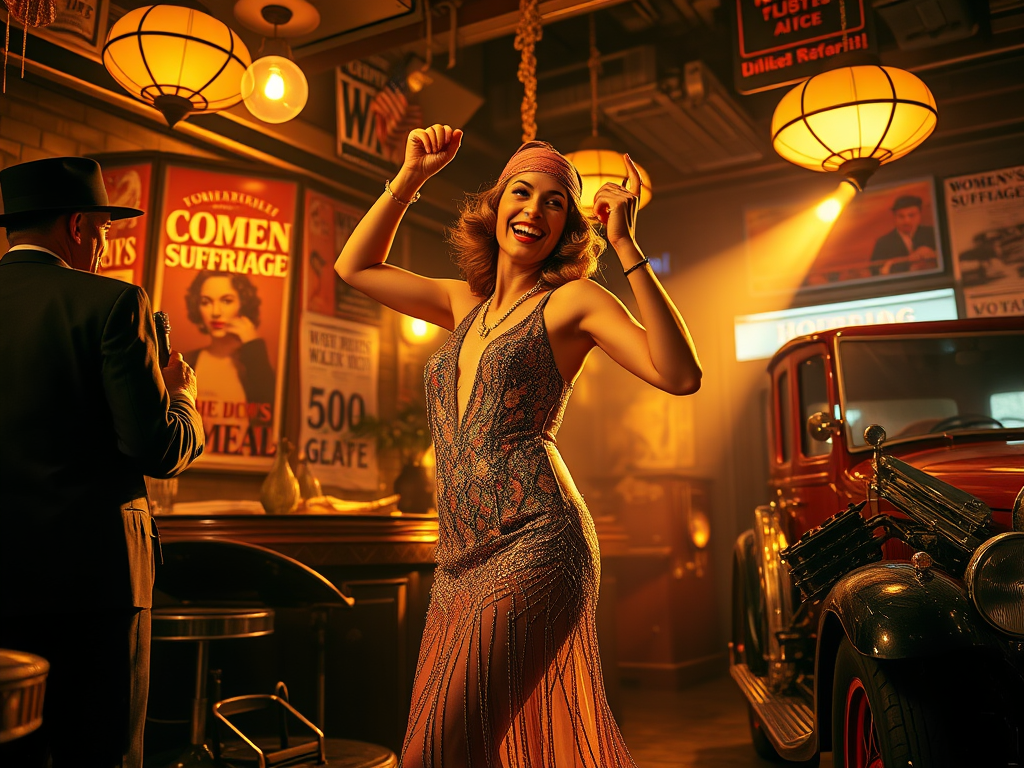
The Roaring Twenties stands out in history as a decade of dazzling contradictions. Sandwiched between the trauma of a world war and the despair of a great depression, it was a ten-year surge of energy, innovation, and rebellion. Emerging from the shadow of World War I, America was ready to shed its old skin. The decade was a cultural and social battlefield where tradition clashed with modernity at every turn. It was the age of jazz, the flapper, and the Model T; an era of unprecedented economic prosperity that gave rise to a new consumer culture, even as it was fueled by dangerous, unsustainable speculation.
This was the decade when the modern America we know began to take shape. Cities swelled, skylines grew, and the airwaves crackled with radio broadcasts that, for the first time, connected the nation through a shared popular culture. Yet, beneath the glittering surface of this decade-long party, deep tensions simmered—over Prohibition, religion, race, and the changing roles of women. To understand this electrifying era is to understand the moments that defined its character. These are the ten moments that forged the identity of the Roaring Twenties and set the stage for the century to come.
1. The 19th Amendment (1920): Women Gain the Vote 🗳️
On August 18, 1920, the political landscape of America was fundamentally and permanently altered. With the ratification of the 19th Amendment, the right to vote was finally extended to women after a century of fierce and tireless struggle. This was more than just a legislative victory; it was a seismic social shift that unlocked a new world of possibilities for American women. For the first time, millions of women had a direct voice in their own governance, a power that could no longer be ignored by the political establishment.
The impact of women’s suffrage rippled through the decade, fueling a new sense of independence that was perfectly embodied by the “flapper.” With her bobbed hair, short skirts, and disdain for “acceptable” behavior, the flapper became the icon of this newfound freedom. She smoked, she drank (in illegal speakeasies), she danced the Charleston, and she embraced a social and economic freedom her mother’s generation could only have dreamed of. While not all women in the 1920s were flappers, the spirit they represented—one of rebellion against outdated norms and an assertion of personal liberty—was a direct consequence of the political power and social confidence won by the 19th Amendment.
2. The Dawn of Prohibition (1920): The Nation Goes “Dry” 🍸
With the passage of the 18th Amendment and the Volstead Act, the United States officially became a “dry” country on January 17, 1920. The “Noble Experiment” of Prohibition was intended to reduce crime, solve social problems, and improve the nation’s health and hygiene. Instead, it did the exact opposite, uncorking a decade of lawlessness and creating a national culture of hypocrisy. The widespread ban on alcohol was met with immediate and creative defiance from a thirsty public.
This moment defined the rebellious, anti-authoritarian spirit of the Roaring Twenties. Illegal hidden bars known as speakeasies flourished in every city, becoming the glamorous epicenters of the Jazz Age. A vast black market for alcohol emerged, giving rise to bootleggers who smuggled liquor from Canada and the Caribbean. Most significantly, Prohibition handed a golden opportunity to organized crime. Gangsters like Al Capone in Chicago built vast, violent empires based on the production and distribution of illegal booze. Trying to enforce Prohibition was like trying to cap a volcano; the pressure simply erupted in other, far more dangerous ways, making criminals rich and turning millions of ordinary citizens into casual lawbreakers.
3. The Harlem Renaissance Flourishes: A Cultural Awakening 🎷
In the 1920s, the Manhattan neighborhood of Harlem became the vibrant heart of a cultural, social, and artistic explosion known as the Harlem Renaissance. This was a landmark moment in African American history, a period of unprecedented creative expression that redefined Black identity in America and beyond. Fueled by the Great Migration of African Americans from the rural South to Northern cities, Harlem became a crucible of Black intellectual and artistic life.
The movement produced a dazzling array of talent that left an indelible mark on American culture. Writers and poets like Langston Hughes and Zora Neale Hurston gave voice to the Black experience with pride and complexity. Musicians like Louis Armstrong and Duke Ellington, performing at venues like the Cotton Club, became the pioneers of the Jazz Age, creating a new and distinctly American sound that would take the world by storm. The Harlem Renaissance was more than just an artistic movement; it was a declaration of self-determination. It fostered a new sense of racial pride and challenged the pervasive racism of the era, creating a legacy that would help fuel the Civil Rights Movement decades later.
4. The Automobile Becomes King: Ford’s Model T Changes Everything 🚗
While the first cars appeared decades earlier, it was in the 1920s that the automobile truly conquered America. The revolution was driven by Henry Ford’s Model T. Thanks to the efficiency of the assembly line, Ford was able to mass-produce the “Tin Lizzie” at a price the average American family could afford. By the end of the decade, the car was no longer a luxury for the rich; it was an essential part of American life, fundamentally reshaping the nation’s geography and culture.
The rise of the automobile was the key that unlocked the map for ordinary people. It offered an unprecedented sense of freedom and mobility, allowing people to escape the confines of their local neighborhoods. This led to the growth of suburbs, as people could now live farther from their city jobs. A whole new ecosystem of businesses—gas stations, motels, roadside diners—sprang up to support this new mobile society. The car changed how Americans worked, lived, and even dated, providing a private space for young couples away from the watchful eyes of their parents. It was the engine of 1920s consumerism and the ultimate symbol of the era’s freedom.
5. The Scopes “Monkey” Trial (1925): Science vs. Tradition ⚖️
In the small town of Dayton, Tennessee, a dramatic courtroom battle unfolded that captured the attention of the entire nation. The Scopes Trial, or the “Monkey Trial” as it was famously called, centered on a young science teacher, John T. Scopes, who was accused of violating a state law by teaching Darwin’s theory of evolution. The trial became a titanic symbolic struggle between two of the most famous figures of the age: three-time presidential candidate William Jennings Bryan for the prosecution (arguing for religious fundamentalism) and famed defense attorney Clarence Darrow for Scopes (defending science and modernism).
The trial was a media circus, the first of its kind to be broadcast live on the radio. It perfectly encapsulated the central conflict of the Roaring Twenties: the clash between the traditional, rural, and religious values of the past and the modern, urban, and secular ideas of the future. While Scopes was ultimately found guilty (a verdict later overturned), the trial was a major public relations victory for the proponents of evolution. Darrow’s cross-examination of Bryan famously exposed the logical inconsistencies in a literal interpretation of the Bible, and the case came to symbolize the triumph of scientific inquiry over dogmatic belief in the modern American mindset.
6. Lindbergh’s Transatlantic Flight (1927): The Lone Eagle Soars ✈️
On May 20, 1927, a shy, 25-year-old airmail pilot from Minnesota named Charles Lindbergh took off from a muddy field in New York in a tiny, single-engine plane, the Spirit of St. Louis. Thirty-three and a half hours later, he landed in Paris, becoming the first person to fly solo and non-stop across the Atlantic Ocean. The world erupted in celebration. Lindbergh’s incredible feat of skill and endurance instantly made him the most famous man on Earth and the decade’s ultimate hero.
Lindbergh’s flight was far more than a record-breaking achievement; it was a profound psychological boost for a nation grappling with the anxieties of modernity. In an age of increasing mechanization and impersonal corporations, his solo accomplishment was a powerful testament to individual courage, determination, and the limitless potential of the human spirit. The “Lone Eagle” became a global icon, shrinking the world and launching the age of commercial aviation. His flight captured the optimistic, can-do spirit of the Roaring Twenties and proved that even in a rapidly changing world, the capacity for individual greatness was boundless.
7. The Jazz Singer (1927): The Silver Screen Learns to Talk 🎬
For three decades, movies had been a silent medium, communicating stories through pantomime, title cards, and musical accompaniment. That all changed on October 6, 1927, with the premiere of The Jazz Singer. While the film was mostly silent, it included several scenes where star Al Jolson sang and spoke dialogue. When Jolson famously ad-libbed the line, “You ain’t heard nothin’ yet!” he was, in effect, delivering the eulogy for the silent film era.
The arrival of sound—the “talkies”—was a technological earthquake that revolutionized the film industry and American popular culture. Audiences were mesmerized. Studios frantically retooled their operations, and the careers of many silent film stars who lacked good speaking voices came to an abrupt end. The talkies created a more immersive and emotionally resonant cinematic experience, giving birth to new genres like the musical and the fast-talking gangster film. This moment transformed Hollywood into the global entertainment powerhouse it remains today and created a new, more powerful form of mass media that would shape the nation’s dreams and desires.
8. The Boom of a New Consumer Culture 🛍️
The economic prosperity of the 1920s gave birth to a phenomenon that defines our world to this day: modern consumer culture. For the first time, a large number of Americans had disposable income, and a booming advertising industry was there to convince them how to spend it. Mass production made a dazzling array of new products—radios, refrigerators, vacuum cleaners, washing machines—available to the middle class. And if you didn’t have the cash upfront, a new innovation called installment buying, or buying on credit, allowed you to “buy now, pay later.”
This new consumerism was fueled by the rise of mass media. National magazines, chain stores, and, most importantly, the radio created a unified American culture. A family in rural Kansas could listen to the same radio programs, hear the same advertisements, and desire the same products as a family in New York City. This was the birth of the national conversation and the modern marketplace, a moment that shifted the American identity from one of a producer to one of a consumer, a trend that has only accelerated in the century since.
9. The Wall Street Crash of 1929: The Party Ends 📉
Throughout the decade, the stock market had been on a dizzying, unprecedented climb. It seemed like a surefire path to riches, and everyone from industrial tycoons to shoeshine boys poured their money into stocks. Much of this speculation was fueled by a risky practice called “buying on margin,” where investors only had to put down a small fraction of a stock’s price, borrowing the rest. This created a massive, unstable financial bubble. On October 29, 1929—a day that would become known as “Black Tuesday”—that bubble burst with catastrophic force.
The Wall Street Crash of 1929 was the moment the music stopped. Panic selling ensued, and in a matter of hours, fortunes were wiped out, and the paper wealth of the nation evaporated. The crash was the single event that brought the exuberant party of the Roaring Twenties to a brutal and definitive end. It exposed the fragile foundations of the decade’s prosperity and served as the starting gun for the Great Depression, the most severe economic crisis in modern history. It was a harrowing conclusion to a decade of excess and a stark lesson in the dangers of unchecked speculation.
10. The Reign of the Jazz Age 🎶
While not a single moment, the cultural phenomenon known as the Jazz Age is perhaps the ultimate defining feature of the decade. More than just a musical genre, jazz was the soundtrack of a cultural revolution. Born from the African American communities of New Orleans, its syncopated rhythms and improvisational spirit perfectly captured the energy, rebellion, and modernity of the Roaring Twenties.
Jazz was the music of the speakeasies, the fuel for new and daring dances like the Charleston and the Lindy Hop. It represented a rejection of the rigid, Victorian social norms of the past and an embrace of a more spontaneous, liberated, and youth-driven culture. The raw energy of jazz, its association with the “illicit” world of Prohibition, and its cross-cultural appeal made it both thrilling and controversial. It was the pulse of the cities, the rhythm of the party, and the definitive sound of a decade that was constantly in motion, loudly and joyfully breaking all the old rules.
Further Reading
- Only Yesterday: An Informal History of the 1920s by Frederick Lewis Allen
- One Summer: America, 1927 by Bill Bryson
- The Great Gatsby by F. Scott Fitzgerald (A novel that perfectly captures the spirit and soul of the Jazz Age)
- Last Call: The Rise and Fall of Prohibition by Daniel Okrent
- The Harlem Renaissance: A Very Short Introduction by Cheryl A. Wall
Here at Zentara.blog, our mission is to take those tricky subjects and unlock them, making knowledge exciting and easy to grasp for everyone. But the adventure doesn’t stop on this page! We’re constantly exploring new frontiers and sharing discoveries across the digital universe. Want to dive deeper into more mind-bending Top 10s and keep expanding your world? Come join us on our other platforms – we’ve got unique experiences waiting for you on each one!
Get inspired by visual wonders and bite-sized facts: See the world through Zentara’s eyes on Pinterest!
Pin our fascinating facts and stunning visuals to your own boards. Explore Pins on Pinterest: https://uk.pinterest.com/zentarablog/
Discover quick insights and behind-the-scenes peeks: Hop over to Tumblr for snippets, quotes, and unique content you won’t find anywhere else. It’s a different flavour of discovery! Follow the Fun on Tumblr: https://www.tumblr.com/zentarablog
Ready for deep dives you can listen to or watch? We’re bringing our accessible approach to video and potentially audio! Subscribe to our YouTube channel and tune into future projects that make learning pop! Subscribe on YouTube: https://www.youtube.com/@ZentaraUK
Seeking even more knowledge in one place! We’ve compiled some of our most popular topic deep dives into fantastic ebooks! Find them on Amazon and keep the learning journey going anytime, anywhere. Find Our Ebooks on Amazon: https://www.amazon.co.uk/s?k=Zentara+UK&ref=nb_sb_noss
Connect with us and fellow knowledge seekers: Join the conversation on BlueSky! We’re sharing updates, thoughts, and maybe even asking you what wonders we should explore next. Chat with Us on BlueSky: https://bsky.app/profile/zentarablog.bsky.social
Perfect for learning on the move! We post multiple 10-minute podcasts per day on Spotify. Pop on your headphones and fill your day with fascinating facts while you’re out and about! Listen on Spotify: https://open.spotify.com/show/3dmHbKeDufRx95xPYIqKhJFollow us on Instagram for bytesize knowledge! We post multiple posts per day on our official Instagram account. https://www.instagram.com/zentarablog/ Every click helps us keep bringing honest, accessible knowledge to everyone. Thanks for exploring with us today – see you out there in the world of discovery!




Leave a Reply