
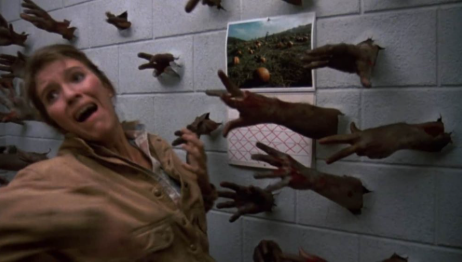
Welcome, fellow cinephiles, to a journey into the dark and desperate world of George A. Romero’s 1985 masterpiece, Day of the Dead. The third installment in his groundbreaking “Living Dead” series, this film plunged audiences into a claustrophobic underground bunker, trading the open-road chaos of Dawn of the Dead for a tense, psychological exploration of humanity on the brink of extinction. While it may not have achieved the immediate commercial success of its predecessors, Day of the Dead has since been rightfully recognized as a brutal, intelligent, and unflinchingly bleak chapter in horror history. Its influence can be seen in countless zombie films and television shows that followed, from 28 Days Later to The Walking Dead. But even the most ardent fans of this cult classic may not be aware of the incredible stories that unfolded behind the scenes. Today, we’re going to unearth ten surprising facts about the making of Day of the Dead that will give you a newfound appreciation for this gut-wrenching, thought-provoking film. So, grab your headphones, salute Bub, and prepare to venture into the depths of one of horror’s most unforgettable creations.
1. The “Gone with the Wind” of Zombie Movies That Never Was
George A. Romero’s original vision for Day of the Dead was epic. He famously described his initial script as the “Gone with the Wind of zombie movies,” a sprawling, ambitious narrative that would have depicted a much larger scale of societal collapse. This early version of the story wasn’t just confined to a single underground bunker. It featured a fortified, above-ground community with an electrified fence, a larger cast of characters including a menacing governor of Florida, and even a small army of trained zombies. Romero’s original screenplay was a staggering 200 pages long, which would have translated to a film well over three hours in length.
However, this grand vision came with a hefty price tag, estimated at around $7 million. When the film’s producers balked at the budget, they presented Romero with an ultimatum: either tone down the script and accept a smaller budget, or agree to an “R” rating, which would have meant significantly toning down the graphic gore that had become a hallmark of the series. For Romero, the unrated, unflinching depiction of the zombie apocalypse was non-negotiable. He chose to maintain his artistic integrity and drastically rewrote the script, condensing the epic story into the more intimate and claustrophobic narrative we know today. This decision, born out of necessity, ultimately shaped the film’s unique identity, focusing more on the intense psychological drama between the surviving humans.
2. The Unseen Star: The Wampum Limestone Mines
The oppressive, claustrophobic atmosphere of Day of the Dead is one of its most defining features, and that’s largely thanks to its primary filming location: the Wampum limestone mines in Pennsylvania. This vast, subterranean labyrinth provided the perfect setting for the film’s underground military base. However, filming in this unique environment presented a host of challenges for the cast and crew. The temperature inside the mines hovered around a cool 50 degrees Fahrenheit (10 degrees Celsius), but the humidity was a staggering 100%. This created a damp, chilly environment that was not only uncomfortable but also wreaked havoc on the production’s equipment.
Furthermore, the sheer size and darkness of the mines posed logistical and safety concerns. The crew had to be careful not to get lost in the winding tunnels, and the lack of natural light meant that every scene had to be meticulously lit. Despite these difficulties, the Wampum mines became an integral part of the film’s character. The cold, damp, and seemingly endless tunnels mirrored the psychological state of the survivors, trapped and surrounded by an ever-present threat. The film’s production designer, Cletus Anderson, masterfully utilized the existing structures of the mine to create the believable and lived-in world of the underground bunker.
3. The Genius of Tom Savini: More Than Just Gore
Tom Savini, the master of special makeup effects, had already cemented his legendary status with his groundbreaking work on Dawn of the Dead. For Day of the Dead, he returned with a larger budget and an even more ambitious vision. Savini’s work on this film is widely considered to be some of the most impressive practical effects ever put to celluloid. From the horrifically realistic zombie gore to the iconic “Dr. Tongue” zombie that graces the film’s opening, Savini’s creations were both stomach-churning and artistically brilliant.
One of the most memorable and technically complex effects was the death of the arrogant Captain Rhodes. Savini and his team created a full-body animatronic of actor Joseph Pilato, which was ripped apart by a horde of zombies in the film’s climax. The effect was so convincing and gruesome that it remains a benchmark for practical gore effects to this day. But Savini’s contributions went beyond just the bloodshed. He and his team were responsible for creating the distinct looks of all the zombies, ensuring that each one felt like a unique and decaying individual. Their work was instrumental in establishing the film’s dark and visceral tone, pushing the boundaries of what was possible in horror filmmaking.
4. The Birth of Bub: A Zombie with Soul
Perhaps the most enduring and beloved character in Day of the Dead is Bub, the “domesticated” zombie played by actor Sherman Howard. Bub represented a significant evolution in Romero’s zombie lore. He wasn’t just a mindless eating machine; he was a character who displayed signs of memory, emotion, and even a glimmer of his former humanity. The idea of a “tamed” zombie was a revolutionary concept that challenged the audience’s perception of the undead.
Sherman Howard’s portrayal of Bub is a masterclass in physical acting. With his movements and expressions largely concealed by heavy makeup, Howard had to convey a wide range of emotions through subtle gestures and the look in his eyes. He famously prepared for the role by studying the movements of the classic movie monsters and by trying to imagine the internal world of a being trapped between life and death. Bub’s connection with his “trainer,” Dr. Logan, and his eventual act of vengeance against Captain Rhodes, are some of the most powerful and thought-provoking moments in the film. He is a testament to Romero’s ability to infuse his horror with genuine pathos and to ask profound questions about what it means to be human.
5. A Tale of Two Tones: From Satire to Unrelenting Bleakness
While Dawn of the Dead was infused with a healthy dose of satire, particularly in its commentary on consumerism, Day of the Dead took a much darker and more nihilistic turn. The film’s tone is relentlessly bleak, reflecting the hopelessness of a world where humanity is on the verge of annihilation. The constant infighting and paranoia among the survivors suggest that the greatest threat isn’t the zombies at the door, but the darkness within humanity itself.
This shift in tone was a deliberate choice by Romero. He wanted to explore the psychological toll of a prolonged apocalypse, to show how even the most well-intentioned individuals can be broken down by fear and despair. The film’s dialogue is often sharp and cynical, and the humor, when it does appear, is pitch black. This uncompromisingly grim vision was a bold move, and it’s one of the reasons why the film was initially met with a mixed reception. However, it is also what has made Day of the Dead such an enduring and respected work of horror. Its unflinching look at the human condition in the face of overwhelming despair is as relevant and powerful today as it was in 1985.
6. Casting the Survivors: Familiar Faces and New Blood
The cast of Day of the Dead was a mix of Romero regulars and new talent. Joseph Pilato, who delivered an unforgettable performance as the tyrannical Captain Rhodes, had previously appeared in Dawn of the Dead in a minor role. His intense and over-the-top portrayal of Rhodes created one of horror’s most hissable villains. The role of the film’s heroine, Sarah, was played by Lori Cardille, the daughter of a Pittsburgh radio and television personality. Her strong and intelligent performance provided a much-needed moral center to the film.
Interestingly, the role of Dr. Logan, the “Frankenstein” of the story, was written specifically for actor Richard Liberty, who had previously worked with Romero on The Crazies. And in a fun bit of casting, members of the rock band NRBQ make a cameo appearance as zombies. The chemistry and conflict between the cast members are palpable, and their performances are a key ingredient in the film’s success. The intense and often confrontational scenes were a reflection of the tense atmosphere on set, and the actors’ commitment to their roles helped to create a truly believable and immersive experience for the audience.
7. The Gory Details: Creating the Unforgettable Effects
The special effects in Day of the Dead were not just about the quantity of gore, but the quality and creativity of their execution. Tom Savini and his team employed a variety of ingenious techniques to bring their nightmarish visions to life. For the infamous “Dr. Tongue” zombie, they created a complex puppet that was operated by several people to achieve its gruesome movements. The effect of a zombie’s head being split open by a shovel was achieved through a clever combination of a specially designed shovel with a section cut out to fit around the actor’s head and a healthy dose of fake blood.
Another memorable effect involved a character having his head ripped off, with his vocal cords still quivering. This was accomplished by creating a false torso and head that was worn by the actor, with a separate, animatronic head used for the gruesome final shot. These are just a few examples of the incredible ingenuity and artistry that went into creating the film’s unforgettable gore. The practical effects in Day of the Dead are a testament to the skill and creativity of a bygone era of filmmaking, and they still hold up remarkably well today.
8. A Cult Classic is Born: From Box Office Disappointment to Enduring Legacy
Upon its initial release, Day of the Dead was not a commercial success. Its bleak tone and graphic violence alienated some critics and audiences, and it failed to match the box office numbers of Dawn of the Dead. However, over the years, the film’s reputation has grown immensely. It has been re-evaluated by critics and has found a passionate and dedicated fanbase that recognizes it as a masterpiece of the horror genre.
Today, Day of the Dead is considered a cult classic and a vital part of Romero’s “Living Dead” saga. Its influence can be seen in the way that many subsequent zombie films and television shows have focused on the psychological drama and the moral complexities of survival. The film’s critique of the military-industrial complex and its exploration of themes such as science versus faith and the nature of humanity have also contributed to its enduring legacy. Day of the Dead is a film that was ahead of its time, and its powerful message and unforgettable imagery continue to resonate with audiences today.
9. The Sound of the Apocalypse: A Unique and Haunting Score
The music of Day of the Dead is as unique and memorable as its visuals. The score, composed by John Harrison, is a departure from the traditional orchestral horror scores of the time. Instead, Harrison created a synthesizer-heavy soundtrack that is both eerie and surprisingly melodic. The music perfectly captures the film’s strange and unsettling atmosphere, with its blend of industrial sounds, Caribbean-inspired rhythms, and haunting melodies.
The main theme, with its infectious steel drum-like melody, is a stark contrast to the film’s grim subject matter, creating a sense of surrealism and unease. The use of synthesizers also gives the score a futuristic and otherworldly quality, which complements the film’s science fiction elements. The soundtrack for Day of the Dead is a bold and unconventional choice that adds another layer of depth and complexity to the film. It is a testament to the creative vision of Romero and his collaborators and a key component of the film’s enduring appeal.
10. An Ambiguous Escape: The Meaning of the Final Scene
The ending of Day of the Dead is both a moment of relief and a source of ongoing debate among fans. After the carnage in the underground bunker, the three surviving characters, Sarah, John, and McDermott, escape by helicopter and land on a deserted tropical island. The final shot shows Sarah waking up from a nightmare, looking out at the seemingly idyllic paradise. On the surface, it appears to be a happy ending, a rare moment of hope in a world consumed by darkness.
However, the ending is deliberately ambiguous. Sarah’s nightmare suggests that the psychological scars of their ordeal will never truly heal. And while the island may be free of zombies for now, there is no guarantee that it will remain that way. The ending can be interpreted in a number of ways. Is it a genuine moment of peace, or simply a temporary reprieve before the inevitable end? This ambiguity is a hallmark of Romero’s filmmaking. He rarely offers easy answers, preferring to leave the audience with lingering questions and a sense of unease. The ending of Day of the Dead is a perfect example of this, a haunting and thought-provoking conclusion to a truly unforgettable film.
Conclusion
From its ambitious origins as a zombie epic to its realization as an intimate and intense psychological thriller, Day of the Dead is a film that is rich with fascinating stories and hidden depths. The challenges faced by the cast and crew, the groundbreaking special effects, and the bold creative choices made by George A. Romero all contributed to the creation of a film that is as intelligent as it is terrifying. It is a testament to the power of horror to not only scare us, but also to make us think about the world we live in and the nature of humanity itself. So, the next time you watch this cult classic, we hope you’ll have a new appreciation for the artistry, ingenuity, and passion that went into bringing it to the screen. What is your favorite moment or character from Day of the Dead? Let us know in the comments below!
Dive Deeper
- The Cinema of George A. Romero: Knight of the Living Dead by Tony Williams: A comprehensive look at the career of the legendary director, with in-depth analysis of his most iconic films, including Day of the Dead.
- The Making of George A. Romero’s Day of the Dead by Lee Karr: An exhaustive behind-the-scenes account of the film’s production, featuring interviews with the cast and crew and a wealth of rare photographs.
Book of the Dead: The Complete History of Zombie Cinemaby Jamie Russell: A fascinating exploration of the zombie genre, from its cinematic origins to its modern-day resurgence, with a dedicated section on Romero’s influential “Living Dead” series.




Leave a Reply