
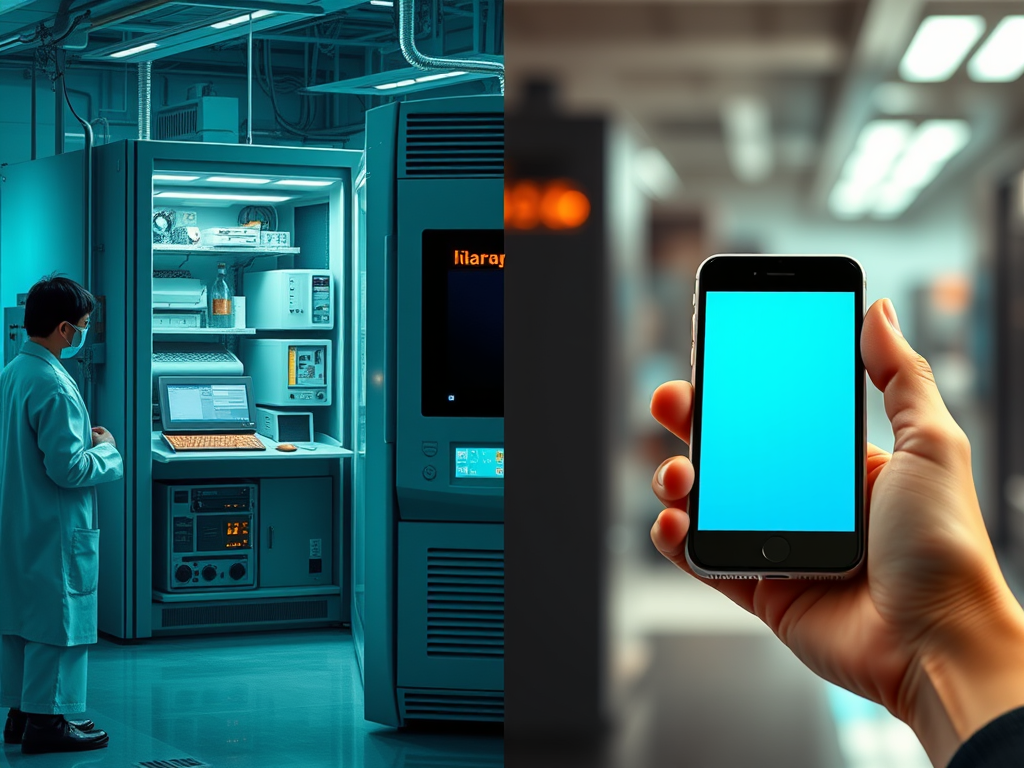
It’s a scene you might picture from a vintage sci-fi movie: a cavernous room filled with humming, refrigerator-sized cabinets, blinking lights, and scientists in lab coats poring over streams of data. This was the world of the supercomputer in the 1980s, the undisputed titans of computation. These machines, costing millions of dollars and requiring dedicated power plants, were humanity’s digital spearhead, tackling the most complex problems of the age, from nuclear physics to weather forecasting. Now, fast forward to today. The device you’re likely using to read this, the sleek rectangle of glass and metal you casually slip into your pocket, possesses computational power that would have been the stuff of fantasy for those scientists. The evolution of technology has been so breathtakingly rapid that the pocket-sized supercomputer is no longer a futuristic dream but an everyday reality. This isn’t just a slight improvement; it’s a quantum leap. Let’s unbox the astonishing specifics and explore the top 10 ways your humble smartphone leaves a 1980s supercomputer in the digital dust.
1. Raw Processing Power: The Gigaflop vs. Teraflop Tsunami
Imagine a single person who is incredibly good at math, able to solve one complex equation every second. Now imagine a stadium filled with a thousand of these math whizzes, all working in perfect sync. That’s the conceptual leap from a 1980s supercomputer to your smartphone. The metric used to measure this raw power is FLOPS, or Floating-Point Operations Per Second. The undisputed champion of the mid-1980s was the Cray-2 supercomputer. It was a liquid-cooled beast that cost the equivalent of over $45 million today and could achieve a peak performance of around 1.9 gigaflops (1.9 billion operations per second). This was an earth-shattering number at the time.
Today, a high-end smartphone, powered by chips like Apple’s A-series or Qualcomm’s Snapdragon, doesn’t just beat the Cray-2; it annihilates it. These modern mobile processors operate in the teraflop range. A single teraflop is 1 trillion operations per second. That means a modern smartphone can have a raw processing capability that is over 500 to 1,000 times greater than the world’s fastest computer from four decades ago. What the Cray-2 needed a full second to calculate, your phone can process in the blink of an eye, with power to spare for scrolling through social media, streaming 4K video, and running augmented reality applications simultaneously. The smartphone processing power has grown at a rate that almost defies belief, truly embodying the spirit of Moore’s Law.
2. Memory (RAM): From a Teaspoon to a Swimming Pool
If processing power is the speed at which a computer can think, then Random Access Memory (RAM) is its short-term memory—the mental workspace it uses to juggle active tasks. The more RAM a computer has, the more things it can think about at once without getting confused or slowing down. The mighty Cray-2 came with what was then a colossal 256 megabytes of RAM (some later models were upgraded). This was an immense amount for the era, allowing it to handle the large datasets required for scientific simulations. However, in today’s digital landscape, 256 megabytes is laughably small. It’s barely enough to open a few tabs in a modern web browser.
Contrast this with the smartphone in your hand. A mid-range smartphone today typically comes with 6 or 8 gigabytes of RAM, while high-end models can boast 12, 16, or even more gigabytes. Let’s put that in perspective: 8 gigabytes is 8,000 megabytes. This means your phone has at least 32 times more working memory than a multi-million dollar supercomputer from the 1980s. This abundance of RAM is what allows for the seamless multitasking we take for granted—switching between a game, a messaging app, your camera, and a map without any of them needing to close and reload. It’s the difference between a desk that can only hold a single piece of paper and a vast library table with room for dozens of open books at once. The smartphone RAM vs old computers comparison is a stark illustration of technological progress.
3. Data Storage: A Filing Cabinet vs. The Library of Congress
Beyond short-term memory, there’s the crucial matter of long-term storage—the computer’s ability to save and retrieve information. The supercomputers of the 1980s relied on massive, spinning hard disk drives. A top-of-the-line system might have been connected to storage units that, in total, could hold a few gigabytes of data. This was enough to store the operating system and the results of complex calculations, but it was incredibly expensive and physically bulky technology. The cost per megabyte was astronomical, and the idea of carrying that much data with you was pure science fiction.
Your smartphone, on the other hand, comes with a standard internal storage of 128, 256, 512 gigabytes, or even a full terabyte (1,000 gigabytes). This solid-state storage is not only orders of magnitude larger, but it’s also exponentially faster and more reliable because it has no moving parts. A phone with 256 gigabytes of storage can hold more than 100 times the data of a high-end 1980s supercomputer setup. You can store tens of thousands of high-resolution photos, hours of 4K video, and a library of apps that would require a warehouse full of 1980s-era hard drives. The computational power comparison isn’t just about speed; it’s also about the sheer volume of data we can now hold in the palm of our hand, turning our phones into personal archives of our digital lives.
4. Graphics and Display: From Blocky Pixels to Cinematic Universes
The primary purpose of a 1980s supercomputer was number crunching. Its output was often just lines of text and numbers on a basic terminal, or perhaps a very rudimentary wireframe model on a specialized monitor. The concept of a high-resolution, full-color graphical user interface was in its infancy. The focus was on raw calculation, not visual representation. These machines were not designed for the rich, interactive visual experiences that define modern computing.
Your smartphone is a visual powerhouse. It features a dedicated Graphics Processing Unit (GPU) that is specifically designed to render complex, high-resolution graphics in real-time. The screen on your phone packs millions of pixels, capable of displaying a stunning range of colors with incredible brightness and clarity. It can play graphically intensive 3D games with lighting and texture effects that would have been impossible to render on even the most advanced systems of the 1980s. The GPU in your phone is a specialized supercomputer in its own right, its architecture honed for the parallel processing required for visual data. The vibrant, responsive, and photorealistic worlds our phones can create make the graphical output of their supercomputing ancestors look like primitive cave paintings in comparison.
5. Connectivity: The Snail Mail vs. Instantaneous Global Network
How did you get data into and out of a 1980s supercomputer? It was a slow and deliberate process involving magnetic tapes or, at best, a rudimentary and slow network connection, often measured in kilobits per second. Collaborating with researchers across the country meant physically shipping tapes of data. The idea of real-time, global connectivity was not yet a reality. The machine was an island of immense power, but it was a very isolated one.
Your smartphone is the ultimate networked device. With technologies like 5G and Wi-Fi 6, it can download data at hundreds of megabits or even gigabits per second—millions of times faster than the connections available to an 80s-era supercomputer. It is perpetually connected to a global network of information and other devices. You can have a live video call with someone on the other side of the planet, stream a high-definition movie from a server thousands of miles away, or access vast cloud computing resources, effectively extending your phone’s power infinitely. This constant, high-speed connection transforms the phone from a standalone device into a portal to the collective knowledge and computational power of the entire world, a capability that 1980s engineers could only have dreamed of. The data transfer speed evolution has been a critical factor in making our phones so versatile.
6. Size and Portability: The Room vs. The Pocket
This is perhaps the most obvious, yet still the most mind-boggling, comparison. A supercomputer like the Cray-2 was enormous. It weighed over 5 tons and was housed in a large, circular chassis, surrounded by cabinets for power and cooling. It required a specially designed room with reinforced flooring and an industrial-grade cooling system to prevent it from overheating. It was the very definition of immobile. You couldn’t move it without a team of engineers and a massive logistical effort. Its size was a direct consequence of the technology of the time; the components were large, generated immense heat, and required extensive wiring.
Your smartphone weighs a few hundred grams and fits comfortably in your pocket. The technological miracle that makes this possible is the integrated circuit, or microchip. Thanks to the relentless march of miniaturization predicted by Moore’s Law, engineers can now cram billions of transistors onto a chip the size of your fingernail. This incredible density of components allows for immense power in an impossibly small package. The concept of a pocket-sized supercomputer has been fully realized. You carry more computational power on your morning jog than was available in the world’s most advanced research labs just a few decades ago.
7. Power Consumption and Efficiency: The Power Plant vs. The Power Bank
Keeping a 1980s supercomputer running was a monumental task. The Cray-2 required around 150 kilowatts of power—enough to power dozens of homes. This immense energy consumption generated a tremendous amount of heat, which in turn required an elaborate and power-hungry cooling system. The Cray-2 was famously cooled by being submerged in a tank of Fluorinert, a special inert liquid, to wick away the heat. The energy bill for running such a machine for a year would run into the hundreds of thousands of dollars.
Your smartphone, by contrast, is a marvel of energy efficiency. It performs its incredible computational feats while running on a small, rechargeable battery and consuming just a few watts of power. While actively using it, your phone might draw 2 to 5 watts. When idle, it sips mere milliwatts. This incredible efficiency is a core focus of modern chip design. Engineers are constantly finding new ways to make transistors that switch faster while using less power, a necessity for a device that needs to last all day on a single charge. When you compare the computational work done per watt of energy consumed, a smartphone is not just millions, but potentially billions of times more efficient than its room-sized ancestor.
8. The Richness of Sensors: A Blind Behemoth vs. A Hyper-Aware Assistant
A supercomputer of the 1980s was, in a sensory respect, blind, deaf, and dumb. Its entire perception of the world was mediated through data fed into it by human operators. It had no awareness of its physical surroundings, its location, or its orientation. Its job was to process numbers, completely disconnected from the physical world.
Your smartphone is packed with a sophisticated suite of sensors that give it a rich and detailed awareness of its environment. It has a high-resolution camera that can see far better than the human eye, capturing stunning photos and videos. It has microphones that can hear your commands and record crystal-clear audio. It has a GPS that knows its precise location anywhere on the planet. It has an accelerometer and gyroscope that sense its movement and orientation. It has a barometer to sense atmospheric pressure, a magnetometer to act as a compass, and a proximity sensor to know when it’s next to your face. This array of sensors allows for incredible applications, from navigating a new city and identifying a song that’s playing, to tracking your fitness and experiencing augmented reality. It transforms the device from a mere calculator into a true digital assistant, deeply integrated with the world around it.
9. Cost and Accessibility: Millions of Dollars vs. A Few Hundred
As mentioned, a 1980s supercomputer was a tool reserved for the most elite and well-funded organizations on Earth: government labs, military installations, major universities, and massive corporations. With a price tag running into the tens of millions of dollars in today’s money, owning one was completely out of reach for the general public. Access was restricted to a handful of top scientists and engineers. This created a huge barrier, limiting the creative and intellectual problems these powerful machines could be applied to.
Today, a smartphone is a consumer product. While high-end models can be expensive, even budget-friendly smartphones possess computational power that dwarfs the Cray-2, and they are accessible to billions of people around the world. This democratization of computing power is arguably one of the most significant technological shifts in human history. It has unleashed a wave of innovation, allowing developers and creators from all walks of life to build applications and services that have fundamentally changed how we communicate, work, learn, and play. The power that was once locked away in secure facilities is now in the hands of the masses, fueling a global digital revolution. The supercomputer cost in the 1980s stands in stark contrast to the affordability of today’s far more powerful devices.
10. The User Interface: Command Line vs. Intuitive Touch
Interacting with a 1980s supercomputer was a job for a specialist. The user interface was typically a command-line terminal, where operators had to type in complex and unforgiving lines of code to submit jobs and retrieve results. There were no icons, no windows, no touchscreens. It was a purely text-based world that required extensive training and a deep understanding of the machine’s operating system. A single typo could cause a command to fail, and the feedback the machine provided was often cryptic and difficult to decipher.
The interface on your smartphone is the complete opposite. It is built around the principles of direct manipulation and intuitive design. You interact with it by simply touching, swiping, and pinching icons and elements on the screen. The operating system is designed to be user-friendly and accessible to people of all ages and technical abilities, from a young child playing a game to a grandparent making a video call. This revolutionary shift in user interface design has removed the final barrier between humans and immense computational power. We no longer need to speak the machine’s language; the machine has learned to understand ours, responding to our touch and even our voice. This seamless and intuitive interaction is the final, crucial piece that makes the smartphone a truly personal and powerful extension of our own minds.
Further Reading
For those interested in diving deeper into the history of computing and the technological principles that made this incredible journey possible, here are a few recommended books:
- “The Innovators: How a Group of Hackers, Geniuses, and Geeks Created the Digital Revolution” by Walter Isaacson
- “A Brief History of the Future: A Brave and Controversial Look at the Twenty-First Century” by Jacques Attali and Tim Bent
- “Superintelligence: Paths, Dangers, Strategies” by Nick Bostrom
- “The Soul of a New Machine” by Tracy Kidder
- “Moore’s Law: The Life of Gordon Moore, Silicon Valley’s Quiet Revolutionary” by Arnold Thackray, David C. Brock, and Rachel Jones
Here at Zentara.blog, our mission is to take those tricky subjects and unlock them, making knowledge exciting and easy to grasp for everyone. But the adventure doesn’t stop on this page! We’re constantly exploring new frontiers and sharing discoveries across the digital universe. Want to dive deeper into more mind-bending Top 10s and keep expanding your world? Come join us on our other platforms – we’ve got unique experiences waiting for you on each one!
Get inspired by visual wonders and bite-sized facts: See the world through Zentara’s eyes on Pinterest!
Pin our fascinating facts and stunning visuals to your own boards. Explore Pins on Pinterest: https://uk.pinterest.com/zentarablog/
Discover quick insights and behind-the-scenes peeks: Hop over to Tumblr for snippets, quotes, and unique content you won’t find anywhere else. It’s a different flavour of discovery! Follow the Fun on Tumblr: https://www.tumblr.com/zentarablog
Ready for deep dives you can listen to or watch? We’re bringing our accessible approach to video and potentially audio! Subscribe to our YouTube channel and tune into future projects that make learning pop! Subscribe on YouTube: https://www.youtube.com/@ZentaraUK
Seeking even more knowledge in one place? We’ve compiled some of our most popular topic deep dives into fantastic ebooks! Find them on Amazon and keep the learning journey going anytime, anywhere. Find Our Ebooks on Amazon: https://www.amazon.co.uk/s?k=Zentara+UK&ref=nb_sb_noss
Connect with us and fellow knowledge seekers: Join the conversation on BlueSky! We’re sharing updates, thoughts, and maybe even asking you what wonders we should explore next. Chat with Us on BlueSky: https://bsky.app/profile/zentarablog.bsky.social
Perfect for learning on the move! We post multiple 10-minute podcasts per day on Spotify. Pop on your headphones and fill your day with fascinating facts while you’re out and about! Listen on Spotify: https://open.spotify.com/show/3dmHbKeDufRx95xPYIqKhJFollow us on Instagram for bytesize knowledge! We post multiple posts per day on our official Instagram account. https://www.instagram.com/zentarablog/ Every click helps us keep bringing honest, accessible knowledge to everyone. Thanks for exploring with us today – see you out there in the world of discovery!




Leave a Reply