
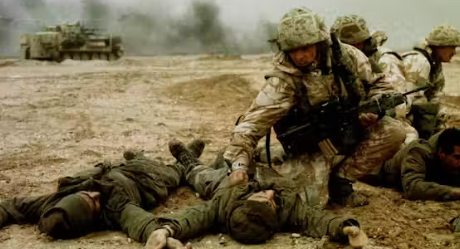
In the late summer of 1990, the world watched in stunned silence as Saddam Hussein’s Iraqi forces invaded and swiftly annexed the small, oil-rich nation of Kuwait. This brazen act of aggression set the stage for a monumental international response, culminating in Operation Desert Storm, the First Gulf War. This was a conflict that redefined modern warfare, showcasing the overwhelming technological superiority of a US-led international coalition and broadcasting its power into living rooms around the globe. The war was short, lasting only 43 days from the first airstrikes to the final ceasefire, but its defining moments were packed with strategic brilliance, technological terror, and dramatic ground assaults that reshaped the Middle East and ushered in a new era of American military dominance. Here are the top 10 defining moments that marked the rapid and decisive campaign of Operation Desert Storm.
1. The Invasion of Kuwait and the “Line in the Sand” (August 2-7, 1990)
The first and most crucial moment was the one that started it all. On August 2, 1990, Saddam Hussein, the dictator of Iraq, ordered a massive invasion of his tiny southern neighbour, Kuwait. Citing disputes over oil production and historical territorial claims, over 100,000 Iraqi troops, backed by tanks and aircraft, rolled across the border, overwhelming the small Kuwaiti army in a matter of hours. The world was shocked by the speed and brutality of the annexation. This act of aggression was a direct challenge to the international order and, critically, to the stability of the world’s oil supply, as the combined oil reserves of Iraq and Kuwait would give Saddam control over a huge portion of the global market.
The international response was swift. The United Nations Security Council immediately condemned the invasion and imposed crippling economic sanctions. The defining response came from the United States. President George H.W. Bush declared that the aggression “will not stand” and initiated Operation Desert Shield. This involved the rapid deployment of a massive international force to Saudi Arabia to protect the kingdom from a potential Iraqi attack. This defensive posture drew a clear “line in the sand,” signalling to Saddam Hussein that any further advance would be met with military force and setting the stage for the largest international military coalition since World War II.
2. The UN Deadline and the Failure of Diplomacy (January 15, 1991)
Following the invasion, the autumn of 1990 was marked by a tense standoff and frantic diplomatic efforts. The United Nations passed Resolution 678, which issued a stark ultimatum to Saddam Hussein: withdraw all Iraqi forces from Kuwait by January 15, 1991, or the US-led Coalition was authorized to use “all necessary means” to liberate the country. This deadline created an incredibly high-stakes countdown, a global game of chicken with peace in the balance. The world held its breath, hoping for a last-minute diplomatic breakthrough.
A final, dramatic attempt at a peaceful resolution occurred on January 9, 1991, when US Secretary of State James Baker met with Iraqi Foreign Minister Tariq Aziz in Geneva. The meeting was a failure. Aziz was intransigent, and Baker made it clear that the consequences of defying the UN would be severe. As the January 15 deadline passed with Iraqi troops still firmly entrenched in Kuwait, the world knew that war was now inevitable. The failure of diplomacy, despite months of effort, was a defining moment that locked the opposing forces onto a path of conflict, transitioning the mission from the defensive Operation Desert Shield to the offensive Operation Desert Storm.
3. “The Air War Begins”: The First Strikes (January 17, 1991)
In the early morning hours of January 17, 1991, the deadline for withdrawal having passed, Operation Desert Storm began with a stunning display of air power. The first shots of the war were fired not by traditional bombers, but by Apache attack helicopters destroying Iraqi early-warning radar sites, creating a secret corridor for the main air armada to fly through undetected. Moments later, F-117 Nighthawk stealth fighters, then still a mysterious and revolutionary technology, slipped through the darkness to drop laser-guided bombs on key command-and-control centres in downtown Baghdad.
For the first time, a global audience watched a war unfold in real time. CNN correspondents Bernard Shaw, John Holliman, and Peter Arnett broadcast live from their Baghdad hotel room as explosions lit up the night sky, their reports punctuated by the sound of air raid sirens and anti-aircraft fire. This was the beginning of the “24-hour news war.” The initial air assault was a precisely coordinated, technologically advanced operation designed to achieve “shock and awe.” It aimed to blind, deafen, and decapitate the Iraqi military leadership in its opening moments, signalling a new era of precision warfare.
4. The “Great Scud Hunt” and the Patriot Missile’s Debut
Saddam Hussein’s primary response to the overwhelming air campaign was a terror weapon: the Scud missile. These were inaccurate, Soviet-made ballistic missiles that Iraq modified to extend their range. While they had little tactical military value, they were a powerful psychological tool. Saddam began launching Scuds at cities in both Saudi Arabia and, most provocatively, Israel. The attacks on Israel were a deliberate attempt to draw the Israeli military into the conflict, a move Saddam hoped would shatter the delicate Coalition, which included several Arab nations that would find it politically impossible to fight alongside Israel.
This sparked the “Great Scud Hunt.” Coalition aircraft were diverted to scour the western Iraqi desert, hunting for mobile Scud launchers. The defining moment in this battle, however, was the combat debut of the American Patriot missile system. Designed to intercept incoming missiles, the Patriot was rushed to Israel and Saudi Arabia. Live television broadcasts of Patriots streaking into the night sky to intercept Scuds became one of the war’s most iconic images. While its actual success rate was later debated, the Patriot’s deployment was a massive political and psychological victory, reassuring nervous allies and helping to keep Israel out of the war, thus preserving the unity of the Coalition.
5. The Battle of Khafji: The First Major Ground Engagement (January 29 – February 1)
While the air war raged, the first significant ground battle of the war took place at the Saudi Arabian coastal town of Khafji. In a surprise move, Iraqi armoured divisions crossed the border and captured the deserted town. Saddam’s aim was to draw Coalition forces into a costly ground battle on his terms and to break the morale of the allied forces. The attack initially caught the Coalition by surprise, but the response was swift and decisive. U.S. Marines, backed by Saudi and Qatari forces, were tasked with retaking the town.
What followed was a brutal, two-day battle. The real star, however, was Coalition air power. Iraqi tanks and armoured vehicles caught in the open were systematically destroyed from the air by A-10 Warthogs and helicopter gunships. While the fighting on the ground was fierce, the battle demonstrated a key theme of the war: Iraqi conventional forces simply could not stand up to the Coalition’s technological and air superiority. The Iraqi offensive was crushed, and Khafji was liberated. The battle was a major propaganda victory for the Coalition and a grim preview for the Iraqis of what was to come in the main ground invasion.
6. The “Highway of Death” and the Power of Air Superiority
One of the most powerful and controversial images of the entire war was the “Highway of Death.” As the ground war reached its climax in late February, Iraqi forces in Kuwait began a disorganized and full-scale retreat, fleeing north back towards Iraq along Highway 80. This massive convoy of tanks, armoured cars, trucks, and stolen civilian vehicles became trapped in a colossal traffic jam, creating a perfect target for Coalition air power. For hours, US Navy and Air Force jets, along with A-10 Warthogs, relentlessly pounded the trapped convoy.
The result was utter devastation. The highway was turned into a smoking, twisted graveyard of thousands of vehicles and, tragically, their occupants. When the smoke cleared, the images that emerged were apocalyptic. While the military argued that these were legitimate military targets in retreat, the sheer scale of the destruction led to accusations that it was a “turkey shoot” and disproportionate. The “Highway of Death” became a stark and brutal symbol of the Coalition’s complete air supremacy and the devastating effectiveness of modern air power against a conventional, retreating army.
7. The “Left Hook”: The Ground War Begins (February 24)
After 38 days of a punishing air campaign that had crippled the Iraqi military, the Coalition was ready to launch the ground invasion, codenamed Operation Desert Sabre. The central challenge was to breach the formidable Iraqi defensive line along the Saudi-Kuwaiti border, a network of minefields, trenches, and fire pits dubbed the “Saddam Line.” The Iraqis expected a frontal amphibious assault and a head-on charge into these defences. Instead, Coalition commander General Norman Schwarzkopf devised a brilliant and audacious plan of deception.
While a smaller force of Marines punched directly into Kuwait to fix the attention of the Iraqi army, the main weight of the Coalition force, led by the US VII Corps and XVIII Airborne Corps, secretly moved hundreds of miles to the west. On February 24, this massive armoured force swung wide into the Iraqi desert in a sweeping flanking manoeuvre known as the “Left Hook.” It was a classic piece of armoured warfare, a “hail Mary” play on a colossal scale. The plan completely bypassed the heaviest Iraqi defences and smashed into the flank and rear of the Iraqi army, encircling the elite Republican Guard divisions and leading to one of the fastest and most decisive victories in modern military history.
8. The Liberation of Kuwait City (February 26)
Two days after the ground war began, the primary objective of the entire operation was achieved: the liberation of Kuwait City. After months of brutal Iraqi occupation, Arab forces from the Coalition, primarily from Saudi Arabia and Kuwait, led the advance into the capital. They were met with scenes of incredible joy and emotion. Kuwaiti civilians poured into the streets, waving flags, cheering, and embracing their liberators. The images broadcast around the world were a powerful and emotional vindication of the war’s stated goal.
However, the joy of liberation was mixed with the horror of what the retreating Iraqi army had left behind. In a final, vindictive act of ecological terrorism, Iraqi forces had set fire to over 600 Kuwaiti oil wells, and a massive oil slick was deliberately released into the Persian Gulf. The sky over Kuwait City was blackened with thick, oily smoke, creating an apocalyptic, sunless landscape. The liberation was therefore a bittersweet moment, marking the successful end of the occupation but also revealing the immense human and environmental cost that would need to be addressed.
9. The Battle of 73 Easting: The Decisive Tank Battle (February 26)
While Kuwait City was being liberated, one of the most decisive and famous battles of the war was raging in the Iraqi desert. On February 26, the US 2nd Armored Cavalry Regiment, the scout force for the VII Corps, ran headlong into a division of the elite Iraqi Republican Guard’s Tawakalna Division near a featureless grid line on the map known as the 73 Easting. What followed was a classic, post-World War II tank battle fought in the middle of a sandstorm.
The technological superiority of the American forces was put on full display. The US M1A1 Abrams tanks, with their advanced thermal sights, could see and target the Iraqi tanks through the blinding sand and smoke, while the Iraqi tankers were effectively blind. The Abrams’ superior firing range and armour allowed them to destroy the Iraqi T-72 tanks from a safe distance. In a short, ferociously one-sided battle, a single US cavalry troop destroyed an entire Iraqi armoured brigade with almost no American losses. The Battle of 73 Easting was a microcosm of the entire ground war—a swift, lethal, and decisive demonstration of the technological gap between the two armies.
10. The 100-Hour War and the Ceasefire (February 28)
The “Left Hook” and the subsequent tank battles had been so overwhelmingly successful that the Iraqi army completely collapsed. After just 100 hours of ground combat, the strategic objectives of the war had been met: Kuwait was liberated, and the Iraqi army was decisively ejected and destroyed as an effective fighting force. At that point, President George H.W. Bush faced a crucial decision. Some urged him to push on to Baghdad and remove Saddam Hussein from power, but the UN mandate for the war was limited to the liberation of Kuwait.
On February 28, exactly 100 hours after the ground invasion began, President Bush announced a unilateral ceasefire. The war was over. The speed and decisiveness of the ground campaign were astonishing. A force of over half a million Coalition troops had defeated what was then the fourth-largest army in the world in just four days of fighting, with remarkably few Coalition casualties. The “100-Hour War” became the defining metric of the victory, a symbol of a perfectly executed military campaign that achieved its goals with stunning speed and efficiency, bringing the dramatic and violent chapter of Operation Desert Storm to a close.
Further Reading
For those who wish to gain a deeper understanding of the First Gulf War, these books offer comprehensive and engaging perspectives:
- Crusade: The Untold Story of the Persian Gulf War by Rick Atkinson – A Pulitzer Prize-winning journalist’s masterful and detailed narrative of the war, from the highest levels of political decision-making to the experiences of the soldiers on the ground.
- The Generals’ War: The Inside Story of the Conflict in the Gulf by Michael R. Gordon and General Bernard E. Trainor – An authoritative account that provides deep insight into the military strategy, inter-service rivalries, and key decisions made by the commanders who planned and executed the war.
- It Doesn’t Take a Hero: The Autobiography of General H. Norman Schwarzkopf by Norman Schwarzkopf and Peter Petre – The memoir of the charismatic commander of the Coalition forces, offering his firsthand perspective on the planning and execution of Operation Desert Storm.
- Desert Storm: The War in the Persian Gulf by Time-Life Books – A highly accessible and visually rich account of the conflict, perfect for readers looking for a clear and concise overview of the war’s key events and technologies.
Here at Zentara.blog, our mission is to take those tricky subjects and unlock them, making knowledge exciting and easy to grasp for everyone. But the adventure doesn’t stop on this page! We’re constantly exploring new frontiers and sharing discoveries across the digital universe. Want to dive deeper into more mind-bending Top 10s and keep expanding your world? Come join us on our other platforms – we’ve got unique experiences waiting for you on each one!
Get inspired by visual wonders and bite-sized facts: See the world through Zentara’s eyes on Pinterest!
Pin our fascinating facts and stunning visuals to your own boards. Explore Pins on Pinterest: https://uk.pinterest.com/zentarablog/
Discover quick insights and behind-the-scenes peeks: Hop over to Tumblr for snippets, quotes, and unique content you won’t find anywhere else. It’s a different flavour of discovery! Follow the Fun on Tumblr: https://www.tumblr.com/zentarablog
Ready for deep dives you can listen to or watch? We’re bringing our accessible approach to video and potentially audio! Subscribe to our YouTube channel and tune into future projects that make learning pop! Subscribe on YouTube: https://www.youtube.com/@ZentaraUK
Seeking even more knowledge in one place? We’ve compiled some of our most popular topic deep dives into fantastic ebooks! Find them on Amazon and keep the learning journey going anytime, anywhere. Find Our Ebooks on Amazon: https://www.amazon.co.uk/s?k=Zentara+UK&ref=nb_sb_noss
Connect with us and fellow knowledge seekers: Join the conversation on BlueSky! We’re sharing updates, thoughts, and maybe even asking you what wonders we should explore next. Chat with Us on BlueSky: https://bsky.app/profile/zentarablog.bsky.social
Perfect for learning on the move! We post multiple 10-minute podcasts per day on Spotify. Pop on your headphones and fill your day with fascinating facts while you’re out and about! Listen on Spotify: https://open.spotify.com/show/3dmHbKeDufRx95xPYIqKhJFollow us on Instagram for bytesize knowledge! We post multiple posts per day on our official Instagram account. https://www.instagram.com/zentarablog/ Every click helps us keep bringing honest, accessible knowledge to everyone. Thanks for exploring with us today – see you out there in the world of discovery!




Leave a Reply