
1. The Thornton Affair: The Spark That Ignited the Flames of War (April 25, 1846)
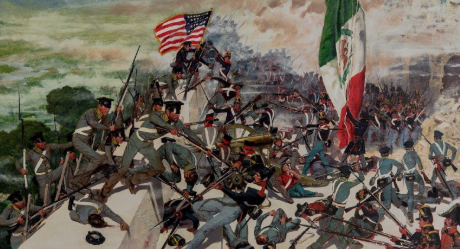
Every great fire starts with a single spark. For the Mexican-American War, that spark flew in the arid, disputed territory between the Nueces River and the Rio Grande. While the United States, having recently annexed Texas, claimed the Rio Grande as the international border, Mexico insisted the boundary lay further north at the Nueces River. Into this volatile no-man’s-land, President James K. Polk sent a force of U.S. troops under General Zachary Taylor. It was a deliberate provocation, a strategic move to bait the Mexican army into a confrontation. On April 25, 1846, the gambit paid off. A 2,000-man Mexican cavalry detachment ambushed a 70-man U.S. patrol led by Captain Seth Thornton. The skirmish was brief but bloody, resulting in the deaths of 11 American soldiers and the capture of the rest.
When news of the Thornton Affair reached Washington D.C., it was the justification President Polk had been waiting for. On May 11, 1846, he addressed Congress, famously declaring that “Mexico has passed the boundary of the United States, has invaded our territory and shed American blood upon American soil.” This powerful, if misleading, statement galvanised public opinion and pushed a divided Congress towards a declaration of war, which was officially made on May 13. This relatively minor cavalry skirmish was masterfully framed as a national insult and an act of unprovoked aggression, providing the political cover needed to launch a full-scale invasion and pursue the expansionist dream of Manifest Destiny.
2. The Battle of Palo Alto: The Decisive Power of “Flying Artillery” (May 8, 1846)
Fought just two weeks after the Thornton Affair, the Battle of Palo Alto was the first major engagement of the Mexican-American War and a brutal introduction to the technological disparity between the two armies. As General Mariano Arista’s larger Mexican force of about 3,700 men moved to besiege an American supply fort, they were intercepted by General Zachary Taylor’s army of 2,200 on a flat, prairie-like plain. The Mexican army, confident in its superior numbers and renowned cavalry, expected a traditional, close-quarters battle. What they got instead was a lesson in the devastating power of modern artillery.
Taylor’s key advantage was his innovative use of “flying artillery,” a tactic developed by Major Samuel Ringgold. These were light, mobile cannons, drawn by horses and crewed by highly trained soldiers, that could be rapidly repositioned on the battlefield. While the Mexican cannons were heavy, slow-firing, and used inferior gunpowder, the American artillery pieces unleashed a relentless and accurate barrage of cannonballs and canister shot from a safe distance. The Mexican infantry and cavalry could do little but endure the punishing fire, which inflicted hundreds of casualties. By the end of the day, it was clear that traditional bravery was no match for technological superiority. The battle was a decisive American victory that shattered Mexican morale and set the tone for the rest of the war.
3. The Battle of Monterrey: Brutal Urban Warfare Tests American Forces (September 21–24, 1846)
Following their success at Palo Alto, General Zachary Taylor’s forces advanced deep into Northern Mexico, targeting the heavily fortified city of Monterrey. Believing the war could be won by seizing Mexico’s northern territories, Taylor launched a major assault on the city in late September. This was no open-field battle; it was a gruelling, house-to-house fight, a form of urban warfare for which the American army was largely unprepared. The Mexican defenders, under General Pedro de Ampudia, put up a fierce and determined resistance, turning every stone building into a fortress and every street into a kill zone.
The initial American attacks on the city’s formidable defenses, including the imposing “Black Fort,” were repulsed with heavy casualties. The tide began to turn when a division led by General William J. Worth managed to seize the strategic heights overlooking the city. From there, the Americans began a brutal, block-by-block advance into the city center. A young officer from Texas, John Coffee Hays, along with his Texas Rangers, employed novel tactics, avoiding the deadly streets by knocking holes through the walls of adjoining adobe houses. After three days of savage fighting, General Ampudia, fearing the complete destruction of his army and the city, requested a truce. Taylor agreed to an eight-week armistice in exchange for the city’s surrender, a lenient decision that infuriated President Polk, who wanted a more total victory.
4. The Battle of Buena Vista: Zachary Taylor’s “Rough and Ready” Legend is Born (February 23, 1847)
With General Zachary Taylor’s army weakened after President Polk had reassigned many of his veteran troops to a new invasion force under General Winfield Scott, the famed Mexican General Antonio López de Santa Anna saw a golden opportunity. Assembling a massive army of around 15,000 men, Santa Anna marched north across a barren desert to crush the vastly outnumbered American force of just 4,500, mostly inexperienced volunteers, dug in at a strategic mountain pass called Buena Vista. Santa Anna was so confident of victory that he sent Taylor a note demanding his unconditional surrender. Taylor famously refused.
The battle that ensued was a brutal, two-day slugfest. The Mexican army launched a series of ferocious assaults that nearly broke the American lines. At several critical moments, the battle seemed lost for the Americans. However, a combination of stubborn defense, the tactical brilliance of officers like Jefferson Davis (who organised a crucial V-shaped defense with his Mississippi Rifles), and the devastating effectiveness of American artillery turned the tide. As the Mexican columns advanced, they were torn apart by canister and grapeshot. The climax came when a cavalry charge threatened the American rear, only to be halted by a defiant artillery battery led by Captain Braxton Bragg. By the end of the second day, Santa Anna, despite his numerical superiority, was forced to withdraw, leaving the battlefield in American hands. The improbable victory turned Zachary Taylor into a national hero and propelled him towards the presidency.
5. The Capture of Veracruz: The Largest Amphibious Landing in History (March 9–29, 1847)
While Taylor was fighting in the north, President Polk had approved a bold new strategy: a direct strike at the heart of Mexico. The plan, masterminded by General-in-Chief Winfield Scott, involved an ambitious amphibious landing on the coast, followed by a 260-mile march inland to capture Mexico City itself. The target for this unprecedented invasion was Veracruz, Mexico’s most important port city, protected by formidable coastal defenses, including the massive fortress of San Juan de Ulúa. On March 9, 1847, in a stunning display of military logistics and coordination, Scott successfully landed over 10,000 American troops on the beaches south of the city without a single loss of life. It was the largest amphibious operation in U.S. history up to that point, a feat that would not be surpassed until World War II.
Rather than launch a costly direct assault, Scott opted for a siege. He encircled Veracruz by land, and with the U.S. Navy blockading the port, he subjected the city to a relentless 20-day artillery bombardment. The cannons from both land and sea hammered the city’s walls and terrorised its civilian population. The Mexican commander, General Juan Morales, finally surrendered on March 29. The capture of Veracruz was a massive strategic victory. It gave the Americans a vital logistical base for their push inland and demonstrated the U.S. military’s ability to project power far beyond its borders. It was the beginning of the end for Mexico.
6. The Battle of Cerro Gordo: Santa Anna’s Wooden Leg and Scott’s Brilliant Flank (April 18, 1847)
After securing Veracruz, General Winfield Scott began his arduous march toward Mexico City. Blocking his path was General Santa Anna, who had hastily assembled another army and fortified a seemingly impassable mountain pass at Cerro Gordo. Santa Anna had positioned his cannons to command the main road, confident that the rugged terrain made his position unassailable. He boasted that the Americans would be swept away. However, he failed to account for the ingenuity of Scott’s engineering staff, which included a young captain named Robert E. Lee.
Lee conducted a daring reconnaissance mission and discovered a rough, little-known trail that could be used to flank the Mexican army’s position. Under the cover of darkness, American engineers worked tirelessly to cut a path through the dense chaparral, allowing a large portion of Scott’s army to bypass the main defenses and attack the Mexican rear. The next morning, Santa Anna was stunned to find American troops attacking from a direction he thought impossible. The Mexican army was thrown into chaos and quickly routed. In his haste to escape, Santa Anna was forced to abandon his carriage, which contained not only a cache of gold but also his spare artificial leg—a prized trophy for the victorious American soldiers. The brilliant victory at Cerro Gordo cleared the road to Mexico City and further cemented Scott’s reputation as a masterful military strategist.
7. The Battle of Contreras and Churubusco: One Long, Bloody Day on the Doorstep of the Capital (August 19–20, 1847)
As Scott’s army approached the heavily fortified valley of Mexico City, they faced a series of formidable defenses. The battles of Contreras and Churubusco, fought over two consecutive days, were crucial engagements that broke the outer ring of the capital’s defenses. The fighting began on August 19 at Contreras, where a Mexican force under General Gabriel Valencia had established a strong position in a volcanic rock field known as the Pedregal. Once again, Robert E. Lee’s reconnaissance proved vital. He identified a route to attack the Mexican rear, and a surprise dawn assault on August 20 shattered Valencia’s army, sending them fleeing in disarray.
The retreating Mexican soldiers fell back to their next defensive line: the fortified convent of Churubusco. Here, the Mexican forces, including the legendary St. Patrick’s Battalion (the San Patricios)—a unit composed primarily of Irish Catholic deserters from the U.S. Army—put up an incredibly fierce and desperate defense. For hours, they repelled wave after wave of American attacks. The fighting was brutal, with one American officer later remarking that the “whole earth seemed to be in a volcanic eruption.” Eventually, the Americans’ superior numbers and firepower prevailed. When the defenders finally ran out of ammunition, their commander, General Pedro María Anaya, famously retorted to an American captain asking for the location of the ammunition, “If I had any ammunition, you would not be here.” The fall of Churubusco left the gates to Mexico City itself dangerously exposed.
8. The Battle of Chapultepec Castle: The “Niños Héroes” and the Final Bastion (September 13, 1847)
The last major obstacle standing between Winfield Scott’s army and the heart of Mexico City was Chapultepec Castle. Perched atop a steep, 200-foot hill, the castle served as Mexico’s military academy and was a powerful symbol of national pride. Scott ordered a massive two-day artillery barrage to soften the fortress before launching an infantry assault on September 13. The defenders, though heavily outnumbered, fought with extraordinary courage. Among them was a small group of young military cadets, ranging in age from 13 to 19.
According to Mexican tradition, when it became clear that the castle was about to fall, six of these cadets refused to retreat, fighting to the death to defend their academy and their nation. The last surviving cadet, Juan Escutia, is said to have wrapped himself in the Mexican flag and leaped from the castle walls to prevent the flag from being captured by the enemy. These six cadets, known as the Niños Héroes (the “Boy Heroes”), became enduring symbols of Mexican bravery and patriotism. While the historical details are debated, their sacrifice is a cornerstone of Mexican national identity. The capture of the castle, though costly for the Americans, was the final blow. The last significant defense of the capital had been broken.
9. The Fall of Mexico City: The Halls of Montezuma (September 14, 1847)
Following the hard-won victory at Chapultepec, American troops stormed the final gates of Mexico City. By the evening of September 13, the remnants of Santa Anna’s army were in full retreat from the capital. The following morning, a delegation of city officials met with General Scott to negotiate the surrender of the city. On September 14, 1847, Winfield Scott, in his full dress uniform, rode into the city’s grand central square, the Zócalo, and formally took possession of the Mexican capital. The U.S. Marines occupied the National Palace, an event immortalized in the opening line of the Marines’ Hymn: “From the Halls of Montezuma…”
The occupation of Mexico City was not entirely peaceful. For several days, sporadic street fighting and sniper fire from hidden citizens known as “polkos” continued to plague the American troops. However, organised resistance had collapsed. Santa Anna made one last, failed attempt to cut Scott’s supply lines at the Siege of Puebla before resigning his presidency and fleeing into exile. The fall of the capital effectively ended the major military operations of the Mexican-American War. The fighting was over; the difficult and contentious process of negotiating peace was about to begin.
10. The Treaty of Guadalupe Hidalgo: A Nation Forged and a Nation Halved (February 2, 1848)
Signed on February 2, 1848, in the town of Guadalupe Hidalgo, this treaty officially ended the Mexican-American War. The terms were devastating for Mexico. The treaty forced Mexico to cede over 525,000 square miles of its territory to the United States in what became known as the Mexican Cession. This vast expanse of land included the present-day states of California, Nevada, Utah, and Arizona, as well as parts of New Mexico, Colorado, and Wyoming. In exchange, the United States agreed to pay Mexico a token sum of $15 million and assume $3.25 million in debt owed by the Mexican government to U.S. citizens.
The Treaty of Guadalupe Hidalgo was a landmark moment in the history of both nations. For the United States, it was the ultimate fulfilment of Manifest Destiny, a massive expansion that transformed it into a continental power stretching from the Atlantic to the Pacific. However, this new territory came with a heavy price. The debate over whether the newly acquired lands would permit slavery dramatically intensified sectional tensions, leading directly to the Compromise of 1850 and ultimately pushing the nation ever closer to the brink of the Civil War. For Mexico, the treaty was a national trauma, a humiliating loss of nearly half its territory that would leave deep and lasting scars on its national psyche and its relationship with its powerful northern neighbour.
Further Reading
For those interested in exploring this pivotal conflict in greater detail, these books provide excellent and accessible accounts:
- A Wicked War: Polk, Clay, Lincoln, and the 1846 U.S. Invasion of Mexico by Amy S. Greenberg – An engaging narrative that explores the political machinations and domestic opposition to the war.
- So Far from God: The U.S. War with Mexico, 1846-1848 by John S. D. Eisenhower – A comprehensive and highly readable military history of the war, written by the son of President Dwight D. Eisenhower.
- The Dead March: A History of the Mexican-American War by Peter Guardino – A powerful account that balances the American perspective with a deep look at the Mexican experience of the war, from its soldiers to its civilians.
- With the Old Breed: At Peleliu and Okinawa by E.B. Sledge – While this is about a different war, its raw, first-hand account of combat provides timeless insight into the soldier’s experience, relevant to understanding the human cost of conflicts like the Mexican-American War.
Here at Zentara.blog, our mission is to take those tricky subjects and unlock them, making knowledge exciting and easy to grasp for everyone. But the adventure doesn’t stop on this page! We’re constantly exploring new frontiers and sharing discoveries across the digital universe. Want to dive deeper into more mind-bending Top 10s and keep expanding your world? Come join us on our other platforms – we’ve got unique experiences waiting for you on each one!
Get inspired by visual wonders and bite-sized facts: See the world through Zentara’s eyes on Pinterest!
Pin our fascinating facts and stunning visuals to your own boards. Explore Pins on Pinterest: https://uk.pinterest.com/zentarablog/
Discover quick insights and behind-the-scenes peeks: Hop over to Tumblr for snippets, quotes, and unique content you won’t find anywhere else. It’s a different flavour of discovery! Follow the Fun on Tumblr: https://www.tumblr.com/zentarablog
Ready for deep dives you can listen to or watch? We’re bringing our accessible approach to video and potentially audio! Subscribe to our YouTube channel and tune into future projects that make learning pop! Subscribe on YouTube: https://www.youtube.com/@ZentaraUK
Seeking even more knowledge in one place? We’ve compiled some of our most popular topic deep dives into fantastic ebooks! Find them on Amazon and keep the learning journey going anytime, anywhere. Find Our Ebooks on Amazon: https://www.amazon.co.uk/s?k=Zentara+UK&ref=nb_sb_noss
Connect with us and fellow knowledge seekers: Join the conversation on BlueSky! We’re sharing updates, thoughts, and maybe even asking you what wonders we should explore next. Chat with Us on BlueSky: https://bsky.app/profile/zentarablog.bsky.social
Perfect for learning on the move! We post multiple 10-minute podcasts per day on Spotify. Pop on your headphones and fill your day with fascinating facts while you’re out and about! Listen on Spotify: https://open.spotify.com/show/3dmHbKeDufRx95xPYIqKhJFollow us on Instagram for bytesize knowledge! We post multiple posts per day on our official Instagram account. https://www.instagram.com/zentarablog/ Every click helps us keep bringing honest, accessible knowledge to everyone. Thanks for exploring with us today – see you out there in the world of discovery!



Leave a Reply