
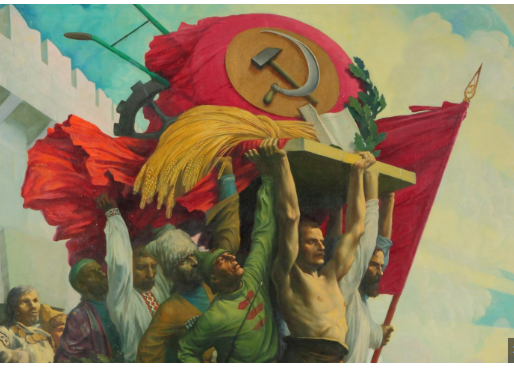
In the vast and powerful Union of Soviet Socialist Republics (USSR), information was not merely a tool for communication; it was a weapon, a building material, and a currency, all tightly controlled by the state. For over seven decades, the Communist Party of the Soviet Union orchestrated one of the most comprehensive systems of information control ever devised. This was not just about hiding the truth; it was about creating a new one. The goal was to forge the “New Soviet Man,” a citizen whose thoughts, beliefs, and very perception of reality aligned perfectly with the Party’s ideology. To achieve this, the state had to become the sole gatekeeper of knowledge, deciding what its citizens would see, hear, and read. From the ink in the printing presses to the signals in the radio waves, every medium was a front in the ideological war. Understanding the methods of this control is to understand the very nature of the Soviet state and the daily reality for millions of its people. We will explore the ten principal ways the Soviet Union mastered the art of shaping minds and manufacturing consent.
1. The All-Encompassing Power of Glavlit
Imagine a single, all-powerful editor for an entire nation. That, in essence, was Glavlit. Established in 1922, the Main Administration for Literary and Publishing Affairs was the central nervous system of Soviet censorship. Its official mandate was to safeguard state secrets, but its real function was far broader: to ensure that nothing was published—no book, no newspaper article, no theatrical play, not even a postage stamp or a vodka bottle label—that contradicted the Communist Party line. Glavlit’s censors were embedded in every publishing house and media organization. Before any piece of writing could reach the public, it had to pass their meticulous inspection. They would check for ideological deviations, anti-Soviet sentiment, “bourgeois” tendencies, or anything that might cast doubt on the wisdom of the Party. This pre-publication censorship was incredibly effective. It meant that dissent was not just punished after the fact; it was strangled in its cradle. Authors and journalists learned to self-censor, anticipating what the Glavlit official would strike out, leading to a culture of conformity and cautious prose. Glavlit was the ultimate gatekeeper, ensuring that the only information landscape available to the public was the one the state had meticulously cultivated.
2. State Monopoly on All Media Outlets
In the Soviet Union, there was no such thing as a privately owned newspaper, television station, or radio broadcaster. Every single media outlet was an organ of the state. The most important national newspapers, Pravda (“Truth”) and Izvestia (“News”), were the official voices of the Communist Party and the Soviet government, respectively. This state monopoly created a perfect echo chamber. The news on television, the articles in the paper, and the reports on the radio all presented the same synchronized message, reinforcing the Party’s narrative of progress, prosperity, and capitalist decay. There were no alternative perspectives or opposition voices to challenge the official version of events. If the state announced a record-breaking grain harvest (even amidst a famine), every media outlet reported a record-breaking grain harvest. This monolithic control over the means of production for information made it incredibly difficult for citizens to access alternative viewpoints. The official narrative wasn’t just one version of the truth; for most people, it was the only version they ever encountered, turning the media from a watchdog into a loyal lapdog of the state.
3. The Cult of Personality and Historical Revisionism
A key function of Soviet information control was not just to manage the present but to rewrite the past. History was treated like clay, to be molded to serve the current needs of the Party. This was most evident in the creation of cults of personality, particularly around leaders like Vladimir Lenin and Joseph Stalin. They were portrayed as infallible, god-like figures, their genius guiding every success of the Soviet state. To maintain this image, history had to be constantly edited. Political figures who fell out of favor with the regime, like Leon Trotsky, were literally erased from the historical record. They were airbrushed out of official photographs, their writings were banned, and their contributions to the revolution were either ignored or villainized. This process of damnatio memoriae (condemnation of memory) meant that the Soviet past was a fluid concept. Textbooks were frequently updated to reflect the new political realities, ensuring that each generation learned a version of history that glorified the current leadership and justified their policies. This manipulation created a disorienting reality where even documented facts could disappear overnight, replaced by a more politically convenient truth.
4. The Iron Curtain and Jamming Foreign Broadcasts
The Soviet Union worked tirelessly to isolate its citizens from the outside world, creating a barrier that Winston Churchill famously dubbed the “Iron Curtain.” This wasn’t just a physical barrier of fences and walls; it was an electronic one as well. Recognizing the threat posed by foreign information, the state invested enormous resources into “jamming” Western radio broadcasts. Stations like the BBC World Service, Voice of America (VOA), and Radio Free Europe/Radio Liberty, which transmitted news and programming in Russian and other Soviet languages, were considered sources of ideological contamination. The USSR built a massive network of transmitters across its territory designed to broadcast noise on the same frequencies as these foreign stations, making them difficult or impossible to listen to. This electronic warfare was a clear admission that the state’s narrative was fragile and could not withstand exposure to alternative ideas and uncensored news about world events. For Soviet citizens, trying to tune into a Western broadcast often meant a frustrating search through a wall of static, a stark auditory symbol of their isolation.
5. The Control of Arts and Culture Through Socialist Realism
Information control extended deep into the realm of arts and culture. The state mandated a single, official artistic style: Socialist Realism. Its purpose was not artistic expression but political indoctrination. All art—be it painting, literature, film, or music—was expected to be realistic in form and socialist in content. In practice, this meant depicting a sanitized, idealized version of Soviet life. Paintings showed happy, heroic workers building a utopian future. Novels told stories of dedicated communists triumphing over saboteurs. Films celebrated the wisdom of the Party and the successes of the five-year plans. Any art that was deemed too “formalist” (abstract), pessimistic, or experimental was condemned as decadent and bourgeois. Artists who strayed from the strict guidelines of Socialist Realism faced censorship, public denunciation, and in the darkest times, arrest and execution. This turned artists from creators into state employees, their imaginations shackled to the task of producing propaganda and reinforcing the official myth of the Soviet paradise.
6. The Spoken Word: Agitprop and Political Education
The Communist Party understood that controlling information required more than just censoring print media; it meant actively shaping public discourse at the grassroots level. This was the role of “agitprop”—agitation and propaganda. The Party trained and deployed a vast army of agitators and lecturers whose job was to travel to factories, farms, and community centers to deliver the official Party line in person. They would explain new government policies, denounce foreign enemies, and lead mandatory political education sessions, known as the politgramota. These sessions ensured that even citizens with limited literacy were exposed to the state’s ideology. This system of oral propaganda personalized the state’s message, making it feel immediate and communal. It was a way of preempting rumors and ensuring that the government’s interpretation of events was the first and most forceful one people heard. This network of direct, state-controlled communication was a vital tool for mobilizing the population and maintaining ideological conformity across the vast and diverse Soviet empire.
7. The Power of Libraries and the Spetskhran
Even libraries, typically seen as gateways to knowledge, were transformed into instruments of control. Soviet libraries were carefully curated to promote communist ideology. The books available on the open shelves were overwhelmingly political in nature, consisting of the works of Marx, Engels, Lenin, and contemporary Party leaders, alongside approved literature that followed the Socialist Realism model. However, the most sensitive materials—banned books, foreign publications, old academic journals, and texts by political enemies—were not destroyed but locked away in special closed-access collections known as the spetskhran (special storage department). Access to the spetskhran was severely restricted and required special permission, usually granted only to trusted academics or high-ranking officials for specific research purposes. This system effectively created two tiers of knowledge: a limited, sanitized version for the masses and a hidden, more complete version for the trusted elite. It ensured that potentially subversive ideas were kept under lock and key, accessible only to those deemed ideologically reliable enough to handle them without being corrupted.
8. Restricting Access to Technology and Information Tools
The state was deeply suspicious of any technology that could facilitate the uncontrolled creation and dissemination of information. Tools that we take for granted today were subject to strict regulation. Access to photocopiers and printing presses was tightly controlled, with organizations needing to account for every single copy made to prevent the illicit production of unapproved materials. Even the typewriter was seen as a potential threat. Each typewriter was registered with the KGB, and a sample of its typeface was kept on file, allowing the secret police to trace the origin of any unauthorized typed documents, such as samizdat literature. This “ballistic” tracking of typewriters made anonymous dissent a risky endeavor. By limiting access to the basic tools of reproduction, the state created a significant practical barrier to the spread of alternative information. It ensured that the means of mass communication remained firmly and exclusively in the hands of the Party.
9. The Role of the Secret Police (KGB)
The ultimate enforcer of information control was the pervasive and feared secret police, known by various acronyms over the years but most famously as the KGB. The KGB’s role went far beyond traditional espionage; it was the guardian of ideological purity. Its vast network of informants, estimated to include millions of citizens, monitored society for any signs of dissent or “anti-Soviet agitation.” Telling a political joke, possessing a banned book, or listening to a foreign radio station could lead to a visit from the KGB, interrogation, and potentially a long sentence in the Gulag. This created a powerful “psychology of surveillance,” where people became afraid to speak their minds even in private conversations, for fear that a friend, neighbor, or colleague might be an informant. The threat of the KGB was the iron fist inside the velvet glove of propaganda. It ensured that even if a person managed to access forbidden information, the risk of sharing it was often too great to contemplate, effectively atomizing dissent and enforcing conformity through fear.
10. The Samizdat and Tamizdat Counter-Narratives
Despite the state’s monolithic control, human ingenuity and the desire for truth could not be completely extinguished. The most significant challenge to the Soviet information monopoly came from samizdat, which translates to “self-published.” This was the clandestine practice of copying and circulating banned literature by hand or on a typewriter. Readers would be given a manuscript, often for just a single night, to re-type several copies before passing them on, creating a slow but resilient chain of distribution. Samizdat included everything from forbidden poetry and political essays to human rights reports. A related phenomenon was tamizdat (“published over there”), which involved smuggling manuscripts abroad for publication and then smuggling the printed books back into the USSR. Works by authors like Aleksandr Solzhenitsyn, most famously The Gulag Archipelago, reached a Soviet audience through these illicit channels. While the readership of these materials was small compared to the reach of state media, they were a vital lifeline for the dissident movement, proving that even in the most tightly controlled system, information could, and would, find a way to be free.
Further Reading
For those who wish to delve deeper into the mechanics of Soviet society and its control over information, these books provide compelling and accessible accounts:
- “The Gulag Archipelago” by Aleksandr Solzhenitsyn
- “The Whisperers: Private Life in Stalin’s Russia” by Orlando Figes
- “Everything Was Forever, Until It Was No More: The Last Soviet Generation” by Alexei Yurchak
- “The Red Flag: A History of Communism” by David Priestland
- “Armageddon Averted: The Soviet Collapse, 1970-2000” by Stephen Kotkin
Here at Zentara.blog, our mission is to take those tricky subjects and unlock them, making knowledge exciting and easy to grasp for everyone. But the adventure doesn’t stop on this page! We’re constantly exploring new frontiers and sharing discoveries across the digital universe. Want to dive deeper into more mind-bending Top 10s and keep expanding your world? Come join us on our other platforms – we’ve got unique experiences waiting for you on each one!
Get inspired by visual wonders and bite-sized facts: See the world through Zentara’s eyes on Pinterest!
Pin our fascinating facts and stunning visuals to your own boards. Explore Pins on Pinterest: https://uk.pinterest.com/zentarablog/
Discover quick insights and behind-the-scenes peeks: Hop over to Tumblr for snippets, quotes, and unique content you won’t find anywhere else. It’s a different flavour of discovery! Follow the Fun on Tumblr: https://www.tumblr.com/zentarablog
Ready for deep dives you can listen to or watch? We’re bringing our accessible approach to video and potentially audio! Subscribe to our YouTube channel and tune into future projects that make learning pop! Subscribe on YouTube: https://www.youtube.com/@ZentaraUK
Seeking even more knowledge in one place? We’ve compiled some of our most popular topic deep dives into fantastic ebooks! Find them on Amazon and keep the learning journey going anytime, anywhere. Find Our Ebooks on Amazon: https://www.amazon.co.uk/s?k=Zentara+UK&ref=nb_sb_noss
Connect with us and fellow knowledge seekers: Join the conversation on BlueSky! We’re sharing updates, thoughts, and maybe even asking you what wonders we should explore next. Chat with Us on BlueSky: https://bsky.app/profile/zentarablog.bsky.social
Perfect for learning on the move! We post multiple 10-minute podcasts per day on Spotify. Pop on your headphones and fill your day with fascinating facts while you’re out and about! Listen on Spotify: https://open.spotify.com/show/3dmHbKeDufRx95xPYIqKhJFollow us on Instagram for bytesize knowledge! We post multiple posts per day on our official Instagram account. https://www.instagram.com/zentarablog/ Every click helps us keep bringing honest, accessible knowledge to everyone. Thanks for exploring with us today – see you out there in the world of discovery!




Leave a Reply