
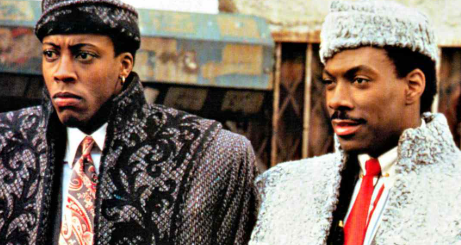
In the summer of 1988, at the absolute zenith of his comedic powers, Eddie Murphy gifted the world a film that was part fairy tale, part fish-out-of-water comedy, and all heart. Coming to America tells the story of Prince Akeem Joffer of Zamunda, a benevolent and fabulously wealthy heir who rejects an arranged marriage to travel to the one place he believes he can find his true queen: Queens, New York.
Decades later, the film isn’t just a nostalgic 80s classic; it’s an enduringly quotable and beloved cultural touchstone. Its genius lies in the perfect blend of a sweet, romantic storyline and the wildly inventive character comedy of Eddie Murphy and his comedic partner-in-crime, Arsenio Hall. But behind the iconic jokes, the McDowell’s golden arcs, and the mic-dropping performances of Randy Watson, lies a treasure trove of fascinating and hilarious stories. From near-lawsuits to legendary on-set feuds and makeup magic that fooled everyone, the making of Coming to America is almost as funny as the film itself. These ten facts reveal the incredible creativity and chaos that went into crafting a comedy masterpiece.
1. The Barbershop Boys Were Almost All Eddie and Arsenio in Disguise
The scenes in the My-T-Sharp barbershop are legendary, a masterclass in comedic timing and character work. The rapid-fire banter between the barbers—Clarence, the opinionated owner; Morris, the elderly Jewish man; and Sweets, the easy-going checker player—feels incredibly authentic. The hilarious secret is that you’re mostly watching Eddie Murphy and Arsenio Hall argue with themselves. In an incredible display of versatility, Eddie Murphy plays both the fast-talking Clarence and the ancient, rambling Saul. Not to be outdone, Arsenio Hall plays the cheerful Sweets, the over-the-top Reverend Brown, and another barber.
This was all made possible by the genius of veteran monster-maker and makeup artist Rick Baker, who earned an Oscar nomination for his work. He spent weeks developing the prosthetics that would transform the two young comedians into a host of different characters. The process was gruelling, with the actors spending up to five hours in the makeup chair each day. The effect was so convincing that many audience members had no idea they were watching the film’s two leads. It’s a testament to both the actors’ talent and Baker’s artistry that they could disappear so completely into these beloved, hilarious characters.
2. The McDowell’s Miracle: How “The Big Mick” Dodged a Lawsuit
One of the film’s most brilliant running gags is McDowell’s, the fast-food restaurant where Akeem finds work and love. It is a shameless, yet fiercely proud, ripoff of McDonald’s. “They got the Golden Arches, mine is the Golden Arcs. They got the Big Mac, I got the Big Mick.” This parody was a comedic tightrope walk, as Paramount Pictures was terrified of being sued by the very real and very litigious McDonald’s Corporation.
To pull it off, the filmmakers had to get permission from McDonald’s. Their legal team approved the parody on one condition: the film had to be a clear and obvious spoof, never passing itself off as the real thing. Director John Landis took this to heart, ensuring every detail was just different enough. The uniforms are similar but not identical, the logos are a letter off, and the menu items are comically derivative. This legal necessity is what makes the joke so perfect. Cleo McDowell’s passionate defence of his restaurant’s originality in the face of overwhelming evidence is a masterclass in comedic denial, all born from a studio’s very real fear of a lawsuit.
3. The “Trading Places” Connection: A Secret Crossover Cameo
Before Coming to America, Eddie Murphy and director John Landis had a massive hit with the 1983 comedy Trading Places, which starred Murphy as a street hustler who swaps lives with a wealthy commodities broker played by Dan Aykroyd. In that film, the main antagonists are the villainous, super-rich Duke brothers, Randolph and Mortimer, who orchestrate the life-swap for a one-dollar bet.
Landis decided to create a secret crossover between the two films. In one scene in Coming to America, Prince Akeem, feeling generous, gives a large wad of cash to two homeless men on the street. Those men are none other than Randolph and Mortimer Duke, played once again by Ralph Bellamy and Don Ameche. The implication is that after being bankrupted by Murphy’s character at the end of Trading Places, they lost everything and ended up on the streets. When Akeem hands them the money, Randolph triumphantly tells his brother, “Mortimer, we’re back!” It’s a hilarious Easter egg that rewards eagle-eyed fans and unofficially places two of Eddie Murphy’s greatest comedies in the same cinematic universe.
4. Randy Watson’s Legacy: That Boy Is Good!
The performance of Randy Watson and his band, Sexual Chocolate, at the Black Awareness Rally is one of the most cringe-inducingly funny scenes in comedy history. Randy’s off-key, soul-crushing rendition of “The Greatest Love of All” is a work of comedic genius. Watson, of course, is another character played by Eddie Murphy in heavy prosthetics, showcasing his incredible ability to create a fully realised, hilariously pathetic persona in just a few minutes of screen time.
The character was reportedly inspired by the opening acts Eddie Murphy would see while he was on tour as a stand-up comedian. He was fascinated by the unwavering, and often completely misplaced, confidence of local singers who would perform with all the passion in the world but none of the talent. The name “Sexual Chocolate” itself has become a legendary part of pop culture. The scene is made even funnier by the barbers from My-T-Sharp being in the audience, with Clarence loudly declaring, “That boy’s good!” and Morris agreeing, “Mm-hmm, good and terrible!” It’s a perfect encapsulation of the film’s character-driven humour.
5. A Royal Feud: The On-Set Tension Between Murphy and Landis
While the final film is a joyful and lighthearted classic, the production was famously tense. Eddie Murphy and director John Landis, who had worked so well together on Trading Places, clashed frequently on the set of Coming to America. Murphy, now a global superstar and the film’s co-creator, wanted more creative control, while Landis was an established and famously assertive director. Their personalities collided, leading to reports of screaming matches and a generally frosty atmosphere.
Arsenio Hall later described the situation as two bulls in a pen, with both men at the peak of their success and unwilling to back down. Landis felt Murphy was often sullen and difficult, while Murphy felt Landis was dismissive of his ideas. The feud became so legendary in Hollywood that it took nearly 30 years for the two to finally reconcile and admit their shared fault. The fact that they managed to create such a funny and cohesive film in the midst of this tension is a testament to their underlying professional talent, even if their personal relationship was at rock bottom.
6. A Future Oscar Winner’s Hidden Debut
Every star has to start somewhere, and for Academy Award winner Cuba Gooding Jr., that start was in the My-T-Sharp barbershop. In his very first feature film role, a then-unknown Gooding Jr. plays the boy getting his hair cut in the barber chair while Clarence and the gang argue. Listed in the credits simply as “Boy Getting Haircut,” he has no lines, but his amused reactions to the barbers’ wild debate are a memorable part of the scene.
It’s a classic “blink and you’ll miss it” debut. Gooding Jr. himself has spoken about the experience with fondness, recalling his awe at being on set with his idol, Eddie Murphy. He was so nervous and excited that he just focused on doing what he was told and not messing up. Watching the scene now is a fun piece of movie archaeology, seeing a future star at the very beginning of his journey, sitting quietly in the middle of a scene that would become an iconic part of comedy history. He had a front-row seat to comedic genius, and just a few years later, he’d be a household name himself.
7. The MPAA Battle: “The Royal Penis Is Clean”
The film’s PG-13 rating (changed to a 15 in the UK) was secured after a hilarious battle with the Motion Picture Association of America (MPAA) ratings board. The censors were particularly concerned about the scene where a group of female bathers proclaims, “The royal penis is clean, your highness!” They insisted the line was too suggestive and demanded it be cut for the film to avoid a more restrictive R rating.
Director John Landis, known for his rebellious streak, decided to fight back with comedic logic. He argued that the word “penis” was a proper, clinical anatomical term, not a swear word. He reportedly told the board, “It’s the name of the organ. If you want me to say ‘The royal dick is clean,’ I can do that, but I think ‘penis’ is better.” He also pointed out that the scene was completely non-sexual and played for absurdity. After much debate, Landis won his case, and the iconic, hilariously formal line remained in the film, becoming one of its most quoted phrases.
8. The Original, Downbeat Ending Was Scrapped
The fairy-tale ending we all know and love—where Lisa discovers Akeem is a prince and surprises him by coming to Zamunda for a royal wedding—was not the original plan. The first version of the ending was much more cynical and less satisfying. In the original cut, Lisa, angry at Akeem for lying about his identity, refuses to see him and stays in Queens. Akeem’s father, King Jaffe Joffer, then essentially bribes Lisa’s father, Cleo McDowell, to force her into the marriage.
When this version was shown to test audiences, they hated it. They felt it betrayed the sweet, romantic core of the story and made Lisa’s character seem like she was only in it for the money. The studio and filmmakers listened to the feedback and spent a significant amount of money to re-shoot the entire wedding sequence. They flew the main cast back to soundstages to create the heartwarming finale where Lisa makes her own choice to follow Akeem. It was a classic case of test audiences saving a film from itself and ensuring the story had the perfect happily-ever-after moment.
9. Arsenio Hall’s Most Unflattering Role
Arsenio Hall’s multi-character performance is one of the film’s highlights, but one of his roles is so well-disguised that many people still don’t know it’s him. In the nightclub scene where Akeem and Semmi are searching for a queen, they encounter a series of unsuitable women. One particularly enthusiastic but unattractive woman approaches Semmi at the bar and propositions him. That character, credited as “Extremely Ugly Girl,” is played by Arsenio Hall himself in drag.
The makeup, again by Rick Baker, is a masterpiece of comedic ugliness. It was apparently a running gag on set, with Hall staying in character and playfully harassing the crew between takes. It’s another example of the sheer joy the two leads took in disappearing into the most ridiculous characters they could imagine. Hall’s commitment to the bit is what makes it so funny; he doesn’t just wear the makeup, he embodies the character’s slightly desperate and overly forward personality, making Semmi’s horrified reaction even more hilarious.
10. The Plagiarism Lawsuit That Mirrored the Film’s Plot
In a case of life imitating art, the film’s success led to a major plagiarism lawsuit that was almost as dramatic as a Hollywood movie. Humorist Art Buchwald sued Paramount Pictures, claiming the story of Coming to America was based on a screen treatment he had submitted to the studio years earlier called “King for a Day.” Buchwald’s story was about a deposed African king who travels to America and ends up living in a Washington, D.C. ghetto.
The legal battle was long and complex. Ultimately, the court sided with Buchwald, ruling that Paramount had indeed based the film on his concept. However, due to Hollywood’s notoriously creative accounting practices, the studio claimed that despite grossing nearly $300 million, the blockbuster film had somehow not made a net profit, meaning Buchwald was initially owed nothing. The case became a landmark moment in Hollywood, exposing the opaque financial structures of major studios. It’s a fascinating, ironic postscript to a film about a ridiculously wealthy prince trying to live a simple life.
Further Reading
For those who want to dive deeper into the golden age of 80s comedy and the career of its biggest star, these books are fantastic resources:
- “Eddie Murphy: The Life and Times of a Comic Icon” by Frank Sanello (A biography covering the incredible rise of Murphy from stand-up to global superstar.)
- “Wild and Crazy Guys: How the Comedy Mavericks of the ’80s Changed Hollywood Forever” by Nick de Semlyen (Places Murphy and films like Coming to America in the context of the larger 80s comedy boom.)
- “John Landis: Conversations with the Filmmakers Series” by Giulia D’Agnolo Vallan (A collection of interviews with the director, shedding light on his career and filmmaking process.)
- “Rick Baker: Metamorphosis” by J.W. Rinzler (A massive, two-volume book showcasing the incredible life’s work of the makeup genius behind the film’s characters.)
Here at Zentara.blog, our mission is to take those tricky subjects and unlock them, making knowledge exciting and easy to grasp for everyone. But the adventure doesn’t stop on this page! We’re constantly exploring new frontiers and sharing discoveries across the digital universe. Want to dive deeper into more mind-bending Top 10s and keep expanding your world? Come join us on our other platforms – we’ve got unique experiences waiting for you on each one!
Get inspired by visual wonders and bite-sized facts: See the world through Zentara’s eyes on Pinterest!
Pin our fascinating facts and stunning visuals to your own boards. Explore Pins on Pinterest: https://uk.pinterest.com/zentarablog/
Discover quick insights and behind-the-scenes peeks: Hop over to Tumblr for snippets, quotes, and unique content you won’t find anywhere else. It’s a different flavour of discovery! Follow the Fun on Tumblr: https://www.tumblr.com/zentarablog
Ready for deep dives you can listen to or watch? We’re bringing our accessible approach to video and potentially audio! Subscribe to our YouTube channel and tune into future projects that make learning pop! Subscribe on YouTube: https://www.youtube.com/@ZentaraUK
Seeking even more knowledge in one place? We’ve compiled some of our most popular topic deep dives into fantastic ebooks! Find them on Amazon and keep the learning journey going anytime, anywhere. Find Our Ebooks on Amazon: https://www.amazon.co.uk/s?k=Zentara+UK&ref=nb_sb_noss
Connect with us and fellow knowledge seekers: Join the conversation on BlueSky! We’re sharing updates, thoughts, and maybe even asking you what wonders we should explore next. Chat with Us on BlueSky: https://bsky.app/profile/zentarablog.bsky.social
Perfect for learning on the move! We post multiple 10-minute podcasts per day on Spotify. Pop on your headphones and fill your day with fascinating facts while you’re out and about! Listen on Spotify: https://open.spotify.com/show/3dmHbKeDufRx95xPYIqKhJFollow us on Instagram for bytesize knowledge! We post multiple posts per day on our official Instagram account. https://www.instagram.com/zentarablog/ Every click helps us keep bringing honest, accessible knowledge to everyone. Thanks for exploring with us today – see you out there in the world of discovery!




Leave a Reply