
Table of Contents
We are a species of builders. We defy gravity with skyscrapers, we tame rivers with dams, and we slip the bonds of Earth with rockets. Engineering is humanity’s superpower, the practical application of science that has built our modern world. But for every triumphant success, there is a shadow—a failure, a collapse, a disaster.
These failures are not just tragedies; they are our most profound and costly lessons. We build, we fail, and if we are wise, we learn. The bridges that stand today are stronger because of the ones that fell. The planes that fly today are safer because of the ones that were lost.
This is not a story of steel and concrete, but of human beings—of hubris, of miscalculation, of groupthink, and of the slow, painful, but essential-learning process that defines engineering. We are going to explore ten of these teachers, the disasters that became the unwritten, blood-red ink in the margins of our textbooks.
1. The Vasa (1628): The Ship That Was Too Proud to Sail
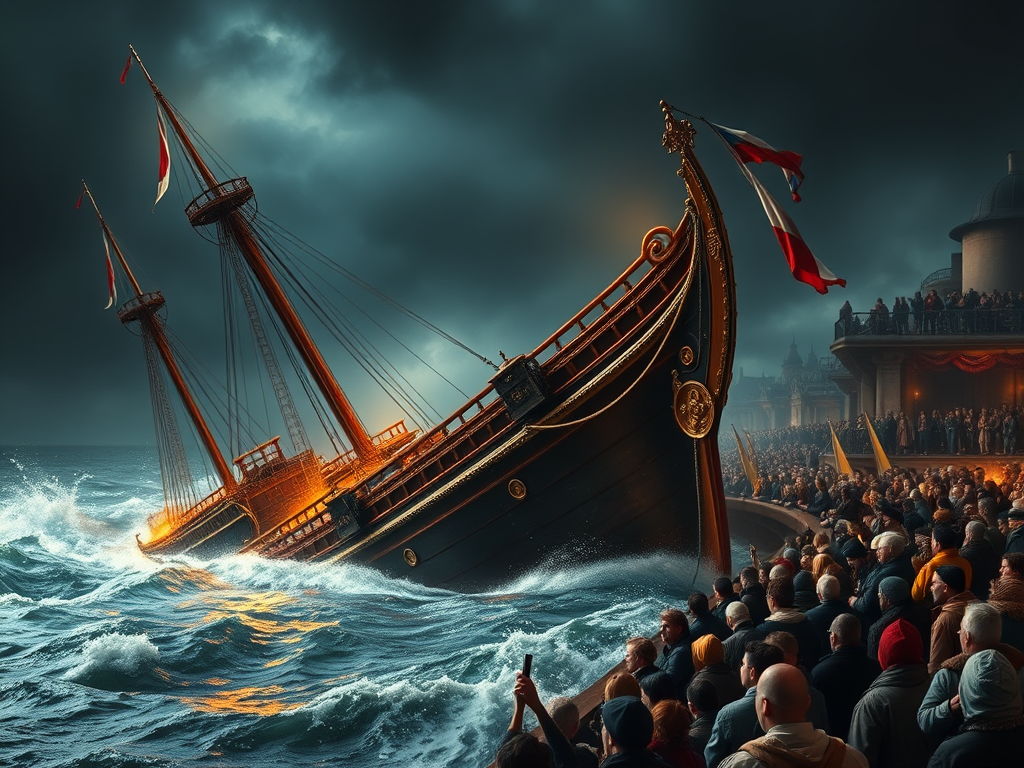
The Disaster: On its maiden voyage, the Vasa, the most powerful warship in the Swedish fleet, sailed less than a mile from the dock. A light gust of wind hit, it tipped over, and it sank in full view of the horrified crowds. Why? The king, Gustavus Adolphus, had insisted on adding a second full cannon deck, against the advice of his builders.
The Lesson: Ignoring Physics for “Features” (Scope Creep) The Vasa is the 17th-century equivalent of a “feature creep.” The ship was simply too top-heavy. The builders knew it was unstable, but you don’t say no to a king. The ship’s center of gravity was so high that a stiff breeze was all it took to capsize it. It’s a simple, brutal physics lesson: you can’t just keep adding features (more cannons, a bigger processor, a new software module) and expect the original design to cope. The Vasa teaches us that the laws of physics are not negotiable, and sometimes the most important part of engineering is the courage to say, “No, that won’t work.”
2. The Quebec Bridge (1907 & 1916): The Disaster of Unchecked Scaling
The Disaster: Designed to be the longest cantilever bridge in the world, the Quebec Bridge collapsed not once, but twice during construction, killing 88 people. The first collapse (1907) was due to a simple, catastrophic miscalculation.
The Lesson: You Can’t Just “Scale Up” a Design The chief engineer, Theodore Cooper, was a legend. He was also working from New York, not on-site, and he based his plans on “proven” designs. But the forces acting on a 1,800-foot span are not the same as those on an 800-foot span; they are exponentially greater. His calculations for the bridge’s own weight were off, and as the steelwork extended out, the compression members (the “legs” holding it up) buckled. The disaster wrote the textbooks on load calculations, created the Canadian tradition of the “Iron Ring” (a ring worn by engineers to remind them of their ethical duty), and taught us that what works on a small scale cannot simply be “made bigger” without entirely new, more rigorous calculations.
3. The RMS Titanic (1912): The Unsinkable System That Wasn’t
The Disaster: The most famous maritime disaster in history. The “unsinkable” Titanic struck an iceberg and sank in the North Atlantic, with a catastrophic loss of life.
The Lesson: Hubris and Material Failures We all know the lesson about the lifeboats—a story of pure hubris. But the engineering lesson is in the steel. It wasn’t just a gash; the iceberg’s impact caused the ship’s steel plates to crack like glass. Modern analysis shows the steel was high in sulfur, which makes it extremely brittle in near-freezing water. Furthermore, the 16 “watertight” compartments were a flawed system; they were open at the top, like an ice-cube tray. As the first few compartments filled, the water simply spilled over the top into the next, and the next. The Titanic’s failure led to the creation of SOLAS (Safety of Life at Sea), which still governs maritime safety, and forced engineers to realize that materials behave differently in the real, cold, and unforgiving world.
4. The St. Francis Dam (1928): When You Build on a Fatal Flaw
The Disaster: A massive concrete gravity dam, the personal masterpiece of legendary engineer William Mulholland, collapsed just 12 hours after he inspected it, releasing a 12-billion-gallon wall of water that killed nearly 450 people.
The Lesson: Geology Is More Important Than Concrete Mulholland was a brilliant water engineer, but he was not a geologist. He built his dam on a foundation that was, quite literally, a disaster waiting to happen. One side of the dam was anchored into a rock (schist) that was unstable. The other side was anchored into a known, ancient landslide formation that turned back into mud when it got wet. The water pressure from the dam didn’t just push the dam over; it liquefied the very ground it was standing on. It was a 100% avoidable failure. The St. Francis disaster forced the entire field of civil engineering to treat geology and “site investigation” as a primary, non-negotiable step.
5. The Tacoma Narrows Bridge (1940): “Galloping Gertie” and the Wind
The Disaster: A new, sleek, and elegant suspension bridge in Washington state, “Galloping Gertie” famously began to twist and ripple in a 40-mph wind before tearing itself apart, an event captured on stunning film.
The Lesson: The Unseen Power of Aerodynamic Forces Engineers had always built bridges to fight gravity (a static vertical load). But “Gertie” was the first long, narrow, and “light” bridge. Its deck was like a flat ribbon. The wind didn’t just push against it; it flowed over and under it, creating a phenomenon called “aeroelastic flutter.” This was an unstable, self-reinforcing feedback loop: the wind would lift the deck, which would cause it to twist, which would then “catch” the wind at a new angle, making it twist even more. The bridge’s own natural frequency (like a guitar string) was its undoing. After this, all major bridges are “wind-tunnel tested” as models, a lesson we learned from Gertie.
6. The De Havilland Comet (1954): The Dangers of a Square Window
The Disaster: The Comet was the world’s first commercial jetliner, a symbol of a new age. But in 1954, two of them disintegrated in mid-air at high altitude.
The Lesson: Metal Fatigue and Stress Concentration After recovering the wreckage, investigators found the answer. The Comet’s cabin was pressurized, like a soda can. With every flight, the fuselage “flexed” outward at 30,000 feet and relaxed when it landed. The problem? The Comet had square windows. These sharp 90-degree corners became focal points for all that repeated stress, creating invisible, microscopic cracks. This is metal fatigue. After a few thousand cycles, that tiny crack would, in an instant, rip the entire plane apart. The Comet disaster was a brutal lesson in stress concentration, and it’s the reason every single window you see on an airplane today is a soft, rounded oval.
7. The Hyatt Regency Walkway (1981): The Lethal Cost of a “Simple” Change
The Disaster: During a packed dance party in the hotel’s lobby, two “floating” walkways suspended from the ceiling collapsed, one onto the other, killing 114 people. It remains the deadliest structural failure in U.S. history.
The Lesson: Communication and Professional Responsibility This wasn’t a complex physics problem; it was a human communication failure. The original design for the walkway supports was (barely) safe. But the steel fabricator, finding the design difficult to build, proposed a “simple” change. The new design, which the engineers on record failed to review, doubled the load on a crucial nut and washer. The connection was now holding up the weight it was designed for… twice. It was a 100% preventable failure caused by a “simple” change that no one double-checked. This disaster redefined engineering ethics and professional responsibility, making it clear that an engineer’s stamp on a drawing is a life-or-death promise.
8. The Challenger Shuttle (1986): The Failure to Listen
The Disaster: Seventy-three seconds after launch, on a cold Florida morning, the Space Shuttle Challenger exploded, killing all seven astronauts on board.
The Lesson: “Go Fever” and the Danger of Groupthink The technical cause was a simple, low-tech part: a rubber O-ring in the solid rocket booster. The launch was the coldest on record, and the cold had made the rubber rings stiff and brittle. They failed to seal their joint, allowing hot gas to escape, which burned through the main fuel tank. The real disaster, however, was in the boardroom. The engineers at Morton Thiokol, who made the O-rings, knew it was too cold. They warned NASA. They begged them not to launch. But NASA, under intense pressure to maintain its launch schedule (“Go Fever”), refused to listen to its own experts. This is the ultimate lesson in groupthink—when the desire for consensus in a group overrules the cold, hard, life-saving data.
9. The Chernobyl Disaster (1986): The Catastrophe of Flawed Design and No Safety Culture
The Disaster: A poorly-designed “safety test” at a nuclear power plant in Ukraine led to a catastrophic reactor explosion and meltdown, releasing a plume of radioactive fallout across Europe.
The Lesson: The Primacy of Safety Culture Chernobyl was a perfect storm of failure. First was the RBMK reactor, a Soviet design with a fatal flaw: at low power, it was inherently unstable. Second was the safety culture, which was a culture of secrecy, politics, and lies. The operators, who were untrained for the test they were running, made a series of mistakes that drove the reactor into its most unstable state. When they hit the “shutdown” button, that same design flaw caused a massive, final power surge. Chernobyl is the ultimate example that a technology (especially nuclear power) is only as safe as the culture that operates it. A system that punishes bad news and ignores safety protocols is a system that is doomed.
10. The Columbia Shuttle (2003): The Normalization of Deviance
The Disaster: Seventeen years after Challenger, the Space Shuttle Columbia broke apart upon re-entry, killing all seven astronauts. The cause was a piece of insulating foam that broke off during launch, striking the wing and punching a hole in the heat shield.
The Lesson: The “Normalization of Deviance” This is perhaps the most subtle and terrifying lesson of all. NASA knew foam was breaking off. It had happened on dozens of previous flights, striking the shuttle with no “fatal” consequences. Over time, a problem that was once a critical danger (“foam shouldn’t hit the shuttle!”) was slowly, unconsciously re-classified as a “maintenance issue” and an “acceptable risk.” This is the normalization of deviance—what happens when you see a problem so many times that you stop seeing it as a problem. It’s a warning against complacency, the slow, deadly creep of “it’s always been fine before.”
Conclusion
These ten stories are tragedies, written in steel and stone and fire. But they are also the foundation of our modern, safer world. Every engineering blueprint today has the ghosts of these failures looking over the designer’s shoulder, asking the hard questions: Did you check the geology? Did you account for the wind? What happens when this gets cold? Did you review the fabricator’s changes?
Engineering is not just about success; it is about a profound, almost religious humility in the face of physics, nature, and human error. The greatest lesson of all is that the moment we believe we are infallible, the moment we say “it’s unsinkable,” we are guaranteeing that, one day, we will be proven wrong.
Further Reading
For those who want to dive deeper into the fascinating, and often sobering, world of engineering and failure:
- To Engineer Is Human: The Role of Failure in Successful Design by Henry Petroski.
- The absolute classic on this topic. A must-read for understanding that engineering is a story of learning from failure.
- Why Buildings Fall Down: How Structures Fail by Matthys Levy & Mario Salvadori.
- A fantastic, accessible look at the physics and case studies behind structural failure, from the Parthenon to the Hyatt Regency.
- Command and Control: Nuclear Weapons, the Damascus Accident, and the Illusion of Safety by Eric Schlosser.
- A terrifyingly brilliant look at the “illusion of safety” and “normalization of deviance” within the world of nuclear weapons.
- The Truth About the Titanic: A Survivor’s Story by Archibald Gracie.
- A firsthand account from a survivor that cuts through the myths and shows the human side of this iconic disaster.
Here at Zentara.blog, our mission is to take those tricky subjects and unlock them, making knowledge exciting and easy to grasp for everyone. But the adventure doesn’t stop on this page! We’re constantly exploring new frontiers and sharing discoveries across the digital universe. Want to dive deeper into more mind-bending Top 10s and keep expanding your world? Come join us on our other platforms – we’ve got unique experiences waiting for you on each one!
Get inspired by visual wonders and bite-sized facts: See the world through Zentara’s eyes on Pinterest!
Pin our fascinating facts and stunning visuals to your own boards. Explore Pins on Pinterest: https://uk.pinterest.com/zentarablog/
Discover quick insights and behind-the-scenes peeks: Hop over to Tumblr for snippets, quotes, and unique content you won’t find anywhere else. It’s a different flavour of discovery! Follow the Fun on Tumblr: https://www.tumblr.com/zentarablog
Ready for deep dives you can listen to or watch? We’re bringing our accessible approach to video and potentially audio! Subscribe to our YouTube channel and tune into future projects that make learning pop! Subscribe on YouTube: https://wwws.youtube.com/@ZentaraUK
Seeking even more knowledge in one place? We’ve compiled some of our most popular topic deep dives into fantastic ebooks! Find them on Amazon and keep the learning journey going anytime, anywhere. Find Our Ebooks on Amazon: https://www.amazon.co.uk/s?k=Zentara+UK&ref=nb_sb_noss
Connect with us and fellow knowledge seekers: Join the conversation on BlueSky! We’re sharing updates, thoughts, and maybe even asking you what wonders we should explore next. Chat with Us on BlueSky: https://bsky.app/profile/zentarablog.bsky.social
Perfect for learning on the move! We post multiple 10-minute podcasts per day on Spotify. Pop on your headphones and fill your day with fascinating facts while you’re out and about! Listen on Spotify: https://open.spotify.com/show/3dmHbKeDufRx95xPYIqKhJFollow us on Instagram for bytesize knowledge! We post multiple posts per day on our official Instagram account. https://www.instagram.com/zentarablog/ Every click helps us keep bringing honest, accessible knowledge to everyone. Thanks for exploring with us today – see you out there in the world of discovery!




Leave a Reply