
Table of Contents
What is the most powerful sound in the universe? For millions of people across generations, it’s not a big bang or a booming voice. It’s a wheezing, groaning noise. Vworp… vworp… vworp. It’s the sound of a blue 1960s police box materializing out of thin air, a promise of adventure, danger, and the boundless wonders of time and space.
For over 60 years, the question “Doctor who?” has been the central, driving mystery of the longest-running science-fiction show in history. He (or she) is a rebel, a hero, a lonely god, and an madman in a box. But how did this quintessentially British, often wonderfully eccentric, and endlessly inventive show come to be? How did it survive cancellation, conquer the world, and regenerate its way into the 21st century?
The Doctor’s own history is shrouded in mystery, but the history of the show itself is a story as fantastic as any of his adventures. From a dusty scrapyard in 1963 to a global, high-budget phenomenon, this is the story of Doctor Who.
1. An Unearthly Child: The Scrapyard Where It All Began
On November 23, 1963—one day after the assassination of JFK—BBC Television aired the first episode of a new, low-budget “educational” serial. Titled “An Unearthly Child,” it was designed to fill the Saturday teatime slot, appealing to children and adults alike. Created by a team headed by Sydney Newman, it was brought to life by a pioneering young producer named Verity Lambert, one of television’s first female producers.
The premise was simple: two school teachers, Ian Chesterton and Barbara Wright, follow their unusually bright and “alien” student, Susan Foreman, back to her home… which turns out to be a police box in a junk-filled scrapyard. There, they meet her “grandfather,” a curmudgeonly, arrogant, and mysterious old man known only as “The Doctor.” Fearing the teachers will reveal his secret, the Doctor kidnaps them, and the TARDIS takes its first, chaotic flight. This was William Hartnell, the First Doctor. The goal was to teach history (by visiting the past) and science (by visiting the future), but it was the show’s second serial that would change television forever.
2. EXTERMINATE!: How a Pepper Pot Saved the Show
The show’s initial ratings were modest, and the “historical” episodes were not gripping audiences. The BBC considered canceling it. Then, in its second serial, the TARDIS landed on the dead planet of Skaro. There, the crew encountered a new, terrifying, and utterly alien foe: The Daleks.
Created by writer Terry Nation and designer Raymond Cusick, the Daleks were an immediate sensation. They were not “robots”; they were a race of mutated, hate-filled creatures encased in seemingly unstoppable “pepper pot” war machines. Their grating, electronic voices shouting “EXTERMINATE!” became an instant playground catchphrase.
“Dalekmania” swept the UK. Merchandise flew off the shelves, and the show’s ratings soared. The Daleks proved that the “monster-of-the-week” format was the show’s future. They were the first, and remain the most iconic, of the Doctor’s foes, and they are the single biggest reason Doctor Who survived its first year.
3. The First ‘New’ Face: The Genius of Regeneration
By 1966, the show was a massive hit, but it faced a critical problem: its star, William Hartnell, was in declining health. His health struggles made it difficult to keep up with the show’s grueling production schedule. The producers faced a choice: end the show or replace their lead actor.
They chose a third, far more brilliant option. Sydney Newman proposed a radical idea: The Doctor is an alien, so when he is old or near death, he can “renew” himself. He can change his entire body. This concept, later dubbed “regeneration,” is the key to Doctor Who’s 60-year longevity.
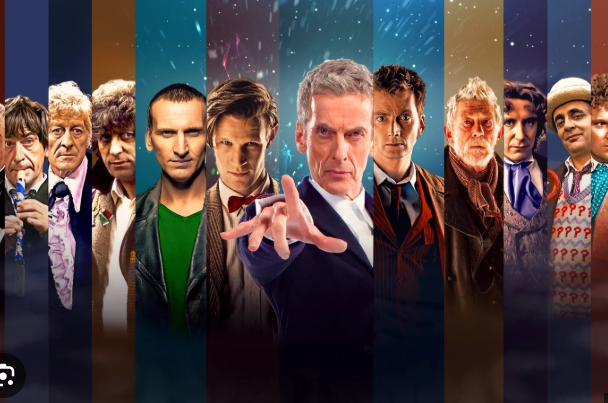
Audiences watched in shock as a dying First Doctor collapsed in the TARDIS, his face bathed in light, transforming into the younger, “cosmic hobo” form of Patrick Troughton, the Second Doctor. The character was the same, but the man was new. The show had just discovered its ultimate survival trick—it could, and would, literally reinvent itself, forever.
4. The Magic Blue Box: What Is the TARDIS?
Alongside the Doctor, the show has one other main character: the TARDIS. Standing for Time and Relative Dimension in Space, the TARDIS is the Doctor’s ship, his home, and his one true constant. It is “dimensionally transcendental,” meaning it’s “bigger on the inside”—a vast, cavernous ship housed within a small, unassuming exterior.
But why a police box? As the show’s lore explains, the TARDIS is supposed to blend in with its surroundings by using its “chameleon circuit.” However, that circuit broke when the Doctor visited 1963 London, leaving it stuck in the form of a now-obsolete police telephone box. This was a brilliant, budget-saving move by the original production team, but it created an icon. The TARDIS is also famously unreliable; it rarely takes the Doctor where he wants to go, but as the show often argues, it always takes him where he needs to go.
5. The Doctor’s Secret: Who Are the Time Lords?
For years, the Doctor was simply a mysterious “exile” on the run. But as the show’s lore deepened, we learned the truth. The Doctor is a Time Lord from the planet Gallifrey. First introduced during the Second Doctor’s era and heavily expanded upon with the Third Doctor (Jon Pertwee), the Time Lords are an ancient, powerful, and profoundly stuffy race. They are the masters of time travel, but they live by a strict, almost religious code of non-intervention.
The Doctor isn’t just any Time Lord; he’s a rebel. He grew bored with the Time Lords’ stagnant, observational-only culture. He stole an old, unreliable TARDIS and ran away to see the universe, to get involved, and to right wrongs. This backstory reframed the entire show: The Doctor isn’t just a wanderer; he’s a runaway from the most powerful society in history, a renegade who chose to make a difference.
6. The Moriarty to His Holmes: The History of The Master
Every great hero needs a great arch-rival, and the Doctor has one of the best. While the Daleks are his greatest foes, The Master is his greatest enemy. Introduced in the 1970s, The Master is the Doctor’s polar opposite: another Time Lord from Gallifrey, a brilliant (and equally mad) mind who, instead of running away to see the universe, ran away to conquer it.
The Master was the Doctor’s childhood friend, the “Moriarty to his Holmes.” This relationship adds a deep, personal, and emotional layer to their conflict. The Doctor doesn’t just want to defeat The Master; he wants to save him. Like the Doctor, The Master has regenerated many times, from the suave original (Roger Delgado) to the twisted, decaying version, and into the modern era with the chaotic energy of John Simm, the brilliant, twisted “Missy” (Michelle Gomez), and the rage-fueled Sacha Dhawan.
7. Off the Air, Not Out of Time: The ‘Wilderness Years’
Despite its heights (particularly the Fourth Doctor, Tom Baker, who became a cultural icon), Doctor Who’s ratings began to wane in the 1980s. The show faced stiff competition, budget cuts, and a changing television landscape. In 1989, after the final serial of the Seventh Doctor (Sylvester McCoy), the BBC quietly canceled the show.
For 16 years, Doctor Who was off the air. This period is known as the “Wilderness Years.” But the show never truly died. It lived on in the hearts of fans and, crucially, in other media. A series of “Virgin New Adventures” novels continued the Doctor’s story, becoming darker and more adult. Big Finish Productions began a long-running, critically acclaimed series of audio dramas, bringing back past Doctors and companions. A 1996 one-off TV movie was made in America, introducing the Eighth Doctor (Paul McGann). While it failed to launch a new series, it kept the flame alive, proving that the TARDIS was just waiting for the right pilot to bring it back.
8. “Run!”: The 2005 Revival and the Time War
That pilot was writer and lifelong fan Russell T Davies. In 2005, Davies triumphantly brought Doctor Who back to the BBC, re-imagined for a 21st-century audience. It was fast, it was funny, it was emotional, and it was a massive hit.
Starring Christopher Eccleston as the Ninth Doctor and Billie Piper as his companion Rose Tyler, the new series had a new energy. But it also had a new, dark secret: The Time War. To bridge the 16-year gap and explain the Doctor’s new, leather-jacket-clad, PTSD-fueled personality, Davies invented a devastating, off-screen war. The Time Lords and the Daleks had fought a war that consumed all of time and space, and the Doctor had been forced to end it by destroying everyone—including his own people. This made him “The Last of the Time Lords,” a lonely god and a survivor, giving the character a profound new depth.
9. The ‘Tennant’ Era and Going Global
If the 2005 revival was a success, the next era turned Doctor Who into a global phenomenon. When Eccleston regenerated, David Tennant’s Tenth Doctor took the TARDIS and, with his pin-striped suit, plimsolls, and charismatic energy, became an international superstar. The “Tennant Era” saw the show reach new heights of popularity, cementing its place as a flagship of British culture.
Under Tennant and his successor, the “floppy-haired” Eleventh Doctor (Matt Smith), the show transformed. Headed by showrunner Steven Moffat, it moved from a “cult British show” to a genuine global franchise. The 50th-anniversary special, “The Day of the Doctor” (2013), was broadcast in 94 countries simultaneously and shown in cinemas worldwide, earning a Guinness World Record. The little show from 1963 was now one of the biggest in the world.
10. The Doctor is Never the Same: A Future of New Faces
The final, and most enduring, part of Doctor Who’s history is its future. The show’s core concept of regeneration means it must always change. In 2017, the show made its most significant change yet: Jodie Whittaker was cast as the Thirteenth Doctor, the first woman to officially play the part. This was a landmark moment, proving that the Doctor’s ability to change was truly limitless and that anyone—regardless of gender—could be the hero.
The show continues to evolve. After Whittaker, the 60th anniversary saw the shocking return of David Tennant as the Fourteenth Doctor, only for him to “bi-generate”—a new concept where he split in two—handing the TARDIS keys over to the vibrant, energetic Fifteenth Doctor, Ncuti Gatwa. With Russell T Davies back as showrunner and a new production partnership with Disney+, the show has entered a new, high-budget “Whoniverse” era. The history of Doctor Who is one of constant, brilliant, and necessary reinvention.
📚 Further Reading
The “Whoniverse” is vast, and its history is chronicled in countless volumes. For those looking to dive deeper into the TARDIS, these books offer a fantastic look at the show’s past, present, and creative process.
- Doctor Who: The Writers’ Tale: The Final Chapter by Russell T Davies & Benjamin Cook
- An incredible, exhaustive, and deeply personal collection of emails between the showrunner and a journalist during the production of the David Tennant era. It’s the single best book on the creative process of making modern Doctor Who.
- Doctor Who: The Whoniverse: The Staggering Story of the Doctor and the Universe by Justin Richards & Christel Dee
- A beautifully illustrated, in-universe history book. It organizes the entire, messy 60-year-old story of the Doctor, Gallifrey, and their greatest foes into a (mostly) coherent timeline.
- Doctor Who: A Short History of Everyone by Steve Tribe
- An accessible and well-researched book that focuses on the complete histories of every major and minor character in the Doctor’s life, from companions to villains.
Here at Zentara.blog, our mission is to take those tricky subjects and unlock them, making knowledge exciting and easy to grasp for everyone. But the adventure doesn’t stop on this page! We’re constantly exploring new frontiers and sharing discoveries across the digital universe. Want to dive deeper into more mind-bending Top 10s and keep expanding your world? Come join us on our other platforms – we’ve got unique experiences waiting for you on each one!
Get inspired by visual wonders and bite-sized facts: See the world through Zentara’s eyes on Pinterest!
Pin our fascinating facts and stunning visuals to your own boards. Explore Pins on Pinterest: https://uk.pinterest.com/zentarablog/
Discover quick insights and behind-the-scenes peeks: Hop over to Tumblr for snippets, quotes, and unique content you’d never find anywhere else. It’s a different flavour of discovery! Follow the Fun on Tumblr: https://www.tumblr.com/zentarablog
Ready for deep dives you can listen to or watch? We’re bringing our accessible approach to video and potentially audio! Subscribe to our YouTube channel and tune into future projects that make learning pop! Subscribe on YouTube: https://www.youtube.com/@ZentaraUK
Seeking even more knowledge in one place? We’ve compiled some of our most popular topic deep dives into fantastic ebooks! Find them on Amazon and keep the learning journey going anytime, anywhere. Find Our Ebooks on Amazon: https://www.amazon.co.uk/s?k=Zentara+UK&ref=nb_sb_noss
Connect with us and fellow knowledge seekers: Join the conversation on BlueSky! We’re sharing updates, thoughts, and maybe even asking you what wonders we should explore next. Chat with Us on BlueSky: https://bsky.app/profile/zentarablog.bsky.social
Perfect for learning on the move! We post multiple 10-minute podcasts per day on Spotify. Pop on your headphones and fill your day with fascinating facts while you’re out and about! Listen on Spotify: https://open.spotify.com/show/3dmHbKeDufRx95xPYIqKhJ
Follow us on Instagram for bytesize knowledge! We post multiple posts per day on our official Instagram account. https://www.instagram.com/zentarablog/
Every click helps us keep bringing honest, accessible knowledge to everyone. Thanks for exploring with us today – see you out there in the world of discovery!




Leave a Reply