
Table of Contents
Art isn’t just paint on a canvas or a chip of marble; it’s a piece of our collective history, a snapshot of a culture’s soul. When a masterpiece is stolen, we don’t just lose an object of value; we lose a story. This is why art heists capture the public imagination in a way no simple bank robbery ever could. They feel like something out of a Hollywood script—a blend of high-culture, high-stakes, and cunning thieves.
But the reality is often messier and far more mysterious. The most infamous art heists are not famous for their cleverness but for their baffling, unanswered questions. The biggest mystery of all? Most priceless, world-famous art is “uncatchable”—it’s too hot to sell, impossible to insure, and a nightmare to hide.
So why do they do it? For ransom? For a twisted private collection? Or just for the thrill? We’re diving into 10 infamous art heists that have left investigators, art experts, and the public completely baffled, staring at the empty frames where history used to hang.
1. The Night of the Empty Frames: The $500 Million Gardner Museum Heist
The Heist: In the early hours of March 18, 1990, the day after St. Patrick’s Day, two men dressed as police officers buzzed the door of the Isabella Stewart Gardner Museum in Boston. They claimed to be responding to a “disturbance.” Breaking protocol, the young security guard let them in. The “cops” quickly subdued the two guards, tied them up in the basement, and then had the entire museum to themselves for 81 minutes.
Why It’s Baffling: This wasn’t a smash-and-grab; it was a bizarre shopping spree. The thieves stole 13 priceless works, including Vermeer’s The Concert (one of only 34 in the world), two Rembrandts (including his only seascape, The Storm on the Sea of Galilee), and a Manet. Yet, they left behind more valuable works, like a Titian. They crudely cut the Rembrandts from their frames, severely damaging them. They even tried to steal a Napoleonic flag, but gave up.
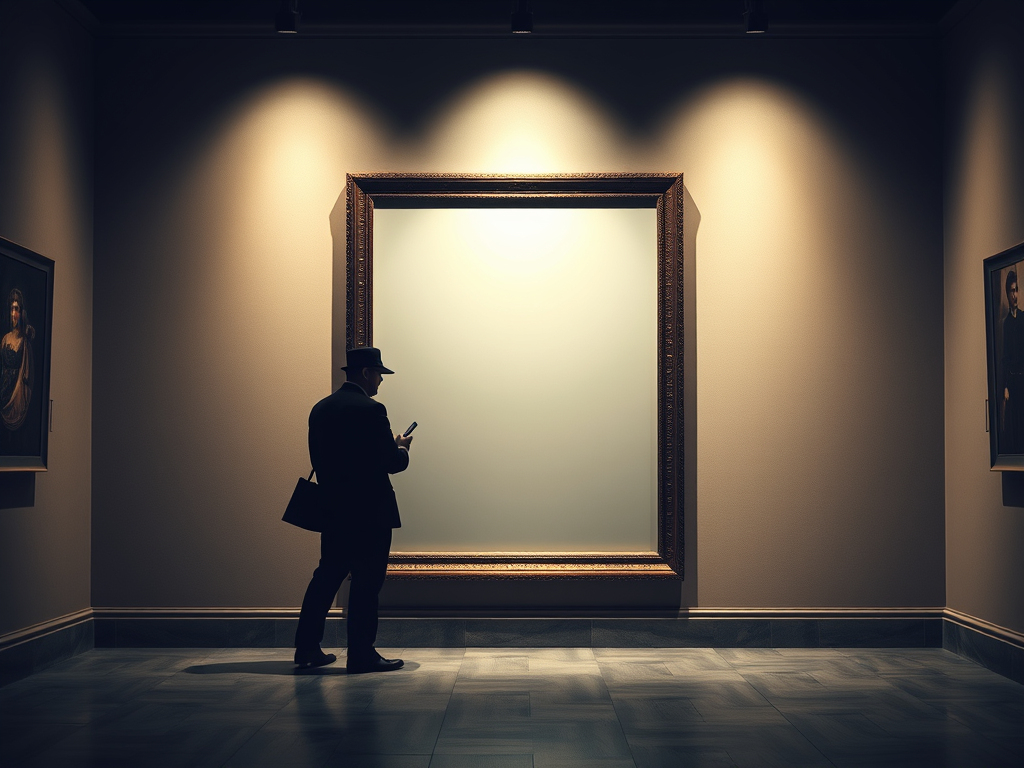
For over three decades, every lead has run cold. The FBI believes it was the work of an East Coast crime organization, but the thieves have never been identified, and not one of the 13 pieces has ever surfaced. The museum, honoring the bizarre will of its founder, still hangs the empty frames in their original spots—a ghostly, daily reminder of the biggest unsolved art heist in history.
2. The Patriot in the Closet: How the Mona Lisa Vanished from the Louvre
The Heist: On August 21, 1911, a painter walked into the Louvre to admire the Mona Lisa and found only four iron pegs. The museum staff’s first reaction? They assumed it was being photographed. It wasn’t until 26 hours later that they realized Leonardo’s masterpiece was gone.
Why It’s Baffling: The investigation was a circus. The police even questioned Pablo Picasso, who was linked to stolen statues from the museum. The truth, however, was bafflingly simple. The thief was Vincenzo Peruggia, an Italian handyman and former Louvre employee. He had simply hidden in a broom closet overnight. The next morning, he tucked the small wooden panel under his workman’s smock and walked out.
He kept the painting hidden in his cheap Paris apartment for two years. What was his motive? Bafflingly, it seemed to be patriotism. He believed the painting had been stolen from Italy by Napoleon (it hadn’t; Leonardo gave it to the French king) and wanted to return it. He was only caught when he tried to sell it to a gallery in Florence. This theft, and the two-year media frenzy, is what transformed the Mona Lisa from a masterpiece into the most famous painting on Earth.
3. The Cryptic Ransom Note: The Unsolved Disappearance of the “Just Judges”
The Heist: Jan van Eyck’s Ghent Altarpiece is one of the most important works of art in history. In 1934, one of its 12 panels, “The Just Judges,” was meticulously removed from the Saint Bavo Cathedral. It wasn’t a random theft; this was a surgical operation.
Why It’s Baffling: This case is a true detective novel. The thief sent a series of 13 ransom letters to the bishop, demanding one million Belgian francs. To prove he wasn’t bluffing, he even led police to a train station locker where he had returned the panel’s reverse side (a painting of St. John the Baptist).
The mystery took a wild turn when a local stockbroker, Arsène Goedertier, suffered a heart attack. On his deathbed, he confessed to his lawyer, “I am the only one who knows where ‘The Just Judges’ is.” He pointed to a file containing copies of the ransom notes and a final, cryptic message. But the clues led nowhere. Goedertier died, and his secret died with him. Was it a political statement? A simple extortion plot? To this day, the original “Just Judges” panel has never been found, and a hand-painted copy sits in its place.
4. “Thanks for the Poor Security”: The 50-Second Heist of The Scream
The Heist: On February 12, 1994, the world’s attention was on Lillehammer, Norway, for the opening ceremony of the Winter Olympics. That same morning, two men leaned a ladder against the National Gallery in Oslo, smashed a window, and climbed in. Fifty seconds later, they were back out with Edvard Munch’s 1893 version of The Scream.
Why It’s Baffling: The sheer audacity of this theft was a national embarrassment. The museum’s security was so lax that the thieves had time to leave a postcard at the scene. It read, “Thanks for the poor security.” The painting, which depicts a raw-nerve of human anxiety, was now the subject of an international punchline.
Investigators were stumped, not by the complexity, but by the simplicity. It was a classic “distraction” heist, using the Olympics as cover. The painting was recovered three months later in a sting operation involving British detectives posing as art buyers. The baffling part wasn’t the “how,” but the sheer, brazen nerve of the thieves who saw an entire country looking the other way and simply took their shot.
5. The Phantom of Paris: The “Spiderman” Heist of Picasso and Matisse
The Heist: In the early morning of May 20, 2010, a single figure slipped through a smashed window at the Musée d’Art Moderne de la Ville de Paris. The museum’s alarm system had been malfunctioning for weeks, and the guards on duty somehow missed him. The thief, Vjeran Tomic (dubbed “Spiderman” by the press), was a seasoned cat burglar.
Why It’s Baffling: Tomic was only hired to steal a single painting by Fernand Léger. But once inside, he found the security so non-existent that he decided to… browse. He roamed the silent museum for over an hour, hand-picking four other masterpieces, including Picasso’s Le pigeon aux petits pois and Matisse’s La Pastorale. The total haul was valued at over $100 million.
Tomic was eventually caught, but the paintings were not. The truly baffling—and heartbreaking—part of the mystery is their alleged fate. An accomplice, who was supposed to hide the art, claims he panicked after Tomic’s arrest. He swears he destroyed all five paintings and threw the tattered remains in a public garbage bin. Investigators are left to wonder: is he lying to protect a hidden billionaire collector, or did one of the greatest art thefts in history end in a dump truck?
6. The 14-Year Secret: The Rooftop Robbery at the Van Gogh Museum
The Heist: This was a real “Ocean’s 11” job. In the early hours of December 7, 2002, two Dutch thieves used a 15-foot ladder to climb onto the roof of the Van Gogh Museum in Amsterdam. They smashed a reinforced window with a sledgehammer, rappelled into the main gallery, snatched two priceless early Van Goghs, and were gone in minutes.
Why It’s Baffling: The thieves, Octave “The Ape” Durham and his accomplice, were professionals. They were caught years later, but the paintings had vanished. They had been “swallowed” by the criminal underworld, used as collateral in drug deals. The baffling part of this story is the sheer time they remained hidden.
For 14 years, the art world feared the paintings were lost forever. Then, in 2016, Italian police investigating a notorious Camorra mafia clan raided a villa near Naples. There, hidden behind a false wall in a bathroom, were the two Van Goghs, wrapped in simple cloth. They had been in the possession of a wanted cocaine kingpin, a real-life movie villain, for over a decade, baffling investigators who had searched the globe.
7. The Missing Caravaggio: A Masterpiece Stolen by the Mafia
The Heist: This is one of the art world’s coldest and darkest cases. In October 1969, two thieves entered the Oratory of San Lorenzo in Palermo, Sicily. They used razor blades or box cutters to crudely carve Caravaggio’s massive Nativity with St. Francis and St. Lawrence directly from its frame. This was not a sophisticated job; it was butchery.
Why It’s Baffling: The theft is almost universally attributed to the Sicilian Mafia (Cosa Nostra). But its fate is a horrifying mystery that has baffled investigators for over 50 years. There is no proof, only dark, conflicting rumors from mafia informants. One claims the masterpiece was used as a “pass” by powerful drug bosses, shown at meetings to prove their power. Another, more gruesome story, claims it was stored in a dilapidated farm, where it was eaten by rats and pigs before being burned.
The truth is, no one knows. The painting is on the FBI’s list of top 10 unsolved crimes. It wasn’t just stolen; it was consumed by the criminal underworld, leaving a permanent, baffling wound in art history.
8. The Ski-Mask Raid: The $163 Million Sunday Afternoon Robbery
The Heist: Most heists rely on stealth, darkness, and disabled alarms. This one relied on pure, terrifying force. On Sunday, February 10, 2008, three ski-masked gunmen in dark clothing calmly walked into the Foundation E.G. Bührle in Zurich. It was a bright afternoon, and the museum was open.
Why It’s Baffling: The thieves spoke German with a Slavic accent. One brandished a pistol, forcing staff and visitors to lie on the floor while the other two grabbed four of the museum’s most prized Impressionist paintings: a Cézanne, a Degas, a Van Gogh, and a Monet. The entire operation took three minutes. It was the largest art theft in Swiss history, and one of the biggest in the world.
The speed and brazenness of a daylight, armed robbery was baffling. But the recovery was just as strange. Just days later, two of the paintings (the Van Gogh and the Monet) were found in a car in a nearby parking lot. Why were they abandoned? Were they too hot to handle? The other two were recovered years later, but the masterminds who dared to pull off an armed art robbery in broad daylight have never been caught.
9. The Violinist’s Secret: The 35-Year Disappearance of the Ames Stradivarius
The Heist: Art isn’t just paint on canvas. In 1980, the virtuoso violinist Roman Totenberg performed a concert at the Longy School of Music in Massachusetts. After the show, he was greeting well-wishers when his prized “Ames” Stradivarius violin, crafted in 1734 and valued in the millions, was stolen from his dressing room.
Why It’s Baffling: This was not a mystery with no suspects. Totenberg was certain he knew who did it: a struggling young violinist named Phillip Johnson, whom Totenberg had seen loitering near his dressing room. But police could never find the evidence. The case went cold, bafflingly so. Totenberg died in 2012 at the age of 101, never seeing his beloved instrument again.
Then, 35 years after the theft, the case was solved. Johnson had died in 2011. His ex-wife found a locked violin case in his belongings and, in 2015, took it to an appraiser. The appraiser immediately identified it as the long-lost “Ames.” It turned out Johnson had confessed the theft to his wife on his deathbed. For three and a half decades, a rival musician simply kept a masterpiece hidden in his closet, baffling police with a crime that was, in the end, as simple as it was personal.
10. The “We Stole It to Prove a Point” Heist
The Heist: This is perhaps the most intellectually baffling heist on the list. On a stormy night in April 2003, thieves broke into the Whitworth Art Gallery in Manchester, England. They stole three minor masterpieces: Van Gogh’s The Fortification of Paris with Houses, Picasso’s Poverty, and Gauguin’s Tahitian Landscape.
Why It’s Baffling: The police were stumped. The pieces weren’t the gallery’s most famous, and the motive was unclear. Then, just days later, an anonymous tip led police to a bizarre discovery. The three paintings were rolled up in a cardboard tube, stuffed behind a public toilet in a nearby park. Attached was a note from the “thieves.”
The note explained that they had returned the art and that the entire theft was an act of protest. Their intention? To “highlight the appalling state of security” at the gallery. Investigators were left completely baffled. Was this a genuine act of cultural criticism by a “white hat” thief? Or was it a botched theft by amateurs who panicked and invented a noble motive to cover their tracks? We still don’t know.
Further Reading
If you’re fascinated by the world of high-stakes art crime, here are a few books that pull back the curtain on these real-life mysteries:
- The Gardner Heist: The True Story of the World’s Largest Unsolved Art Theft by Ulrich Boser
- The Man Who Stole the Mona Lisa by R.A. Scotti
- Stealing the Scream: The Hunt for a Lost Masterpiece by Edward Dolnick
- The Concert: A Novel by H.K. Kimm (A fictional take on the Gardner heist, but deeply researched)
Here at Zentara.blog, our mission is to take those tricky subjects and unlock them, making knowledge exciting and easy to grasp for everyone. But the adventure doesn’t stop on this page! We’re constantly exploring new frontiers and sharing discoveries across the digital universe. Want to dive deeper into more mind-bending Top 10s and keep expanding your world? Come join us on our other platforms – we’ve got unique experiences waiting for you on each one!
Get inspired by visual wonders and bite-sized facts: See the world through Zentara’s eyes on Pinterest!
Pin our fascinating facts and stunning visuals to your own boards. Explore Pins on Pinterest: https://uk.pinterest.com/zentarablog/
Discover quick insights and behind-the-scenes peeks: Hop over to Tumblr for snippets, quotes, and unique content you won’t find anywhere else. It’s a different flavour of discovery! Follow the Fun on Tumblr: https://www.tumblr.com/zentarablog
Ready for deep dives you can listen to or watch? We’re bringing our accessible approach to video and potentially audio! Subscribe to our YouTube channel and tune into future projects that make learning pop! Subscribe on YouTube: https://www.youtube.com/@ZentaraUK
Seeking even more knowledge in one place? We’ve compiled some of our most popular topic deep dives into fantastic ebooks! Find them on Amazon and keep the learning journey going anytime, anywhere. Find Our Ebooks on Amazon: https://www.amazon.co.uk/s?k=Zentara+UK&ref=nb_sb_noss
Connect with us and fellow knowledge seekers: Join the conversation on BlueSky! We’re sharing updates, thoughts, and maybe even asking you what wonders we should explore next. Chat with Us on BlueSky: https://bsky.app/profile/zentarablog.bsky.social
Perfect for learning on the move! We post multiple 10-minute podcasts per day on Spotify. Pop on your headphones and fill your day with fascinating facts while you’re out and about! Listen on Spotify: https://open.spotify.com/show/3dmHbKeDufRx95xPYIqKhJFollow us on Instagram for bytesize knowledge! We post multiple posts per day on our official Instagram account. https://www.instagram.com/zentarablog/ Every click helps us keep bringing honest, accessible knowledge to everyone. Thanks for exploring with us today – see you out there in the world of discovery!




Leave a Reply